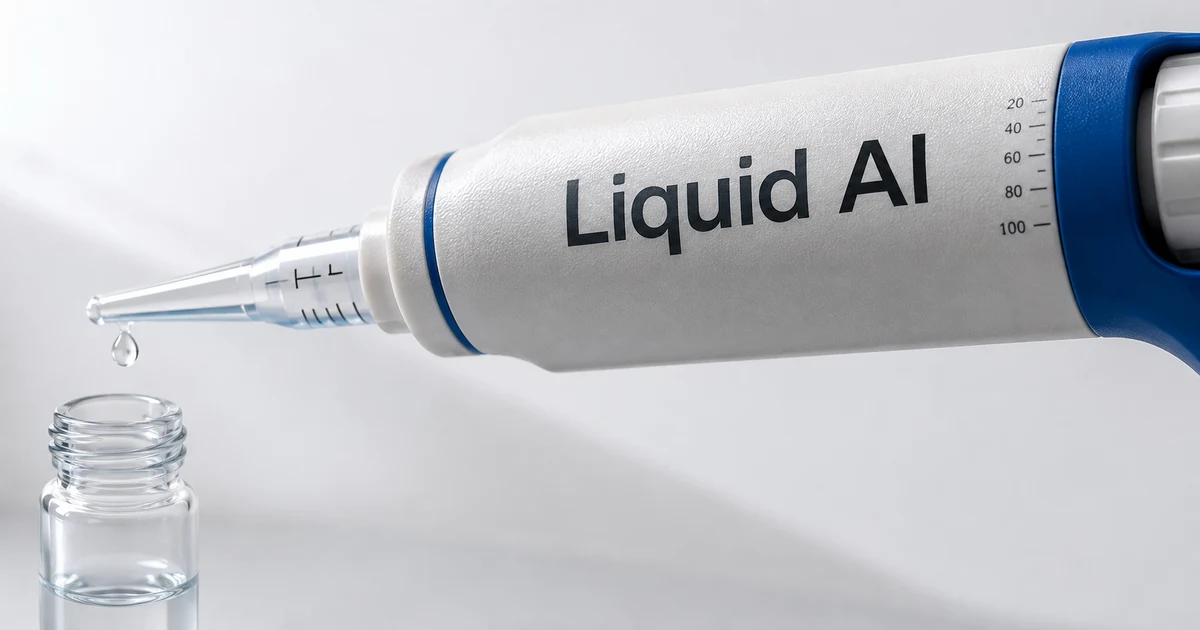
Pipetteはモデルと機器の組み合わせを実機で測る
Pipetteは、モデルと機器の組み合わせごとに、AIの速さと回答の質を実機で測るベンチマークです。また、Liquid AIは2026年8月24日、Artificial Analysisと組んで、Pipetteをオープンソースの基盤として公開しました。
スマホでは、モデルがスマホのメモリに収まるかどうかが結果を左右します。回答が出力されるまでの速さも、実用になるかどうかに直結します。
Pipetteは、量子化とランタイム(モデルを動作させるためのソフト)にモデルと機器を加えた4つを1組の構成とみなします。そのうえで、構成ごとに答えるまでの時間やメモリ使用量などを測ります。
Pipetteの公開範囲
| 種類 | 内容 |
|---|---|
| データ | 1,000超の構成 × 5つの性能指標 |
| モデル数 | 30以上 |
| ランタイム | macOS・iOS・Windows・Android向けのllama.cpp |
| 文脈長(一度に読み書きする長さ) | 256〜8,192トークン |
| 初期の対象機器 | MacBook Pro(M5 Max)・iPhone 17 Pro・Galaxy S26 Ultra |
| 品質評価 | IFBench・GPQA Diamond・MATH-500 |
| ソフトウェア | pipette-mgmt・pipette-clients・pipette-scores(Apache 2.0) |
ご自身のスマートフォンやPCでも試すことができます。クライアントはGitHubで公開されており、App StoreとGoogle Playにはアプリ「Pipette by Liquid」もあります。ただしコミュニティが投稿した結果の公開は、まだベータ版の段階です。
Today, in partnership with Artificial Analysis , we release Pipette , an open-source platform for benchmarking foundation models on edge devices. / Pipette is built around a simple premise: on-device behavior is a property of the deployed system, not the model in isolation. / It contains five on-device performance metrics for more than 1,000 model × quantization × runtime × device × context configurations. The current data spans 30+ models, multiple quantization formats, llama.cpp builds for macOS, iOS, Windows, and Android, and context lengths from 256 to 8,192 tokens. Initial published results cover MacBook Pro with M5 Max, iPhone 17 Pro, and Galaxy S26 Ultra / Publication of community-submitted results is currently in beta. — 冒頭の公開内容に関する記述より公式情報を見る →
Artificial Analysisが検証した測り方
Pipetteの測り方は、Artificial Analysisが検証しています。また、機器で動作させたときの挙動はモデル単体ではなく機器とソフトまで含めた全体の性質だというのが、Liquid AIの前提です。
同じモデルでも、機器の温度やメモリの状態で結果は変わります。そのため、1回の測定は次の手順にそろえています。
- 入力と出力のトークン数(AIが文章を読み書きするときの単位)を固定する
- 文章は、次の1語をいつも最も確率が高い語に定める貪欲デコードで生成する
- 最初の1回は準備運転として捨てる
- 続く5回を測る
- 測る前に機器の温度と負荷を確認し、基準を満たした実行だけを結果として公開する
この手順は、Pipetteが公開している測定方法に沿ったものです。Artificial Analysisは、Liquid AIとは別に、自社でもこの手順を検証したとしています。
Performance benchmarks follow Pipette's published measurement methodology : timing and memory runs use fixed token shapes, greedy decoding, a discarded warm-up, five measured repetitions, and readiness gating. Pipette's methodology has been reviewed and verified by Artificial Analysis . / Before each timed repetition, a platform-specific readiness check verifies acceptable thermal and load conditions. Pipette publishes results only for runs that pass this check. — How Pipette Works 節より公式情報を見る →
We have independently validated Liquid AI's inference benchmarking methodology — What we're launching 節より公式情報を見る →
iPhone 17 Proで回答を1分で切るとトップが交代
iPhone 17 Proで回答を1分で打ち切ると、63点でトップだった2モデルが38点と18点に下がり、47点のLFM2.5-8B-A1Bがトップに立ちます。点数はArtificial Analysisが公開した5つの評価の平均です。また、5つは小型モデルによく求められるツール呼び出し・知識・推論の課題を代表するものとして選ばれています。
文脈(モデルが一度に読み書きする入力と出力の長さ)の上限を16Kトークンにした条件では、Nanbeige4.2-3BとLFM2.5-2.6Bがともに63点でトップでした。続くのは62点のOrnith-1.0-9Bと、61点のQwen3.5 9B(推論)です。
モデル名の9Bや350Mはパラメータ数の表記で、Bは10億、Mは100万を表します。「推論」と付くモデルは、回答の前に考える過程を長く書き出す方式を取ります。
同じ63点でも、1,024トークンの入力に回答するまでの時間とメモリ使用量は大きく異なります。数字は次のとおりです。
- LFM2.5-2.6B: 8.0秒、メモリ2.3GB
- Nanbeige4.2-3B: 21.4秒、メモリ4.0GB
- 9B級の2モデル: 25秒超、メモリ6.9GB
回答を1分で打ち切る条件では、各モデルが1分間に出力できる量で回答を切り、そこまでの内容を採点しています。 トップは47点のLFM2.5-8B-A1Bです。2位は45点のLFM2-2.6B-Exp、3位は44点のGemma 4 E4B(非推論)でした。63点だったLFM2.5-2.6Bは38点、Nanbeige4.2-3Bは18点まで下がっています。
iPhone 17 Proの平均点、条件別
棒は5つの評価の平均点(高いほど高性能)。左は文脈の上限を16Kトークンにした条件、右は回答を1分で打ち切る条件。出典: Artificial Analysis。
 LFM2.5-2.6B
 Qwen3.5 9B(推論)LFM2.5-8B-A1BLFM2-2.6B-Exp
 Gemma 4 E4B(非推論)LFM2.5-2.6B
Nanbeige4.2-3Bが18点まで下がったのは、書き出す速さが毎秒14トークンで、1回の回答で出力できるのが約850トークンにとどまるためです。推論の大半が最後まで終わらないので、点が落ちました。
Artificial Analysisは、1分の制限をこのデータの主なフィルターにはしていないとしています。そのうえで、スマホのユーザーが待てる最大の時間には、この条件のほうが近いかもしれないと述べています。
Intelligence is measured by a set of five evaluations selected to represent the types of function/tool calling, knowledge and reasoning tasks small models are often asked to accomplish. / Nanbeige4.2-3B and LFM2.5-2.6B share the top average evaluation scores (with a 16K context limit) at launch, both scoring 63, ahead of Ornith-1.0-9B on 62 and Qwen3.5 9B (Reasoning) on 61. / on an iPhone 17 Pro it answers a standard 1,024-token prompt in 8.0 seconds using 2.3 GB of memory, against 21.4 seconds and 4.0 GB for Nanbeige4.2-3B and more than 25 seconds and 6.9 GB for the two 9B models. / Capping each answer at what a model can generate in 60 seconds on the iPhone 17 Pro (its output speed × 60, ignoring prompt processing time) puts LFM2.5-8B-A1B first on 47, followed by LFM2-2.6B-Exp on 45 and Gemma 4 E4B (Non-reasoning) on 44. LFM2.5-2.6B falls to 38, and Nanbeige4.2-3B to 18: at 14 output tokens per second it gets about 850 tokens per answer, so most of its reasoning never finishes. / While we aren't using the one-minute limit as the primary filter for this benchmark data, it may be more in line with the maximum wait time mobile users are willing to tolerate. — Launch results for the iPhone 17 Pro 節より公式情報を見る →
同じ350Mでも文脈を伸ばすと速度の落ち方に差が出る
同じ350Mでも、入力を長くすると書き出す速さが保たれる割合は、Granite-4.0-H-350Mが78.4%、Granite-4.0-350Mが33.8%と大きく異なります。Liquid AIはGalaxy S26 Ultraで、入力を256トークンから4,096トークンまで伸ばして測りました。デコード速度とは、モデルが文章を出力していく速さのことです。
Granite-4.0-H-350Mは書き出す速さの大半を保ち、Granite-4.0-350Mは1/3ほどしか保てませんでした。2モデルとも、量子化はQ4_K_M(量子化の種類の1つ)にそろえています。
入力を伸ばしたあとに保たれるデコード速度の割合
棒は入力を256トークンから4,096トークンまで伸ばしたとき、保たれた速さの割合(%)。Galaxy S26 Ultra・Q4_K_M。出典: Liquid AI。
 Granite-4.0-H-350MGranite-4.0-350M
8B級のモデル同士でも、速度だけでは品質の違いを判断できません。M5 MaxでGranite-4.1-8BとMinistral-3-8Bを入力2,048トークンで動作させると、書き出す速さの差は2.4%、メモリの最大使用量の差は1.2%でした。
同じQ4_K_Mで量子化した2モデルの品質を測ると、IFBenchではGraniteが7.3ポイント、GPQA DiamondではMinistralが14.0ポイント上回りました。Liquid AIは、ベンチマークごとの品質差を1つの順位にまとめず、速さ・メモリ・品質を別々に見られるようにしています。
At Q4_K_M on Galaxy S26 Ultra, Granite-4.0-H-350M retains 78.4% of its decode throughput from 256 to 4,096 input tokens, while Granite-4.0-350M retains only 33.8%. / At Q4_K_M and 2,048 input tokens on M5 Max, Granite-4.1-8B and Ministral-3-8B-Instruct-2512 differ by only 2.4% in decode throughput and 1.2% in peak RAM. In quality evaluations of the same Q4_K_M artifacts, Granite leads IFBench by 7.3 points while Ministral leads GPQA Diamond by 14.0 points. / Pipette keeps these tradeoffs separate and inspectable rather than collapsing deployment readiness into a single ranking. — 本文の構成比較の記述より公式情報を見る →
初期版のPipetteにNPUでの計測結果は含まれない
初期版のPipetteには、NPUを使った計測結果は入っていません。NPUとは、AIの計算を少ない電力で速く処理するために作られたプロセッサーのことです。
初期版では、NPUを使う経路のうち公開モデルの多くに対応して一貫した比較ができるものがなかったため、結果に含めていません。GPUについても、Androidで試した安定版の経路のなかに、現在の設定とモデルの範囲で全モデルを通してCPUより一貫して速いものはありませんでした。
機器をまたいだ比較にも注意が必要です。Liquid AIは現時点で、機器同士の結果をそのままハードウェアの優劣として読むことを勧めていません。現在の結果が最も信頼できるのは、同じ機器の中で構成を比較するときです。
In this initial release, no NPU path supports enough of the published model set to provide consistent comparisons across model classes, so NPU results are not included. / Under the current benchmark setup and model coverage, none of the stable GPU backends tested on Android consistently outperformed the selected CPU path across the full model set. / We do not currently recommend interpreting cross-device results as controlled hardware comparisons. / Current Pipette results are most reliable for comparing configurations within the same device. — Limitations and Future Directions 節より公式情報を見る →
まとめ:待ち時間の条件しだいで順位は変わる
Pipetteは、Liquid AIとArtificial Analysisが公開した、モデル・量子化・ランタイム・機器の組み合わせごとの実機ベンチマークです。iPhone 17 Proでは、回答を1分で打ち切ると63点でトップだった2モデルが大きく下がり、47点のLFM2.5-8B-A1Bがトップに立ちました。
同じ350Mのモデルでも、入力を伸ばしたときに書き出す速さが保たれる割合は大きく異なりました。待ち時間の条件しだいで順位が入れ替わるため、Pipetteの結果は測った条件とあわせて確認しておくといいでしょう。
FAQ
- Pipetteは何を測るベンチマークですか?
- スマートフォンやPCで動作させたときの実際の挙動です。モデル・量子化・ランタイム・機器の組み合わせを1つの構成とみなして、構成ごとに測ります。公開データには1,000を超える構成が含まれます。
- 測定の信頼性はどう担保されていますか?
- トークン数を固定し、貪欲デコードで文章を生成します。最初の1回は準備運転として捨てて、続く5回を測ります。機器の温度と負荷が基準を満たした実行だけを公開し、測り方はArtificial Analysisが検証しています。
- iPhoneで一番強いモデルはどれですか?
- iPhone 17 Proでは条件によって変わります。文脈の上限を16Kトークンにした条件の平均点ではNanbeige4.2-3BとLFM2.5-2.6Bが同点の63点ですが、回答を1分で打ち切ると47点のLFM2.5-8B-A1Bがトップに立ちます。
関連する記事
 LFM2.5のDSparkで推論が最大3.18倍に高速化、量子化版も公開Liquid AIがLFM2.5向けに公開したDSparkは投機的デコードのドラフトモデルで、2.6Bモデルの生成をH100で平均2.67倍、M4 MaxのMacBookで2.27倍速くします。SGLangとllama.cppに対応し、4bitのQAD版では精度が16bit版の約97%まで戻ります。
 LFM2.5-2.6Bとは?スマホで動作するエージェント用ローカルLLMLiquid AIのLFM2.5-2.6Bはツールを使うエージェント処理に特化した小型モデルで、4倍規模のモデルに匹敵するとしています。M5 Maxで毎秒220トークンを出し、メモリ2.5GB未満で動作しますが、コーディングや知識量が必要な作業には適していません。
 LFM2.5-24B-A2Bとは?2Bだけが動作するエージェント用モデルLiquid AIのLFM2.5-24B-A2Bは、総24B・アクティブ2BのMoEモデルです。エージェント系ベンチマーク8本中5本でQwen3.6-35B-A3Bを超え、M5 Maxならメモリ15GB・毎秒184トークンで動作します。知識とコーディングはQwen3.6が上です。
 EmbeddingGemma 2とは?オンデバイス動作の埋め込みモデルEmbeddingGemma 2はGoogle DeepMindが公開したApache 2.0の埋め込みモデルで、テキスト・画像・音声・動画を1つの空間で検索できます。テキストだけならPixel 11 Proで約191MBのメモリから動き、OllamaなどでローカルRAGにも組み込めます。