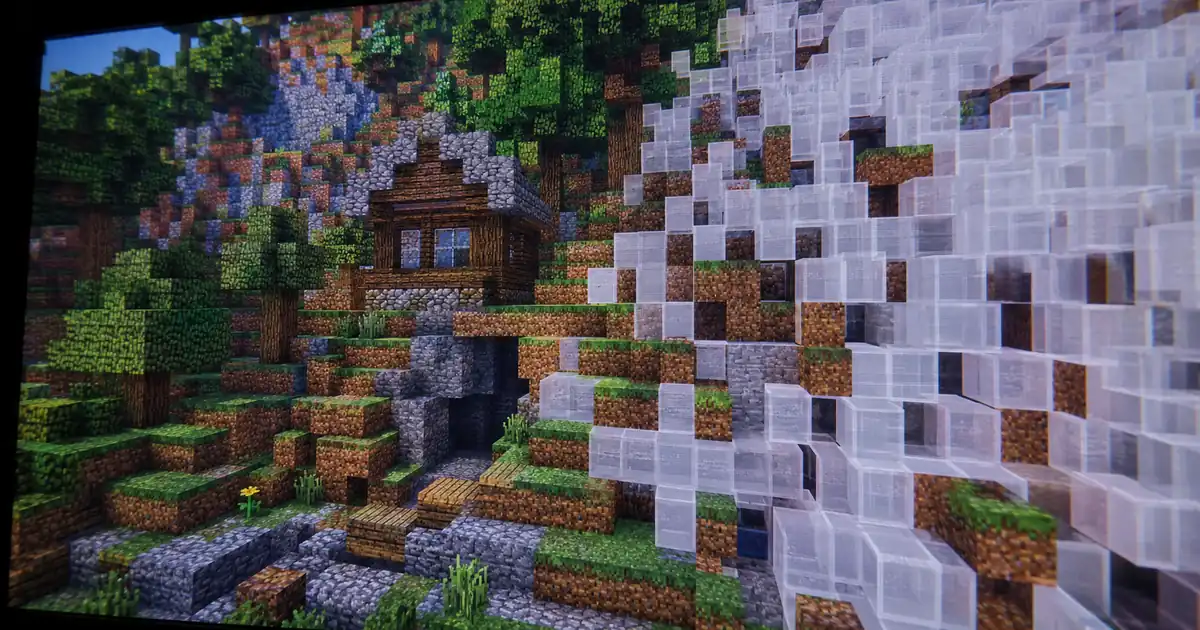
Sakana AIがマイクラのワールド生成AIを公開
Dream-Cubedはマイクラのワールドを、ブロック1個の単位で生成するためのデータセットと生成モデル群です。このDream-Cubedは、Sakana AIがニューヨーク大学と共同で開発し、2026年7月29日に公開しました。
論文はarXiv(2604.22847)に、コードはGitHubのSakanaAI/DreamCubedにあります。Sakana AIは集めたデータと学習済みのモデルも公開しており、研究者やマイクラのユーザーが使うことができます。
We are excited to share our latest work, together with New York University: Dream-Cubed: Controllable Generative Modeling in Minecraft by Training on Billions of Cubes. / Technical Blog: https://pub.sakana.ai/dream-cubed / Paper: https://arxiv.org/abs/2604.22847 / Code: https://github.com/SakanaAI/DreamCubed — 公開告知の冒頭より公式情報を見る →
マイクラのブロックは単語と同じ単位で3D生成AIに適している
生成AIは文章・画像・動画で大きく進んだ一方で、ゲームのように操作できる3Dの世界はあまり研究されてきませんでした。Sakana AIが題材にマイクラを選んだ理由は、ワールドの作られ方にあります。マイクラの世界は砂や石や水といったブロックの積み重ねでできていて、ブロックの種類ごとに意味を持っています。
言語モデルは文章を単語という単位に分けて学習することで大きく伸びました。マイクラのワールドも同じようにブロックという単位に分けて処理できます。
ブロックを単語として見なせば、言語モデルと同じく大量のデータで学習できる、というのがSakana AIの考えです。ブロックやタイルを部品にして世界を組み立てる方式は、マイクラ以外の人気ゲームにも多いとSakana AIは述べています。
Generative AI has made incredible progress in language modeling, far beyond other modalities, where words and tokens offer a natural compositional unit for scalable training. This is similar to Minecraft and many other popular video games, where developers rely on cubes, tiles, and other discrete primitives to build rich, interactive worlds. — 言語モデルとゲームのブロックを対比した段落より公式情報を見る →
Generative AI has made incredible progress in the fields of image, video, and text generation. Despite success in these modalities, the interactive 3D worlds of video games have received much less research attention. / The 3D world of Minecraft is made up of voxels: discrete, compositional building blocks like sand, stone, and water. These semantically meaningful block types provide a perfect abstraction for generative modeling: each piece of the game world is simply a collection of block tokens that come together to create a simulacrum of the natural world. — 3D世界が研究の手薄な領域であることと、ブロック構造が生成モデルに向く理由の記述より公式情報を見る →
村やバイオーム15種を含む300億ブロックのデータセット
データの出どころはゲームが自動で作る地形と人が手で作ったマップです。構成は次のとおりです。
Dream-Cubedデータセットの構成(公式の技術ブログより)
自動生成の地形は、マイクラの手続き生成(ゲームがプログラムで地形を自動で作る仕組み)で作られたものです。研究チームは地表から32×32×32ブロックのかたまりを180万件以上集め、かたまりごとに海や村といったバイオーム(地形の種類)のラベルを割り当てました。バイオームは村を含めて15種類に分かれ、集めたブロックは合計で300億個を超えます。
マイクラの村はゲームの中で最も作りが複雑なのに、最も出てきにくい場所です。自然に集めるだけでは村のデータが足りないため、研究チームは特定のバイオームを狙って集める仕組みを用意しました。学習データをバイオームごとにどれだけ集めるかで、モデルの成績は大きく変わります。その差は後半にある評価の数字で確認できます。
人が手で作ったマップを集めるために、研究チームはプロのマップ制作者の1人に連絡を取りました。その制作者から大規模で質の高いマップを複数使う許可を得ています。データとモデルの公開についても制作者と合意しています。
We create automated data collection and curation pipelines, collecting 1.8+ million / chunks of procedurally generated Minecraft worlds, and 200,00+ chunks from human-authored maps, comprising over 30 billion total blocks. / We collect chunks from the surface level of the world and assign a class label based on the biome they are in, creating a dataset for biome-conditional generation. / Villages, for example, are both the most structurally complex and the least common areas of the game world. To overcome this data balancing problem, we set up targeted collection pipelines to identify and collect specific biomes to ensure adequate representation, which we show can have a very significant impact on downstream models. / chunks generated by our top-performing discrete MD4 model and continuous DDPM model for each of the 15 biome classes. / We reached out to one such professional map creator, who granted permission to use several of their large and high-quality maps for scraping. We release all our data and models in accordance with the map creators for the larger research and Minecraft community. — データセットの規模、バイオームの分類と種類数、偏りへの対処、および人が作ったマップの許諾に関する記述より公式情報を見る →
圧縮しない拡散モデルでマイクラのブロックを細かく制御
拡散モデルはデータにノイズを少しずつ混ぜて壊し、その逆の手順で新しいデータを作る生成AIの方式です。画像生成AIの多くがこの方式を使っています。
Dream-Cubedはこの拡散モデルをマイクラのブロックに適用しました。技術面でいちばんの決め手になったのは、データを圧縮せずにブロックのまま学習したことです。
マイクラのブロック単位のまま拡散モデルを学習
画像を作る拡散モデルの多くは、VAE(データを小さく圧縮するモデル)で縮めたデータを使って学習します。圧縮すれば計算量が大きく減るためです。
Dream-Cubedはこの圧縮を使わず、32×32×32ブロックのかたまりをそのまま3Dの拡散モデルに入れています。モデルの大きさは約2億8千万パラメータ(モデルの規模を表す数)です。
圧縮で得られる速さは手放すことになりますが、Sakana AIはこの選択が生成を細かく制御するうえで欠かせなかったとしています。圧縮せずに元の解像度のまま学習しているので、ブロック1個ずつを狙って操作できます。
A key design decision is not to compress the spatial dimensions of our data. Commonly, diffusion models operate on the compressed representations from models like Variational Autoencoders, which can massively improve the efficiency of diffusion models. We choose to train directly at the native block resolution, feeding each / chunk of the world into a 3D Diffusion Transformer with ~280M parameters. While we miss out on the performance gains of compressed representations, we find this choice is crucial for enabling fine-grained control over generation. — 空間の次元を圧縮しないという設計判断と、その代償および狙いに関する記述より公式情報を見る →
拡散モデルのマスク拡散と埋め込みDDPMの違いは?
マスク拡散はブロックを少しずつ[MASK]という空白に置き換えて壊し、空白から元のブロックを当てる練習をモデルにさせる方式です。生成するときは、すべて空白の状態から少しずつブロックを埋めていきます。研究チームが使ったマスク拡散はMD4と呼ばれます。
もう一方の埋め込みDDPMは、ブロックの名前(stoneなど)を文章用のAIで16次元の数値列へ変換します。その数値にノイズを少しずつ混ぜ込んで壊し、ノイズを取り除いたあとで最も近いブロックの種類へ置き直す方式です。両者の違いは次のとおりです。
| 方式 | ブロックの表し方 | 生成のしかた |
|---|---|---|
| マスク拡散(MD4) | ブロックの種類をそのまま使う | [MASK]にしたブロックを予測して埋め戻す |
| 埋め込みDDPM | 名前から作った16次元の数値に置き換える | ノイズを取り除いてから最も近いブロックへ戻す |
両方とも同じ構造のモデルで比較しており、どちらの方式でも指定したバイオームに合うそれらしいかたまりを作れました。ただしマスク拡散は生成の途中で人が手を入れられるため、Sakana AIは対話的な生成にはマスク拡散が適していると判断しています。
To understand what makes a great foundation model for Minecraft, we study both diffusion formulations, using an identical Diffusion Transformer backbone / MD4 discrete masked diffusion: We add a special [MASK] state to the vocabulary, and corrupt chunks by gradually replacing real blocks with [MASK] tokens. To generate new chunks, the model "unmasks" blocks by predicting the original block type to replace the [MASK] tokens. / DDPM in embedding space: We map each block type to a 16-dimensional vector obtained by a frozen text embedding model, using the block's in-game name (e.g., "stone"). Chunks are corrupted by gradually adding Gaussian noise, and we generate chunks by gradually removing noise back to clean embeddings. We perform a nearest neighbor lookup to recover discrete block types from denoised embedding vectors. / With our carefully curated data and after hyper-parameter tuning, we show that both models perform well on the training task, generating believable / we find the discrete diffusion formulation unlocks a variety of interactive generation workflows beyond the single-chunk generation case, making it a more compelling choice for an interactive world model. — 比較した2方式の手順と、どちらも学習課題をこなせたうえで離散マスク拡散を選んだ理由に関する記述より公式情報を見る →
マスク拡散ならマイクラの地形生成で穴埋めや拡張も可能
マスク拡散では好きなブロックを先に置いておけば、モデルはそのブロックを変えずに残りを埋めます。モデルは置いたブロックを変えられません。配置するのは生成の途中でも構いません。
たとえば渦巻きや波の模様にブロックを並べてモデルに与えると、その模様を残したまま周りが自然な地形で埋まります。火山のようにマイクラに自然には出てこない地形でも、モデルはうまく地形にまとめていました。ゲーム内から切り出したかたまりの一部だけを生成し直させることもできます。
置いたブロックを守る性質は、32×32×32の範囲の外へワールドを広げるときにも役立ちます。すでに作った隣のかたまりと重なる部分を固定し、生成する範囲を少しずつずらしていけば、どんな大きさのワールドでも作ることができます。Dream-Cubedの技術ブログによると、この性質は学習の副産物として得られたものとのこと。
This simple property gives us a fine-grained block-conditioning on top of class-conditioning as a free byproduct of training. / In practice, this means we can write any pattern of blocks as an initial state and even during the generation process, which becomes a hard constraint that the model must work around. / you can regenerate parts of a chunk taken directly from the game world, or hand-craft custom patterns, then let the model fill in the rest. / We can make spirals, waves, and slopes of blocks to see how our model works with these constraints to create a realistic chunk of the game world. Even suggestive patterns like a volcano, which don't naturally occur in Minecraft, are no problem and result in successful extrapolation. / We can use a simple sliding window procedure to generate arbitrarily-sized worlds, generating overlapping chunks in sequence and stitching them together: — ブロックを指定した生成が学習の副産物として得られること、その実例、および任意の大きさのワールド生成に関する記述より公式情報を見る →
人が作ったマイクラのマップはブロック171種に限定して学習
人が作ったマップでは数千種類のブロックが使われていますが、学習では171種類に限定しています。また、ブロックが数千種類にもなるのは、制作者が細かい見た目を出すために多くの種類を使い分けているからです。学習では、マップ1つを1つのバイオームと見なして加えています。
ブロックの種類を限定すればデータが単純になり、モデルは人が作った複雑で細かな構造を覚えることに集中できます。Sakana AIは人の創造性を含むデータから学ぶことには倫理面の課題もあると認め、今回の成果をこの分野の第一歩としています。
When training on human-authored maps, we treat each map as its own additional "biome", and compress the thousands of block types present in this data down to a smaller, more manageable vocabulary of 171 unique blocks. As map creators use a much larger palette of blocks to capture small visual details, compressing maps to a limited vocabulary results in data that is simpler, allowing our models to focus instead on capturing the complex and detailed human structures. We acknowledge that learning to generate from data that encodes human creativity comes with a new set of challenges and even ethical considerations, and we present our models and results as a first step in this domain. — 人が作ったマップの語彙を171種類へ絞った理由と、その扱いに伴う倫理面の論点に関する記述より公式情報を見る →
村とバイオームの配分で変わるマイクラ生成AIの評価
FID(Fréchet Inception Distance・フレシェ・インセプション距離)は、生成した画像が本物の画像にどれだけ近いかを表す指標です。数字が小さいほど本物に近いと見なします。3Dのブロック世界には標準として定まった評価指標がありません。
研究チームはワールドを画像に描き出したうえでFIDを適用し、モデル同士を比較しました。比較ではバイオームごとの配分、とくに村の配分しだいでモデルの成績が大きく変わりました。
データの1%未満のマイクラの村は成績が低下
データの配分が成績にどれだけ影響するかを調べるため、研究チームは100万件ずつのデータセットを3種類用意しました。中身と結果は次のとおりです。
| データセット | 集め方 | 結果 |
|---|---|---|
| Balanced | 15種類のバイオームを均等に集める | 比較の基準となる均等な配分 |
| Boosted | 村のサンプルの割合を2倍にする | 村のFIDが大きく改善 |
| Natural | ゲーム内で自然に出てくる割合のまま集める | 海(35%)は好成績・村(1%未満)は成績が低下 |
ゲーム内の割合のまま集めたNaturalは、データの35%を占める海では良い成績でした。一方で1%未満しかない村では成績が落ちています。
村の割合を2倍にしたBoostedでは、村のFIDが大きく改善しました。珍しくて複雑な場所でも、集める割合を増やせば成績が上がると分かりました。
パッチサイズ(モデルが一度にまとめて見るブロックの大きさ)も、2と4で比較しています。パッチ4のモデルは村で大きく性能が落ちており、Sakana AIは複雑なデータには細かい解像度が大事だとみています。
To test how important data composition is, we create three variants of our dataset, each with 1 million chunks. The Balanced dataset represents even distribution between the 15 natural biome classes, while the Boosted dataset doubles the proportion of village samples. The Natural dataset represents the naive approach, collecting chunks at their natural spawn rate in the game world, leading to large imbalances between biome labels. / We can see a significant performance drop in our patch 4 models in the village biome, suggesting that the finer resolution at lower patch sizes is important for modeling this more complex data. Similarly, we see differences regarding dataset composition: the Natural dataset model performs well on the overrepresented ocean biome (35% of the dataset), and underperforms in the village biome (< 1% of the dataset). We find that doubling the number of village samples compared to the rest in the Boosted model, we see a significant improvement in FID. — データセット3変種の中身、パッチサイズの影響、およびデータの構成による成績の違いに関する記述より公式情報を見る →
マイクラのプレイヤーが本物より選んだ生成AIのワールド
人による評価実験では、マイクラのプレイヤーに同じバイオームのかたまりを2組見せて、良いと思うほうを選んでもらいました。比較したのはMD4の2モデルとDDPMの1モデル、そして学習データから取った本物のかたまりです。生成物が本物より選ばれた割合(勝率)は次のとおりです。
| 生成したモデル | 本物に対する勝率 | 試行数 |
|---|---|---|
| MD4(パッチ2) | 67.1% | 173 |
| MD4(パッチ4) | 57.1% | 163 |
| DDPM(パッチ2) | 55.2% | 192 |
3モデルすべてで生成物のほうが本物より多く選ばれました。勝率が最も高いのはMD4(パッチ2)の67.1%です。残りの2モデルはMD4(パッチ4)が57.1%、DDPM(パッチ2)が55.2%でした。
Sakana AIはデータの選別や生成の過程が、結果に影響した可能性も認めています。そのうえで、この結果は生成物が少なくとも本物の分布と同じ水準にあることを示すと見ています。
We create an experiment where humans view two sets of chunks for the same biome, and pick the one they think is better. We include samples generated by two of our discrete models, our DDPM model, and real samples taken from our training data. / MD4 (patch 2) Real 67.1% 173 / MD4 (patch 4) Real 57.1% 163 / DDPM (patch 2) Real 55.2% 192 / Model vs. real. Win rate is the fraction of trials where participants preferred generated chunks from Source A over real Minecraft chunks from the same biome. / Across all three models, generated chunks were actually preferred to real ones. This may be partly due to our process of data curation and generation, but we view it as evidence that generated chunks are at least on par with the distribution we're trying to model. — 人による比較実験の設計、モデル別の勝率と試行数、およびその結果の解釈に関する記述より公式情報を見る →
指標FIDとマイクラのプレイヤーの好みは一部だけ一致
画像の評価用に作られたFIDが3Dのかたまりの良し悪しを正しく評価できているかは、数字だけでは確認することができません。研究チームはプレイヤーの選択データを使い、FIDが低いモデルほどプレイヤーに選ばれやすいかどうかを解析しました。FIDと、プレイヤーが選んだ結果との関係は統計的に有意でしたが、強いものではありませんでした。
モデル同士のFIDの差が小さいバイオームでは、プレイヤーの好みとの一致が弱くなります。FIDの差が15ポイントを超える組み合わせでは、FIDの低いモデルが66.1%の割合で選ばれました。
Lacking established metrics for 3D voxel worlds, we adapt Fréchet Inception Distance (FID) / Using this data, we validate the render-based FID metric we use. If image-based FID is a good proxy for 3D chunk quality, we'd expect that lower-FID models would win more against higher FID models. / And we do find a limited but significant relationship between FID and win rate. In particular, we find that for biomes where there are small FID differences across models, this relationship is weaker. However, focusing on more structured biomes where the FID differences are larger, alignment of our metric with human judgment becomes stronger, with the lower-FID model winning 66.1% of the time when the gap is > 15 points. — 3Dのブロック世界に確立した指標が無いことと、人の選択で指標そのものを検証した結果に関する記述より公式情報を見る →
生成AIのワールドはマイクラでそのまま編集して遊べる
Dream-Cubedが出力するのは眺めるための3Dモデルではなく、マイクラのブロックそのものです。ゲーム内と同じ種類のブロックで圧縮せずに出力するため、生成したワールドはそのままゲームの中身になります。
たとえばプレイヤーが好きな配置にブロックを数個置き、残りをモデルに埋めさせるといった使い方もあります。ブロックを1個ずつ指定できる細かな制御は、データを圧縮しないという最初の判断によるものです。 Sakana AIは、プレイヤーや制作者が構造物や地形やマップを生成し、すぐ編集できることを成果としています。
Sakana AIは研究だけでなく製品も提供しており、複数のAIを組み合わせて動作させるサービスを公開しています。研究として公開された別の成果を解説した記事は、PicbreederをサカナAIがVLMで再現、人間との創造性の差を検証です。
We use our data to train a family of powerful transformers for efficient generation of interactive 3D environments at cube resolution. We show how our models allow players to mold the world around them by generating structures, terrain, and maps that are immediately editable and playable. — 生成物がそのまま編集・プレイできる点に関する記述より公式情報を見る →
まとめ:Sakana AIのマイクラ生成AIはすぐ遊べるワールドを作る
Sakana AIのDream-Cubedは、マイクラのブロックを圧縮せずにそのまま学習した拡散モデルです。ブロック単位のままマスク拡散で学習したことで置いたブロックを守る穴埋めや任意の大きさへの拡張が可能になり、出力はそのまま編集して遊べます。評価ではデータの配分が成績を左右し、村のように珍しく複雑な場所は、集める割合を増やすと成績が上がりました。
プレイヤーの比較では3モデルとも、生成したワールドのほうが本物より多く選ばれましたが、Sakana AIはデータの選別などが影響した可能性も認めています。データとモデルとコードは公開されているため、マイクラでAIによるワールド生成を試したい人は、公式の技術ブログとGitHubから入手することができます。
FAQ
- Dream-Cubedとは何ですか?
- Sakana AIがニューヨーク大学と共同で公開した研究で、マイクラのワールドをブロック単位で生成するデータセットと生成モデル群です。ゲームが自動で作った地形と、人が作ったマップの両方から集めたデータで学習しています。
- なぜマイクラを題材にしたのですか?
- マイクラの世界は砂・石・水のように種類の定まったブロックの積み重ねでできていて、生成モデルが処理しやすいためです。文章を単語に分けて学習する言語モデルと同じように、ワールドをブロックに分けて学習できます。
- 生成されたワールドの品質はどのくらいですか?
- マイクラのプレイヤーに生成物と本物を見比べてもらった実験では、3つのモデルすべてで生成物のほうが多く選ばれました。Sakana AIはデータの選別や生成の過程が影響した可能性を認めつつ、少なくとも本物の分布と同じ水準にはあると見ています。
- 生成したワールドはそのまま遊べるのですか?
- 遊べます。ゲーム内と同じ種類のブロックを圧縮せずに出力するため、生成したワールドがそのままゲームの中身になります。Sakana AIは、プレイヤーや制作者が構造物や地形を生成してすぐ編集して遊べることを、成果としています。
関連する記事
 Sakana AIのAPIに法人向け管理機能、申し込み制で提供開始Sakana AIは2026年10月28日、法人向けのAPI基盤「Sakana API Platform」のアーリーアクセスを始めました。FuguとFugu UltraをOpenAI互換のAPIで呼び出せ、メンバーとAPIキーの管理・監査ログ・予算上限・請求書払いにも対応します。料金は申し込み後に個別に提示されます。
 Sakana Aquariumとは?オントロジー型のAIエージェント基盤Sakana Aquariumは、Sakana AIが2026年10月23日に発表した企業向けのAIエージェント基盤です。社内の知識・ルール・データをオントロジーで意味づけし、権限・承認・記録を管理しながら、AIエージェントに判断から実行までを任せられます。料金は非公開で、導入は個別相談から始まります。
 Sakana ChatのMy Fishとは?メモリの中身を見られる新機能My Fishは、Sakana Chatが覚えた内容を3つの画面で見られる新機能で、設定の「メモリ」から開きます。メモリは初期設定でオンになっていて、いつでもオフにできます。学習への利用を無効にするのは、メモリとは別の設定「Sakana AIのモデル改善に協力する」です。
 Sakana AIが防衛省から情報分析AIの実証を受注、情報本部向けSakana AIは2026年7月29日、防衛省と契約を結び、情報本部の総合分析業務に使うAI機能の実証を受注しました。実証するのは情報収集の効率化・分析能力の向上・情報の体系的な管理の3点です。3月の防衛装備庁の案件とは、対象の組織と業務が異なります。