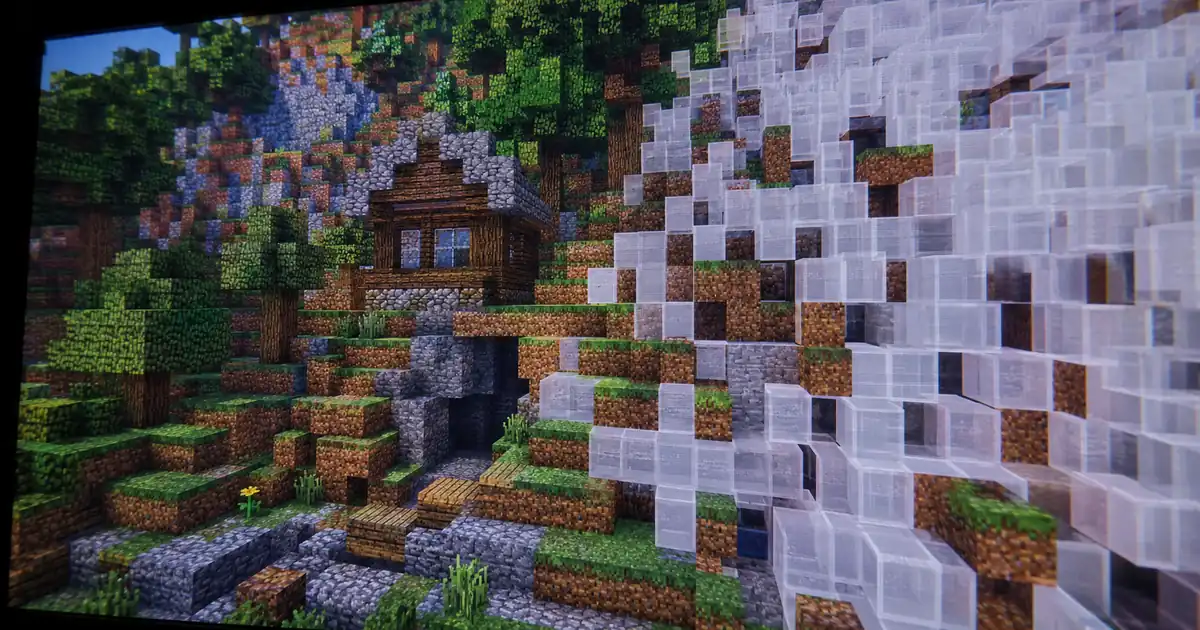
What Sakana AI built as a Minecraft world generator
Dream-Cubed is a dataset and a set of AI models that generate Minecraft worlds at the resolution of single blocks. Sakana AI built it with New York University and announced it on July 29, 2026. The paper is on arXiv as 2604.22847, and its title begins "Dream-Cubed: Controllable Generative Modeling."
Two groups should care. Players and map creators get worlds they can edit and play straight away, not a 3D picture. Researchers get the full data, code and trained models to build on.
We are excited to share our latest work, together with New York University: Dream-Cubed: Controllable Generative Modeling in Minecraft by Training on Billions of Cubes . / Technical Blog: https://pub.sakana.ai/dream-cubed / Paper: https://arxiv.org/abs/2604.22847 / Code: https://github.com/SakanaAI/DreamCubed — From the announcement post, on the NYU collaboration, the paper title and where each part is publishedView official source →
Why a Minecraft AI can treat blocks like words
A Minecraft world is already split into named blocks, the way text is split into words. Each block is one thing: sand, stone, water. AI researchers call this kind of 3D grid "voxels."
Language models learn from text that comes cut into words. In the same way, a model can read a patch of Minecraft terrain as a sequence of block "tokens" and learn which ones tend to sit next to each other.
Sakana AI also points to a gap. Image, video and text generators have moved fast, while the interactive 3D worlds of video games have had far less research. Minecraft is the best-selling video game in history and already a favorite testbed for AI research.
Generative AI has made incredible progress in the fields of image, video, and text generation. Despite success in these modalities, the interactive 3D worlds of video games have received much less research attention. / Minecraft is the best-selling video game in history, and a favorite testbed for a variety of AI research. The 3D world of Minecraft is made up of voxels: discrete, compositional building blocks like sand, stone, and water. These semantically meaningful block types provide a perfect abstraction for generative modeling: each piece of the game world is simply a collection of block tokens that come together to create a simulacrum of the natural world. — From the "Why Minecraft?" sectionView official source →
A Minecraft dataset of 30 billion blocks and 15 biomes
The training data holds over 30 billion blocks, drawn from game-generated terrain and from hand-built maps. The terrain is cut into cubes of 32×32×32 blocks called chunks. The hand-built maps come from a professional map creator who gave permission to use them.
What is in the Dream-Cubed dataset
Generated terrain is close to unlimited, but uneven. A biome is a region type like desert or ocean, and some types show up far more often than others.
Villages are the hardest case: they hold the most complex structures and are also the rarest. Sakana AI set up collection pipelines that hunt for specific biomes so rare ones still get enough samples.
Hand-built maps are the opposite problem. They are scarce, use many more block types, and contain far more detailed buildings. Sakana AI states that it releases the data and models with the map creator's agreement.
We create automated data collection and curation pipelines, collecting 1.8+ million / chunks of procedurally generated Minecraft worlds, and 200,00+ chunks from human-authored maps, comprising over 30 billion total blocks. / Villages, for example, are both the most structurally complex and the least common areas of the game world. To overcome this data balancing problem, we set up targeted collection pipelines to identify and collect specific biomes to ensure adequate representation, which we show can have a very significant impact on downstream models. / We reached out to one such professional map creator , who granted permission to use several of their large and high-quality maps for scraping. We release all our data and models in accordance with the map creators for the larger research and Minecraft community . — From "The Dream-Cubed Dataset" section, on scale, biome balancing and permission for human-built mapsView official source →
How the Minecraft diffusion model generates terrain
Dream-Cubed generates terrain with a diffusion model, a generator that learns by scrambling data and then restoring it. During training, real data is scrambled step by step, and the model learns to undo each step.
To create something new, it starts from fully scrambled input and repairs it until a clean result appears. Many image generators work this way, and Dream-Cubed applies the same idea to blocks.
Training at native block resolution without compression
Dream-Cubed feeds raw blocks to the model with no compression step, trading speed for control. Image diffusion models usually squeeze each picture into a smaller code first, using a helper model called a variational autoencoder (VAE). That makes training much cheaper.
Here, each 32×32×32 chunk goes straight into a 3D Diffusion Transformer with about 280 million parameters. Sakana AI accepts the lost efficiency because the model then sees every single block. That is what later lets a user pin individual blocks in place and have the model respect them.
A key design decision is not to compress the spatial dimensions of our data. Commonly, diffusion models operate on the compressed representations from models like Variational Autoencoders, which can massively improve the efficiency of diffusion models. We choose to train directly at the native block resolution, feeding each / chunk of the world into a 3D Diffusion Transformer with ~280M parameters. While we miss out on the performance gains of compressed representations, we find this choice is crucial for enabling fine-grained control over generation. — From "Training Models on Blocks," on skipping compressionView official source →
Two diffusion models for Minecraft blocks: MD4 and DDPM
A block is a category, not a number: "stone" is not halfway between "sand" and "water." Sakana AI tried two ways around this, MD4 and DDPM, on the same Transformer.
- MD4 (masked diffusion): blocks are hidden behind a special
[MASK]token during training. To generate, the model guesses which real block belongs under each mask and fills it in. - DDPM (noise in embedding space): each block's in-game name, such as "stone," is turned into a 16-dimensional number vector by a frozen text model. The model removes noise from these vectors, and each cleaned vector is matched to the nearest real block.
Both models learned to produce believable chunks for a chosen biome. The deciding difference is what MD4 can do beyond single chunks, covered next.
MD4 discrete masked diffusion: We add a special [MASK] state to the vocabulary, and corrupt chunks by gradually replacing real blocks with [MASK] tokens. To generate new chunks, the model "unmasks" blocks by predicting the original block type to replace the [MASK] tokens. / DDPM in embedding space: We map each block type to a 16-dimensional vector obtained by a frozen text embedding model, using the block's in-game name (e.g., "stone"). / While this doesn't tell us which formulation is better for Minecraft, we find the discrete diffusion formulation unlocks a variety of interactive generation workflows beyond the single-chunk generation case, making it a more compelling choice for an interactive world model. — From "Training Models on Blocks," on the two formulations and why MD4 was favoredView official source →
Inpainting structures and generating worlds of any size
MD4 can fill in around blocks a user places and can extend a world without limit, with no extra training. Inpainting means filling in the missing part of something while keeping the rest. Since MD4 already generates by filling in masked blocks, any block a user places is simply treated as already filled, and the model has to build around it.
In practice, a creator can lay down a few blocks in a spiral, a slope or even a volcano shape and let the model complete a natural-looking chunk around them. The same trick works on terrain cut from a real game world.
Outpainting stretches this past the edge of one chunk. The model slides its window so each new chunk overlaps the last one, keeps the shared blocks fixed, and fills the rest. Repeating this stitches together a world of any size.
This simple property gives us a fine-grained block-conditioning on top of class-conditioning as a free byproduct of training. / Even suggestive patterns like a volcano, which don't naturally occur in Minecraft, are no problem and result in successful extrapolation. / We can use a simple sliding window procedure to generate arbitrarily-sized worlds, generating overlapping chunks in sequence and stitching them together: — From "Controllable Generation via Masked Diffusion" and "World-scale generation"View official source →
How the AI world generator scored against real Minecraft
The generated terrain held up against real Minecraft in a player study, and the training data mix shaped where it was weak. Sakana AI tested this three ways: by changing the data mix, by asking players, and by checking its automatic score against those players.
Minecraft biome balance drove the generated map results
A model gets good at the biomes it sees often, so the data mix decided which terrain came out well. To show this, Sakana AI built three versions of the dataset with 1 million chunks each and trained on each one.
Three dataset mixes and how the trained models did
| Mix | How chunks were picked | Result |
|---|---|---|
| Balanced | Even share for each of the 15 biomes | Baseline for comparison |
| Boosted | Village chunks doubled | Clearly better village terrain |
| Natural | Taken at the rate the game spawns them | Strong on ocean (35% of data), weak on village (under 1%) |
With the game's natural mix, oceans flood the data and villages almost vanish, so the model struggles with villages. Doubling the village share in the Boosted mix brought a significant improvement.
Patch size also mattered. A patch is the group of blocks the Transformer reads as one unit, and models using size 4 did noticeably worse on villages than those using size 2. Sakana AI reads this as a sign that finer detail matters for complex structures.
To test how important data composition is, we create three variants of our dataset, each with 1 million chunks. / We can see a significant performance drop in our patch 4 models in the village biome, suggesting that the finer resolution at lower patch sizes is important for modeling this more complex data. Similarly, we see differences regarding dataset composition: the Natural dataset model performs well on the overrepresented ocean biome (35% of the dataset), and underperforms in the village biome (< 1% of the dataset). We find that doubling the number of village samples compared to the rest in the Boosted model, we see a significant improvement in FID. — From "Quantitative Evaluation and Comparisons," on the three dataset mixes and patch sizeView official source →
Minecraft players preferred generated chunks in all 3 models
Players chose the generated chunk over the real one more often than not, for every model tested. Each person saw two sets of chunks from the same biome and picked the one they thought was better. One set came from a model, the other from real Minecraft terrain.
How often players chose the generated chunk over a real one
Share of side-by-side trials won against real Minecraft chunks from the same biome. Trials: 173 for MD4 patch 2, 163 for MD4 patch 4, 192 for DDPM patch 2. A bar at the halfway line would mean neither side was preferred. Source: Sakana AI.
MD4 at patch size 2 was preferred in 67.1% of trials; the other two, at 57.1% and 55.2%, sit just above an even split. Sakana AI adds its own caveat: the result may come partly from how it cleaned and picked the data. It reads the numbers as the output being at least on par with real terrain, not as proof that it is better.
We create an experiment where humans view two sets of chunks for the same biome, and pick the one they think is better. / 67.1% / 57.1% / 55.2% / Model vs. real. Win rate is the fraction of trials where participants preferred generated chunks from Source A over real Minecraft chunks from the same biome. / Across all three models, generated chunks were actually preferred to real ones. This may be partly due to our process of data curation and generation, but we view it as evidence that generated chunks are at least on par with the distribution we're trying to model. — From "Human Evaluation," on the test design, the win-rate table (MD4 patch 2, MD4 patch 4 and DDPM patch 2 rows) and Sakana AI's reading of itView official source →
Checking the FID metric against Minecraft player votes
Sakana AI's automatic quality score agreed with players more closely when the gap between two models was large. The score is FID (Fréchet Inception Distance), a standard measure for image generators that compares generated pictures with real ones; lower is better. No such score exists for 3D block worlds, so Sakana AI rendered chunks as images and measured FID on those.
That only helps if the score tracks what people actually like, so Sakana AI checked it against the player votes. When two models scored almost the same, the link between FID and the votes was weaker.
When the FID gap was larger than 15 points, the model with the lower (better) FID won 66.1% of the time. Sakana AI calls this a limited but significant link.
Lacking established metrics for 3D voxel worlds, we adapt Fréchet Inception Distance (FID) to measure the differences between our models. / And we do find a limited but significant relationship between FID and win rate. In particular, we find that for biomes where there are small FID differences across models, this relationship is weaker. However, focusing on more structured biomes where the FID differences are larger, alignment of our metric with human judgment becomes stronger, with the lower-FID model winning 66.1% of the time when the gap is > 15 points. — From "Quantitative Evaluation and Comparisons" and "Human Evaluation," on validating FID with player votesView official source →
Human-authored Minecraft maps cut to 171 block types
For hand-built maps, Sakana AI cut the thousands of block types they use down to 171. Each map is also treated as its own extra "biome," the same kind of label the generated terrain carries. Sakana AI adds that learning from data that holds human creativity raises new problems, including ethical ones, and presents this part of the work as a first step.
When training on human-authored maps, we treat each map as its own additional "biome", and compress the thousands of block types present in this data down to a smaller, more manageable vocabulary of 171 unique blocks. / We acknowledge that learning to generate from data that encodes human creativity comes with a new set of challenges and even ethical considerations, and we present our models and results as a first step in this domain. — From "Training on Human-Authored Maps"View official source →
What the Sakana AI release includes for Minecraft research
The release is a full research kit: paper, code, datasets and trained model weights, with no app or in-game button. Four pieces are public:
- Technical blog at pub.sakana.ai, with 3D samples of generated chunks and worlds
- Paper on arXiv (2604.22847), with the full method and results
- Code on GitHub (SakanaAI/DreamCubed) for training, evaluation and visualization
- Data and models on Hugging Face: raw and processed datasets, the curated human-built maps, and the trained model weights
For a player who just wants a new world to explore, this is not a finished tool yet. For anyone who can run the training code, the data, code and weights are all in one place.
We release the paper, code, model artifacts, and datasets to support future work on generative modeling for interactive 3D worlds. / Training, evaluation, and visualization code. / Raw and processed datasets and trained model weights / Curated Minecraft maps for large-world generation. — From the "Release" sectionView official source →
Summary: a playable Minecraft world generator with caveats
Dream-Cubed is an AI Minecraft world generator whose output is real game terrain, ready to edit and play. That comes from one decision: training on raw blocks with no compression. The same decision makes inpainting and worlds of any size possible with the MD4 model.
The headline result, that players preferred generated chunks in all 3 models, needs its caveat. MD4 at patch size 2 won 67.1% of trials, while the other two models won 57.1% and 55.2%, and Sakana AI itself says data curation may account for part of the win. The safest reading is Sakana AI's own: the generated terrain holds up against the real thing.
FAQ
- What is Dream-Cubed?
- Dream-Cubed is a dataset plus a family of AI models that generate Minecraft worlds at the resolution of single blocks. Sakana AI built it with New York University and released it on July 29, 2026. The data mixes terrain the game generates by itself with maps built by a professional human creator.
- Why use Minecraft for AI world generation?
- A Minecraft world is made of separate blocks such as sand, stone and water, and each block type has a clear meaning. That lets a model handle blocks the way a language model handles words. The same kind of large Transformer can then learn to place them.
- Are AI-generated Minecraft worlds as good as real ones?
- In Sakana AI's player study, chunks from all three models were picked over real game chunks more often than not. Sakana AI notes that its own data curation may explain part of this. It reads the result as the output being at least on par with real terrain, not better.
- Can you play the worlds Dream-Cubed generates?
- Yes. The model writes real in-game blocks at full resolution, so what it produces is ordinary Minecraft content. Sakana AI describes the structures, terrain and maps as editable and playable right away.
Related articles
 Sakana AI API Platform: Fugu with admin controlsSakana AI API Platform entered early access on October 28, 2026, offering Fugu and Fugu Ultra via an OpenAI-compatible API with audit logs and budget caps.
 Sakana Aquarium: An Enterprise AI Agent PlatformSakana Aquarium is Sakana AI's enterprise AI agent platform, announced Oct. 23, 2026. It maps company data in an ontology and runs agents with human approval.
 Sakana Chat's My Fish shows what the AI remembersMy Fish shows what Sakana Chat's memory holds about you. Memory is on by default, opting out of training is separate, and Sakana Chat only works in Japan.
 Sakana AI Signs Japan Defense Deal to Study AISakana AI signed a contract with Japan's Ministry of Defense on July 29, 2026 to study and demonstrate AI for intelligence analysis. Its value is undisclosed.