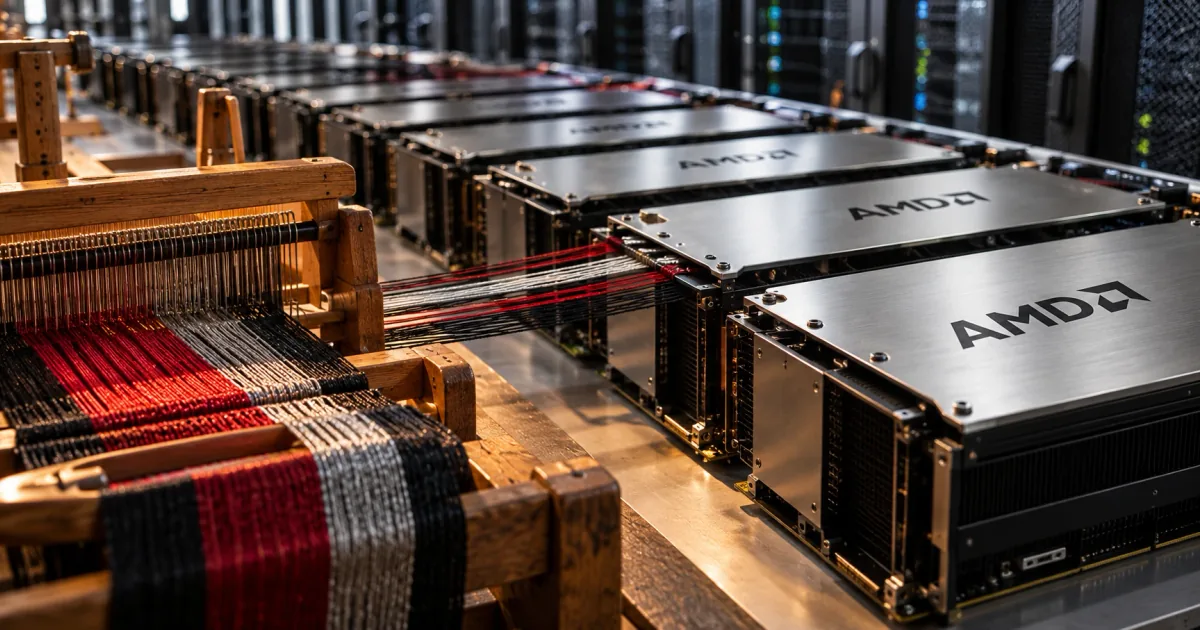
AMD ROCm 10 ships with ROCm.AI generally available
ROCm 10 at a glance
ROCm is the software AMD provides for running AI training, inference and scientific computing on its GPUs. It does the job CUDA does on NVIDIA hardware, and its compilers, runtimes and libraries are open source.
AMD released ROCm 10 on August 27, 2026, announcing it in its newsroom, and made ROCm.AI generally available at the same time. ROCm.AI had only been previewed at Advancing AI 2026, and from this release anyone can install it.
One stack for Instinct, Radeon, and Ryzen GPUs
TheRock, AMD's open-source build and release system, produced every part of ROCm 10, the first major release to be built that way. TheRock entered production with ROCm 7.14. One pipeline builds the libraries and framework packages and checks the whole stack before anything is released.
With a single pipeline behind it, the same ROCm now runs on Instinct data center accelerators, Radeon graphics cards and Ryzen integrated graphics, on Windows and Linux alike. A feature added for one GPU family or operating system gets built and tested for the rest in the same release. AMD's pitch is that what you prototype on a laptop carries over to a data center rack.
Version 10 lands a decade after ROCm 1.0 came out in April 2016, and ROCm Blogs says skipping 8 and 9 was on purpose. Minor releases will keep coming about every six weeks.
"ROCm 10.0 marks that decade with a major version bump, and the jump is deliberate."/"That single pipeline is what puts ROCm on AMD GPUs across the entire portfolio — Instinct accelerators, Radeon graphics cards, and Ryzen integrated graphics — on Windows and Linux alike."/"The platform you prototype on a laptop is the same platform that serves frontier models in a datacenter rack, and the work you do on one carries straight over to the other."/"ROCm 10 and its minor releases will continue to be released approximately every six weeks." (opening and "A New Major Version, Built on TheRock") — from ROCm BlogsView official source →
The Windows HIP SDK gives way to one Core SDK
The Windows HIP SDK is gone in ROCm 10. ROCm Core SDK replaces it, which puts Windows on the same SDK definition and release schedule as Linux. Windows developers used to get a separate package on its own timeline, and now both systems share one SDK and one release schedule.
Packaging is the weak spot for now. Windows builds come as a tarball that you unpack and point your build settings at, and AMD says native Windows installers with managed updates will arrive later in 2026.
"On Windows, the HIP SDK is retired."/"ROCm on Windows ships as a tarball today — extract it where you want it and point your build at it."/"Native Windows installers follow later in 2026, bringing the same managed install and update experience Linux users get from the package repositories." ("Windows: One SDK, One Release Cadence") — from ROCm BlogsView official source →
ROCm.AI in three parts: Skills, Hyperloom, and a CLI
Earlier ROCm releases mostly improved the libraries. ROCm.AI goes after the work around them, from installing ROCm to running models and speeding them up. Two of its three parts are generally available, and the CLI is still a Technology Preview.
| Component | What it does | Where it runs | Status |
|---|---|---|---|
| AMD Skills | Gives AI coding agents AMD-specific knowledge and tested procedures | Claude Code, Codex, Cursor | Generally available |
| ROCm Hyperloom | Lets an agent profile and tune inference on its own | Instinct MI300X, MI325X, MI355X | Generally available, open source |
| ROCm CLI | Installs, diagnoses, and serves models from one command-line tool | Windows, Linux | Technology Preview |
AMD Skills bring AMD know-how to Claude Code, Codex, Cursor
AMD Skills hand AI coding agents ROCm knowledge that AMD has checked, so the agents can use it in the middle of a task. They use the Agent Skills format and drop into folders those tools already read, such as ~/.claude/skills/ for Claude Code.
The skills install from the Claude Code, Codex and Cursor marketplaces or from the open amd/skills catalog on GitHub. That catalog has three areas: local AI on client PCs, cross-stack jobs such as diagnostics and optimization, and server work on Instinct GPUs and EPYC CPUs. One skill in it, serving-llms-on-instinct, takes an agent through standing up a vLLM server with an OpenAI-compatible API on Instinct hardware.
Every skill that ships has passed structural and behavioral tests, AMD says, to keep workflows consistent and reliable. An agent setting up an environment or serving a model therefore starts from steps AMD has already checked. For Claude itself, see What Is Claude AI? Free Plan, Models, vs ChatGPT.
"AMD Skills brings curated AMD knowledge and validated workflows into supported AI coding agents like Claude Code, Cursor and Codex, giving developers AMD-specific guidance within the tools they already use."/"The skills previewed at Advancing AI are now available through the Claude Code, Codex and Cursor marketplaces, as well as through the open catalog on GitHub."/"Each shipped skill passes structural and behavioral testing before release to help provide consistent, reliable workflows." ("Build with AMD Expertise") — from AMD NewsroomView official source →
"serving-llms-on-instinct walks an agent through standing up a vLLM OpenAI-compatible endpoint on MI300X, MI325X, MI350X, or MI355X" ("AMD Skills") — from ROCm BlogsView official source →
Hyperloom tunes vLLM and SGLang inference on Instinct
ROCm Hyperloom is an open-source agent that keeps improving inference speed on its own, round after round, without a person directing each step. Its targets are vLLM and SGLang, two open-source servers for running large language models.
In every cycle Hyperloom profiles the workload, locates the bottleneck, writes candidate fixes, benchmarks them and checks both speed and output correctness. Its changes can go into GPU kernels written in HIP, Triton or FlyDSL, or into the host code that calls them. At the end it returns a report of the proposed edits with their measured or expected gains.
AMD says weeks of manual tuning shrink to hours. The catch is hardware: AMD lists Hyperloom only for Instinct MI300X, MI325X and MI355X and says nothing about Radeon or Ryzen. It installs with a single pip command and runs either alone or through AMD Skills.
"AMD reports that Hyperloom cuts what used to be weeks of manual optimization work down to hours, while exploring far more of the solution space than a human would attempt under time pressure."/"Hyperloom is public today, runs on MI300X, MI325X, and MI355X, and installs with a single pip command" ("Hyperloom: Closing the Optimization Loop") — from ROCm BlogsView official source →
"Hyperloom profiles workloads, identifies bottlenecks, explores optimization options, implements targeted changes, benchmarks the results, and validates performance and correctness."/"Developers can target optimizations across HIP, Triton and FlyDSL, with reports describing proposed code changes and measured or expected performance improvements." ("Optimize End-to-End Inference") — from AMD NewsroomView official source →
The CLI is a Technology Preview for Windows and Linux
The ROCm CLI puts installing, troubleshooting and serving models into one command-line tool, and in ROCm 10 it carries the Technology Preview label. AMD distributes it as a prebuilt binary for Windows and Linux that works without ROCm already installed.
rocm serve <model> starts a model for inference, and rocm examine looks for environment and driver problems. Several ROCm versions can sit side by side, and you can switch between them or roll back. The bundled ROCm Console, once called dash, shows GPU utilization and, on supported Instinct systems, HBM memory use, power draw and tokens per watt.
The CLI is early access, and AMD expects its interface to keep changing. It works with ROCm releases from 7.13 on, but AMD lists official ROCm 10 support as coming soon, so read the release notes before relying on it with ROCm 10.
"The CLI is available on Windows as well as Linux as a prebuilt binary and does not require an existing ROCm installation."/"Available as a Technology Preview, ROCm CLI provides a version-agnostic experience across ROCm releases, beginning with ROCm 7.13 software, with ROCm 10 official support coming soon." ("Run with Simpler Workflows") — from AMD NewsroomView official source →
"It ships as a tech preview in ROCm 10.0 — treat it as early access and expect the interface to keep evolving." ("ROCm CLI") — from ROCm BlogsView official source →
Reading the 3.3x claim and the gap with CUDA
AMD's headline claim is that ROCm.AI makes inference 3.3x faster and training 2.4x faster on average. AMD measured both figures in its own lab, and the footnotes set conditions few readers' setups will match.
The 3.3x and 2.4x figures come from eight MI355X GPUs
AMD Performance Labs ran both tests on July 7, 2026, on one system with eight Instinct MI355X GPUs. The inference figure averages tokens per second over three models, and the training figure averages three other models trained with the Megatron-LM framework. The footnotes give these conditions.
| Item | Inference (3.3x) | Training (2.4x) |
|---|---|---|
| Tested | July 7, 2026, by AMD | Same |
| Hardware | 8x Instinct MI355X | 8x Instinct MI355X |
| Models | GLM-5, Kimi-K2.5, DeepSeek-R1-0528 | DeepSeek-V2-Lite, DeepSeek-V3-16B, Qwen3-30B-A3B |
| Software | vLLM (Kimi), SGLang (DeepSeek-R1), SGLang → ATOM (GLM-5) | Megatron-LM |
| Compared | ROCm 7.0 vs a ROCm 7.2.2 preview with added optimizations | Same |
The comparison row matters most. The baseline is ROCm 7.0, and the faster side is a preview of ROCm.AI on ROCm 7.2.2 with added kernel, parallelism and scheduling work, not ROCm 10 as it ships.
The serving software also differs between the two sides of the inference test: Kimi-K2.5 goes from vLLM 0.16.0 to 0.22.0, GLM-5 moves from SGLang to ATOM, and only DeepSeek-R1 keeps the same SGLang version. AMD adds that results vary with configuration, software and drivers. Installing ROCm 10 will not by itself make your GPU 3.3x faster.
"Stated performance uplift is expressed as a combined average TPS over across the (3) models tested."/"Performance may vary based on configuration, software, vLLM version, and the use of the latest drivers and optimizations."/"a similarly configured system using a preview version of AMD ROCm.ai (ROCm 7.2.2 with optimizations such as Optimized Kernels, Parallelism and Scheduling)"/"Kimi ROCm Docker Image: vllm/vllm-openai-rocm:v0.16.0, vLLM version 0.16.0"/"Kimi ROCm Docker Image: vllm/vllm-openai-rocm:v0.22.0, vLLM version V0.22.0"/"PYTorch Version 2.8.0, SGLang v0.5.8"/"ATOM v0.1.2.post" (footnote MI350-81) — from AMD NewsroomView official source →
Radeon and Ryzen AI Max get ComfyUI tuning and Unsloth
On Radeon and Ryzen, what ROCm 10 offers is tuned image and video models, plus local fine-tuning on Ryzen AI Max only. The 3.3x figure comes from MI355X and Hyperloom is listed for Instinct only, so neither carries over directly.
ComfyUI workflows for image and video models such as Wan2.2, FLUX.2 KLEIN and Stable Diffusion 3.5 Medium have been tuned for supported Radeon and Ryzen hardware. Ryzen AI Max machines, with their large pool of unified memory, get Unsloth support for LoRA and QLoRA fine-tuning in ROCm 10, which lets you adapt a model locally instead of renting cloud GPUs.
Radeon and Ryzen also now have production support for vLLM and SGLang, with validated containers on Docker Hub. Running models on your own machine is covered in Local LLM Coding Now Hits 75% of Cloud AI.
ROCm 10's pitch against CUDA is developer tooling, such as coding-agent skills and a single CLI, on top of the usual library updates. Gaps remain: the CLI is a preview, and native Windows installers will not arrive until later in 2026. AMD published no ROCm-versus-CUDA numbers, so anyone thinking of switching should benchmark their own workload on both.
"ROCm 10.0 adds support for Unsloth on Ryzen™ AI MAX platforms, enabling fast, memory-efficient local fine-tuning of large language models."/"enabling teams to run LLM inference on AMD Instinct, Radeon, and Ryzen hardware without building the stack from source"/"AMD has performance-tuned popular models, including Wan2.2, FLUX.2 KLEIN, Stable Diffusion 3.5 Medium, Stable Diffusion 2.1, and Stable Diffusion XL Base, helping users achieve strong out-of-the-box performance on supported Radeon and Ryzen platforms." ("Local LLM Fine-Tuning on Ryzen™ AI MAX" and ComfyUI sections) — from ROCm BlogsView official source →
Summary: ROCm 10 unifies AMD GPUs, but the 3.3x is a lab figure
ROCm 10 celebrates a decade of ROCm by skipping to version 10 and putting Instinct, Radeon and Ryzen on one stack. ROCm.AI became generally available the same day, bringing AMD Skills for Claude Code, Codex and Cursor, Hyperloom for automated inference tuning, and a preview ROCm CLI for setup and diagnostics.
The 3.3x inference figure is AMD's own measurement on eight MI355X GPUs, and Hyperloom is listed for Instinct only. On Radeon or Ryzen hardware, start with the ComfyUI tuning, or with Unsloth fine-tuning on Ryzen AI Max.
FAQ
- When was ROCm 10 released?
- AMD released ROCm 10 on August 27, 2026, and made ROCm.AI generally available the same day. ROCm.AI had first been shown at Advancing AI 2026.
- Does Hyperloom work on Radeon GPUs?
- Not according to AMD. It lists Hyperloom for Instinct MI300X, MI325X, and MI355X accelerators only. On Radeon, the ROCm 10 changes you will notice are the ComfyUI tuning for image and video models and the validated vLLM and SGLang containers.
- Can I use ROCm 10 on Windows?
- Yes. ROCm Core SDK now covers Windows and replaces the HIP SDK, but for now it ships as a tarball you extract and point your build at. Native Windows installers are planned for later in 2026.
- Is ROCm 10 faster than CUDA?
- AMD did not publish a CUDA comparison with ROCm 10. Its 3.3x inference and 2.4x training figures compare a preview ROCm.AI build against ROCm 7.0 on similarly configured eight-GPU MI355X systems, so they say nothing about NVIDIA hardware.
Related articles
 GPU Utilization: Adobe's GPUs Sat Two-Thirds IdleLow GPU utilization at Adobe traced to slow storage and uneven work per GPU. Per Backblaze, two-thirds of GPU time went to waiting; fixes reached about 80%.
 SpaceX Cognition Report: Scott Wu Denies TalksSpaceX Cognition report: Bloomberg says SpaceX tried to buy Cognition AI, maker of Devin AI. Scott Wu denied talks; a possible compute deal went unaddressed.
 AMD Anthropic Deal: Up to 2GW MI450 and $5B StakeAMD Anthropic deal explained: up to 2GW of Instinct MI450 Series GPUs in Helios racks, an equity stake of up to $5B, and a Claude-ROCm tie-up.
 Claude Code Token Usage: 33K vs OpenCode's 7KClaude Code token usage starts near 33,000 before your prompt, 4.7x OpenCode. CLAUDE.md and MCP servers push it to 75,000, but requests set the total.