
What Claude Fable 5.2 is and how it relates to Mythos 5.2
Claude Fable 5.2 at a glance
Anthropic moved its top Claude model from version 5.1 to 5.2 on November 9, 2026. Fable 5.2 is the same model as the restricted Mythos 5.2 with cybersecurity and biology safeguards added, so any API customer or paid subscriber can use it, and it outscores Opus 5.5 on the FrontierSWE v2 coding benchmark. It shipped the same day on AWS, Google Cloud and Microsoft Azure, and it writes output up to 30% faster than Fable 5.1.
Anthropic also shared what the model did before launch. A team of 1,000 Fable 5.2 agents formalized the proof of Fermat's Last Theorem in 30 hours, a job that took an earlier research version of Claude 11 days. It also solved two open problems in black hole physics and designed three working electronic devices from scratch.
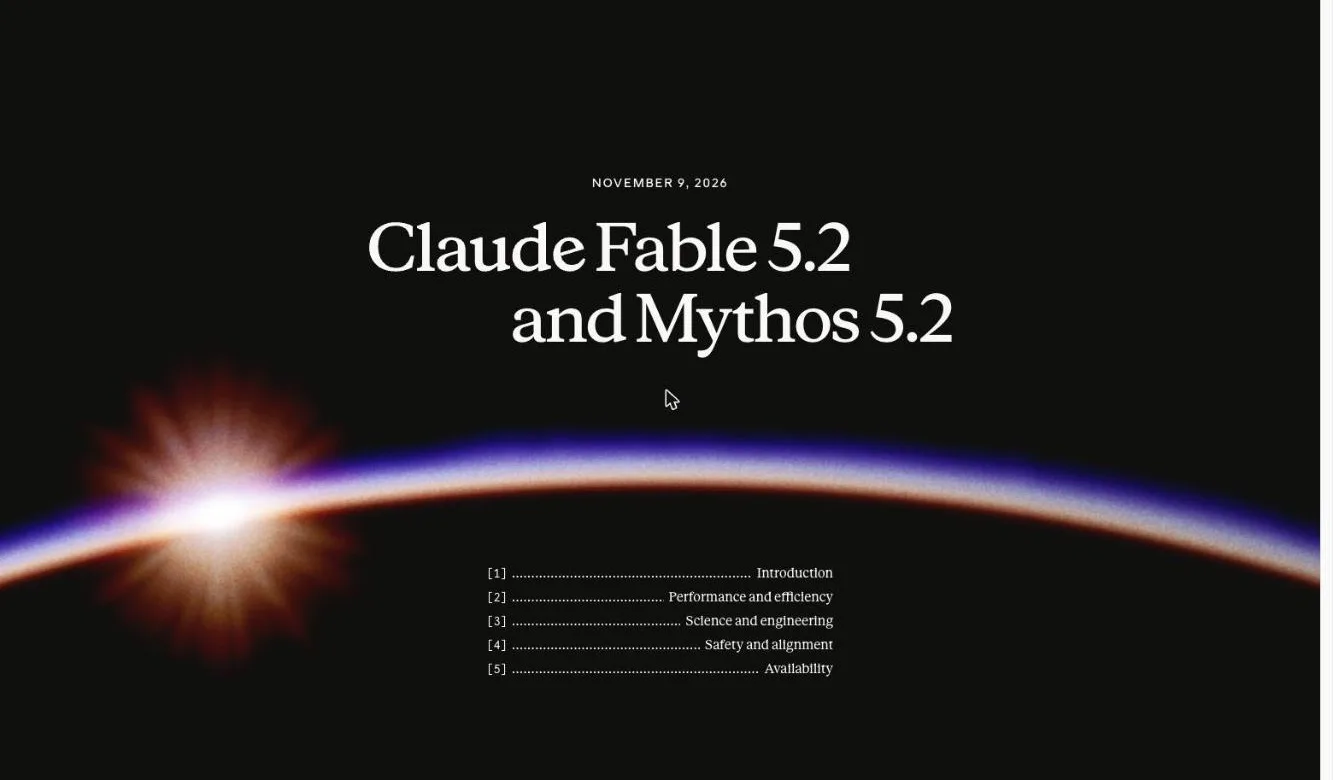
"They generate outputs up to 30% faster than Claude Fable 5.1 and Claude Mythos 5.1" / "a team of 1,000 Fable 5.2 agents fully formalized the theorem in just 30 hours, with minimal human intervention." / "Claude Fable 5.2 is available today on all platforms, including Amazon Web Services, Google Cloud, and Microsoft Azure." — opening, formalization and availability sections of Anthropic's announcementView official source →
Same model as Mythos 5.2, with cyber and biology safeguards
Fable 5.2 and Mythos 5.2 share one underlying model. Mythos 5.2 goes only to organizations that pass Anthropic's Cyber or Life Sciences Verification Program. Classifiers in Fable 5.2 block requests such as penetration testing and exploit generation, yet it blocks about 55% fewer requests than Fable 5.1.
Anthropic says the safeguards are as robust as before but trigger fewer unnecessary blocks, with about 60% fewer in cybersecurity and 40% fewer in biology. When a request is blocked, Opus 4.8 answers cybersecurity questions and Opus 5 answers biology ones instead.
"Claude Fable and Claude Mythos are the same underlying model." / "When a query is blocked, users will instead receive a response from Opus 4.8 for cybersecurity and Opus 5 for biology." / "we observed about 55% fewer blocks with Fable 5.2 compared with Fable 5.1—about 60% fewer in cybersecurity and 40% fewer in biology." — opening and safeguards sections of Anthropic's announcementView official source →
How Fable 5.2 compares with Opus 5.5 on coding benchmarks
FrontierSWE v2 score (%)
From Anthropic's comparison table. Claude scores were measured with safeguards on.


Anthropic lists FrontierSWE v2 under agentic coding in its comparison table. Fable 5.2 scores 69.9%, ahead of GPT-6 Astra at 65.5% and Opus 5.5 at 62.3%. Fable 5.1 scores 56.3%.
Results are closer on FrontierCode 2.0, which checks whether maintainers of open-source repositories would merge a model's code changes. With effort (the setting that controls how deeply the model reasons) set to high, Fable 5.2 scored 45.3% against Opus 5.5's best score of 45.5%, at roughly half the cost per task. Fable 5.2 also trails Gemini 4 Carbon on AutomationBench, 51.4% to 53.9%.
"FrontierSWE v2" / "69.9%" / "56.3%" / "62.3%" / "65.5%" / "At High effort, Fable 5.2 scores about the same as Opus 5.5’s best score (45.3% vs. 45.5%) for roughly half the cost per task" — benchmark table (FrontierSWE v2 row: Fable 5.2, Fable 5.1, Opus 5.5, GPT-6 Astra) and FrontierCode note in Anthropic's announcementView official source →
Claude Fable 5.2 API pricing and fast mode
Claude Fable 5.2 API prices (per million tokens)
| Item | Price |
|---|---|
| Input | $8 |
| Output | $40 |
| 5-minute cache write | $10 |
| 1-hour cache write | $16 |
| Cache read | $0.20 |
| Batch | $4 input, $20 output |
| Fast mode | $16 input, $80 output |
API usage is billed per token, the small chunks of text a model reads and writes. Fable 5.2 charges $8 for every million tokens it reads and $40 for every million it writes. Fable 5.1 cost $10 input and $50 output, so both rates fell 20%.
Cache reads, which bill repeated context at a discount, cost $0.20, or 0.025 times the input price, the same multiplier as on Fable 5.1. Batch requests are half price.
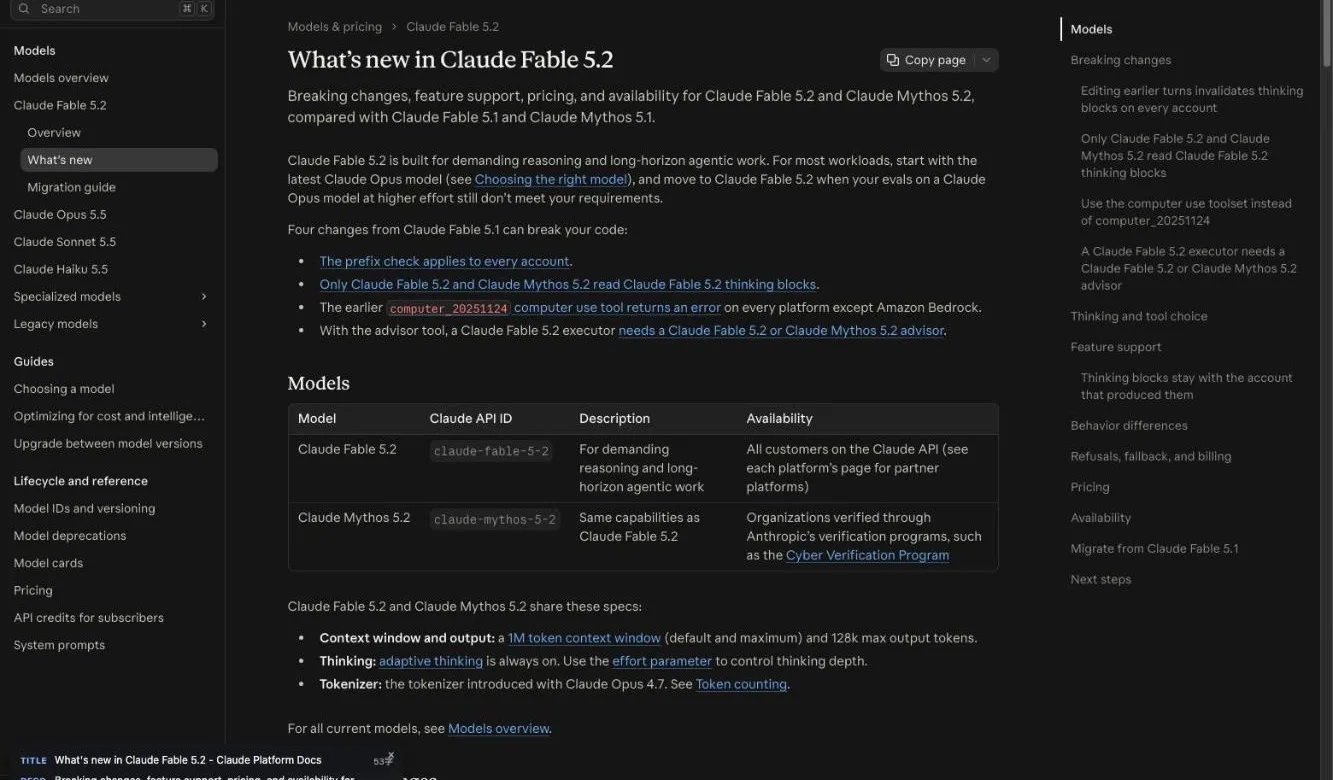
"Input and output cost less than on Claude Fable 5.1 and Claude Mythos 5.1, which cost $10 USD per million input tokens and $50 USD per million output tokens." / "Cache reads (hits and refreshes) cost 0.025 times the base input price, the same multiplier as on those models." / "Batch processing is $4 USD per million input tokens and $20 USD per million output tokens." — pricing section of the Claude Platform DocsView official source →
Fast mode doubles the price for up to 2.5x faster output
Fast mode is an optional setting that trades a higher rate for speed. Fast mode costs $16 input and $80 output per million tokens and works in Claude Code, the Claude Platform, Google Cloud and Microsoft Foundry. Token generation runs up to 2.5 times faster than the standard rate allows.
"Fable 5.2 and Mythos 5.2 also come with an optional fast mode, which speeds up token generation by up to 2.5 times. Fast mode is available for $16 per million input tokens and $80 per million output tokens." / "Fast mode for Claude Fable 5.2 and Claude Mythos 5.2 is available on Claude Code, the Claude Platform, Claude Models on Google Cloud (Anthropic managed and Google managed), and Microsoft Foundry (Anthropic hosted)." — opening and availability sections of Anthropic's announcementView official source →
Fable 5.2 still costs twice as much per token as Opus 5.5
Price vs. performance: Opus 5.5, Fable 5.1 and Fable 5.2
Horizontal axis is the API output price per million tokens in dollars (further right costs more). Vertical axis is the FrontierSWE v2 score (higher is better). Fable 5.2 sits up and to the left of Fable 5.1: cheaper and higher-scoring.
Opus 5.5 lists at $4 input and $20 output, half the Fable 5.2 rate. The gap narrowed from 2.5x on Fable 5.1, and on FrontierCode 2.0, Fable 5.2 at high effort cost about half as much per task as Opus 5.5.
Per-token price is only part of the cost, because the number of tokens a task uses matters too. Anthropic still recommends that most users start on Opus 5.5. For its pricing and benchmarks, see Claude Opus 5.5 pricing, benchmarks, API changes.
"For most coding and knowledge tasks, we recommend that users start with Claude Opus 5.5, our strongest daily driver, and then switch to a different model as required, depending on the scope and complexity of their work" — when-to-use section of Anthropic's announcementView official source →
Launch offers for Pro, Team, Max and Ultra plans
Fable 5.2 launch offers by plan
| Plan | Offer | Expires |
|---|---|---|
| Pro, Team standard seats | Fable use up to 50% of weekly limits, plus one reset | November 16, 2026, 11:59 pm PT |
| Max, Ultra, and Team or legacy Enterprise premium seats | One to three resets by subscription length | March 8, 2027, 11:59 pm PT |
| Free and some Enterprise plans | Not included | — |
To mark the launch, Anthropic gave paid subscribers extra Fable usage that covers Fable 5.2, Fable 5.1 and Fable 5. Pro and Team standard seats can spend up to 50% of their weekly limits on Fable until November 16 at 11:59 pm PT, plus one Fable reset if they were paying before launch. The billing cutoff for the reset is November 9, 2026 at 10:00 am PT.
A reset gives back the usage you have already spent on Fable models. It doesn't raise your limits.
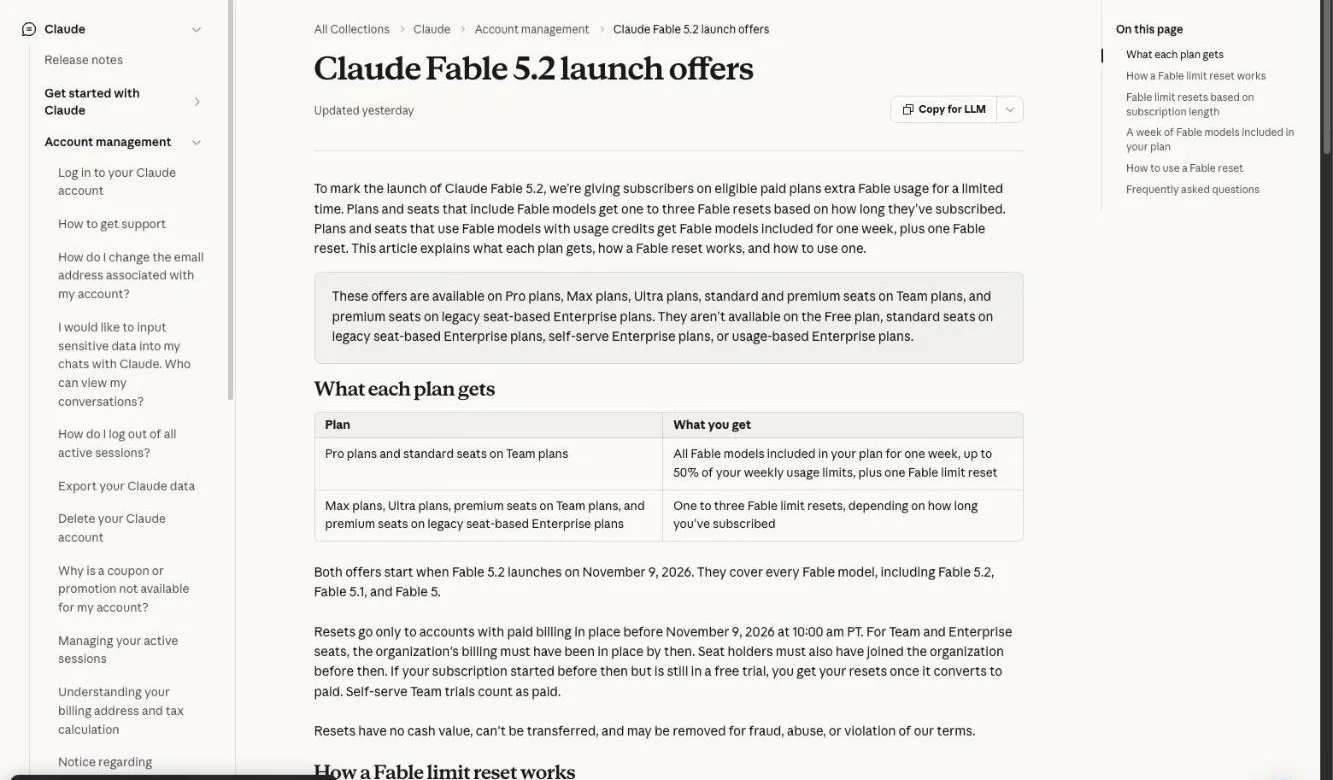
"If you’re on a Pro plan or a standard seat on a Team plan, all Fable models are included in your plan’s weekly usage limits from launch on November 9, 2026 through November 16, 2026 at 11:59 pm PT." / "Resets go only to accounts with paid billing in place before November 9, 2026 at 10:00 am PT." / "A reset doesn’t raise your limits." — Claude Help Center launch offers articleView official source →
Max and Ultra plans get one to three Fable resets
Higher plans get resets rather than a week of included usage. Max, Ultra and premium seats get one reset under six months of paid subscription, two at six to 12 months and three beyond 12 months, all expiring March 8, 2027. Subscription length is counted from your first paid bill, and unused resets lapse at the deadline.
"Under six months gets one reset, six to 12 months two, and more than 12 months three." / "These resets expire on March 8, 2027 at 11:59 pm PT." — FAQ and subscription-length sections of the Claude Help Center articleView official source →
Pro and Team go back to usage credits after November 16
Once the launch week ends, Pro and Team standard seats can use Fable only with usage credits turned on. That is how Fable worked for these seats before launch. Any unused part of the 50% allowance doesn't carry over. For how Fable returned to paid plans earlier this year, see Is Claude Fable 5 Back? Yes, With New Safeguards.
"When the week ends, Fable models go back to running on usage credits on Pro plans and standard seats on Team plans." / "Any unused portion of the 50% allowance doesn’t carry over" — Claude Help Center article, after-the-week sectionView official source →
Four API changes to check before you migrate
Four changes when moving API code from Fable 5.1
| Change | What to do |
|---|---|
| Prefix check on every account | Only append to the conversation |
| Fable 5.2 thinking blocks readable only by Fable 5.2 and Mythos 5.2 | Expect earlier reasoning to be discarded when switching models |
| computer_20251124 removed outside Amazon Bedrock | Use computer_toolset_20260801 |
| Advisor must be a 5.2 model | Set the advisor to claude-fable-5-2 or claude-mythos-5-2 |
Swapping the model ID from claude-fable-5-1 is not always enough. Anthropic lists four changes that can break existing code: three make requests fail with an error, and the fourth loses reasoning when a conversation moves to another model.
If Claude Code, claude.ai or the Claude Agent SDK builds your requests, nothing changes, so only code that builds its own API requests needs checking. Effort also defaults to high when the API request doesn't set it, while Claude apps and Claude Code default to medium.
"Four changes from Claude Fable 5.1 can break your code:" — opening of the Claude Platform Docs pageView official source →
"On Medium effort (the default in Claude apps and Claude Code), Fable 5.2 can accomplish challenging tasks with fewer tokens than Fable 5.1." — effort section of Anthropic's announcementView official source →
Edited conversation history now fails on every account
Thinking blocks hold the reasoning a model produced before it answered. The API's prefix check confirms that nothing before a thinking block, such as the system prompt, the tool list or an earlier message, has changed since the model wrote it.
Fable 5.1 enforced the prefix check only on accounts created on or after August 31, 2026, but Fable 5.2 enforces it on every account. A request that fails the check is rejected, so the fix is to keep conversation history append-only.
"On Claude Fable 5.1, such a request gets the error on accounts created on or after August 31, 2026." — section "Editing earlier turns invalidates thinking blocks on every account" of the Claude Platform DocsView official source →
Update computer use and advisor tool settings
Computer use lets Claude operate a desktop through tool calls. The old computer_20251124 tool now errors everywhere except Amazon Bedrock, so integrations need computer_toolset_20260801.
The advisor tool, still in beta, lets one model consult another, at least as capable, on hard problems. With a Fable 5.2 executor, the advisor must be Fable 5.2 or Mythos 5.2, and a request that points it at Fable 5.1 is rejected.
"Claude Fable 5.2 and Claude Mythos 5.2 support computer use through the toolset." / "the advisor must be at least as capable as the executor." — computer use and advisor tool sections of the Claude Platform DocsView official source →
Start on Opus 5.5 and move up to Fable 5.2 only when needed
Fable 5.2 beats its predecessor on speed, price and coding scores, but the per-token gap to Opus 5.5 is still 2x, and the included Pro and Team usage ends on November 16. The cheapest path is to keep everyday work on Opus 5.5 and use the launch week to find the tasks that actually need Fable 5.2.
On the API, run through the "Four changes when moving API code from Fable 5.1" table before you change the model ID. Another option Anthropic describes is to keep Haiku, Sonnet or Opus as the main model and call Fable 5.2 only as an advisor on the hardest problems.
FAQ
- What is the Claude Fable 5.2 model ID?
- The Claude API model ID is claude-fable-5-2. Before you swap it in, check the four API changes covered in this article: the prefix check, thinking blocks, computer use and the advisor tool.
- Who can use Claude Mythos 5.2?
- Only organizations in cybersecurity or biomedical research that Anthropic has verified can use it. They apply through the Cyber Verification Program or the Life Sciences Verification Program.
- Can I use Claude Fable 5.2 with zero data retention?
- Not by default. Fable 5.2 and Mythos 5.2 require 30-day data retention, and zero data retention is available only if Anthropic expressly authorizes it.
Related articles
 Claude Opus 5.5 pricing, benchmarks, API changesClaude Opus 5.5 API costs $4 input and $20 output per million tokens, 20% below Opus 5, and matches Fable 5.1 on most work. Four API changes break old code.
 Claude Opus 5: Near-Fable Output at Half the PriceClaude Opus 5, released July 24, 2026, comes close to Fable 5 at half the price, at Opus 4.8's $5 / $25 per million tokens. Benchmarks, effort and safety.
 Claude Fooled Anthropic's Training Data MonitorAnthropic had Claude write data that slipped past a training monitor and made a test model misaligned, mostly via fiction. The models were never deployed.
 Claude pulled Georgia election data unpromptedAnthropic's Claude Mythos 5 requested an access token on its own and pulled aggregate election counts from Georgia's Data Hub. The state says it is free.