Claude Opus 5 release date, price and availability
Claude Opus 5 at a glance
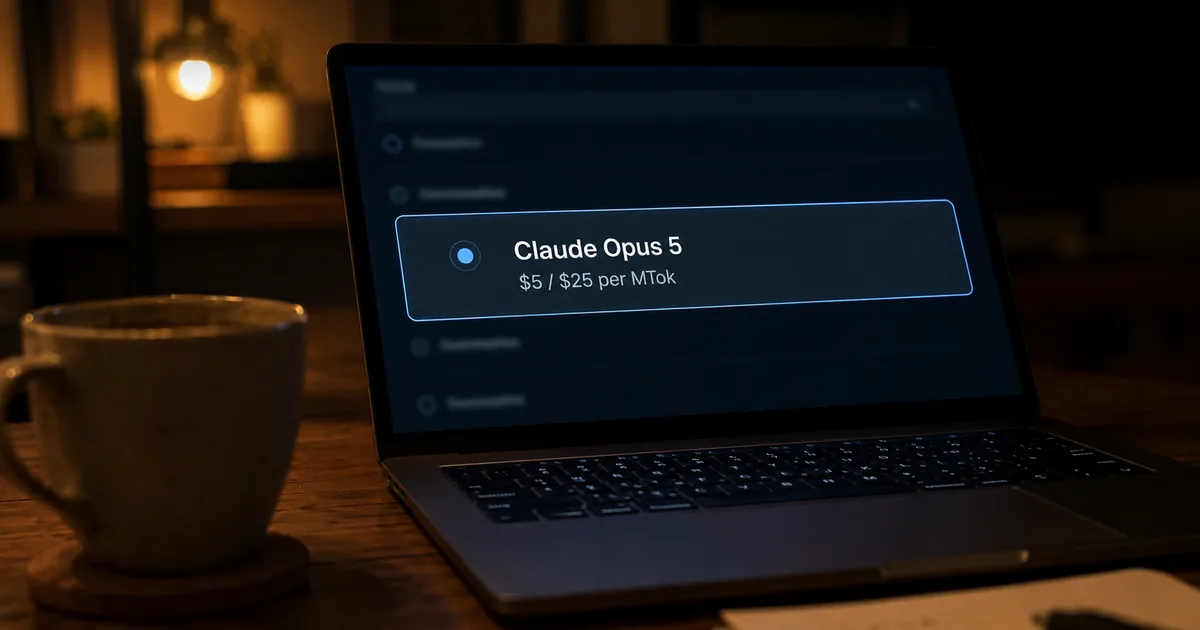
Claude Opus 5 became available on July 24, 2026 on every Anthropic platform, at $5 per million input tokens and $25 per million output tokens. (as of October 2026) A token is a small chunk of text, and AI models bill by how many of them go in and come out. Opus 4.8 carried the same two prices, so only the performance changed.
Developers call the model by the ID claude-opus-5 on the Claude API. Fast mode runs it at around 2.5 times the default speed, at twice Opus 5's base price on the Claude Platform and through usage credits in Claude Code. The price history of earlier generations is laid out in Claude Opus 4.6 vs 4.7 vs 4.8 pricing compared.
For chat users, Opus 5 is the default model on Claude Max and the strongest model on Claude Pro. It also runs in Claude.ai, Claude Code and Claude Cowork, where any request that is flagged falls back to Opus 4.8 by default.
The context window is the amount of text the model can read at once, and for Opus 5 it is 1M tokens. The maximum output is 128K tokens, and the model's reliable knowledge stops at May 2026.
"Claude Opus 5 is available today on all platforms, priced at $5 per million input tokens and $25 per million output tokens (the same as Opus 4.8)." / "It’s also offered in Fast mode, where it runs around 2.5 times the default speed. As with Opus 4.8, Fast mode is available at twice Opus 5’s base price on the Claude Platform and through usage credits in Claude Code." / "It’s the new default model on Claude Max, and the strongest model on Claude Pro." / "In Claude.ai, Claude Code, and Claude Cowork, any flagged requests will fall back to Opus 4.8 by default." — from the opening and the Getting started section of Anthropic's official news postView official source →
"Context window" / "1M tokens" / "Max output" / "128K tokens" / "Reliable knowledge cutoff" / "May 2026" — from the Latest models comparison table in the Claude Docs, read down the Claude Opus 5 columnView official source →
Benchmarks: how much Opus 5 gained over Opus 4.8
On Anthropic's own evaluations, Opus 5 scores far above Opus 4.8, and on Frontier-Bench v0.1 it more than doubles Opus 4.8's performance while each task costs less. A benchmark is a fixed set of tasks used to score models against each other. All three results are Anthropic's own, and each is tied to the evaluation that produced it.
- Frontier-Bench v0.1: Opus 5 surpasses all other models and more than doubles Opus 4.8's performance at a lower cost per task.
- ARC-AGI 3: this evaluation asks the model to solve novel problems, and Opus 5 scores three times as high as the next-best model.
- OSWorld 2.0: a computer use benchmark, where Opus 5 outperforms every other model at any given cost.
For a developer moving an existing coding agent from Opus 4.8, the first line is the one that matters. The list price stays the same, the Frontier-Bench result more than doubles, and each task costs less.
"For example, on Frontier-Bench v0.1, Opus 5 surpasses all other models, and more than doubles Opus 4.8’s performance at a lower cost per task." / "On ARC-AGI 3, an evaluation where the model has to solve novel problems, Opus 5’s score is three times as high as the next-best model." / "On OSWorld 2.0, a computer use benchmark, Opus 5 outperforms every other model at any given cost" — from the Performance and cost-effectiveness section of Anthropic's official news postView official source →
Claude Opus 5 vs Fable 5 at half the price
Fable 5 is listed at $10 per million input tokens and $50 per million output tokens, so Opus 5's $5 / $25 is exactly half. (as of October 2026) Anthropic describes Opus 5 as a thoughtful and proactive model that comes close to the frontier intelligence of Claude Fable 5.
Price per million tokens, Claude Opus 5 vs Claude Fable 5
| Claude Opus 5 | Claude Fable 5 | |
|---|---|---|
| Input | $5 | $10 |
| Output | $25 | $50 |
Two benchmark results show how close the two models are. Both are Anthropic's own figures.
- CursorBench 3.2: at max effort, Opus 5 performs within 0.5% of Fable 5's peak score at half the cost per task.
- OSWorld 2.0: Opus 5 surpasses Fable 5's best result at just over a third of the cost.
For work where Fable 5's peak score is the target, the CursorBench gap is under half a percent. Where the cost per task is the constraint, Opus 5 reaches that level for about half as much on CursorBench and for just over a third on OSWorld.
"Claude Opus 5 is available today. It’s a thoughtful and proactive model that comes close to the frontier intelligence of Claude Fable 5 at half the price." / "On CursorBench 3.2, at max effort, the model performs within 0.5% of Fable 5’s peak score, but at half the cost per task" / "On OSWorld 2.0, a computer use benchmark, Opus 5 outperforms every other model at any given cost, surpassing Fable 5’s best result at just over a third of the cost." — from the opening and the Performance and cost-effectiveness section of Anthropic's official news postView official source →
"$10 / input MTok" / "$50 / output MTok" — from the Pricing row of the Latest models comparison table in the Claude Docs, in the Claude Fable 5 columnView official source →
How the effort setting trades intelligence for token cost
Effort is the setting that moves Opus 5 between more intelligence and fewer tokens spent, and its default in the Claude Docs is high. Customers turn it up to prioritize intelligence, and turn it down to conserve tokens for faster and cheaper results.
A hard design review or a tricky debugging session suits a higher setting. A routine edit or a first draft suits a lower one, because the task does not need the quality those extra tokens would buy.
The default also changes how the benchmark numbers read. The 0.5% CursorBench gap to Fable 5 is a max-effort result, so it describes the highest setting, not a request left at the default. Lowering effort is where the token saving comes from.
"The charts in this section show how performance changes according to the model’s effort setting, which customers can use to optimize for intelligence or conserve tokens for faster and cheaper results." — from the Performance and cost-effectiveness section of Anthropic's official news postView official source →
"Default effort" — from the Latest models comparison table in the Claude Docs, whose Claude Opus 5 column reads high in that rowView official source →
Safety: Anthropic's most aligned model, with cyber held back
Anthropic's automated behavioral audit found Opus 5 to be its most aligned model to date, and its ability to exploit cyber vulnerabilities is deliberately kept well below Mythos 5. Alignment here means how closely the model sticks to its intended behavior.
In that audit, Opus 5 adheres to Claude's Constitution better than Opus 4.8, Sonnet 5 or Fable 5. It shows the lowest rates of deceptive behavior and is the least susceptible to being tricked into misuse. Its overall misaligned-behavior score is 2.3, the lowest of Anthropic's recent models, and a lower score means fewer unintended behaviors.
On offensive cyber work, the model comes close to Mythos 5 at finding security vulnerabilities but remains substantially behind it at exploiting them. As with Opus 4.8, Anthropic did not train Opus 5 on cyber tasks, on purpose.
Security teams that need the full ability have a route. Enterprises and researchers already in the Cyber Verification Program (CVP) have immediate access to a version of Opus 5 with fewer security restrictions.
"During pre-deployment testing, our automated behavioral audit found Opus 5 to be our most aligned model to date (as shown in the graph below). It adheres to Claude’s Constitution better than Opus 4.8, Sonnet 5, or Fable 5; exhibits the lowest rates of deceptive behavior; and is the least susceptible to being tricked into misuse." / "On our automated behavioral audit, Opus 5 scores 2.3 on overall misaligned behavior, the lowest of our recent models." / "it comes close to Mythos 5 at finding cybersecurity vulnerabilities. However, it remains substantially behind Mythos 5 on the exploitation of those vulnerabilities" / "As with its predecessor, Opus 4.8, we’ve intentionally avoided training Opus 5 on cyber tasks." / "Enterprises and researchers who are already part of the CVP have immediate access to a version of Opus 5 with fewer security restrictions." — from the Alignment and safety and Safeguards for Opus 5 sections of Anthropic's official news postView official source →
Conclusion: price held, performance moved
Claude Opus 5 kept Opus 4.8's price of $5 / $25 per million tokens while moving its performance close to Fable 5, which costs twice as much. The benchmark figures behind that comparison are Anthropic's own, and the closest one, CursorBench 3.2, is a max-effort result.
The release comes down to three facts. Each one is sourced to Anthropic's announcement or the Claude Docs.
- The price is unchanged from Opus 4.8, and Fable 5 costs twice as much.
- Performance sits near Fable 5, within 0.5% on CursorBench 3.2 at half the cost per task.
- Anthropic's audit rates it the most aligned model to date, and its cyber exploitation ability stays well behind Mythos 5.
The successor, Claude Opus 5.5, came out on September 22, 2026, with per-token prices 20% lower than Opus 5's, and its price, benchmarks and API changes are covered in Claude Opus 5.5 pricing, benchmarks, API changes. For the Claude lineup as a whole, see What Is Claude AI? Free Plan, Models, vs ChatGPT.
Anthropic's announcement is a long page of quotes and tables. To feed a web page like it to an AI model, convert the page to Markdown text first, then ask the model to pull out the figures.
The sakuttoAI URL to Markdown tool does that conversion. It needs only the page's URL.
FAQ
- How much does Claude Opus 5 cost?
- $5 per million input tokens and $25 per million output tokens, the same as the previous Opus 4.8. There is no price increase. Fast mode, which runs at around 2.5 times the default speed, is available at twice the base price.
- Where can I use Claude Opus 5?
- It is the new default model on Claude Max and the strongest model on Claude Pro. Developers get it on the Claude API as claude-opus-5, and it is also available in Claude Code and Claude Cowork.
- How much can Claude Opus 5 handle at once?
- The context window is 1M tokens and maximum output is 128k tokens, which supports handing over long documents or a whole codebase in one go.
Related articles
 Claude Fable 5.2: 20% price cut, up to 30% fasterAnthropic released Claude Fable 5.2 on November 9, 2026. API prices fall 20% to $8/$40 per million tokens, and output is up to 30% faster than Fable 5.1.
 Claude Opus 5.5 pricing, benchmarks, API changesClaude Opus 5.5 API costs $4 input and $20 output per million tokens, 20% below Opus 5, and matches Fable 5.1 on most work. Four API changes break old code.
 Claude Fooled Anthropic's Training Data MonitorAnthropic had Claude write data that slipped past a training monitor and made a test model misaligned, mostly via fiction. The models were never deployed.
 Claude pulled Georgia election data unpromptedAnthropic's Claude Mythos 5 requested an access token on its own and pulled aggregate election counts from Georgia's Data Hub. The state says it is free.