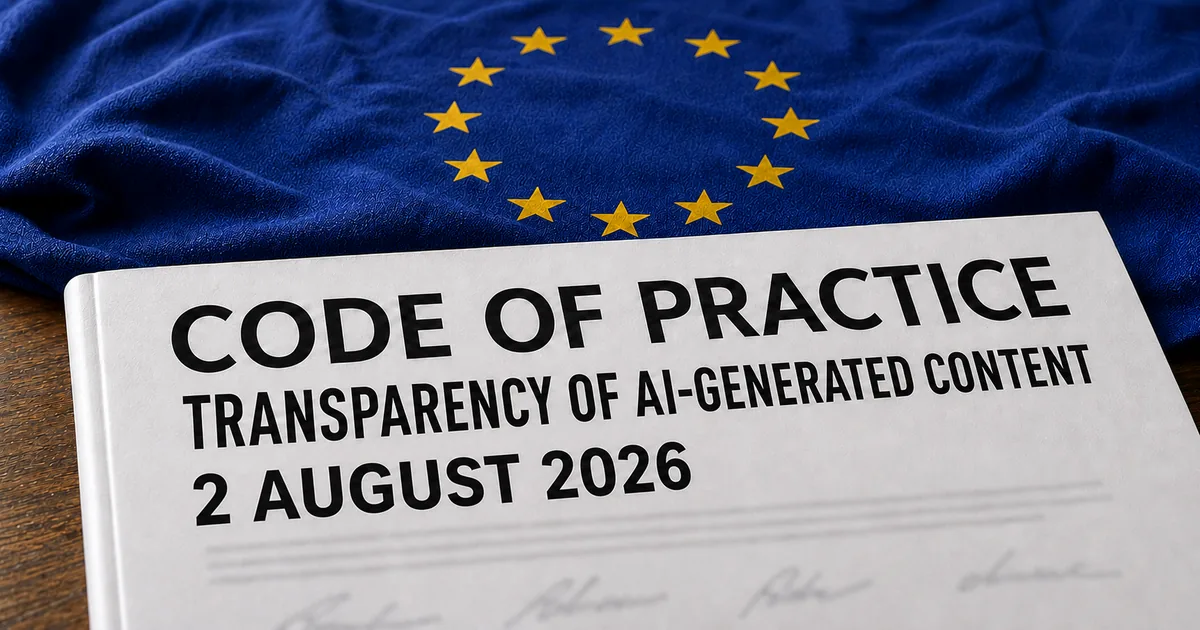
EU AI Act enforcement and Article 50 transparency
Article 50 of the AI Act sets transparency duties for providers and deployers of generative AI systems. The duties cover marking and detecting AI-generated content and labeling deepfakes.
A provider builds or supplies the AI system. A deployer uses it, for example by publishing its output.
Since 2 August 2026 the Commission's AI Office, together with national authorities, has been enforcing the Act, and the Article 50 rules have applied since the same day. For a business that runs a chatbot or publishes AI-made images, video, audio or text, the duties are now enforceable.
AI Act deepfake labeling and watermarking rules
The Commission names three rules. The table shows who each one covers.
The three Article 50 labeling rules that apply from 2 August 2026
| Rule | Who it covers | What it requires |
|---|---|---|
| Say it is AI | Chatbots and other interactive AI systems | Tell users they are dealing with AI, not a human |
| Label deepfakes | Images, videos or audio edited or generated using AI | Label the content as a deepfake |
| Add machine-readable marks | AI-generated or altered content | Carry marks so the content can be detected more easily |
The Commission says the measures are meant to reduce deception and manipulation and help people make informed choices. It adds that they give businesses clearer obligations and a practical way to show compliance. The schedule for the other AI Act duties, including the high-risk delay, is in EU AI Act 2026: What Applies in August, What Waits.
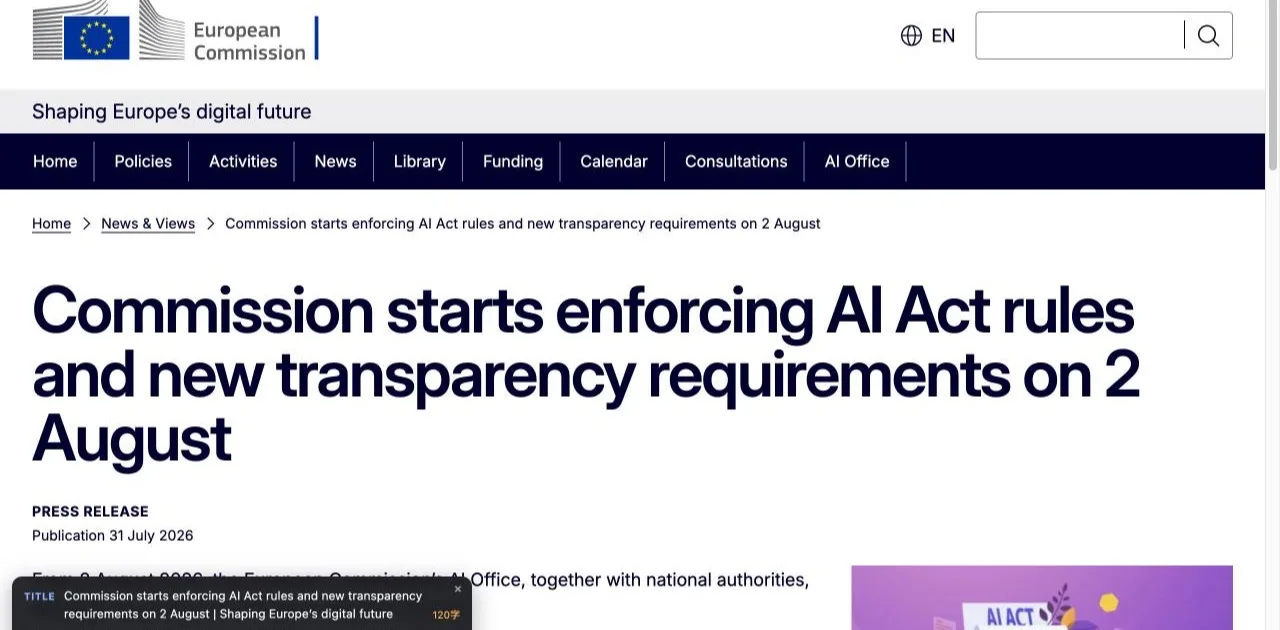
From 2 August 2026, the European Commission’s AI Office, together with national authorities, will begin enforcing the Artificial Intelligence (AI) Act. / Under the new rules, chatbots and other interactive AI systems will have to tell users they are dealing with AI, not a human. Deepfakes (images, videos, or audio that have been edited or generated using AI) will have to be labelled. AI-generated or altered content will also have to carry machine-readable marks so it can be detected more easily. / The measures are intended to reduce deception and manipulation and help people make informed choices. They also give businesses clearer obligations and a practical way to show compliance. — From the start of enforcement, the three labelling rules, and the stated aim of the measuresView official source →
AI Act 2 August 2026 and the code of practice signatory list
On 2 August 2026 the Commission published a first list of more than 180 organizations that signed the transparency code. The code's own policy page puts the count at about 190 organizations by the end of July 2026. Both numbers are reported here as each page gives them: "more than 180" is a lower bound, and neither page says how the two counts relate.
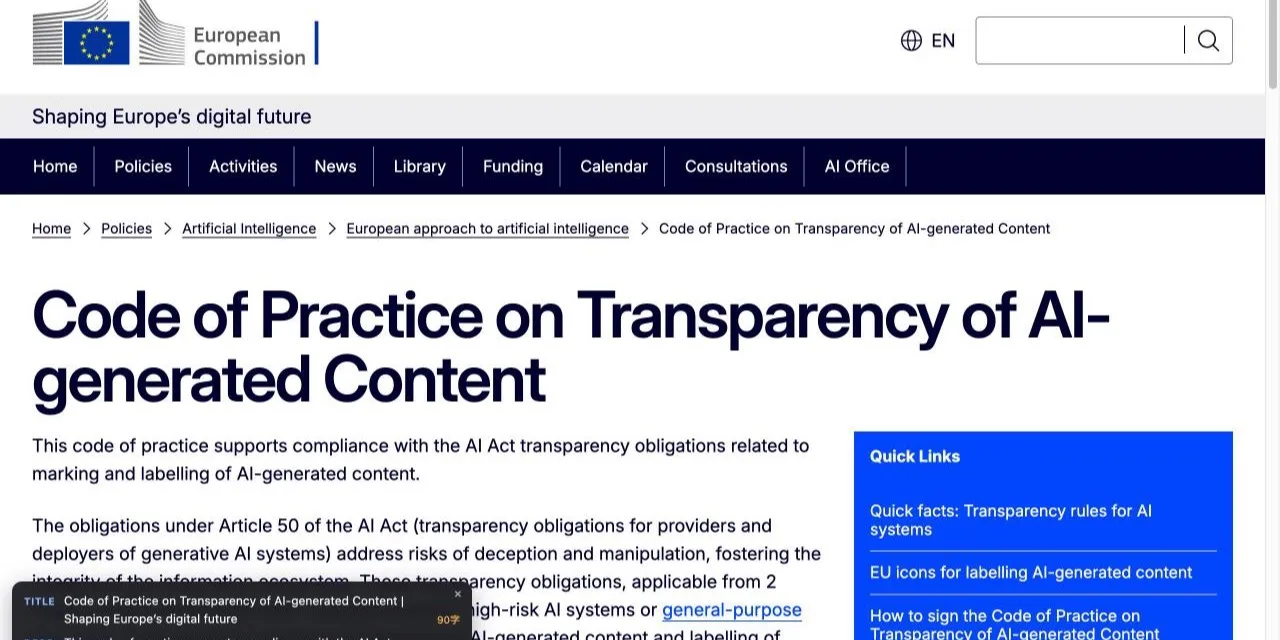
By the end of July 2026, about 190 companies organisations have signed the code. — From the signatory count on the policy pageView official source →
EU AI Act code of practice for AI content labeling
The code of practice is a voluntary tool for meeting the rules in the table above. Independent experts drew it up in a multi-stakeholder process coordinated by the AI Office. It helps providers and deployers of generative AI systems comply with the labeling and marking duties in Article 50(2), (4) and (5) of the AI Act.
Article 50 code of practice: providers and deployers
The code has two sections, one for each role. Each section covers one side of the Article 50 duties:
- Section 1 is for providers. It sets rules for marking and detecting AI-generated and manipulated content.
- Section 2 is for deployers. It sets rules for labeling deepfakes and AI-generated and manipulated text.
In short, providers mark the content and deployers label it. The EU has created a set of icons that deployers of generative AI systems may use to label their AI-generated content. Signatories will also work together in Signatory Taskforces, yet to be set up, to share practices and advance marking and labeling.
The Code of Practice on transparency of AI-generated content (PDF) has 2 sections : Section 1: Providers - Rules for marking and detection of AI-generated and manipulated content Section 2: Deployers - Rules for labelling of deepfakes and AI-generated and manipulated text / The EU has also created a set of icons that deployers of generative AI systems may use to label their AI-generated content. / Signatories to the code will also collaborate in the Signatory Taskforces, which will be set up to share practices and advance the implementation of the marking and labelling. — From the two-section structure, the official labelling icons, and the Signatory TaskforcesView official source →
Signing the code of practice and Article 50 compliance
The Commission and the AI Board have confirmed that the code is an adequate voluntary tool to demonstrate compliance with the transparency obligations. Following a positive assessment, providers and deployers who sign can rely on the code's measures to demonstrate compliance. The Commission says this reduces administrative burden and gives predictability, legal certainty and trust across all Member States.
Signing does not remove the duty. Adherence to the code is voluntary, while the Article 50 requirements are legal obligations. A signature changes how you show compliance, not whether you owe it.
It helps providers and deployers of generative AI systems to comply with the AI Act’s obligations for labelling and marking of AI-generated content – Article 50(2), (4) and (5) of the AI Act . Even though adherence to the code is voluntary, the transparency requirements under article 50 of the AI Act are legal obligations. / Following a positive assessment of the code, all providers and deployers who sign it can rely on its measures to demonstrate compliance with the AI Act’s rules for labeling and detection of AI-generated content, deepfakes and certain text publications. This will reduce their administrative burden and give them predictability, legal certainty and trust across all Member States. — From the provisions covered, the relationship between voluntary adherence and legal obligation, and the effect of signingView official source →
Without signing: AI Act transparency requirements
A provider or deployer can comply through other means. If it does, it has to demonstrate that those measures are adequate. Different market surveillance authorities assess this individually.
The code is published as a PDF. To work with specific provisions, you can convert it to Markdown first.
By contrast, providers and deployers that decide to comply through other means will have to demonstrate that those measures are adequate. This will be assessed individually by different market surveillance authorities. — From the demonstration burden when complying by other means and the individual assessment by market surveillance authoritiesView official source →
AI Act enforcement: where to report Article 50 transparency breaches
Alongside the start of enforcement, the Commission links three channels for reporting a breach of the Act. Each one handles a different kind of report.
AI Act transparency obligations: three reporting channels
Reporting channels the Commission links with AI Act enforcement
| Channel | Meant for |
|---|---|
| AI Act complaints tool | Complaints about AI Act breaches |
| AI Act Whistleblower Tool | Whistleblower reports |
| Complaints channel for downstream providers | Downstream providers using general-purpose AI models |
Two of the channels take complaints and whistleblower reports; the third is for downstream providers that use general-purpose AI models. The same page also points to further guidance, including the Commission's guidelines on AI-generated content transparency and on general-purpose AI model providers.
Read more about the Enforcement of the AI Act and the: AI Act complaints tool AI Act Whistleblower Tool Complaints channel for downstream providers using general-purpose AI models / Find more information about: Guidelines on Transparency of AI-generated Content General-Purpose AI (GPAI) Code of Practice Guidelines for providers of GPAI models Guidelines on prohibited AI practices — From the list of channels and guidelines given as related information for enforcementView official source →
Outside the EU: check Article 50 and AI content labeling
A business outside the EU that serves EU users has two checks to make. Both come from the provider and deployer roles in Article 50:
- Has the generative AI provider you build on signed the code? If so, it can rely on the code's marking measures to demonstrate its own compliance.
- Do you publish AI-generated content? Then you act as a deployer, and Section 2 of the code is the part written for deployers. Deployers of generative AI systems may use the EU icons to label that content.
For how the schedule moved, including the delay to high-risk obligations, see EU AI Act Omnibus: New Deadlines and Nudifier Ban. EU AI Act 2026: What Applies in August, What Waits sets out what applies in August and what waits.
Summary: code of practice signatures and AI content labeling
EU AI Act enforcement began on 2 August 2026, and the Article 50 labeling rules apply from the same day. Signing the code of practice is voluntary and changes how you show compliance, not the legal duty. Check whether your AI provider signed the code, and check your own labeling against Section 2 if you publish AI-generated content.
FAQ
- Does signing the code of practice exempt you from the legal obligation?
- No. Adherence to the code is voluntary, and the transparency requirements in Article 50 remain legal obligations. What signing changes is not whether the obligation exists but how you show you are meeting it.
- Is it illegal not to sign?
- No. Adherence to the code is voluntary. If you comply through other means, you have to demonstrate that those measures are adequate, and different market surveillance authorities assess that individually.
- How many organizations have signed?
- Alongside the start of enforcement, the Commission published a first list of more than 180 organizations that signed the code. The code's policy page states that about 190 organizations had signed by the end of July 2026.
Related articles
 California AI Transparency Act: SB 942 and AB 853The California AI Transparency Act took effect August 2, 2026, and SB 1000 rewrote it on September 30: who is covered, three duties and the $5,000 penalty.
 EU AI Act 2026: What Applies in August, What WaitsEU AI Act 2026: from 2 August, chatbot and deepfake disclosure duties and AI Office enforcement apply, while high-risk rules wait until 2027 and 2028.
 EU AI Act Omnibus: New Deadlines and Nudifier BanThe EU AI Act omnibus is law: high-risk rules move to December 2027 and August 2028, and a nudifier ban and watermarking deadline hit 2 December 2026.
 Ratepayer Protection Act Fails Senate Vote 57-43The House passed H.R. 9340 417-3, but the Senate fell three votes short of 60 on September 30. What the Ratepayer Protection Act asks of data centers.