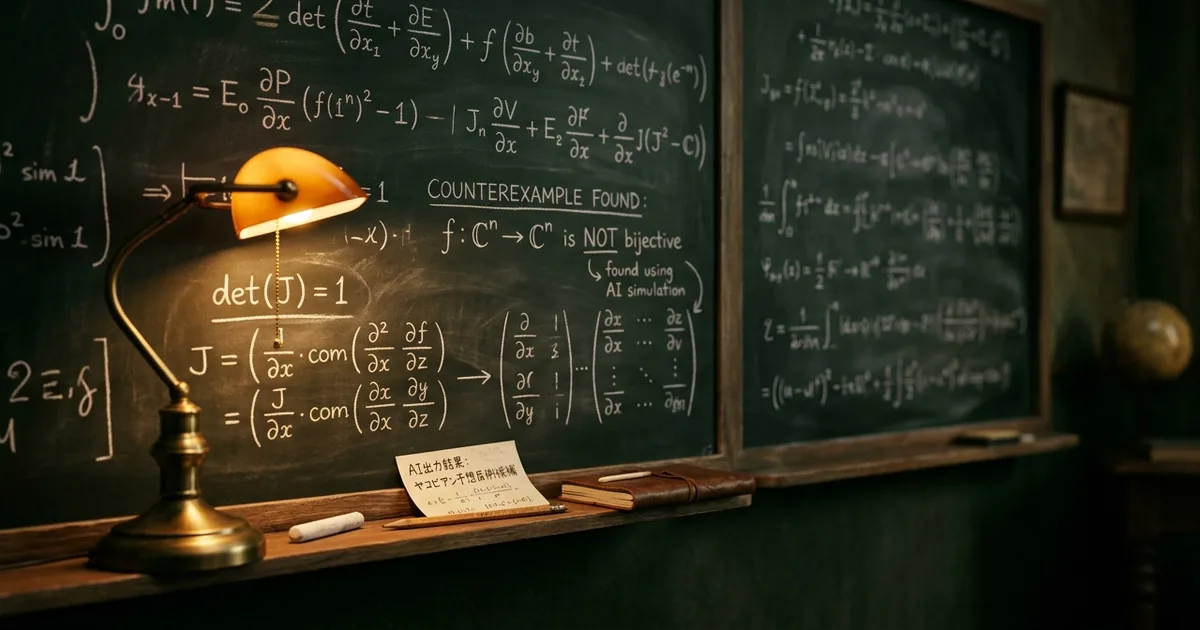
Levent Alpöge's counterexample, found with Claude Fable 5
The announcement at a glance
The result did not arrive as a paper or a press release. It came as a single casual post from a mathematician, and within a day other mathematicians had redone the arithmetic.
A short X post said the conjecture is false
Alpöge, a Princeton-trained number theorist, wrote on X that the Jacobian conjecture is false and pasted the formula underneath. The rest of the post was thanks: to his friend Akhil, the University of Chicago mathematician Akhil Mathew, for raising the problem, and to "fable" for working on it while the World Cup final was on. He also linked to Wolfram Alpha pages so readers could rerun the calculations.
Two details are easy to miss. The post names only "Fable", not a model version, and it was a personal announcement rather than anything Anthropic published. Claude Fable 5 had been available to the public for only a few weeks at that point.
"On July 20, Anthropic researcher Levent Alpoge said he used Claude Fable 5 to find a counterexample to the Jacobian conjecture, one of the central open problems in algebraic geometry."/"Alpoge included Wolfram Alpha links where the calculations can be reproduced." — From ForkLog's reportView official source →
Mathematicians checked the counterexample within a day
Because the formula fits in one post, verifying it took hours rather than months. By the following day other mathematicians had worked through it by hand and with software, and the claim held.
Reactions came fast. Qiaochu Yuan called it by far the most famous open problem a large language model has resolved to date, and Jared Duker Lichtman described it as a remarkable result. Checking in public is still not peer review, though, and no journal has refereed the result.
"An artificial intelligence model has helped disprove a mathematical conjecture that had gone unsolved for 87 years, and the answer was confirmed within a day because anyone can now check it by hand." — From CoinDesk's reportView official source →
The Jacobian conjecture said polynomial maps can be undone
The conjecture in two lines
The conjecture is about maps built only from adding and multiplying, known as polynomial maps. It links a local measurement to a global promise, and that jump from local to global is where the counterexample breaks it.
A Jacobian determinant only measures the map near a point
Picture a map as something that takes a point in space and moves it somewhere else. The Jacobian determinant, a single number computed from the map's partial derivatives (the Jacobian matrix), tells you how the map stretches or squeezes space right around a given point. When it is a constant other than zero, the map never folds space onto itself in any small neighborhood.
The Jacobian conjecture says that for polynomial maps, this local good behavior is enough: there must be a polynomial inverse that reverses the whole map. That does not follow automatically, for a simple reason. If a map sends two different points to the same place, nothing can send them back, because the output no longer says which one you started from.
A well-known older result is sometimes confused with this one. In 1994 Sergey Pinchuk built a two-variable real map that is reversible near every point but not on the whole plane. His determinant is never zero but is not constant, and the map works only over the real numbers, so it answers a weaker question.
"If the Jacobian determinant is always a constant number that is not zero, then the function never folds or crushes space around a particular point."/"The Jacobian conjecture states that when the Jacobian determinant is a non-zero constant, there should always exist another function, also made up of polynomials, that reverses the original one." — From Melissa Lee, Monash UniversityView official source →
From Kraus in 1884 to Keller in 1939 and Smale in 1998
The Czech mathematician Ludwig Kraus wrote down the two-variable form in 1884, and the German mathematician Ott-Heinrich Keller stated it for any number of dimensions in 1939. Headlines count the 87 years from Keller. Stephen Smale later put it at number 16 on his 1998 list of problems for the next century.
The problem also has a long history of failed proofs, including ones by Beniamino Segre and Wolfgang Gröbner. Partial results kept narrowing the search: the degree-2 case was proved, so any counterexample had to be at least cubic.
"The Jacobian conjecture was originally formulated without being named in two dimensions by Ludwig Kraus in 1884, who gave a flawed proof in the same paper."/"The Jacobian conjecture is number 16 in Stephen Smale's 1998 list of Mathematical Problems for the Next Century." — From the Wikipedia articleView official source →
Checking the Jacobian conjecture counterexample yourself
Alpöge's map from ℂ³ to ℂ³ (as posted)
(1 + xy)³z + y²(1 + xy)(4 + 3xy),
y + 3x(1 + xy)²z + 3xy²(4 + 3xy),
2x − 3x²y − x³z
)
You only need to confirm two facts, and neither requires any theory beyond calculus. We ran both checks in SymPy 1.14.0 on September 26, 2026, using the formula exactly as posted.
The map's Jacobian determinant is −2 at every point
Take the partial derivatives of the three components with respect to x, y and z, arrange them in a 3-by-3 matrix, and simplify the determinant. The answer comes out as −2 with no variables left, so it holds at every point of complex three-space rather than at a few sampled ones.
The conjecture is often stated with determinant 1, but that is only a scaling choice. Multiplying the first output by −1/2 turns the determinant into 1, and the three inputs below still collide. In our run the three components came out with total degrees 7, 6 and 4, consistent with the older result that any counterexample had to be at least cubic.
"This is an identity of polynomials, not a sample taken at a few points." — From Kingy.ai's verificationView official source →
Three inputs give the same output: (−1/4, 0, 0)
Now substitute the three points Alpöge listed. Each one produces the same output, coordinate for coordinate.
Three different inputs, one output
Given only the output (−1/4, 0, 0), there is no way to know which of the three inputs produced it, so no inverse can exist. The map meets the conjecture's condition and breaks its conclusion, and one such example is enough. Adding extra coordinates that the map leaves alone carries the same collision into four, five or any higher number of dimensions.
Some commenters online pointed out that the map is not "proper", meaning some points that run off toward infinity are sent back into a bounded region. That is true, but properness was never one of the conjecture's assumptions, so it does not disqualify the example.
"Because the counterexample lives in three dimensions, it also breaks the conjecture for every higher dimension." — From DataCamp's explainerView official source →
The plane case and Fable 5's role are still open
Settled and still open
A verified counterexample disproves the general statement, but it answers fewer questions than the headlines suggest. Three gaps remain.
The two-variable Jacobian conjecture is still unsolved
Padding a map with extra coordinates only moves a counterexample up in dimension, never down. The plane case, the version Kraus first wrote down and the one several mathematicians regard as the core of the problem, is untouched.
Computer searches have ruled out plane counterexamples of low degree. Tzuong-Tsieng Moh's 1983 work covered every degree up to 100, and Thuy Nguyen raised the bound to 104 in 2025.
"This bound was increased to 104 by Thuy Nguyen in 2025." — From the Wikipedia articleView official source →
No peer review yet, and no record of how Fable 5 was used
As of late July 2026 there was no journal paper, only the post and the public checks. There is also no transcript: outsiders do not know how the model was prompted, how many candidates failed, or how much Alpöge and Mathew guided it. Mathew has put it this way: the answer can be verified, but a story explaining it would be nicer.
That leaves a narrower lesson than "AI solves math problems." The formula itself is simple; the hard part was searching an enormous space of polynomial maps for one with both properties.
A model like Claude Fable 5 can be a useful search partner when every candidate can be checked exactly, and the checking still falls to people. To see how it compares with Anthropic's other models, read Claude models compared: Fable, Opus, Sonnet, Haiku.
"The difficulty in finding it seems to have lain not in an intricate construction or a lengthy proof, but rather in finding a good way of navigating an enormous search space of possible polynomial mappings to find one with the right properties." — From Melissa Lee, Monash UniversityView official source →
FAQ
- Is the Jacobian conjecture false now?
- Yes, in three or more dimensions. Alpöge's map has a Jacobian determinant of −2 everywhere yet sends three different points to one output, which breaks the conjecture's promise of an inverse. Adding untouched coordinates carries the same failure to every higher dimension. The original two-variable version is still unsolved.
- Did Claude Fable 5 find the counterexample on its own?
- Outside observers cannot tell yet. Alpöge credits Fable in his post, but the prompts and failed attempts have not been released, and nobody has said how much he or Akhil Mathew steered the search. What can be checked is the finished formula, not the process that produced it.
- Has the counterexample been peer reviewed?
- Not as a journal paper. Mathematicians reproduced both checks in public within a day, and we reran them in SymPy, so the algebra itself is on solid ground. A formal write-up and refereeing are still to come.
Related articles
 Claude models compared: Fable, Opus, Sonnet, HaikuClaude models as of September 2026: how Fable 5.1, Opus 5.5, Sonnet 5.5 and Haiku 4.5 differ on API price, context window and plans, and which to start with.
 Claude Jailbreak Severity and Fable 5 SafeguardsClaude jailbreak severity gets a 0 to 4 scale: on July 2, 2026 Anthropic detailed Fable 5's four-category cyber classifier and the CJS bands.
 Is Claude Fable 5 Back? Yes, With New SafeguardsClaude Fable 5 back worldwide since July 1, 2026: US export controls ended June 30, and a new classifier blocks the jailbreak Amazon found.
 Claude Fable 5 Unavailable: The Ban and Your PlanClaude Fable 5 unavailable? A US export directive banned it on June 12, 2026; it returned July 1. Today the cause is your plan, app version, or a fallback.