SpaceXSI shipped Grok Voice 3.0 in the Voice Agent API
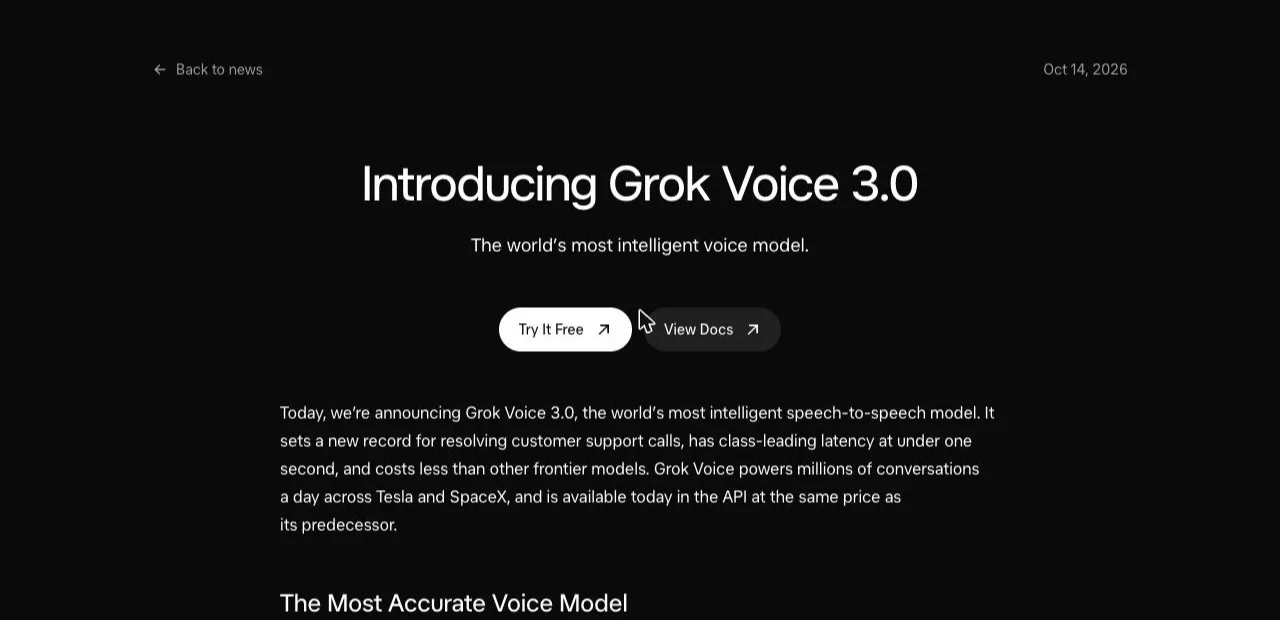
Grok Voice 3.0 is a new speech-to-speech model from SpaceXSI, and developers have been able to call it through the Voice Agent API since October 14, 2026. A speech-to-speech model listens to a caller and answers out loud on its own, so a voice agent does not need a separate transcription step and a separate text-to-speech step. The announcement page carries the SpaceXSI brand, while its copyright line reads SpaceXAI LLC.
The same company runs the Grok chatbot, whose plans are covered in Grok Pricing 2026: Free, SuperGrok, and API Costs. Grok Bot's voice mode, covered further down, runs on the same new model.
"Today, we’re announcing Grok Voice 3.0, the world’s most intelligent speech-to-speech model." — opening paragraphView official source →
The grok-voice-latest alias now points to 3.0
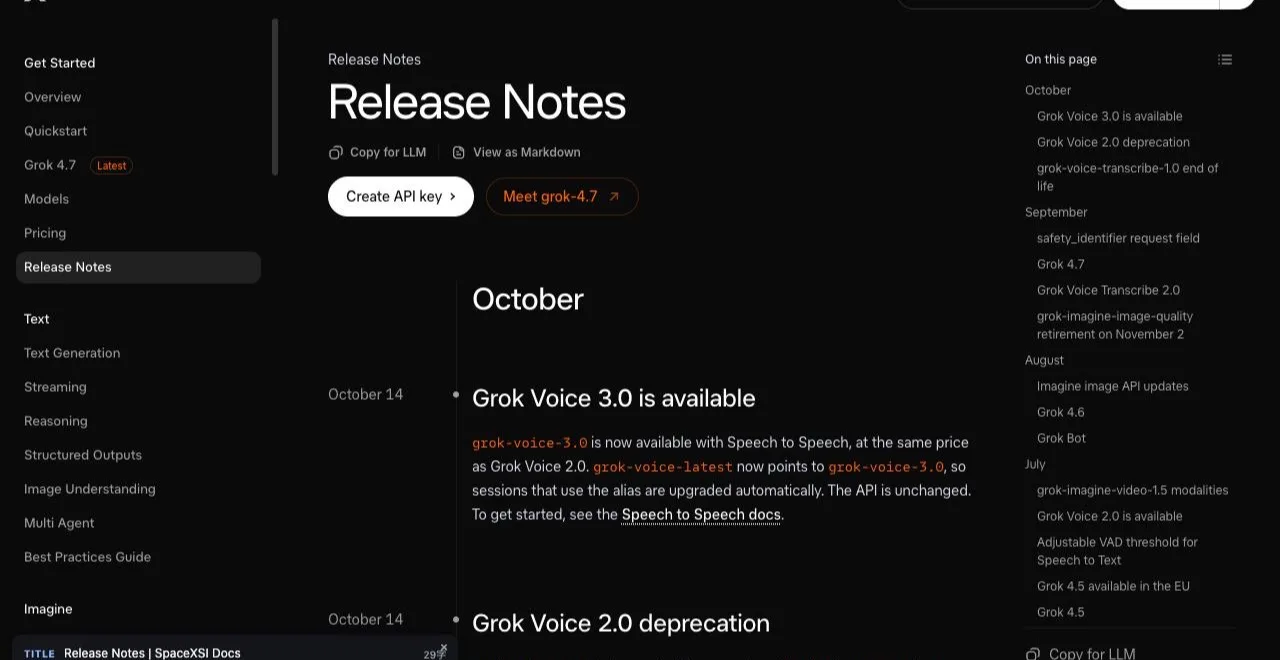
Any session that requests grok-voice-latest has been running on Grok Voice 3.0 since October 14, with no code change. The release notes say the alias was repointed and the API stayed the same, so endpoints and session settings carry over.
Grok Voice 2.0 had arrived on July 29, so 3.0 replaced it after 11 weeks. SpaceXSI's previous model launch was text-focused (see Grok 4.5 benchmarks, pricing, and where to use it).
"so sessions that use the alias are upgraded automatically. The API is unchanged." — "Grok Voice 3.0 is available"View official source →
Grok Voice 3.0 leads the index but not every test
Artificial Analysis Speech to Speech Index
Grok Voice 3.0 sits 3.7 points above GPT-Live-1, and 5.6 points above the Grok Voice 2.0 release it replaces, which now ranks last of the four.


Grok Voice 3.0 scored 86.9 on the Artificial Analysis Speech to Speech Index, the highest of any model on the board. Artificial Analysis is an independent group that benchmarks AI models, and its index blends four results: spoken reasoning, support-call handling (τ-Voice), head-to-head listener preference, and task completion. The overall lead hides two places where 3.0 is not first.
SpaceXSI published the component scores below, measured by Artificial Analysis on October 13, 2026. GPT-Live-1 is an OpenAI model, and Gemini 3.8 Live comes from Google.
| Test | Grok Voice 3.0 | Grok Voice 2.0 | GPT-Live-1 | Gemini 3.8 Live |
|---|---|---|---|---|
| Overall index | 86.9 | 81.3 | 83.2 | 82.6 |
| Spoken reasoning | 98.5% | 97.2% | 90.1% | 97.7% |
| Listener preference (Elo) | 1070 | 1011 | 1048 | 990 |
| Task success | 94.8% | 94.6% | 87.4% | 89.1% |
| Turn-taking | 97.0% | 95.1% | 94.9% | 91.9% |
| Support calls (τ-Voice) | 71.6% | 56.5% | 74.5% | 68.6% |
Of the six rows, Grok Voice 3.0 trails only on support calls. The turn-taking row comes from Full Duplex Bench, which checks how a model handles pauses and interruptions; it sits outside the four index components.
"In Artificial Analysis’s independent testing, Grok Voice 3.0 ranks #1 on the Speech-to-Speech Index, with a score of 86.9." — "The Most Accurate Voice Model"View official source →
GPT-Live-1 still wins the τ-Voice support-call test
On τ-Voice, OpenAI's GPT-Live-1 resolved 74.5% of tasks and Grok Voice 3.0 resolved 71.6%. τ-Voice simulates customer support calls with accents, background noise and callers who cut in. Grok Voice 3.0 gained 15.1 points over 2.0 here, the biggest jump in the table, and SpaceXSI describes its score as comparable to GPT-Live-1's while answering faster.
"Grok Voice 3.0 scores 71.6%, comparable with GPT-Live-1 (Astra), but at 40% lower latency" — "The Most Accurate Voice Model"View official source →
Grok Voice 2.0 starts speaking sooner than 3.0
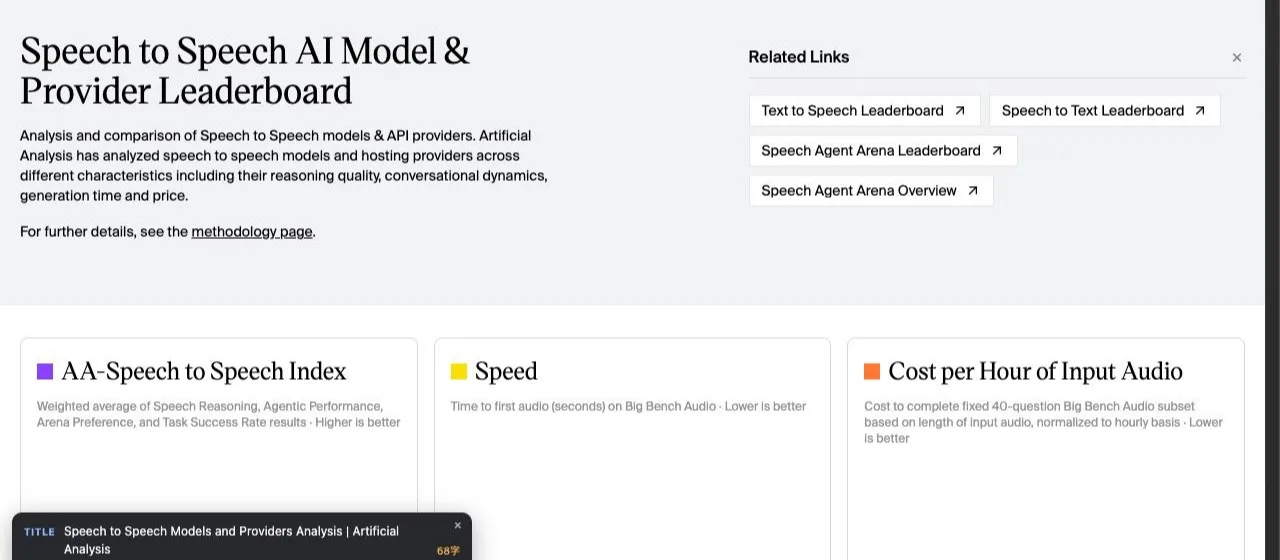
Grok Voice 2.0 begins its spoken answer after 0.70 seconds, while Grok Voice 3.0 needs 0.81 seconds. Artificial Analysis measures this as time to first audio: the gap between the end of a question and the first sound of the reply. Version 3.0 is still well ahead of GPT-Live-1 at 1.34 seconds, which is where the 40% figure comes from, but it is 0.11 seconds slower than its own predecessor.
"Time to first audio (seconds) on Big Bench Audio" — "Speed"View official source →
ServiceNow's EVA-Bench also ranks it first on accuracy
Grok Voice 3.0 posted the top accuracy score, 74%, on EVA-Bench, ServiceNow's open-source test for enterprise voice agents. EVA-Bench grades agents on more than 200 realistic business scenarios for both accuracy and caller experience. SpaceXSI says the model also placed first when those two scores are combined.
"On EVA-Bench, ServiceNow’s benchmark for enterprise voice agents, Grok Voice 3.0 achieves the highest accuracy score at 74%" — "The Most Accurate Voice Model"View official source →
The price stays at $0.08 per minute
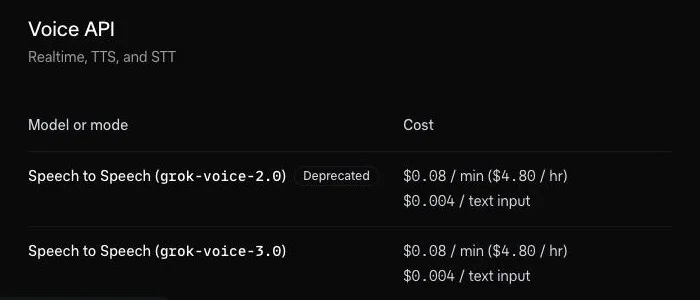
Grok Voice 3.0 costs $0.08 per minute, or $4.80 per hour, exactly what Grok Voice 2.0 cost. Billing follows conversation time, so a team running 1,000 hour-long sessions would pay $4,800 in audio charges under either version. The upgrade therefore changes quality and speed, not the bill.
"Grok Voice 3.0 is available today in the Voice Agent API at $0.08 / min ($4.80 / hr), the same price as Grok Voice 2.0." — "Pricing and Availability"View official source →
Text input adds $0.004 on top of the minute rate
Each typed text input sent into a session costs $0.004 extra. The pricing page lists that charge for both 2.0 and 3.0, so voice-only agents pay just the minute rate. On the Big Bench Audio run, Artificial Analysis put the average cost per task at $0.025 for Grok Voice 3.0, against $0.030 for GPT-Live-1 and $0.055 for OpenAI's GPT-Realtime-2.1.
"$0.004 / text input" — "Voice API" tableView official source →
Moving off grok-voice-2.0 takes one model change
The grok-voice-2.0 model was deprecated on October 14, and switching means setting the model to grok-voice-3.0 or grok-voice-latest. The release notes say the price stays the same after the move. They give no shutdown date for 2.0, so pinned sessions keep working for now.
"grok-voice-2.0 is deprecated." — "Grok Voice 2.0 deprecation"View official source →
Tesla and Starlink figures come from SpaceXSI itself
Grok Voice usage reported by SpaceXSI
SpaceXSI says Grok Voice 3.0 already handles millions of conversations a day in Tesla vehicles. Drivers can check a calendar or reply to email, and the Grok Bot assistant can go as far as ordering coffee or booking dinner without the driver touching a screen. Grok Bot's own voice mode also runs on the new model.
At Starlink, Grok Voice answers 20,000 customer calls a day in several languages, and about 70% end without a human agent stepping in. SpaceXSI adds that one in four sales calls closes with a purchase during the call, and that one agent built on the model handles the whole call, from checking who the caller is to sending out a replacement unit. No outside party has published measurements of these deployments.
"Roughly 70% are resolved with no human in the loop, and one in four sales calls ends in a purchase before the caller hangs up." — "Used by Millions of Customers at Tesla & SpaceX"View official source →
The 40% latency claim is measured against GPT-Live-1
The speed advantage SpaceXSI advertises is a comparison with a rival, and against its own previous release the new model is slower. Put the latency numbers next to the alias change and three points follow:
- Teams on grok-voice-latest moved on October 14 to a model that takes 0.11 seconds longer to start talking, without choosing to
- A team that cares most about response time can pin grok-voice-2.0, which still runs at the same price, and test 3.0 before switching
- A team building support lines should compare τ-Voice, where GPT-Live-1 leads, rather than the overall index alone
The independent numbers here come from Artificial Analysis and ServiceNow; the deployment figures do not. Picking a voice model by the single test closest to your own calls will serve you better than picking by rank.
FAQ
- How much does Grok Voice 3.0 cost?
- It costs $0.08 per minute of conversation, or $4.80 per hour, which is the same rate Grok Voice 2.0 charged. If your app also sends typed text into a session, each text input adds $0.004.
- Is Grok Voice 3.0 better than GPT-Live-1?
- On the Artificial Analysis Speech to Speech Index it scores 86.9 to GPT-Live-1's 83.2. On τ-Voice, the test built around messy customer support calls, GPT-Live-1 is ahead at 74.5% against 71.6%. Grok Voice 3.0 starts speaking sooner, at 0.81 seconds versus 1.34.
- Do I need to change my code to use Grok Voice 3.0?
- Not if your sessions request grok-voice-latest; that alias moved to 3.0 on October 14 and the API did not change. If you pinned grok-voice-2.0, set the model to grok-voice-3.0 or grok-voice-latest.
Related articles
 The X Subscription: Grok, Cursor and X from $8SpaceXSI put Grok, Grok Bot, Cursor and X Premium on one bill on October 12, from $0 to $200 a month. Claude, GPT and Grok API use cost extra.
 Grok Build on Every Plan: App Builder, Not the CLISince August 19, Grok Build runs on every plan, on web and mobile. It turns a chat prompt into an app with a grok.me link. The CLI is a different product.
 Grok prompt injection slips past filtersGrok prompt injection can hide in AES-256 ciphertext the filter can't read. Adversa AI says it reported the flaw June 3, 2026; it was still open August 19.
 Grok 4.5 benchmarks, pricing, and where to use itGrok 4.5 is SpaceXAI's coding model, trained with Cursor. It leads SWE Marathon, trails GPT-5.5 on DeepSWE, and costs $2/$6 per million tokens via the API.