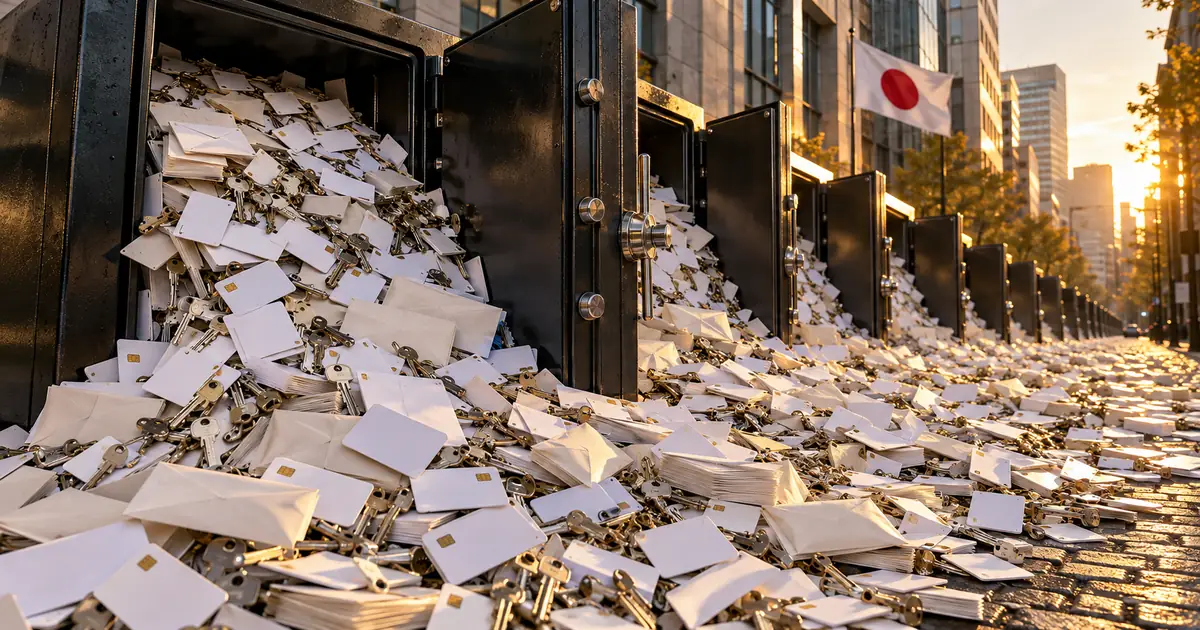
Japan data breach cases in date order
These are the main personal data breaches Japanese companies disclosed in 2026, 12 in all. Nine of them involve more than 1 million records.
Main data breaches disclosed by Japanese companies in 2026 (newest first)
| Date | Company | Count | Data leaked | Cause |
|---|---|---|---|---|
| Oct 9 | Skyticket | 14.64M | Name, address | Three hacks |
| Oct 9 | Bookoff | 6.43M | Name, address | Group firm hacked |
| Oct 8 | Lawson ID | 2.16M | Email, name | Hacking |
| Oct 8 | Big Echo | 8.72M | Guest, staff | Vendor PC malware |
| Oct 7 | IDCF Cloud | 1.67M | Ransomware | |
| Oct 6 | Asahi Kasei | 514K | Medical staff | Vendor hacked |
| Oct 6 | Scala | 713K | Client queries | FAQ system hacked |
| Oct 5 | Yakiniku King | 10.79M | Name, email | App hacked |
| Oct 5 | infoQ | 948K | Name, address | Hacking |
| Sep 25 | Times Car | 6.6M | License images | Hacking |
| Jun 30 | Aflac Japan | 4.4M | Name, bank details | Hacking |
| Jun 23 | KDDI | 12.23M | Email, password | Software flaw |
Nine disclosures in five days in October
Nine of the 12 disclosures fell in the five days from October 5 to 9. Yakiniku King and infoQ came on October 5, Asahi Kasei Therapeutics and Scala Communications on October 6, and Skyticket and Bookoff both on October 9.
Times Car confirmed 6.6 million accounts in its second report
Times Car's first report on September 25 said data might have leaked, and its second report on September 28 confirmed about 6.6 million accounts. The affected users are members of Times Car, a car sharing service.
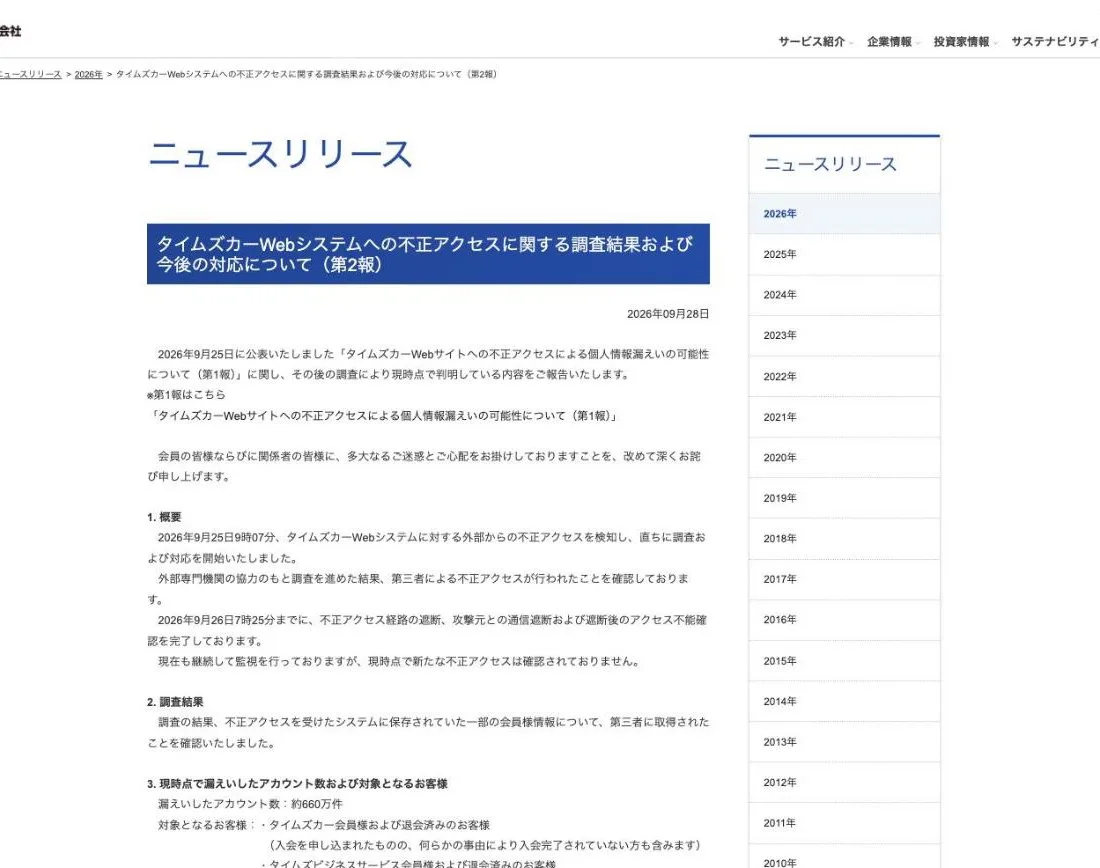
"漏えいしたアカウント数:約660万件" — 「3. 現時点で漏えいしたアカウント数および対象となるお客様」よりView official source →
What recent data breaches in Japan have in common
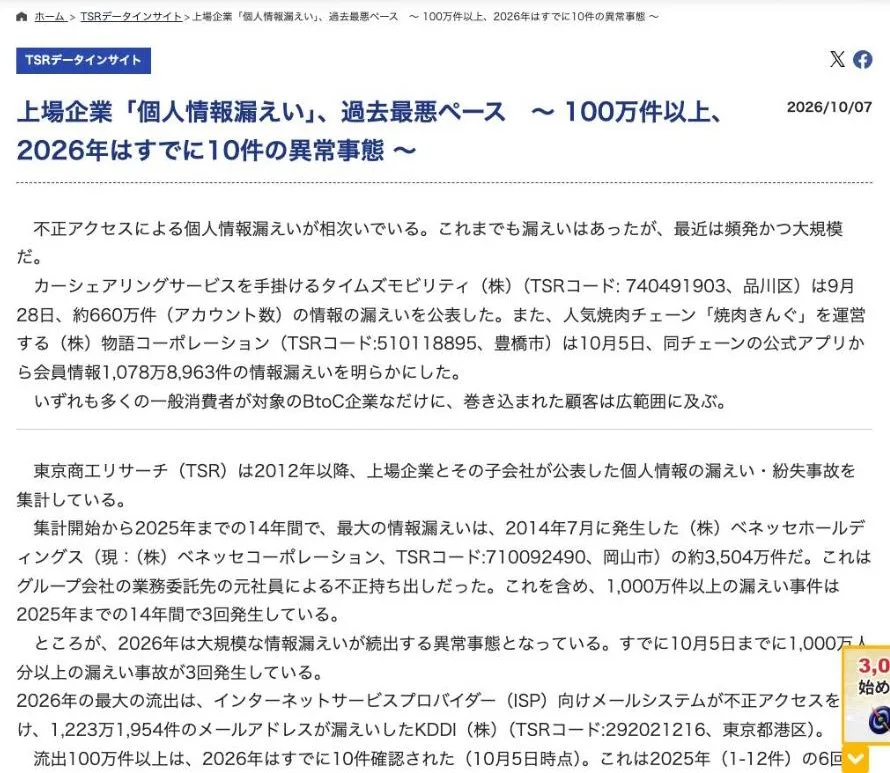
This year's cases share three things: large breaches keep coming, many leaked through contractors, and sensitive data such as passwords got out. On October 7, Tokyo Shoko Research, a Japanese credit research firm, published a count showing that listed companies are leaking personal data at a record pace.
Breaches of 1M+ records: 10 so far in 2026
Tokyo Shoko Research counted 10 breaches of 1 million records or more in 2026 as of October 5. There were 6 in all of 2025, so 2026 has already passed last year's total.
Breaches of 1 million records or more (listed companies and subsidiaries)
Count by Tokyo Shoko Research. The 2026 figure is as of October 5.
Three of this year's breaches topped 10 million people. That matches the total for the 14 years up to 2025.
Breaches of 10 million records or more (listed companies and subsidiaries)
Count by Tokyo Shoko Research. 2012–2025 is the 14-year total; 2026 is as of October 5.
The largest case on record is still Benesse Holdings in July 2014, at about 35.04 million records. A former employee of a contractor working for a group company took the data out. Five of this year's large breaches rank in the all-time top 10 by record count.
Some companies were hit twice. Yellow Hat, a car accessories chain, disclosed 3,179,454 records leaked from a subsidiary's member server in April, then up to 1,801,499 records that may have leaked from its own booking system in August.
"流出100万件以上は、2026年はすでに10件確認された(10月5日時点)。これは2025年(1-12件)の6回を大幅に上回っている。" — 本文よりView official source →
Breaches through contractors and cloud providers
Four of the 12 cases leaked because a contractor or an outside service was attacked. Here is what was attacked in each case and who was affected:
- Asahi Kasei Therapeutics: unauthorized access to a member database managed by a contractor
- Daiichikosho: one PC at its contractor, a Nippon Columbia group company, infected with malware
- Scala Communications: unauthorized access to its FAQ system, which led five client firms including Daiwa Securities to disclose as well
- IDCF Cloud: 495 client companies and local governments affected, and JR East said data of its Eki-net members may have leaked
IDCF Cloud was hit by ransomware, an attack that encrypts data so it cannot be used and demands a ransom to restore it. When one cloud service is attacked, the damage can spread to the companies that run on it.
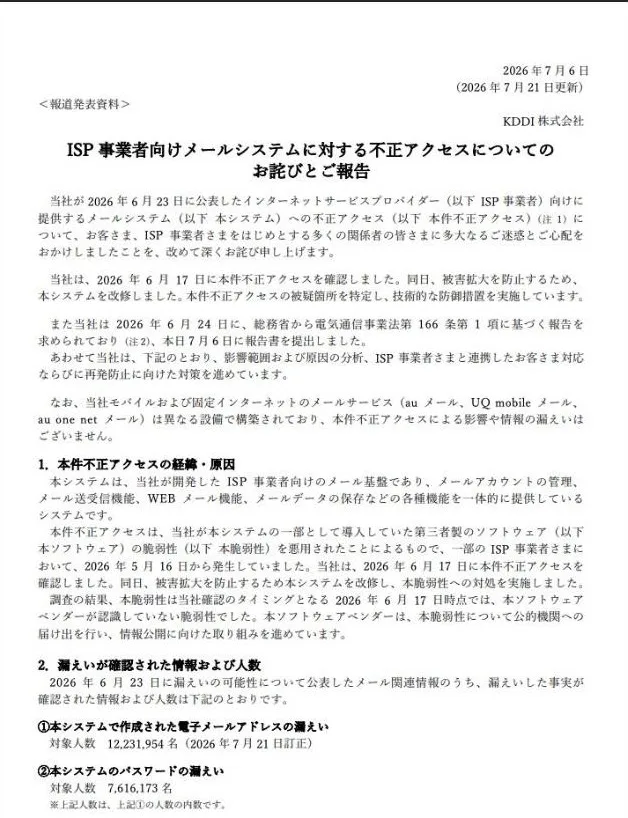
KDDI's case also came through a flaw in third-party software built into its own system. Even if the company you signed up with keeps its own systems in order, your data can leak through the contractors and software it relies on.
"本件不正アクセスは、当社が本システムの一部として導入していた第三者製のソフトウェア(以下/本ソフトウェア)の脆弱性(以下 本脆弱性)を悪用されたことによるもので、一部の ISP 事業者さまに/おいて、2026 年 5 月 16 日から発生していました。" — 「1.本件不正アクセスの経緯・原因」よりView official source →
Passwords and driver's license images leaked
The data that leaked in this year's cases includes email passwords and driver's license images. KDDI leaked email passwords for 7,616,173 people and is working with the internet providers to reset them, in some cases by force. At Skyticket, about 4.13 million records included hashed passwords, meaning passwords stored in a scrambled form.
At Times Car, ID documents leaked, including images of driver's licenses. Tokyo Shoko Research noted that highly confidential data may have been exposed. You can change a password or an email address, but not your license number or your date of birth.
Some companies say card data stayed safe. Skyticket, Bookoff and Times Car all say no credit card information leaked.
What to do if your personal data was leaked
If a service you use discloses a breach, take the three steps below in order. Change the password on every other service where you use the same one, too.
What to do if you are affected by a data breach
| Step | What to do |
|---|---|
| 1 | Read the official announcement to see if you are affected and how to contact the company |
| 2 | Change the password on the breached service and on any service that uses the same one |
| 3 | Do not open links or attachments in emails or texts that claim to be from the company |
Check the company's official announcement and contact details
When a service you use discloses a breach, start with the announcement on the company's official website. The announcement shows which members are affected, what data leaked and where to send questions.
Lawson, for example, is emailing each affected customer. Fake breach emails also circulate, so if you get one, go to the official website yourself without clicking its links.
Change passwords you reuse elsewhere
If a password leaked, change it on that service. Someone could use the leaked password to log in to other services, so change it anywhere else you use it too.
Adventure, which runs Skyticket, asked its members to change their password, and to change it on any other service where they use the same one. In KDDI's case, some internet providers reset passwords themselves.
Watch for phishing emails and texts
Leaked email addresses and phone numbers can draw phishing emails and texts that pretend to come from the company. Monogatari Corporation, which runs Yakiniku King, warned its members about fake emails and phishing scams. Lawson also asked affected Lawson ID users to watch for suspicious emails, texts and calls.
Park24 says it never asks for passwords or credit card details by email, text or phone. Do not open links in messages you did not expect, and never enter your password on a page they lead to.
"なお、当社がメール、SMS、電話等でパスワードやクレジットカード情報をお伺いすることはありません。" — 「6. 会員の皆様へのお願い」よりView official source →
FAQ
- What is the largest data breach in Japan?
- In Tokyo Shoko Research's count, the largest is Benesse Holdings in July 2014, at about 35.04 million records. A former employee of a contractor working for a group company took the data out. The count covers incidents disclosed by listed companies and their subsidiaries since 2012.
- How many large data breaches has Japan had in 2026?
- Tokyo Shoko Research counted 10 breaches of 1 million records or more as of October 5, 2026. Three of them reached 10 million people or more, as many as in the 14 years up to 2025 combined.
- Was au Mail affected by the KDDI data breach?
- No. The breach hit an email system KDDI provided to other internet providers. KDDI says au Mail, UQ mobile Mail and au one net Mail run on separate equipment and were not affected.
- Should I change my password after a data breach?
- Yes. Change it on the breached service and on every other service where you use the same password. Adventure, which runs Skyticket, asked its members to do exactly that.