
Panasonic says HR data went into a banned AI service
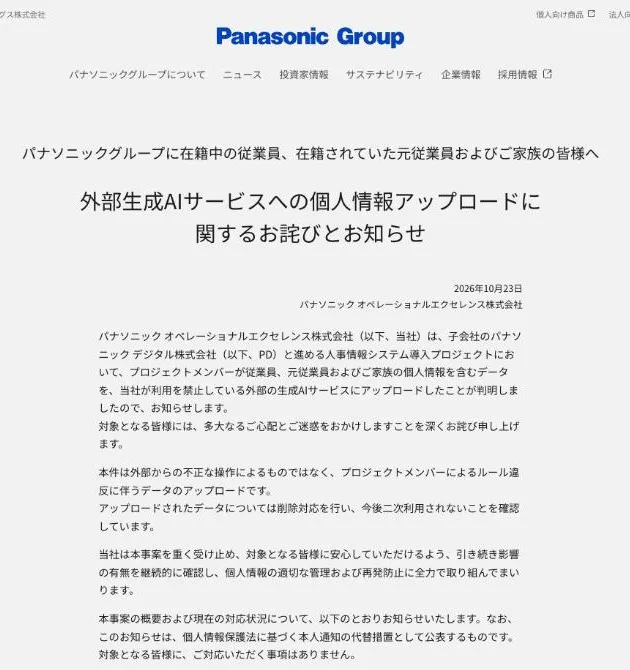
On October 23, 2026, Panasonic Operational Excellence announced that part of the group's HR data had been uploaded to an outside generative AI service that the company prohibits. The data came from its HR information system as it stood in April 2026. Panasonic has not said which AI service was used.
A generative AI service, such as ChatGPT, is an online tool that writes answers or summaries from the text and files you give it. For other breaches Japanese companies have disclosed, see Japan data breach list: cases by date and cause.
A member of an HR system project broke the company's rules
The upload was made by a member of a project to roll out a new HR information system, which Panasonic Operational Excellence runs with its subsidiary Panasonic Digital. The company stresses that nobody broke in from outside. The cause was a project member going against internal rules.
"本件は外部からの不正な操作によるものではなく、プロジェクトメンバーによるルール違反に伴うデータのアップロードです。" — from the opening apologyView official source →
The notice replaces letters, and no action is needed
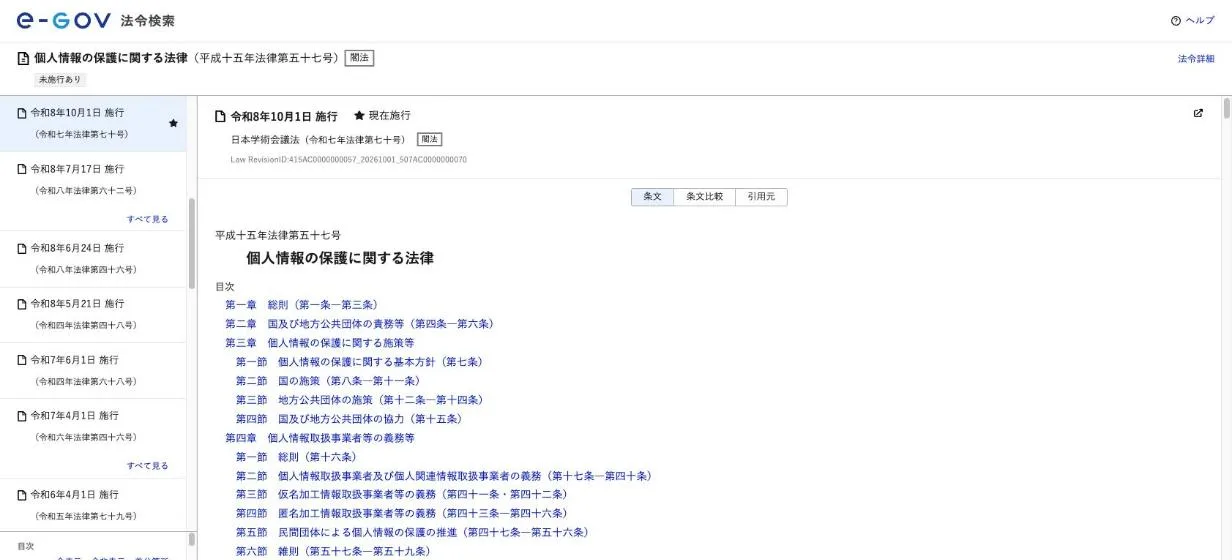
Panasonic published the notice in place of contacting each affected person. Under Japan's privacy law, the Act on the Protection of Personal Information, a company that leaks personal data must normally tell each person involved. When that is hard to do, the law lets it take other steps that protect those people instead.
Panasonic Operational Excellence says there is nothing affected people need to do. The notice does not explain why the company chose a public notice over individual contact.
"なお、このお知らせは、個人情報保護法に基づく本人通知の代替措置として公表するものです。対象となる皆様に、ご対応いただく事項はありません。" — from the opening apologyView official source →
"ただし、本人への通知が困難な場合であって、本人の権利利益を保護するため必要なこれに代わるべき措置をとるときは、この限りでない。" — from paragraph 2View official source →
About 334,000 employees, ex-staff and relatives affected
The people affected are current and former employees of Panasonic Group companies in Japan that use the group-wide HR system, and their family members. Former employees include people who moved to companies that bought Panasonic businesses. The notice gives a count for each of four groups, which add up to about 334,000.
Who is affected and what data was uploaded (from Panasonic's notice)
| Group | People | Data uploaded |
|---|---|---|
| Employees | About 75,000 | Employee number, address, phone number, email address |
| Former employees (left between 1978 and fiscal 2026) | About 178,000 | Employee number, address, phone number, email address |
| Employees' family members | About 55,000 | Name, address, phone number, email address |
| Former employees' family members (people who left in 2016 or later) | About 26,000 | Name, address, phone number, email address |
The 334,000 figure is the sum of the four groups. Panasonic's notice does not state a total.
Employee records include addresses but not names
For current and former employees, the uploaded data covers employee number, address, phone number and email address, but no names. The former employees are about 178,000 people who left the company between 1978 and fiscal 2026.
"従業員:約7万5千人、元従業員:約17万8千人(1978年~2026年度退職者)" / "社員番号、住所、電話番号、メールアドレス ※氏名は含まれていません" — from section 1, OverviewView official source →
Family records come from emergency contact details
The family data is the emergency contact information employees filed with the company, so it includes each relative's name, address, phone number and email address. Only relatives whom employees entered in the HR system themselves are affected. For former employees, only the families of people who left in 2016 or later are included.
"※人事情報システムに従業員自身が登録されていた方のみ" / "従業員に代わる緊急連絡先のご家族の氏名、住所、電話番号、メールアドレス" — from section 1, OverviewView official source →
No misuse found, and the AI provider says training was off
Panasonic Operational Excellence says it has found no case of the data being posted publicly or misused. After checking internally and with the AI provider, it also confirmed the data will not be put to any other use.
To keep this from happening again, the company will review its rules for handling personal data and how it controls staff use of generative AI. It will also give the staff involved more training. Former employees and their families can reach the company through an inquiry form on the notice page.
Panasonic told the privacy regulator on September 29
Panasonic Operational Excellence reported the upload to Japan's Personal Information Protection Commission on September 29, 2026, 24 days before the public notice. Right after the upload came to light, the project member deleted the AI chat history and the data saved on their work computer.
"2026年9月29日に個人情報保護委員会に報告しました。" / "本事案発覚直後に、当該メンバーは、生成AIのチャット履歴および業務に使用したPC内の対象データを削除しました。" — from section 2, Current responseView official source →
The provider kept deleted data for 30 days, until October 25
The company that runs the AI service told Panasonic that the setting for using uploaded data in AI training was switched off at the time. That means the data was not used to improve the AI and will not appear in answers to other users.
Even after a user deletes data, the provider keeps it for 30 days for security and legal reasons. During that time, access is tightly controlled and happens only for audits or similar requests. The 30 days ran out on October 25, and the provider no longer holds the data.
"データをAI学習に利用する機能が無効になっていましたので、他の利用者が関連する質問をした場合でも当該データが回答に使用されることはありません。" / "発覚直後に削除しましたデータは、保持期間30日経過後の10月25日以降は事業者内でも保持されません。" — from section 2, Current responseView official source →
How companies and staff can keep personal data out of AI
In Panasonic's case, a ban on the AI service was already in place, and a project member still uploaded personal data to it. A company that uses generative AI needs both clear company rules and employees who are careful with data.
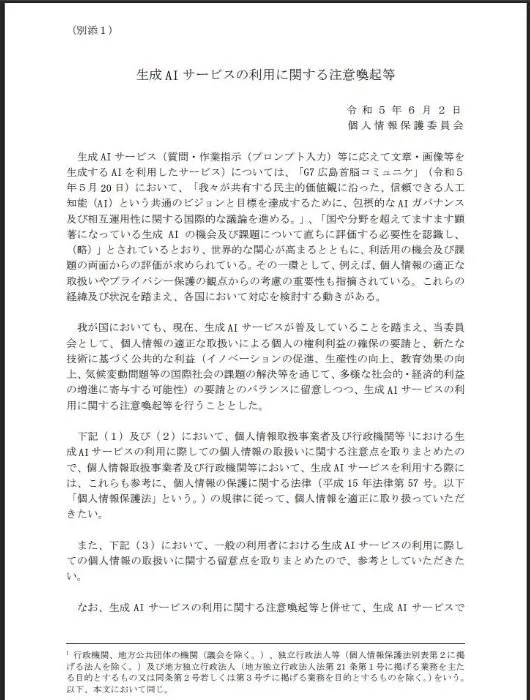
On June 2, 2023, Japan's Personal Information Protection Commission published an alert on generative AI for both businesses and individual users. The two steps below are based on that alert.
Decide which AI tools staff may use and what data can go in
The Commission says a business that enters personal information into a generative AI tool must first check that doing so fits the purpose it collected the data for. Putting personal data into a prompt without consent may break Japan's privacy law if the data is then used for anything beyond producing the answer. A company that does so should confirm the provider will not use the data for machine learning.
On top of that, list the AI services staff may use and spell out which information can and cannot go into them. When an approved tool is available, employees have less reason to reach for a banned one.
"当該個人データを機械学習に利用しないこと等を十分に確認すること。" — from section 1, Points for businesses handling personal informationView official source →
Check company rules and the tool's terms before uploading
Before using a generative AI service for work, employees should check that their employer's rules allow it. Even with an approved tool, the Commission warns that personal information you enter may be used for machine learning and later appear in the tool's output, accurate or not.
Read the service's terms of use and privacy policy, and decide based on what you plan to enter. Never upload a file that still contains customers' or colleagues' personal details. For another company that restricted an AI tool through internal rules, see Alibaba bans Claude Code over hidden tracking code.
"他の情報と統計的に結びついた上で、また、正確又は不正確な内容で、生成 AI サービスから出力されるリスクがある。" — from section 3, Points for individual usersView official source →
FAQ
- Which AI service did the Panasonic employee use?
- Panasonic has not named it. The notice only calls it an outside generative AI service that the company does not allow staff to use.
- Do affected people need to change a password or do anything else?
- No. Panasonic Operational Excellence says there is nothing affected people need to do. No passwords were in the uploaded data.
- How can former Panasonic employees ask about the upload?
- The notice page has an inquiry form for former employees and their families. Panasonic asks them to get in touch through that form first.
Related articles
 Cloudflare's GLM-5.3 leaked data in 155 responsesFrom August 27 to September 9, 155 GLM-5.3 replies on Cloudflare Workers AI held other users' data. Only prompts over 681,280 tokens were hit; it is fixed.
 AI cyber attack: AI agents hit 27 firms for $25In an AI cyber attack disclosed by Gambit Security, three open source AI agents breached at least 27 retailers and took 600,000+ cards for about $25 a target.
 EMBRACE flaws hit 5 AI coding tools, 2 unpatchedForever Security found flaws in the built-in browsers of Cursor, Copilot, Codex, VS Code and Claude Desktop. Codex and VS Code were unpatched at publication.
 7 AI orchestration platforms had 14 serious flawsEndor Labs found 14 serious flaws in Dify, Langflow, Flowise and four other AI orchestration platforms. In some, one prompt could run code without a login.