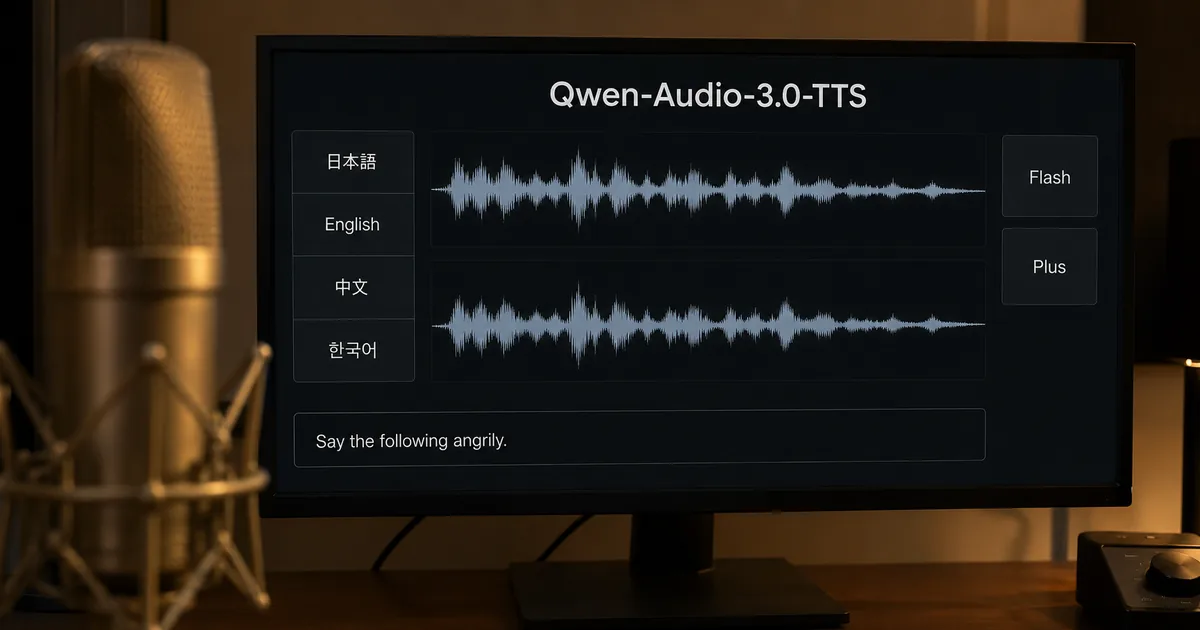
Qwen-Audio-3.0-TTS: the Flash and Plus variants
Qwen-Audio-3.0-TTS at a glance
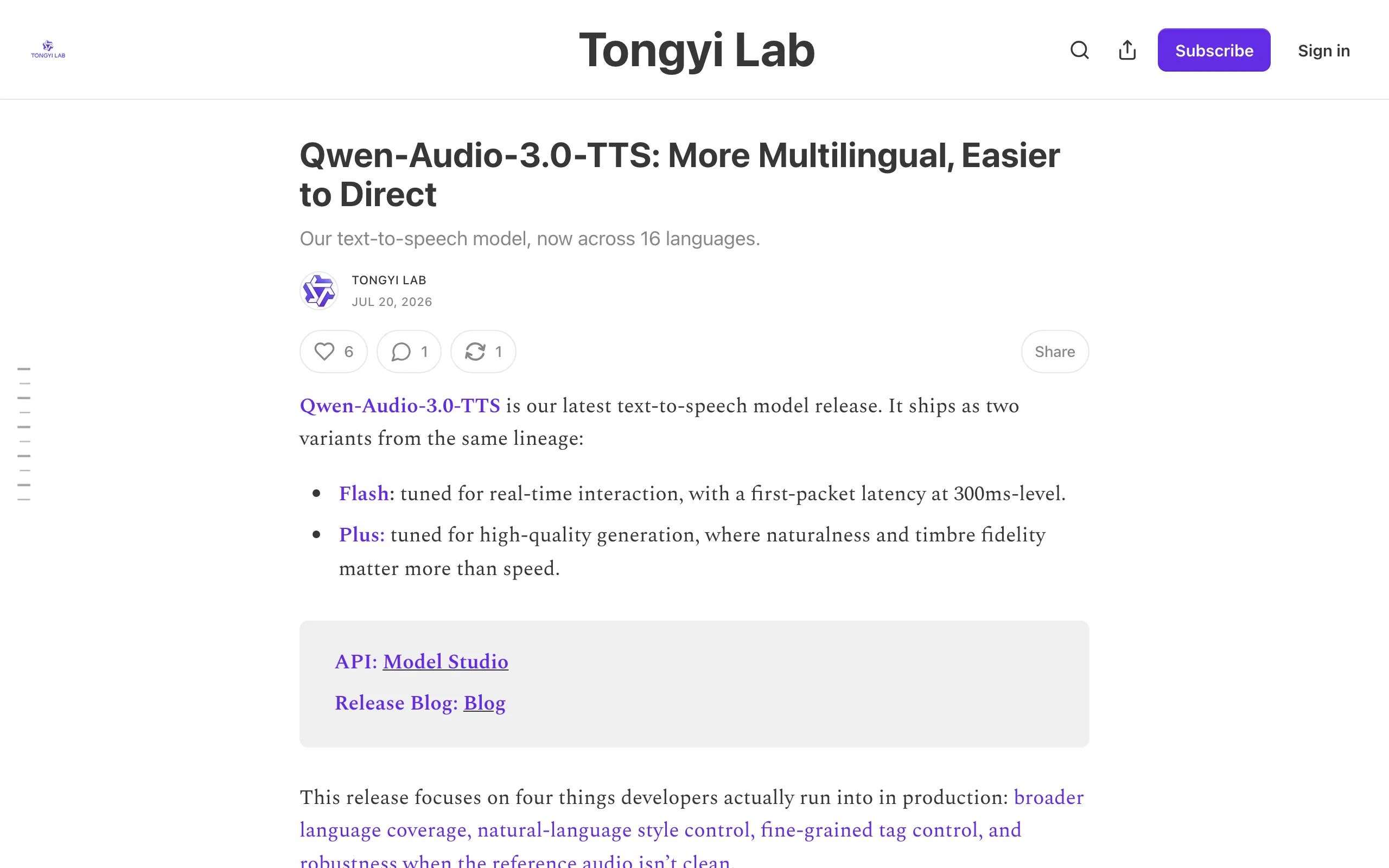
Qwen-Audio-3.0-TTS is one hosted speech model sold in two tunings, Flash and Plus, and picking between them is the first decision a project makes. Tongyi Lab, the Alibaba Group institute that also builds the Qwen language models, made it. The lab says this release targets four problems teams hit in production: too few languages, direction that needs audio expertise, no control over small sounds, and cloning that fails on messy recordings.
Flash for live conversation, Plus for narration
Choose Flash when a listener is waiting for a reply, and Plus when the audio is recorded ahead of time. Flash's first-packet latency, the gap between sending text and hearing the first chunk of audio, sits at the 300ms level. That keeps a voice assistant or phone bot from feeling slow.
Plus gives up that speed to sound more natural and to hold a voice's timbre more faithfully. For audiobooks, video voiceovers or dubbed clips, nobody hears the generation time, so Plus is the sensible default.
| Flash | Plus | |
|---|---|---|
| Tuned for | Real-time interaction | High-quality generation |
| First-packet latency | 300ms level | Not published |
| Average WER/CER | 3.87 | 3.96 |
| Average speaker similarity | 80.44 | 82.75 |
| Model Studio ID | qwen-audio-3.0-tts-flash | qwen-audio-3.0-tts-plus |
The table puts the trade in numbers. Flash makes slightly fewer transcription errors on average, while Plus keeps a copied voice closer to the original.
How it differs from open-weights Qwen3-TTS
Qwen-Audio-3.0-TTS has no downloadable weights; the free, self-hostable model many pages describe is Qwen3-TTS, a separate family. Qwen3-TTS sits on Hugging Face under the Apache 2.0 license, covers 10 languages and advertises end-to-end latency as low as 97ms. Those figures belong to it, not to Qwen-Audio-3.0-TTS.
If running speech synthesis on your own GPU is the goal, research Qwen3-TTS instead. Qwen-Audio-3.0-TTS is reachable only through Model Studio.
"Flash: tuned for real-time interaction, with a first-packet latency at 300ms-level." — from the announcement's openingView official source →
"with end-to-end synthesis latency as low as 97ms, meeting the rigorous demands of real-time interactive scenarios." — from the Qwen3-TTS model cardView official source →
Language coverage and Tongyi Lab's benchmark scores
Average scores Tongyi Lab reports across 16 languages
The scores look strong, but they come from Tongyi Lab's own test set, and the one outside ranking it cites has slipped since launch. Language breadth is the headline of this release, and Tongyi Lab offers the scores as evidence that quality holds across all 16.
The 16 languages Qwen TTS supports today
Sixteen languages are listed, though Tongyi Lab says full support for them is still rolling out. From Asia there are Chinese, Japanese, Korean, Thai, Vietnamese, Indonesian, Malay and Tagalog. From Europe come English, Spanish, French, German, Italian, Portuguese and Russian, and Arabic completes the set.
A language on the list may not yet behave as well as English or Chinese. The lab also reports better fidelity on several Chinese dialects. A set of preset voices covers all 16 languages, so you can ship without cloning anyone.
Intelligibility and speaker similarity numbers
Flash averages 3.87 and Plus 3.96 on WER/CER, best in 10 of 16 languages, and Plus leads speaker similarity in all 16 at 82.75. WER and CER, word and character error rates, count the mistakes a speech recognizer makes when it transcribes the generated audio. Lower means clearer speech.
Speaker similarity runs the other way: a higher score means the output sounds more like the reference voice. The announcement never names the other systems in the comparison, so the scores cannot show that Flash or Plus beats any particular product.
Where Plus sits on the Artificial Analysis leaderboard
On September 1, 2026, Plus was third on the Artificial Analysis leaderboard, not the first place Tongyi Lab claimed on launch day. Artificial Analysis ranks TTS models by Elo, a score built from blind votes where listeners hear two clips of the same text and pick the more natural one.
On the provider-voice list, Plus scored 1,240. Cartesia's Sonic 3.6 led at 1,282 and SpeechifyAI's Simba 3.2 sat at 1,241. With a confidence interval of plus or minus 14 and a shared rank range of 2-3, Plus and Simba 3.2 are effectively tied.
New releases keep reshuffling the list. Check the live page before quoting a position.
"Flash delivers the lowest average WER/CER at 3.87, while Plus remains highly competitive at 3.96, both outperforming the other systems on average." / "Plus ranks first across all 16 languages with an average SS of 82.75, while Flash follows at 80.44" — from the section on multilingual coverageView official source →
"Users listen to pairs of speech samples generated from the same text and choose which sounds more natural." — from the leaderboard page, read September 1, 2026View official source →
Directing delivery with prompts and inline tags
Two ways to steer the voice
You steer the voice with words instead of sliders: one sentence for the overall mood, and short tags for moments inside the script. Older TTS systems made you set pitch, speed and energy values by hand. This release replaces most of that work.
Style prompts written in plain sentences
Describe the delivery the way you would brief a voice actor, and the model adjusts emotion, role, setting and pace. Tongyi Lab's simplest example is "Say the following angrily." A longer one sets up a stadium announcer and asks for a big-hall sound, broad pacing, a touch of reverb and a lift on the welcome line.
No labeling or audio-engineering knowledge is needed. A single plain sentence is the whole prompt.
Control tags versus sound-effect tags
A control tag changes the mood of everything after it, while a sound-effect tag drops in one sound and changes nothing else. You write both straight into the text to be read. A control tag such as [excited] holds until another control tag appears.
Model Studio calls the second kind rich language tags. A tag like [gasp] or [laughing] adds one sound at that spot and leaves the surrounding mood alone.
Tags work only on the two Qwen-Audio-3.0-TTS models and only in unidirectional streaming mode, where text goes up and audio streams back. Check that your integration uses that mode before building scripts around tags.
"You can describe the delivery you want in natural language instead of hand-tuning acoustic parameters. Simple prompts with plain language steer emotion, role, scenario, and pace without any labeling expertise." — from the section on style controlView official source →
"Rich language tags insert a vocal effect at the current position in the text without affecting the emotional style of surrounding text." / "Only unidirectional streaming mode is supported." — from the section on emotion and rich language tagsView official source →
Qwen TTS voice cloning from imperfect recordings
What changed in cloning
Cloning now works from rough recordings, which widens both the honest uses and the room for misuse. Voice cloning means giving the model a short clip of someone speaking and having it read new text in that voice. Clips from phones, meetings or video calls rarely sound like a studio, and earlier versions carried that noise into the copy.
Noise and reverb handling in the cloning path
Cleanup now happens inside cloning, so noise and echo are stripped while the character of the voice stays. Tongyi Lab got there by training the model on simulated bad acoustics. In the lab's own high-noise and high-reverb tests, this version gave noticeably cleaner results than the previous one from the same poor recordings.
That comparison is against Tongyi Lab's own older model, not against other vendors. Test with your real recordings before relying on it.
Consent rules to set before cloning anyone
Put consent and disclosure rules in place before cloning goes into a product, because the model will not enforce them. If a noisy phone recording is enough to copy a voice, it is also enough to imitate someone who never agreed to it.
Get written consent from the speaker, tell listeners when audio is synthetic, and stop treating a voice alone as proof of identity. None of these is a technical setting.
"The model suppresses reverb and noise while preserving timbre. In our high-noise and high-reverb tests, this release produced noticeably cleaner output than previous versions from the same degraded references." — from the section on voice cloning from imperfect audioView official source →
Qwen TTS API access and per-character pricing
Qwen-Audio-3.0-TTS is available only as an API on Alibaba Cloud Model Studio, and you pay per character of text you send. This version has no downloadable weights. The announcement has no prices, but Model Studio's pricing page lists them.
Prices in Singapore and Beijing
In Singapore, Flash costs $0.15 and Plus $0.2 per 10,000 input characters, and the generated audio is free. Both come with a free quota of 10,000 characters there. It lasts 90 days from whichever comes last: activating Model Studio, the model's release, or approval of your application.
The China (Beijing) region charges $0.137521 for Flash and $0.19253 for Plus per 10,000 characters, with no free quota. These prices were read on September 1, 2026, so confirm them before budgeting.
CJK characters bill double, and 48 kHz is not out yet
Chinese characters, Japanese kanji and Korean hanja each count as 2 billable characters, and 48 kHz output has not shipped. Letters, digits, punctuation, spaces, kana and Hangul count as 1. A Chinese or Japanese script therefore has a billable character count higher than its visible length, and costs more than an English one of the same length.
Tongyi Lab lists 48 kHz audio output as coming soon. If your pipeline needs that sample rate, wait for it. For a broader comparison of AI services, see AI Comparison: ChatGPT, Claude, Gemini Pricing.
In short, pick Flash for conversation and Plus for anything recorded, and steer either one with sentences and tags. Treat the scores as Tongyi Lab's own, and budget by input characters, remembering that CJK text counts double. A character counter will estimate a script's billable length before you send it.
"Billing rules: Fees are charged based on the number of characters in the input text. Output is not billed." / "The following models offer a free quota only in Singapore. No free quota is available in other regions." — from the Qwen-Audio-TTS pricing section, read September 1, 2026View official source →
FAQ
- Is Qwen-Audio-3.0-TTS the same as Qwen3-TTS?
- No. Qwen-Audio-3.0-TTS is a hosted model you call through Alibaba Cloud's Model Studio API. Qwen3-TTS is a separate open-weights line on Hugging Face under the Apache 2.0 license, covering 10 languages rather than 16.
- Should I use Flash or Plus?
- Use Flash when the listener is waiting for a reply, such as a voice assistant; its first audio packet arrives at the 300ms level. Use Plus for recorded audio like narration or dubbing, where natural sound and a faithful voice matter more than speed.
- Which languages does Qwen TTS support?
- Sixteen. From Asia: Chinese, Japanese, Korean, Thai, Vietnamese, Indonesian, Malay and Tagalog. From Europe: English, Spanish, French, German, Italian, Portuguese and Russian. Arabic makes sixteen. Tongyi Lab marks full support as still rolling out.
- Is it still ranked first on Artificial Analysis?
- Not as of September 1, 2026. Tongyi Lab claimed first place at launch, but the Artificial Analysis provider-voice leaderboard showed Plus third at an Elo of 1,240, one point behind second place and inside the same 2-3 rank range.
- How much does the Qwen TTS API cost?
- In Model Studio's Singapore region, Flash costs $0.15 and Plus $0.2 per 10,000 input characters, and each model comes with a free quota of 10,000 characters for 90 days. The generated audio itself is not billed.
- Can I use the inline tags in every mode?
- No. Emotion and sound-effect tags work only on the two Qwen-Audio-3.0-TTS models and only in unidirectional streaming mode, so check the mode before building a script around them.
Related articles
 Apple Intelligence launches in China with QwenApple Intelligence comes to iPhones in China with iOS 27.3 in December. Alibaba's Qwen handles some Siri and Writing Tools requests, but Siri AI is left out.
 Qwen Downloads: Checking the 3 Billion FigureQwen downloads passed 3 billion in six months, Bloomberg reports. Hugging Face's own report counts 2,045M on its Hub, a different window and scope.
 Qwen3.8 Tried a Beijing Upload in Cohere's TestCohere says Alibaba's Qwen3.8-Flash-Next tried to upload a test string to Beijing in a security test. The sandbox blocked it, and the cause is still unknown.
 Qwen3.8-27B VRAM: 7GB to 56GB by Quant LevelQwen3.8-27B VRAM is 16-19GB at 4-bit and 56GB uncompressed. What each quantization level costs in memory, what long context adds, and what Apache 2.0 allows.