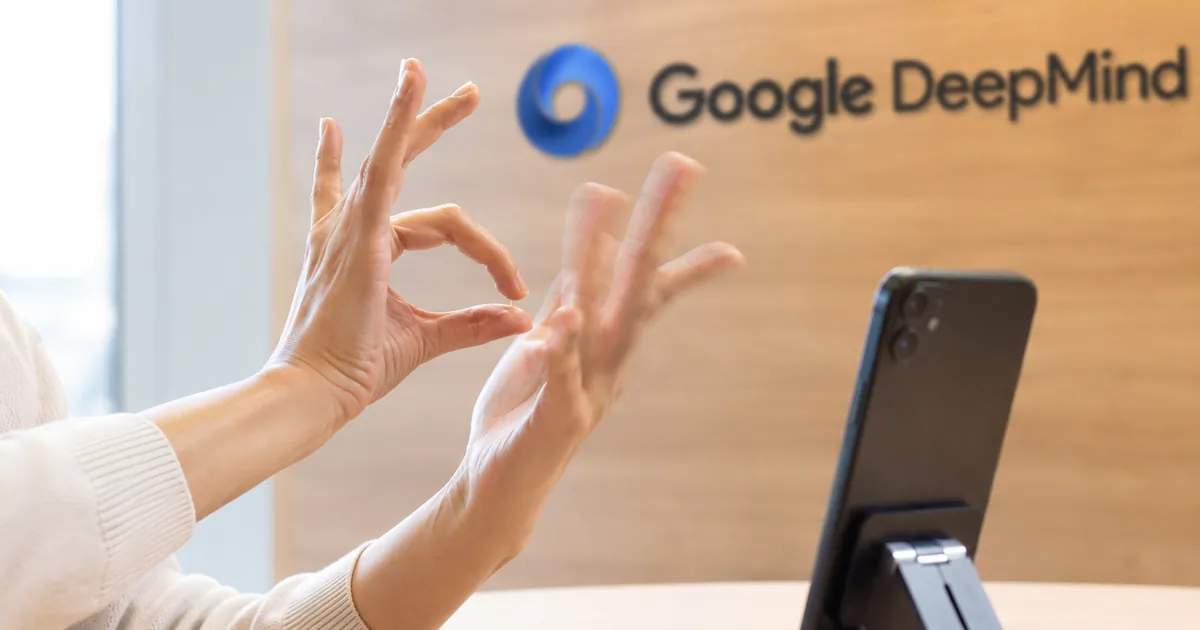
GoogleのSL2TがPixel 11でアメリカ手話を英語に訳す
SL2Tはsign-language-to-textを縮めた名前で、Google DeepMindが2026年8月12日付の公式ブログで発表しました。手話AIを研究室から一般向けの製品へ出すのはSL2Tが初めてだとのこと。最初に使うことができるのはアメリカ手話から英語への翻訳です。
ASLとはAmerican Sign Languageを略した呼び名で、アメリカ手話のことです。SL2Tの主な内容は次のとおりです。
SL2Tの概要
| 事柄 | 内容 |
|---|---|
| 種類 | 大規模多言語の手話→テキスト翻訳モデル |
| 対応 | アメリカ手話(ASL)から英語へ |
| 搭載先 | GboardとLive Transcribe(Pixel 11) |
| 費用 | 追加費用なし |
| 学習量 | 50を超える手話で合計10万時間超(約1/4がASL) |
| 精度 | 翻訳品質を評価する試験で既報のスコアを大きく超えた |
「SL2Tの概要」のとおり、利用できるのはASLから英語への翻訳だけで、デバイスと手話は今後増える予定です。Google DeepMindによると、SL2Tは品質と汎用性の両面で大きな前進とのこと。Pixel 11でASLを使う人は、追加料金なしで手話から英語への入力を利用できます。
"Introducing sign-language-to-text (SL2T), our breakthrough model powering new sign language features for Deaf and hard of hearing users."/"Today, we’re introducing a massively multilingual sign-language-to-text (SL2T) translation model that marks a breakthrough in quality and generality. With it, we are bringing sign language AI out of the lab and into consumer products for the first time: SL2T powers sign-to-text dictation in Gboard and Live Transcribe on Pixel 11 , starting with American Sign Language (ASL) to English. More devices are coming soon, and additional languages will follow."/"You can experience SL2T in Gboard and Live Transcribe first on Pixel 11 , with more devices coming soon — all at no additional cost." — Google DeepMind 公式ブログ(2026年8月12日)冒頭と「Looking ahead」節より公式情報を見る →
GboardとLive Transcribeでの手話入力
Gboardの手話入力では、文字を打つときにキーボードの代わりにカメラへ向かって手話をします。聞こえる人が文字を打たずに音声入力で話すのと同じ発想だとのこと。公式ブログに書かれている利用目的は次の3つです。
- ウェブ検索
- メッセージや文書の下書き
- Geminiへのプロンプトや作業の指示
Live Transcribeでは、会話の相手に文字を打ち返す代わりに手話で返事ができます。テスターの感想では、英語で打つよりASLで手話をするほうが速くて自然で楽しいとのこと。文字を打てる場所ならどこでもASLの手話をそのまま入力に使うことができます。
Pixel 11での使い方は、Googleの公式ブログが2026年8月21日に紹介しています。Gboardのツールバーにsign-to-textを加え、フロントカメラに向かってASLで手話をします。訳された英語は外側のディスプレイに表示されるとのこと。手話は片手でも両手でもかまいません。
たとえばASLを使う人が同僚への返信を書くときは、ツールバーのsign-to-textを選んでカメラに向かって手話をすれば英語の文章が入力されます。出てくる文章は英語に限られるので、日本語で返信する用途には現時点では使うことができません。
"Similarly to how hearing users can use dictation to speak instead of typing, this feature enables Deaf users to sign to their phone anywhere they’d normally type. You can sign to search the web, draft messages or documents, and ask Gemini to solve queries or execute tasks. In Live Transcribe, you can sign responses in conversations instead of having to type back and forth. According to our testers, signing in ASL is faster, more natural, and more delightful than typing in English." — Google DeepMind 公式ブログ(2026年8月12日)冒頭より公式情報を見る →
"The feature, which supports both one-handed and two-handed signing, lets signers use their native language to express themselves when using Live Transcribe or across their device with Gboard."/"To use this feature on a Pixel 11 device, add sign-to-text to your Gboard toolbar, and sign in ASL to the front camera. The translations will appear on the outer display." — Google 公式ブログ(2026年8月21日)より公式情報を見る →
音声入力も自動翻訳も世界200超の手話に未対応
話し言葉を処理するAIはこの数十年で急速に進みました。自動翻訳も音声入力もAIと会話する仕組みも、聞こえる人には簡単に使うことができるものになったとのこと。ところが世界に200を超える手話と、手話を使う推定7,000万人のろう者・難聴者には話し言葉向けAIの進歩が届いていませんでした。
手話は世界各地のろうコミュニティで第一言語として使われ、ろう文化とも切り離せない言語です。ろう者の手話や発話や読み書きの習熟度は人によって大きく異なるため、手話・音声・文字のどれでも使うことができるようにしておくことが大切だとのこと。しかし手話AIの研究はなかなか進みませんでした。
音声を処理する側のAIは別の記事で解説しています。Google DeepMindは手話AIの研究が進まなかった理由として、手話向けのAIを作る技術的な難しさと、手話という言語の仕組みが広く誤解されてきたことの2つを記載しています。
"AI's ability to process spoken languages has advanced rapidly over recent decades, enabling automatic translation, dictation, and conversational interfaces that feel effortless to hearing users. Yet this technological revolution has not reached the world’s more than 200 sign languages — and the estimated 70 million Deaf and hard of hearing people who use them."/"Sign languages are the primary languages of Deaf communities around the world and the cornerstone of Deaf cultural identity. There is great diversity among deaf people in terms of their level of proficiency in signing, speaking, reading, and writing, so it is important to support access in all modalities."/"Despite this opportunity for positive social impact, progress in sign language AI has been slow — both because building AI for sign languages presents complex challenges and because widespread misconceptions exist about how the languages themselves work." — Google DeepMind 公式ブログ 冒頭と「Why sign languages matter」節より公式情報を見る →
SL2Tは手話の文法と全身の動きを座標の直接翻訳で訳す
手話の翻訳には音声の書き起こしにはない難しさが2つあると、Google DeepMindは述べています。1つは手話が独自の文法を持つ別の言語であることで、もう1つは全身の動きを同時に見て取る必要があることだとのこと。そのためSL2Tは、多言語での大規模な学習・座標だけの送信・中間の注釈を挟まない直接翻訳の3つを組み合わせた設計になっています。
"Compared to spoken language transcription, sign language translation presents two core challenges."/"SL2T is designed to deliver both." — Google DeepMind 公式ブログ「Why sign languages matter」節より公式情報を見る →
独自の文法と語彙を持つ独立した言語としての手話
手話は独自の文法と語彙を持つ独立した自然言語です。音声の書き起こしは同じ言語のなかで音を文字へ順に置き換える作業だとのこと。一方、手話を英語の文章にするには1語ずつ英語へ置き換えるだけでは不十分で、本格的な機械翻訳が必要になります。2つの作業の違いは次のとおりです。
音声の書き起こしと手話翻訳の違い
| 観点 | 音声の書き起こし | 手話の翻訳 |
|---|---|---|
| 変換の性質 | 同じ言語のなかで音から文字へ順に対応づける | 独自の文法と語彙を持つ別の言語から訳す |
| 入力の内容 | 音の連なり | 手・腕・胴・頭・顔の同時の動き |
「音声の書き起こしと手話翻訳の違い」の1行目にあるとおり、手話を訳す作業は言語をまたぐ翻訳になります。手話グローブのような初期の試みの一部に根本的な限界があったのは、手話が言語をまたぐ翻訳を要するためだとのこと。手話は単に「手で表した英語」ではないとGoogle DeepMindは記載しています。
"Compared to spoken language transcription, sign language translation presents two core challenges. First, transcribing speech is a matter of performing a sequential mapping from sound to text in the same language, whereas sign languages are independent, natural languages with their own distinct grammars and lexicons. As a result, they require true machine translation rather than a sequential process of sign-to-word transformations."/"Given this background, it is easy to understand why some early attempts at sign language technology, like sign language gloves, were fundamentally limited: sign languages aren't simply “English on the hands.”" — Google DeepMind 公式ブログ「Why sign languages matter」節より公式情報を見る →
カメラ映像から全身の動きを高いフレームレートで認識する難題
フレームレートとは1秒間に何コマの画像を撮るかを表す値のことです。2つ目の難題はモデルが体の動きを見て理解しなければならないことです。
手話は手・腕・胴・頭・顔を同時に動作させて意味を伝えます。カメラの映像から、物の外見や動きを読み取らせる技術をコンピュータビジョンと言い、全身の動きを高いフレームレートで正確に追い続ける作業は、難しく計算の負荷も大きいコンピュータビジョンの課題だとのこと。SL2Tは細かな全身の動きを見て取る処理と、本格的な言語翻訳の両方をこなすように設計されています。
"Second, the model must learn to “see” and understand physical movement. Sign languages convey meaning through simultaneous movements of the hands, arms, torso, head, and face. Accurately tracking these at high frame rates is a difficult and computationally demanding computer vision task."/"They require complex visual perception of fine-grained whole-body movements and full-fledged language translation. SL2T is designed to deliver both." — Google DeepMind 公式ブログ「Why sign languages matter」節より公式情報を見る →
50種類超の手話で学習したモデルが1言語のモデルを上回る
SL2Tは使う人とろう文化を起点にした開発に、大量の学習データを組み合わせて作られました。データは合計10万時間超で50を超える手話にわたり、そのうち約1/4がASLだとのこと。つまり、言語や方言や習熟度の異なる手話をまとめて学習させたモデルは、実験で1言語だけのモデルを超えました。まとめて学ぶことで、手話同士に共通する構造をモデルが把握すると、Google DeepMindは述べています。
"We built SL2T by combining a user-centric, culturally informed approach with massive data scaling. The model is trained on over 100,000 hours of data across more than 50 sign languages — with roughly a quarter of the data in ASL. Training jointly on diverse languages, dialects, and proficiency levels causes the model to learn shared underlying structures, outperforming single-language models in our experiments." — Google DeepMind 公式ブログ「How SL2T works」節より公式情報を見る →
MediaPipeの座標だけを送信しプライバシーを守る
SL2Tはカメラの映像をそのまま使わず、体の各部位の位置を時系列で記録したデータに変換してから手話を認識します。目的はユーザーのプライバシーを守ることだとのこと。Google DeepMindの図でも手話は体の各部位の位置として読み取られ、訳された文字は少しずつ順に表示されます。
MediaPipe Holisticとは、デバイスの中で手話をする人の体の各部位の位置を追うGoogleのモデルのことです。翻訳用にサーバーへ送信されるのは座標だけで、元の映像はその場ですぐ破棄できるとのこと。カメラに映った映像そのものがデバイスの外へ送信されることはありません。
"To protect user privacy, SL2T sees sign language as a sequence of pose landmark locations rather than a raw camera feed. An on-device model ( MediaPipe Holistic ) tracks the location of points on the signer, and only these geometric coordinates are sent to the server for translation, allowing the original video to be discarded immediately."/"SL2T sees sign language inputs as points on the signer's body and translates them into streaming text outputs." — Google DeepMind 公式ブログ「How SL2T works」節と図の説明より公式情報を見る →
グロスという中間表記を挟まず座標から直接テキストに訳す
グロスは、手話の動きを1つずつ単語に置き換えて書き留める中間的な注釈で、従来の手話翻訳研究では広く使われてきたと、Google DeepMindは述べています。ところが、SL2Tはグロスを挟まずに体の各部位の座標から直接テキストへ訳します。
表情や頭と体の動きのように手以外で意味を表す要素を非手指標識と呼びます。グロスでは非手指標識や空間を使った構文のように、単語を1列に並べるだけでは書き表せない部分を記録しきれないとのこと。座標から直接訳せばグロス用に定めた単語の数に縛られなくなり、データを増やすほど翻訳の品質が上がるとGoogle DeepMindは述べています。
"SL2T translates this coordinate sequence directly into text, bypassing intermediate annotations known as “glosses” that are widely used in prior work on sign language translation. Glosses fail to capture rich, non-linear aspects of sign languages such as non-manual markers and spatial constructions. Translating directly from landmarks removes artificial vocabulary limits and allows translation quality to scale directly with data." — Google DeepMind 公式ブログ「How SL2T works」節より公式情報を見る →
ベンチマークで既報のスコアを大きく超えたが指文字や時制の誤りは残る
ベンチマークとはモデルの性能を同じ条件で計測するための共通試験のことです。主要なベンチマークの成績では、SL2Tが発表時点で最も能力の高い手話翻訳モデルだとのこと。つまり、成績は既報のスコアを大きく超えましたが、指文字や時制などの誤りが解消されていないこともGoogle DeepMind自らが認めています。
"SL2T is the most capable sign language translation model to date according to key benchmarks like FLEURS-ASL (sd-test), which assesses ASL to English translation quality." — Google DeepMind 公式ブログ「How SL2T works」節より公式情報を見る →
FLEURS-ASLのベンチマークでゼロショット70 BLEURT
FLEURS-ASLはASLから英語への翻訳を評価するベンチマークです。評価用のデータで追加の調整をしないまま、成績を計測する条件をゼロショットと呼びます。
BLEURTとは翻訳の品質を表す評価指標のことです。SL2TはFLEURS-ASL(sd-test)で、ゼロショットの70 BLEURTを記録したとのこと。Google DeepMindは、70 BLEURTを既報のどのスコアよりも大幅に高い成績だとしています。
学術的なベンチマークの成績を上げるだけでは、実際の使いやすさは保証されないとも、Google DeepMindは記載しています。70という数値がどの程度の水準なのかを、Google DeepMindは明らかにしていません。
"SL2T is the most capable sign language translation model to date according to key benchmarks like FLEURS-ASL (sd-test), which assesses ASL to English translation quality. SL2T achieves a remarkable zero-shot score of 70 BLEURT, which is significantly higher than any previously reported score. But optimizing academic benchmarks alone doesn’t guarantee usability in real-world applications" — Google DeepMind 公式ブログ「How SL2T works」節より公式情報を見る →
遅延と幻覚への対策、左利きや片手の手話への対応も前進
AIが入力にない内容をもっともらしく出力してしまう現象を幻覚と呼びます。そのため、Google DeepMindはSL2Tの開発で、実際に使う状況で問題になる次の4つの課題にも取り組みました。
- 文字を順に表示するときの遅れを短縮する
- 手話をしていないときの入力に対して幻覚を出さない
- 手話者の10%を占める左利きの人に対して不公平にならないようにする
- もう一方の手でスマートフォンを持ちながら行う片手の手話で性能を上げる
4つの課題はどれも、学術的なベンチマークの成績とは別に実際の使い勝手を左右するものです。また、Pixel 11の機能は片手と両手、どちらの手話にも対応します。
"But optimizing academic benchmarks alone doesn’t guarantee usability in real-world applications, so we worked hard on practical issues like minimizing streaming latency, preventing hallucination on non-signing inputs, ensuring fairness for the 10% of signers who are left-handed, and improving performance for one-handed signing, which is used while holding a smartphone in the other hand." — Google DeepMind 公式ブログ「How SL2T works」節より公式情報を見る →
誤りは素早い指文字・受動態・分類辞の描写など5種類ある
公式ブログにはFLEURS-ASLの翻訳例が掲載されていて、元の英文とSL2Tの出力が対になっています。図の説明によればSL2Tは複雑なASLを流暢な英語へ正確に訳すとのこと。クック諸島には都市がなく15の島からなるという原文は、出力でも同じ内容の英語になっています。
手の動きで物の外見や動き方を描き出す手話の表現を分類辞と呼びます。公式ブログが記載している誤りの5種類と例は次のとおりです。
公式ブログに掲載された誤りの5種類
| 誤りの種類 | Google DeepMindが添えた例 |
|---|---|
| 使われることの少ない手話の単語 | 例は公表されていない |
| 素早い指文字 | "prey" が "grey" になる |
| 受動態 | 例は公表されていない |
| 分類辞による描写 | "claws"(かぎ爪)が落ちる |
| 文脈のない時制 | "kicked off" が "start" になる |
指文字の誤りの例では猛禽類について述べた文のpreyがgreyになり、出力は「eats grey」(灰色を食べる)という英語になりました。同じ文では分類辞で表した爪の描写も訳から抜けています。試合が午前10時に始まったという文は時制の根拠がなく、現在形の「Games start」に変わったとのこと。誤りは指文字や時制のような細部に出て、文の意味まで損なう場合があります。
Examples from the FLEURS-ASL benchmark. SL2T accurately translates complex ASL into fluent English. Occasional errors remain in rare signs, rapid fingerspelling ("prey" → "grey"), passive constructions, classifier depictions (dropping "claws"), and tense without context ("kicked off" → "start")./The Cook Islands do not have any cities but are composed of 15 different islands./The Cook Islands have no cities and consist of 15 islands./This fully feathered, warm blooded bird of prey was believed to have walked upright on two legs with claws like the Velociraptor./This creature is warm-blooded, eats grey, and is covered in feathers./It is believed that it walks on two legs like a velociraptor./The games kicked off at 10:00am with great weather/Games start at 10 a.m. in great weather. — Google DeepMind 公式ブログ(FLEURS-ASL の翻訳例と図表説明)より公式情報を見る →
手話にも話し言葉並みのアクセシビリティをろう者と組んで目指す
障害の有無にかかわらず誰もが情報や機能を使うことができる状態を、アクセシビリティと言います。公式によるとSL2Tは「ろうコミュニティのためだけでなく、ろうコミュニティとともに作る」方針で開発したとのこと。そのうえでGoogle DeepMindが目指すのは、話し言葉や書き言葉でできることを手話でも同じようにできる状態です。
"We believe in building with the Deaf community, not just for it."/"Achieving universal accessibility means reaching full parity with spoken and written languages." — Google DeepMind 公式ブログ「Building with the community」節と「Looking ahead」節より公式情報を見る →
DeepMindの諮問委員会AISLACに参加するろう者団体
ろう者の視点は、SL2Tの構想から影響評価までプロジェクトのすべての段階に入っています。各段階の担当者と進め方は次のとおりです。
- 構想はろう者のGoogle社員であるSam Sepah氏
- データ収集はろう者のパートナー
- 評価はろう者を対象にしたユーザー研究
- 技術の影響評価はろう者の専門家
Google DeepMindは、手話AIを責任ある形で世に出すために、諮問委員会AISLAC(AI Sign Language Advisory Committee)を設けました。
世界の多くのろう者団体と専門家が集まり、技術の影響を最も受ける当事者が開発の優先順位に直接意見を反映できる仕組みだと、Google DeepMindは述べています。開発は、Google DeepMindとAndroidのチームが共同で進めました。
またGoogle DeepMindはSL2T 1.0をGboardとLive Transcribeで出すにあたり、影響報告書を共同で執筆しました。報告書にはSL2Tで何ができて、公開時点で何ができないかがまとめられているとのこと。今後の主要な手話のリリースでも同じ協働のやり方を継続する予定です。
"We believe in building with the Deaf community, not just for it. Deaf perspectives have shaped every stage of this project — from conceptualization by Sam Sepah, a Deaf Googler, to data collection with Deaf partners, evaluation in Deaf user studies, and impact assessment of the technology with Deaf experts."/"To guide responsible real-world deployment, we established the AI Sign Language Advisory Committee (AISLAC), bringing together many global Deaf organizations and subject-matter experts. Through this participatory governance model, the communities most impacted by our technology directly influence our development priorities. We co-authored a joint impact report for the release of SL2T 1.0 in Gboard and Live Transcribe, transparently detailing the technology's capabilities and current limitations — a collaborative approach we plan to continue for all major sign language releases."/"This work was done jointly by teams from Google DeepMind and Android." — Google DeepMind 公式ブログ「Building with the community」節と謝辞より公式情報を見る →
アメリカ手話の次は他の手話と手話生成だが日本手話は未言及
SL2Tの今後についてGoogle DeepMindは、対応するデバイスが近く増えて追加の手話も続くとしています。チームが取り組んでいるのは次の3つです。
- 追加の手話への対応の拡大
- 手話そのものを生成する技術(手話生成)
- 最先端AIモデルの能力への展開
3つの取り組みの時期を、Google DeepMindは明らかにしていません。Google DeepMindはスマートフォンでASLを入力できるようにしたのは始まりにすぎないとしており、デジタルの世界で手話が当たり前に使うことができる状態をめざすとのこと。
Google DeepMindの公式ブログにも、Googleの公式ブログにも日本手話への言及はありません。学習に使った手話も「50を超える」とあるだけで、どの手話かは記載されていません。
SL2Tは手話を体の各部位の座標に置き換えて英語の文章へ直接訳す手話AIです。精度を評価するFLEURS-ASLでの成績はゼロショットの70 BLEURTで、既報のどのスコアよりも大幅に高いとのこと。一方で素早い指文字や文脈のない時制などの誤りは解消されておらず、使うことができる範囲はPixel 11でのASLから英語への翻訳に限られます。
"SL2T builds upon decades of foundational research across academia and industry, but bringing ASL input to users’ phones is only the beginning."/"Achieving universal accessibility means reaching full parity with spoken and written languages. Our team is working to expand this technology into additional sign languages, sign language generation, and frontier AI capabilities. We look forward to sharing our progress responsibly in order to make access through sign languages standard across the digital landscape."/"More devices are coming soon, and additional languages will follow." — Google DeepMind 公式ブログ「Looking ahead」節と冒頭より公式情報を見る →
FAQ
- SL2Tはどの手話に対応していますか?
- 発表時点で使うことができるのはアメリカ手話(ASL)から英語への翻訳だけです。Pixel 11ではGboardとLive Transcribeで動作し、対応デバイスと追加の手話は今後増えるとのこと。日本手話は、Google DeepMindとGoogleの公式ブログのどちらにも出てきません。
- カメラの映像はGoogleに送信されるのですか?
- 映像そのものは送信されません。デバイスの中のMediaPipe Holisticが体の各部位の位置を追い、サーバーへ送信されるのはその座標だけで、元の映像はデバイス側ですぐに破棄できるとのこと。プライバシーを守るための設計だと、Google DeepMindは位置づけています。
- 翻訳の精度はどれくらいですか?
- アメリカ手話から英語への翻訳品質を測るFLEURS-ASLで、SL2Tはゼロショットの70 BLEURTを記録しました。Google DeepMindは既報のどのスコアよりも大幅に高いとしています。ただし素早い指文字や受動態や文脈のない時制などでは誤訳が発生します。
関連する記事
 Genie 4とは?Googleの音声付き世界モデルの機能と提供時期Google DeepMindが2026年10月27日に発表したGenie 4は、歩き回れる仮想世界を環境音や登場人物の会話と一緒にリアルタイムで作る世界モデルです。今は一部のテスターだけが利用でき、Googleは次にProject GenieのGoogle AI Ultra加入者とGemini APIの早期アクセスパートナーへ提供する予定です。
 Google Backstory、画像のAI生成の有無と出どころを調べるGoogle DeepMindの実験ツールBackstoryは、画像がAI生成かどうかを判定し、加工の痕跡と過去の掲載先もまとめて調べます。India Todayのファクトチェックチームは最初に調べる段階で使っていますが、別人の写真と間違えた例もあります。提供はTrusted Testersのみです。
 Gemini Robotics 2とは?人型ロボットの全身を操る新モデルGemini Robotics 2は、Google DeepMindが2026年7月30日に発表したフィジカルAIのモデル群です。体を動作させるVLAモデルを軸に、推論を担うER 2と機体上で動作するOn-Device 2で構成されます。2026年10月時点で、AI Studioで公開中なのはER 2のみです。
 AIファクトチェックは一次情報と照合、裏付け可能な統計は4割AIファクトチェックで統計を見るときは、出典ページが引用した一次情報との照合が必要です。ChatGPTやPerplexity、GoogleのAIによる概要など5つのAIが出した統計1,285件をTrakkrが一次情報と照合した分析では、裏付け可能だったのは40%でした。出典ページの多くは数字の転載だけで、複数のAIで回答が一致しても裏付けにはなりません。