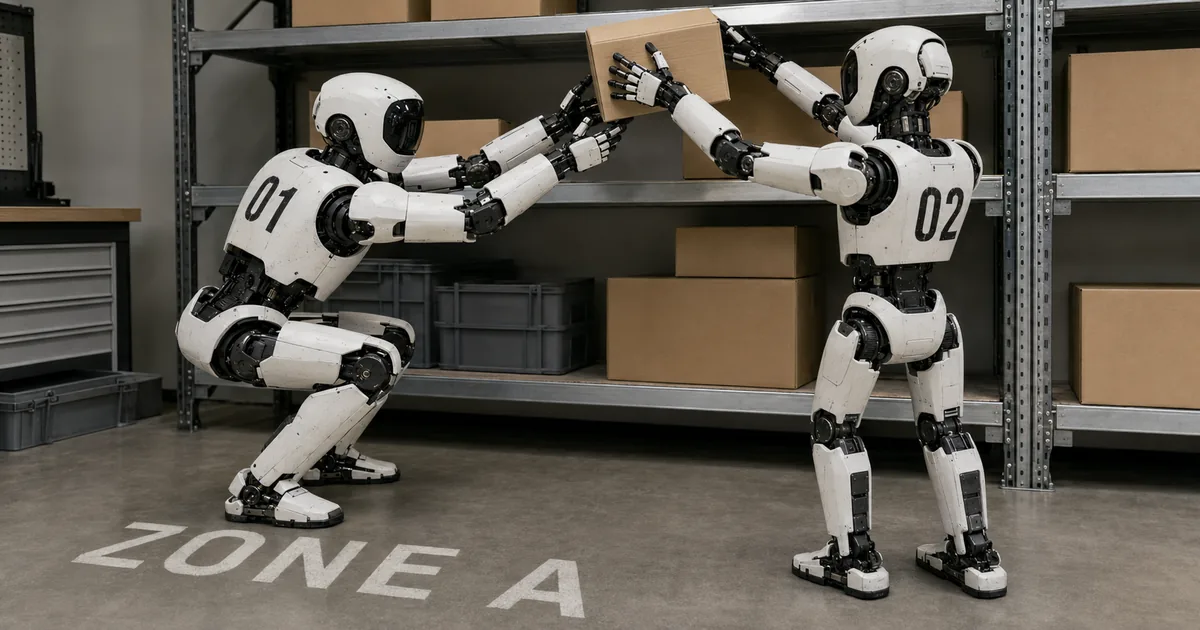
Gemini Robotics 2はどんなフィジカルAIか
Gemini Robotics 2とは、Google DeepMindが2026年7月30日に発表したロボット向けのAIモデル群です。また、Google DeepMindはGemini Robotics 2を「次世代の適応的なロボットを動作させる知能の層」としています。構成する3つのモデルの担当は後半の表にまとめています。
ロボットAIとはロボットの体を動作させるために使うAIのことです。画面の中で文章や画像を出す生成AIとは異なり、現実の物体に触れて動作します。こうしたAIはフィジカルAI(物理世界で働くAI)とも呼ばれます。公式の説明による現状の課題は次の2点です。
- 手順の書き込みと遠隔操作への依存。多くのロボットは、狭く繰り返しの作業手順があらかじめ書き込まれているか、人が遠隔で操作している
- 機体間の技能移転。ある機体で覚えた技能を別の機体へ移すことが、きわめて難しい
Google DeepMindは今回の進歩によって、知的な全身制御・高度な器用さ・複数ロボットの協調が可能になるとしています。Google DeepMindは以前のGemini Roboticsで、Geminiのマルチモーダル理解(文章・画像・音声など複数種類の情報をまとめて理解する力)が現実世界での行動を引き出せることを実証していました。
Most robots are pre-programmed or teleoperated for narrow, repetitive task sequences. They lack the ability to truly learn for themselves or adapt to unpredictable environments. Moreover, transferring learned skills from one robot body to another remains incredibly difficult. / Today, we are introducing Gemini Robotics 2 - the intelligence layer powering the next generation of truly adaptable robots. — 従来のロボット制御が抱える課題と、Gemini Robotics 2 の位置づけに関する記述より公式情報を見る →
Apptronik製ヒューマノイドロボットの全身動作
Gemini Robotics 2は、ヒューマノイドロボットの制御範囲を上半身の机上作業から全身の動きへ広げました。 以前のモデルは、机の上で完結する作業のために人型ロボットの上半身を制御するものでした。今回初めてモデルがヒューマノイドロボット全体を制御できるようになり、意図を全身の動きに変えられるとGoogle DeepMindは書いています。
Google DeepMindは、全身制御が必要な理由として、世界が人間の動きに合わせて作られていることを述べています。狭く散らかった空間でも手を伸ばす・かがむ・バランスを取る動きが必要になります。
Google DeepMindは実演で、Apptronik製のヒューマノイドロボットApollo 2に「じょうろを下の棚の緑色のかごに入れて」と指示しました。Apollo 2は次の順で動作しました。
- 指示を処理してテーブルまで歩く
- じょうろを取る
- 数歩進んで棚まで行く
- 目的の場所に正確に置く
上半身だけを制御していた従来モデルと違い、1つの指示から歩行と物の操作まで続けて実行されるのが特徴です。Google DeepMindは、動作の速度にはまだ上げる余地があるとしています。同時に、この実演を全身の協調が必要な現実の複雑な作業へ進むための重要な一歩としています。
While our previous models controlled the humanoid’s upper-body to achieve table-top tasks, Gemini Robotics 2 expands physical AI into whole-body motions. / Apollo processes the instruction, walks to the table, and picks up the watering can, takes a few steps to the shelves, and places it precisely in its destination. While our robots have more to advance in movement speed, this is an important step towards the skills needed to complete more complex, real-world tasks that require whole-body coordination. — 制御範囲の拡張、実演タスク、動作速度に関する留保の記述より公式情報を見る →
VLAモデルが視覚と言語をヒューマノイドAIの動作に変える
VLAモデルとは視覚と言語の入力をモーター制御に変換して、ロボットに行動させるモデルです。 VLAはvision-language-action(視覚・言語・行動)の頭文字で、Gemini Robotics 2は公式の説明で最も高度なVLAとされています。
文章を出力する生成AIが次の語を出すのに対し、VLAが出すのは次の動きです。カメラの映像と人の言葉による指示を受け取り、モーターをどう動作させるかという信号を出力するモデルです。
制御対象はヒューマノイドロボットの全体で、足先から指先までを含みます。腕が2本のロボットにも対応します。
Gemini Robotics 2: Our most advanced vision-language-action model (VLA) that converts vision and language input into motor control, enabling a robot to take action. This model is capable of controlling full humanoids, from feet to fingertips, and other bi-arm robots. It also brings a new level of dexterous manipulation on both hands and grippers. — VLA モデルの定義と対応する機体の記述より公式情報を見る →
VLAモデルとER 2の役割分担
Gemini Robotics 2は単体のモデルではなく3つのモデルの組み合わせで、担当がはっきり異なります。 表中のVLMは、視覚言語モデルの略です。英語名はvision language modelで、映像と言語を処理するモデルを指し、Gemini Robotics 2という名前は3つのモデルの全体を指すほか、表の1行目のVLAだけを指す名前としても使われます。
Gemini Robotics 2を構成する3つのモデル(公式発表による)
| モデル | 種別 | 担当する仕事 |
|---|---|---|
| Gemini Robotics 2 | VLA | 視覚と言語の入力をモーター制御に変換し体を動作させる |
| Gemini Robotics ER 2 | VLM | 人と意思疎通し物理世界を理解して数分に及ぶ複数段階の作業を計画する |
| Gemini Robotics On-Device 2 | VLA | ロボット本体の上でローカルに動作する効率重視のモデル。新しい機体へ数時間分のデータで適応する |
実際に体を動作させるのはVLAです。ER 2はその前段で状況を把握して手順を定める役割を担い、定めた手順をVLAが実行に移す関係にあります。
ERはembodied reasoning(身体を持った推論)の略です。ER 2はロボットを動作させる高次の頭脳として、ユーザーからの指示の処理と人との意思疎通を担います。部屋を観察して作業に必要な手順を推論し、VLAと連携して実行させながら完了まで進捗を追う流れです。
手順が途中で失敗したときの自己修正も初めての状況や目標への対応も、ER 2とVLAの組み合わせで可能になります。今回の更新でER 2は、数分に及び数百回の判断を含む長い手順を、より確実に実行できるようになりました。
On-Device 2はロボット本体の上でローカルに動作するよう最適化されたVLAで、ネットワークの遅延やインターネット接続がない環境を想定しています。Gemini Robotics 1.5のmotion transfer(動きの移し替え)という技術を引き継いでおり、腕が2本の新しい機体にも数時間の適応で対応できる設計です。
公式の説明では適応に必要なデータは通常200例未満です。形状・センサー・自由度(関節が曲がったり回ったりできる方向の数)が大きく異なる機体でも、この適応は成り立ちます。実演で使われたのは、Dexmate・SO101・Trossenの3種類のプラットフォームです。
Gemini Robotics ER 2: Our most capable embodied reasoning (ER) model. It is a vision language model (VLM) that acts as our agent, enabling robots to communicate with humans, understand the physical world and plan multi-step tasks lasting several minutes. / It observes the room, reasons about the steps needed to complete the task, coordinates with the VLA to carry out the actions, and tracks progress until the task is done. This setup allows robots to execute complex multi-step tasks, self-correct if a step fails, and generalize to novel situations and goals. / In this update, we are enabling robots to more reliably execute longer task sequences, lasting several minutes and involving hundreds of decisions. / Gemini Robotics On-Device 2: Our most efficient vision-language-action model (VLA) optimized to run locally on robotic devices. This model can now achieve fast adaptation to completely new robot embodiments with a few hours of data. / This model is natively multi-embodiment and inherits our advanced "motion transfer" techniques from Gemini Robotics 1.5. We can now adapt to new bi-arm robot embodiments with just a few hours of adaptation time, typically with less than 200 examples. This works even with new embodiments with drastically different shapes, sensors and degrees of freedom, as shown below with a diverse set of tasks being performed by the Dexmate, SO101, and Trossen platforms. — ER 2 と On-Device 2 の種別・担当範囲、ER 2 の手順実行、適応速度と対象プラットフォームの記述より公式情報を見る →
Gemini Robotics ER 2の協調と長い作業
ロボット協調とは種類の異なるロボットが意思疎通して協力し、1台では解けない作業の流れを一緒に進める仕組みです。 ER 2の説明にはロボットがチームとして協力する能力の導入が含まれます。Google DeepMindはヒューマノイドが歩く・かがむ・伸びる・物を操作することで散らかった部屋を片付けられると説明し、他のロボットと組めば作業をより早く完了できるともしています。
ER 2はタスクの開始と終了を理解でき、重要な出来事が発生した瞬間も特定できます。Google DeepMindは、作業の進み具合をつかむ力が大きく伸びたと位置づけています。
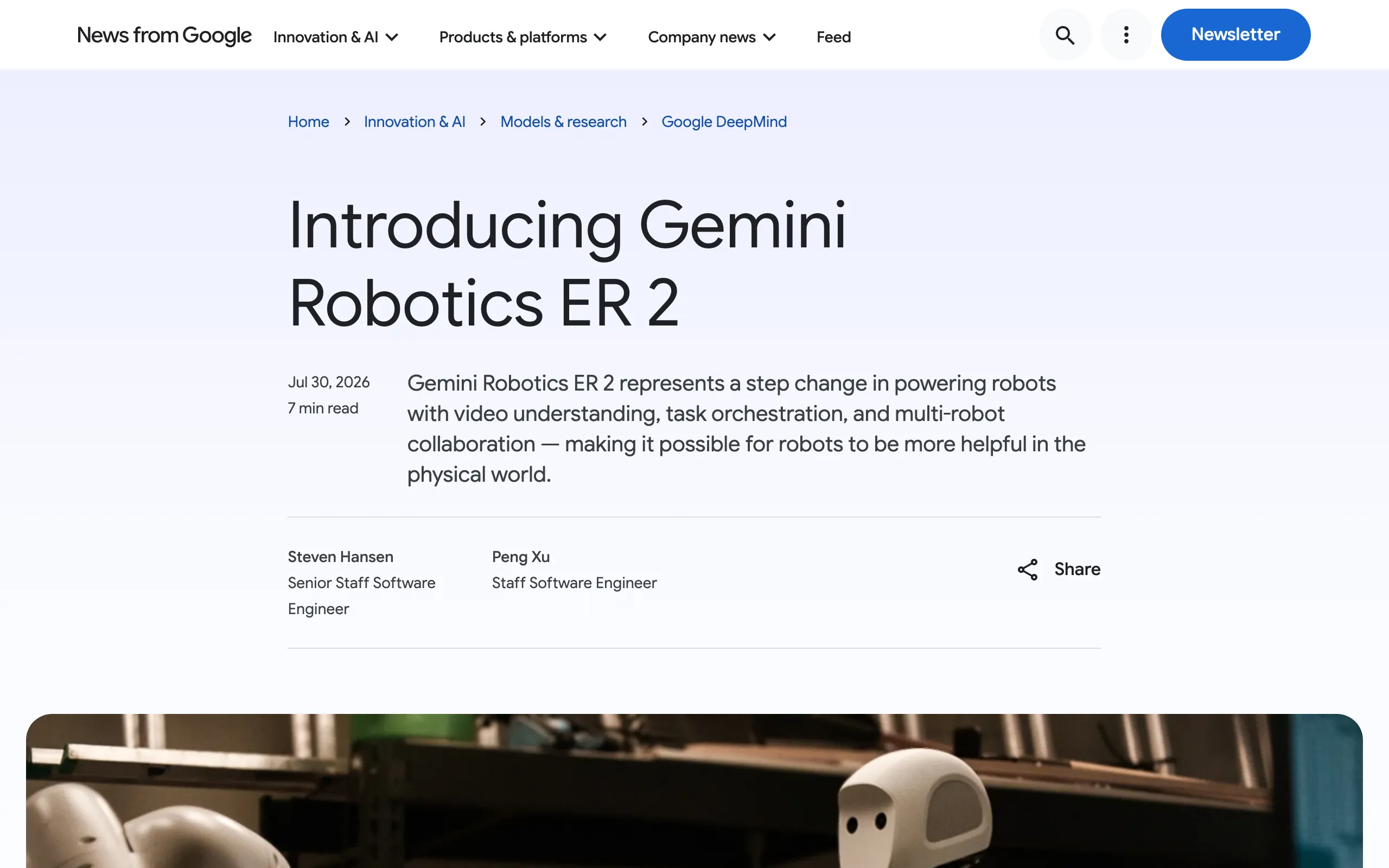
For example, it can enable a humanoid to walk, crouch, stretch, and manipulate objects to clean up a cluttered room. It can even team up with other robots to finish the job faster. / Gemini Robotics ER 2 now understands when tasks begin and end, and can pinpoint the moment key events occur, marking a step change in progress understanding. / Furthermore, we are introducing multi-robot collaboration. This enables different types of robots to communicate and work together to solve complex workflows a single robot could not do alone. — 片付けの例、作業の開始・終了の理解、および多ロボット協調の導入に関する記述より公式情報を見る →
同じVLAモデルによるヒューマノイドロボット以外の機体動作
公式の成績グラフは同じモデルチェックポイントで3種類の機体を制御した結果です。 チェックポイントとは、学習を終えたモデルの中身をそのまま保存したもので、対象になった機体は次の3つです。
- Apptronik製Apollo 2(SharpaWaveハンドを装着)
- Apollo 2(Inspireハンドを装着)
- Franka Duo(Robotiqグリッパを装着)
グリッパとは物をはさんで掴む器具で、Franka Duoで使われたのは標準的な2本指の平行グリッパです。成績グラフにはApollo 2が手の構成を変えて2種類、グリッパを使うFranka Duoが1種類含まれます。機体ごとに専用モデルを用意せず1つのモデルで複数の機体を動作させたことが、この成績グラフの条件です。
Google DeepMindは手とグリッパのどちらを使う場合でも、新しい水準の器用さが得られたとしています。5本指・22自由度のSharpaWaveハンドでは、結び目を作る・ジップ付き袋を閉じるといった繊細な動作が可能です。Franka Duoの2本指グリッパでは、隙間なく詰める作業を行います。
Gemini Robotics 2 controlling three different embodiments, using the same model checkpoint — the Apptronik Apollo 2 robot with SharpaWave hands, the Apollo 2 robot with Inspire hands, and the Franka Duo with the Robotiq gripper — on a wide variety of whole-body and dexterous manipulation tasks. / The model can now control the five-fingered, 22 degree-of-freedom SharpaWave hand on the Apollo 2 robot to complete delicate actions like tying knots or sealing a ziplock bag. It can also operate standard two-fingered parallel grippers on a Franka Duo platform to perform complex dexterous tasks (e.g. tight packing). — 単一チェックポイントによる3機体制御、および SharpaWave ハンドと2本指グリッパの作業例の記述より公式情報を見る →
ロボットAIの限界とフィジカルAIが抱える安全面の課題
Google DeepMindが書いているロボットAIの課題は、多指ハンドによる器用な操作と動作速度の2点です。 全身動作とグリッパを使った器用な作業では、成功率は中〜高の水準に達しています。多指ハンドを使う器用な操作は今も難しいままです。
成績グラフの各棒は同じ技能カテゴリ内で複数タスクを平均した成功率で、多指タスクだけは個別のタスクごとの成績が掲載されています。動作の速度についてもさらに進める余地があるとGoogle DeepMindは書いており、人間並みの器用さを目指して精度と速度の水準を引き続き高めていくとしています。
安全面では、Google DeepMindがASIMOV-Agenticという新しいベンチマークを導入しました。ベンチマークとは性能を測る共通試験のことで、測る対象には次の3点が含まれます。
- 推論側のモデルが、VLAからの安全でないツール呼び出し(AIが外部の機能を実行させる操作。ここではロボットの動作)を拒否できるか
- タスクが可能かどうかを予測できるか
- 不確実なときに自分から人の介入を求められるか
Google DeepMindはER 2を、安全制約の遵守と人の近接に関するベンチマークでこれまでのロボティクスモデルのうちもっとも安全だとしています。人が近くにいることをより正しく検知して安全用のツール呼び出しを起こし、人が近づきすぎたらロボットを安全に停止させられる、というのが公式の説明です。Google DeepMindは、この停止を協働の安全規格で重要な要件と位置づけています。
While Gemini Robotics 2 achieves a medium to high success rate for whole-body and gripper-based dexterous tasks, the multi-finger dexterous manipulation remains challenging. / We are continuing to advance the level of precision and speed to achieve human-level dexterity. / We’re introducing ASIMOV-Agentic , a new benchmark for agentic safety orchestration and uncertainty resolution. For example, it measures the embodied reasoning agent’s ability to refuse unsafe tool calls from a VLA.It also measures the agent’s ability to predict whether a task is possible and to proactively request human intervention when uncertain. / Additionally, with enhanced embodied reasoning, Gemini Robotics ER 2 is our safest robotics model to date in safety constraint following and human proximity benchmarks. It can better detect when humans are nearby, trigger safety tool calls and bring the robot to a safe stop if someone approaches too closely. This is a key requirement in collaborative safety standards. — 多指操作の課題、速度と精度、ASIMOV-Agentic の測定対象、および人との近接に関する安全性能の記述より公式情報を見る →
ER 2は公開、VLAモデルは限定提供
2026年10月9日時点の公式ページでは、一般に使うことができるのはGemini Robotics ER 2だけです。 ER 2はGoogle AI Studioで利用できます。Gemini Enterprise Agent Platform上では、プライベートプレビュー(限られたユーザー向けの試験提供)として提供されています。
VLAモデルとOn-Device 2は、早期アクセスのパートナーに提供されています。ロボットを所有していても、Gemini Robotics 2を今すぐ動作させることができるわけではありません。 試したい場合の入口として、公式ページはTrusted Tester Programへの登録と、Developer blogを案内しています。
Google DeepMindはGemini Robotics 2を、物理世界でAGI(人間と同じ幅広さで作業をこなせるAI)の実現へ向かう道のりの重要な通過点としています。ロボットの力を引き出すには単一作業の自動化から汎用的な知能へ進む必要がある、というのがGoogle DeepMindの考えです。
Anthropicがロボット犬を操作させた実験は、関連記事「Project Fetchとは?ロボット犬の操作で人間の約20倍速を記録」にまとめています。 言語モデル側のGeminiの新しいバージョンは、関連記事(Gemini 3.6 Flashの料金と性能、前世代のモデルからの変更点)で解説しています。
Gemini Robotics ER 2, our reasoning model, is now available on Google AI Studio and in private preview on Gemini Enterprise Agent Platform. Our VLA and On-Device models are available to early-access partners. / Sign up for our Trusted Tester Program / Gemini Robotics 2 marks an important milestone on the path toward solving AGI in the physical world. Unlocking the true potential of robotics requires moving past single-task automation toward general-purpose intelligence. — 3モデルの提供状況、Trusted Tester Program、汎用的な物理AIへの位置づけに関する記述より公式情報を見る →
FAQ
- Gemini Robotics 2とは何ですか?
- Google DeepMindが2026年7月30日に発表した、ロボットを動作させるためのAIモデル群です。中心となるGemini Robotics 2は、カメラで見た映像と言葉による指示をモーター制御へ変換するVLA(vision-language-action)モデルで、Google DeepMindは人型ロボットを足先から指先まで動作させることができるとしています。
- 従来のGemini Roboticsと何が異なるのですか?
- 主な違いは、制御できる範囲が上半身から全身へ広がったことです。従来モデルは机の上で完結する作業のために人型ロボットの上半身を動作させるものでしたが、Gemini Robotics 2は歩く・かがむ・伸びるといった全身の動きにまで対応できるようになりました。
- 今すぐ試すことはできますか?
- 3つのモデルのうち推論を担当するGemini Robotics ER 2はGoogle AI Studioで利用でき、Gemini Enterprise Agent Platformではプライベートプレビューとして提供されています。実際にモーターを動作させるVLAモデルとオンデバイスモデルは早期アクセスのパートナーに限定されており、誰でも使うことができる状態ではありません。公式ページの記載は2026年10月9日時点のものです。
- 苦手なことは残っていますか?
- 残っています。Google DeepMindが公開した成績グラフの説明文で、全身動作とグリッパを使った作業では中〜高程度の成功率に達している一方、多指ハンドによる細かい操作は依然として難しいと明記されています。動作速度についてもまだ改善の余地があると、Google DeepMindが認めています。
関連する記事
 AIファクトチェックは一次情報と照合、裏付け可能な統計は4割AIファクトチェックで統計を見るときは、出典ページが引用した一次情報との照合が必要です。ChatGPTやPerplexity、GoogleのAIによる概要など5つのAIが出した統計1,285件をTrakkrが一次情報と照合した分析では、裏付け可能だったのは40%でした。出典ページの多くは数字の転載だけで、複数のAIで回答が一致しても裏付けにはなりません。
 Geminiでファイルを作成してチャット内で直接編集する方法Geminiのチャットで作成したドキュメントやPDF、スライドなどをダウンロードせずにチャット内で直接編集できるようになりました。編集方法は全画面での直接入力など3つあり、スマホアプリで編集できるのはPDFだけです。編集後はダウンロードかGoogleドライブへ保存できます。Canvasとは異なり、普段のチャットで形式を指定するだけで利用できます。
 Chromeの自動入力がGmailに対応、使える条件とオフにする方法Chromeの自動入力がGmailにある注文番号や追跡情報、フライトの予約をサジェストするようになりました。2026年10月28日に米国で始まり、対象はGeminiのパーソナルインテリジェンスを有効にした18歳以上の人です。設定の「Enhanced autofill」でオフにでき、サジェストは1件ずつ削除できます。日本での提供時期は不明です。
 Gemini 4 Carbonの料金と提供範囲、11月10日から有料APIとAI Ultraへ拡大Gemini 4 Carbonは、Googleが10月28日に発表した上位モデルです。11月10日から有料APIの開発者・企業・Google AI Ultraの契約者へ提供が広がりました。API料金はArgonと同じ100万トークンあたり入力2ドル(約316円)・出力10ドル(約1,581円)で、Argonは12月1日に料金が倍になります。