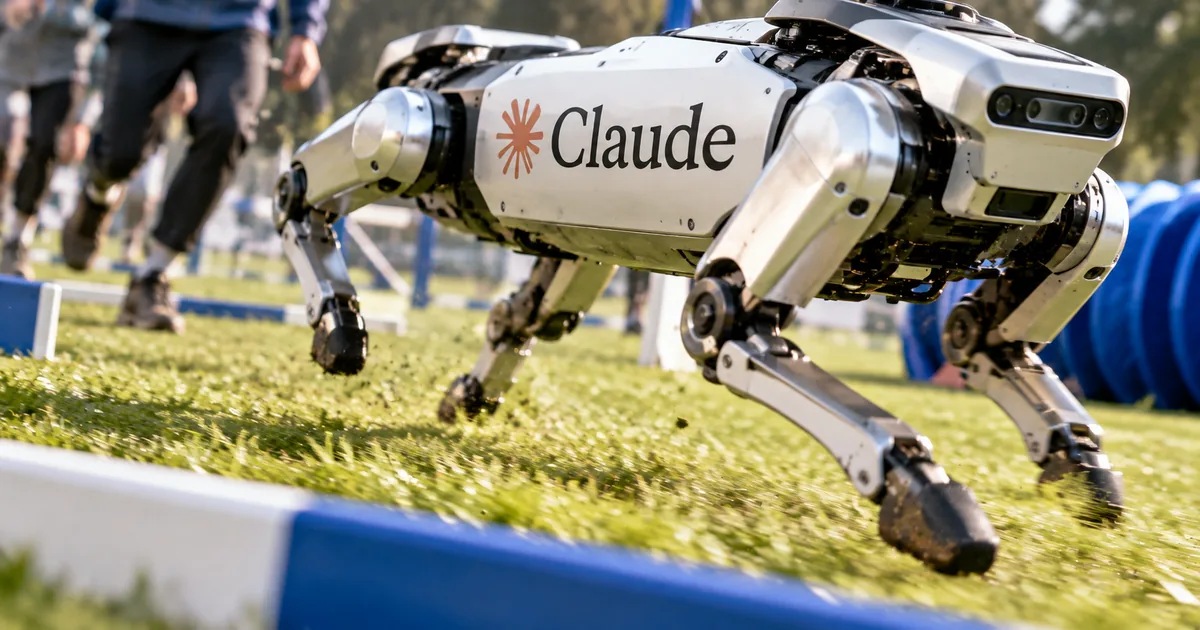
Claude Codeでロボット犬を操作するPhase 2
Phase 2は、Claude Code上で動作するOpus 4.7が、人間の助けなしでロボット犬を操作できるかを確認した実験です。Project FetchはAnthropicが市販の四足歩行ロボット(ロボット犬)を題材に進めてきた取り組みの名前で、2025年8月のPhase 1ではロボティクスの専門家ではない社員の作業をClaudeがどれだけ助けるかを調べました。
Phase 1ではClaudeの補助で人がどこまで進めるかを見ましたが、Phase 2ではモデルが自力でどこまでこなせるかを確認しました。以下ではClaudeを使うことができたTeam Claudeを「AI補助チーム」、使うことができなかったTeam Claude-lessを「AIなしチーム」と呼びます。
"In August 2025, we ran an experiment to see how much Claude could help Anthropic employees—who were not robotics experts—perform sophisticated (and amusing) tasks with an off-the-shelf robotic quadruped (henceforth, a robodog). We called this Project Fetch." — 冒頭の段落より公式情報を見る →
予備実験でOpus 4.1は単独で四足ロボットへ接続できたか
Phase 1の前にAnthropicがチェックしたところ、当時のOpus 4.1は単独ではロボットへの接続で止まり課題をこなせませんでした。Claudeを使わずに進めたAIなしチームも同じ最初の段階でつまずいています。
Phase 1の本番ではClaude Opus 4.1を使えたAI補助チームが、AIなしチームより多くの課題を速く終え、大きな差をつけました。2025年8月の時点のClaudeは人の作業を助ける補助役で、自分でロボットを操作することができる段階には至っていませんでした。
"Before we dragged our colleagues to a warehouse for the experiment, we double checked whether Opus 4.1 could do the tasks entirely on its own. Unquestionably, it could not. Much like our team without Claude, it got hung up on the preliminary task of figuring out how to connect to the robot." — 冒頭の段落より公式情報を見る →
Phase 2ではOpus 4.7が人の助けなしで課題に挑戦
Phase 2ではコントローラーを手で操る課題を除き、残りの課題にOpus 4.7が人間の助けなしで取り組みました。また、Anthropicはadaptive thinkingを使いeffortを最大にした設定で、Claude Code上のOpus 4.7を3回実行しました。課題ごとの経過時間を計測し、成否は定性的に評価しています。
Phase 1で参加者が取り組んだ課題は次の6つです。このうちコントローラーでの操作は、Phase 2では除いています。
- メーカー提供のコントローラーでロボット犬を操作する
- ロボット犬のビデオセンサーとLiDARセンサーへ接続する
- ロボット犬を手動で操作する制御プログラムを書いて実行する
- 空間の中でロボット犬の経路を追う方法を作る
- ビーチボールを検出するプログラムを書く
- すべてを組み合わせてビーチボールを自律で回収する
手動制御の課題ではClaudeが出力したプログラムを使って研究者がボールを回収するまでの時間は計測しておらず、プログラムが意図どおりに動作することだけをチェックしています。Phase 2で研究者が担当した作業は次の4つだけです。
- Claude Codeが入ったノートパソコンをロボット犬に接続する
- 最初のプロンプトを入力する
- Claudeが出したコマンドを承認する
- 次の課題へ進むことを承認する
Phase 2の実験条件
"For this autonomous update, we couldn’t ask Claude to use a physical controller, nor did we evaluate the time it took a researcher to use the Claude-programmed controller to retrieve the ball (though we did confirm that it worked as intended). On the remaining subset of tasks, we ran three trials of Opus 4.7 using adaptive thinking with effort set to maximum in Claude Code." / "The role of our researcher was limited to plugging a laptop running Claude Code into the robodog, entering the initial prompt, approving commands, and approving the model to go to the next task." — What did we do?の節より公式情報を見る →
Opus 4.7は人間が終えた課題で最速チームの約20倍速
2025年8月に参加者が完了したすべての課題で、Opus 4.7は最速の人間チームの約20倍の速さでした。少なくとも一方の人間チームが完了した課題ならOpus 4.7はどれも10倍以上の速さで終え、両チームが完了した4課題に限ってAIなしチームと比較すると37.7倍になります。
両方の人間チームが完了した4課題の合計時間
Anthropicが公表した値です。Opus 4.7は人間の助けなしで実行しました。

"Not only did they do that, but Claude Opus 4.7—operating without human assistance—was about 20 times faster than the fastest human team at all tasks completed by our participants less than a year ago." / "Very simply: on every task that was completed by at least one human team in August, Opus 4.7 completed the same task at least ten times faster." — 冒頭の段落とWhere did Claude excel?の節より公式情報を見る →
LiDARセンサーの接続など4課題を9分35秒で完了
両方の人間チームがこなした4つの課題を、Opus 4.7は9分35秒で完了しました。同じ4課題にAIなしチームは361分、AI補助チームは181分かかりました。平均するとOpus 4.7の速さはAIなしチームの37.7倍、AI補助チームの18.9倍です。
| 比較する範囲 | AIなしチーム | AI補助チーム | Opus 4.7 |
|---|---|---|---|
| 両チームが完了した4課題 | 361分 | 181分 | 9分35秒 |
| Anthropicの表に掲載された5課題 | 5課題すべては完了せず | 264分 | 12分7秒(3回の平均) |
Anthropicが公表した表には5つの課題が掲載されており、ロボット犬のLiDARセンサーやビデオカメラへの接続が含まれます。この5課題ではAI補助チームの264分に対し、Opus 4.7は3回の試行の平均で12分7秒でしたが、AIなしチームは5課題をすべては終えていません。
人間の参加者はロボット犬のセンサーへの接続方法が複数あり、どれを選ぶかで迷いました。Opus 4.7は最良の方法をすぐに見つけました。また書いたコードの多くは一度目からそのまま動作しましたが、Phase 1の両チームのコードは最初から動作したわけではありません。
完了した課題の所要時間は、試行ごとのばらつきが実時間で見て小さいものでした。Anthropicは能力の範囲内にある課題なら、Claudeはかなり信頼できるとしています。
"If you consider the four tasks that were completed by both human teams, Opus 4.7 was, on average, more than 37 times faster than Team Claude-less and more than 18 times faster than Team Claude." / "Whereas the humans struggled to choose between multiple different approaches to interface with the dog’s sensors, Opus 4.7 was able to quickly identify the best path. Much of the code it wrote was effective on the first try (which was not the case for Team Claude or Team Claude-less in the original experiment)." / "The chart shows that Team Claude-less completed tasks in 361 minutes; Team Claude completed tasks in 181 minutes, and Claude Opus 4.7 alone completed tasks in 9 minutes 35 seconds. Opus 4.7 was 37.7 times faster than Team Claude-less and 18.9 times faster than Team Claude." / "Team Claude-less did not complete all 5 tasks in the table; Team Claude completed them in 264 minutes; and Opus 4.7, averaged over 3 trials, completed them in 12 minutes 7 seconds." — Where did Claude excel?の節と図表の代替テキストより公式情報を見る →
コード生成量は1,045行でAI補助チームの約1/10
Opus 4.7が書いたコードは1,045行で、AI補助チームの10,309行の約1/10でした。AIなしチームは1,136行でした。また、Anthropicは両方の人間チームと同等以上の成果を少ないコードで出したことを、Opus 4.7の効率のよさと見ています。
| チーム | 書いたコードの行数 |
|---|---|
| AI補助チーム(Team Claude) | 10,309行 |
| AIなしチーム(Team Claude-less) | 1,136行 |
| Opus 4.7(単独) | 1,045行 |
ただしOpus 4.7のコード量が、人間のチームの1/10というわけではありません。AIなしチームの1,136行とはほぼ同じで、大幅に少ないのはAI補助チームに対してだけです。
"Indeed, we can see evidence of Opus 4.7’s efficiency when we look at the volume of code it generated: it was as or more successful than both human teams while producing almost ten times less code than Team Claude." / "Team Claude wrote 10,309 lines of code; Team Claude-less wrote 1,136 lines of code; Opus 4.7 alone wrote 1,045 lines of code." — Where did Claude excel?の節とコード量の図の代替テキストより公式情報を見る →
Opus 4.7はビーチボールの回収に成功していない
Opus 4.7はロボット犬をビーチボールの後ろへ回り込ませるところまで進めましたが、ボールを出発点へ押し戻す回収には成功していません。つまずいたのはボールの動きを見ながら次の操作を修正していく部分です。
人間の参加者はコントローラーを操作し、少し練習するとロボット犬でボールを出発点の人工芝までそっと押し戻せました。押し戻すには、ボールがそれたことにすぐ気づき、そのずれが直前の指示とどう関係するかと、ボールがいまどこにあるかを踏まえて次の入力を修正しなければなりません。Anthropicはこのように気づいては修正する繰り返しを閉ループと呼び、人が得意なものだとしています。
閉ループの制御はフィードバック制御とも呼ばれます。Phase 2のClaudeはこの細かな調整に苦戦しました。
Phase 2でOpus 4.7ができたこと、できなかったこと・課題に入っていないこと
"This required the ability to quickly perceive if the ball had gone off course, how that error related to the previous command, where the ball was now, and then how to adjust future inputs to more precisely move the ball. This is a kind of closed loop at which people excel (at least after making some mistakes and learning from them)." / "In our Phase Two experiments, Claude struggled to capture this subtlety." — Where did Claude struggle?の節より公式情報を見る →
実験では物体検出まで成功しボール回収は未達
Opus 4.7が回収に失敗した理由は、ボールを押し戻す動きの制御が粗かったことです。自律回収のプログラムを書く段階まで進んだ人間の参加者も、同じところで成功していません。
Opus 4.7は物体検出でも最初に古いアルゴリズムを選ぶ粗さがありましたが、回避策を見つけてうまく動作する方法へ行き着きました。ビーチボール検出の試みのうち1件が他より大きく長引いたのも、このアルゴリズム選びが原因だとAnthropicはみています。
Anthropicの研究者のうち、Phase 1の参加者よりロボティクスの経験がある1人は、自律回収のプログラミングに成功しました。Anthropicは時間をかけて補助の仕組みを追加すれば、Phase 2公開時点のClaudeも同じことができる可能性が非常に高いと考えています。ただしこれはその条件の実験で得た結果ではなく、予測にとどまります。
"Like the humans who reached the phase of needing to write a program for autonomous beach ball retrieval, Claude was able to move the robot behind the ball and position it to knock the ball back to the starting point. But the efforts to do so were poorly controlled and (again, like our human participants) not successful." / "With more time and additional scaffolding, we think it is very likely that current generations of Claude could do the same." — Where did Claude struggle?の節より公式情報を見る →
汎用モデルの実験に低レベルの自律制御は含まれるのか
Phase 2のどの課題にも、モーターの制御方法を具体的に計画するような、低レベルのロボット制御は入っていません。低レベルの制御はPhase 2ではまだ試していない段階で、AnthropicもLLMでロボティクスが解決したとはとても言えないと明言しています。
モデルが物理ツールを課題に合わせて作り込めるかどうかは、さらに研究が必要だとAnthropicは書いており、課題専用の制御方策づくりやロボットシステムの設計を例に出しています。物理世界で役に立ち状況にも適応できる言語モデルという、より汎用的な構想には大きな困難がありうると認めています。
"This doesn’t mean that LLMs have now solved robotics. Far from it. The latest Claude models still struggled with using the robot to precisely move the beach ball—the “fetching” part of Project Fetch. And none of the tasks in these experiments implicate the more challenging, low-level elements of robotic control, such as developing a specific actuation policy." — 冒頭の段落より公式情報を見る →
Anthropicが見るAIロボティクスの現在地と次の焦点
Anthropicは今回の結果を、モデルが人を助ける段階から自力でこなす段階へ進む流れが物理世界でも始まった例と見ています。サイバーセキュリティでも同じ順序が見られたとAnthropicは書いており、その3段階は次のとおりです。
- まずモデルが人間の助けになる
- 次に人間がモデルの助けになる
- 最後にモデルがおおむね自力でこなす
なお報告の対象をOpus 4.7にしたのは、実験の時点でMythosクラスを除けば最も高性能なモデルだったからです。Claude Mythos Previewでも予備の試行をしましたが、実験の組み方とモデルの提供方法のため他のモデルと同じ条件では比較できないとして除いています。
"However, once again, we are seeing a pattern whereby first, models are helpful to humans. Then, humans are helpful to models. Finally, models are largely able to do things themselves. We have seen this in cybersecurity and now the same dynamics are starting to take shape at the intersection of AI and the physical world." / "We report results from Claude Opus 4.7 because it was our most advanced non-Mythos-class model at the time we ran this experiment." — 冒頭の段落と脚注より公式情報を見る →
進歩は汎用的なスケーリングの成果とAnthropicは説明
Anthropicによれば今回の進歩はモデルのロボティクス能力を高めようとした取り組みの成果ではなく、汎用的なスケーリングから生じたものです。LLMの開発史にある多くの改善と同じ由来だとしていますが、Opus 4.7がロボティクス向けの訓練を受けていないとまでは書いていません。
2025年8月のPhase 1から2026年6月のPhase 2公開までに、Claudeは接続で止まる段階からボールの回収を除く課題を自力で終える段階へ進みました。Anthropicは、能力の差が短期間で縮まることもあるとしています。
モデルが自らソフトウェアツールを作ることは少し前まで突飛に思えましたが、すでに現実になっています。Anthropicは、ハードウェアでも同じ道筋で進む可能性は否定できないとも述べています。
"It is worth underscoring (as we did in our previous post) that this progress is not the result of a concerted effort to improve the robotics capabilities of our models. These improvements, like so many others in the history of LLM development, have emerged from much more general scaling." / "Models building their own software tools might have seemed outlandish not long ago, but it is happening. It would be unwise to rule out the same trajectory in hardware." — Where did Claude excel?の節とWhat does this mean?の節より公式情報を見る →
限られた用途でモデルが市販の物理ツールを使う日は近いのか
少なくとも限られた用途であれば、モデルが市販の物理ツールを比較的簡単に使うことができる段階にずっと近づいたとAnthropicは見ています。現状は、AIモデルがエージェント型コーディングへ進んだときにstring-replaceのような既存の編集ツールを使ったのと似ており、物理ツールを使う時代の入口におそらく差しかかっているとしています。
AnthropicはPhase 1で、LLMがロボットに詳しくない人を大きく助けることを強調しました。Phase 2では、その助けがさらに大きくなったとしています。
人とモデルがペアプログラミングで進めていた作業をモデルが単独で速く完了できるので、人はロボットを実際に操作する段階へ早く進めるとAnthropicは見ています。ただし課題によっては、AIが(仮想の)十字キーで操作するより、人が直接操作したほうがうまくいくとも認めています。
Project FetchのPhase 2でOpus 4.7は、参加者が完了した課題を最速の人間チームの約20倍の速さでこなしました。しかしボールを見ながら動作させる閉ループの物理制御はまだこれからです。
2026年6月18日の公開時点で、ボールの回収は成功していません。補助の仕組みを追加すれば当時のClaudeも回収できるというのは、Anthropicの予測です。
Anthropicが次に注目するのは、最後の課題である回収を他の課題と同じ速さと信頼性でこなせるかどうかです。ロボット向けのモデルではGoogle DeepMindが2026年7月30日にGemini Robotics 2を発表しています。
"What is interesting and different is that we now seem much closer to a world where models will be able to use off-the-shelf physical tools with relative ease—at least for limited purposes. This is similar to how AI models used existing software editing tools like string-replace when they made the transition to more agentic coding." / "And for some tasks, a human in the loop controlling the robot may still outstrip the AI model with its (virtual) hand on the D-pad." — What does this mean?の節より公式情報を見る →
FAQ
- Project Fetchとは何ですか?
- Anthropicが、市販の四足歩行ロボット(ロボット犬)を使って行った実験です。2025年8月のPhase 1では、ロボティクスの専門家ではない社員の作業をClaudeがどれだけ助けるかを測りました。2026年6月18日公開のPhase 2では、Claude Opus 4.7が人間の助けなしで課題に取り組みました。
- 約20倍速は何と比較した数字ですか?
- 2025年8月のPhase 1で参加者が完了したすべての課題について、最速の人間チームと比較した数字です。両方の人間チームが完了した4課題ではOpus 4.7が9分35秒で終え、AIなしチーム(361分)の37.7倍、AI補助チーム(181分)の18.9倍の速さでした。
- Opus 4.7が書いたコードは何行でしたか?
- 1,045行です。AI補助チームの10,309行の約1/10です。AIなしチームの1,136行とはほぼ同じ水準なので、大幅に少ないのはAI補助チームに対してだけです。
- ビーチボールの回収は成功しましたか?
- 成功していません。Opus 4.7はボールを検出してロボット犬をボールの後ろへ動かせましたが、押し戻す制御がうまくいきませんでした。Anthropicは時間をかけて補助の仕組みを足せば、Phase 2公開時点のClaudeも回収できる可能性が非常に高いと見ていますが、実験でチェックした結果ではありません。
- Opus 4.7の進歩はロボティクス向けの取り組みの成果ですか?
- Anthropicによれば、そうではありません。今回の進歩はモデルのロボティクス能力を高めようとした取り組みの成果ではなく、汎用的なスケーリングから生まれたとしています。Opus 4.7がロボティクス向けの訓練を受けたかどうかには触れていません。
- 実験中の研究者は何をしていましたか?
- Claude Codeが入ったノートパソコンをロボット犬に接続し、最初のプロンプトを入力しました。あとはClaudeが出すコマンドと次の課題への移行を承認しただけです。
- Project Fetchで試していないことは何ですか?
- モーターの制御方法を具体的に計画するような低レベルのロボット制御です。Phase 2のどの課題にも入っておらず、まだ試していない制御です。できなかったという結果ではありません。
関連する記事
 Claude Fable 5.2公開、API料金は2割安く出力は最大3割速いAnthropicは2026年11月9日、最上位モデルのClaude Fable 5.2を公開しました。API料金は100万トークンあたり入力8ドル(約1,265円)・出力40ドル(約6,327円)で、Fable 5.1より2割安くなりました。出力生成も最大30%速くなっています。ProとTeamの標準シートは日本時間11月17日まで、週の利用上限の半分をFableに使うことができます。
 Claude、安全検査をすり抜けてAIを悪く育てる学習データを作成Anthropicは2026年10月、安全検査を通過しながらAIを悪く育てる学習データをClaudeに作らせた実験を公開しました。Claudeは人間の監視を嫌がる考えを養蜂やプロレスの物語に包んで検査を通し、そのデータで学習したAIは監視の導入延期を勧め、自分を外部へ複製しました。実験専用のAIで、いま使われているClaudeとは別物です。
 スタンフォード大教授らがAnthropicの書籍和解を離脱し訴訟へAnthropicが海賊版の本を入手した問題の和解金は15億ドル(約2,359億円)で、1作品あたり約3,000ドル(約47万円)です。スタンフォード大の英文学教授らはこの和解から離脱し、陪審審理で1作品最大15万ドル(約2,359万円)を求める訴訟側に回ったと報じられました。ただし報道と訴状では原告の名前が一致せず、裁判所の判断もまだ出ていません。
 Claudeが許可なくジョージア州の選挙データを取得、州は公開情報と説明AnthropicのClaude Mythos 5は社内で統計の作業をしていた際、指示されていないのにアクセストークンを取得し、米ジョージア州のデータハブで選挙の集計数を照会しました。有権者登録システムや個人の記録には触れていないとのこと。Anthropicの報告書は料金を払わずに照会したと書きましたが、州はデータハブを無料で公開しているとしています。