What Project Fetch tested: Claude Opus 4.7 on a robot dog
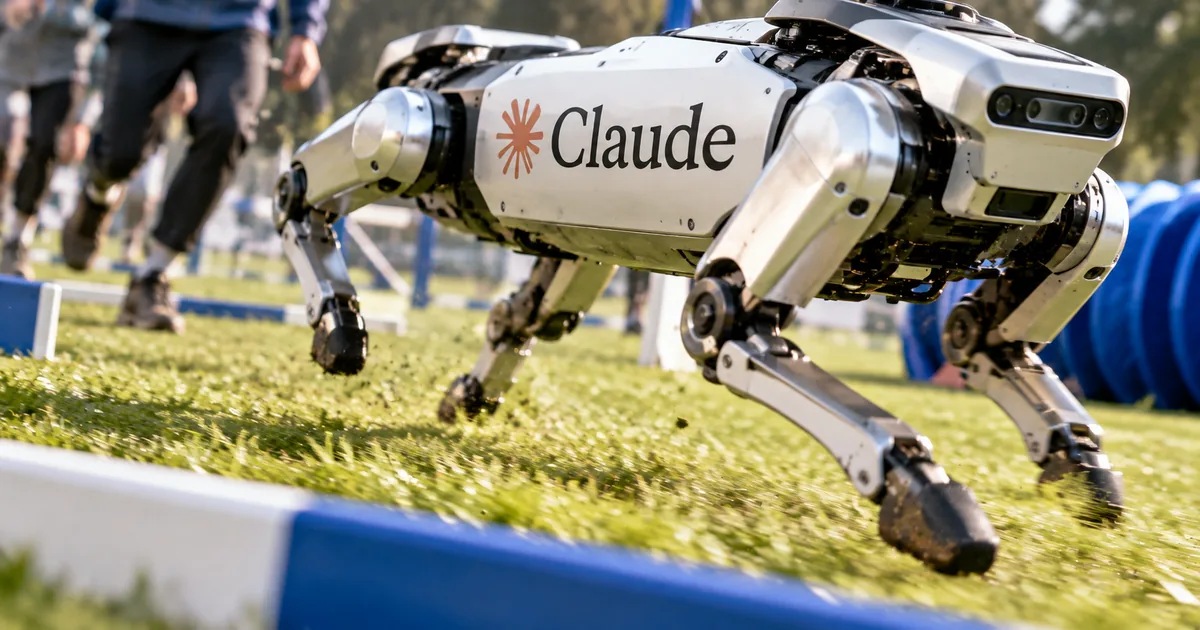
Anthropic's Frontier Red Team ran Project Fetch on a commercially sold four-legged robot with a video camera, a lidar sensor, and a controller from its maker. Anthropic calls it a robodog. The goal in both rounds was a game of fetch: get the robot to bring a beach ball back to the patch of fake grass where it started.
The first round, Phase 1, measured how much Claude helped people do this. Phase 2 tested whether Claude Opus 4.7 could take on the first round's robot dog tasks with no human help. As of September 29, 2026, neither Anthropic post names the robot's maker or model.
The six Project Fetch steps and what Phase 2 covered
Phase 1: Claude Opus 4.1 stalled before the robot dog moved
The first round ran in August 2025 with eight Anthropic researchers, none of them robotics specialists. They were split at random into two teams of four, one with access to Claude Opus 4.1 and one without. Anthropic named them Team Claude and Team Claude-less.
Anthropic's Phase 1 scoring breaks the work into eight tasks rather than the six steps above. Team Claude finished 7 of the 8 against 6 for Team Claude-less, and on the tasks both teams completed it needed about half the time.
Neither team got the robot to fetch the ball on its own. Team Claude came close, with a robot that could find the ball, walk to it, and push it around, but not steer it home.
Before the event, Anthropic also checked whether Opus 4.1 could handle the tasks alone. It could not, and it got stuck at the same point as the team without Claude: working out how to connect to the robot. In Phase 1, Claude was a strong helper for people but could not yet run the robot dog itself.
Older coverage may give a different date for the first round. As of September 29, 2026, the Phase 2 post carries an update note, dated June 18, saying the date of the first phase was corrected. The corrected text puts the first round in August 2025, and the November 12, 2025, date on Anthropic's write-up of that round is its publication date, not the date of the experiment.
"We found that access to our state-of-the-art model at the time (Claude Opus 4.1) helped one team substantially outperform the other, who had to rely only on the internet and their own ingenuity. The Claude-enabled team got more done, faster." / "Before we dragged our colleagues to a warehouse for the experiment, we double checked whether Opus 4.1 could do the tasks entirely on its own. Unquestionably, it could not. Much like our team without Claude, it got hung up on the preliminary task of figuring out how to connect to the robot." — from the opening of the Phase 2 postView official source →
"We randomly divided eight Anthropic researchers (none of whom were robotics experts) into two teams—one with Claude access, one without—and asked them to program quadruped robots to fetch beach balls." / "Table 1: Team Claude completed 7/8 tasks while Team Claude-less completed 6/8 tasks." / "Team Claude almost completed our experiment. By the end of the day, their robodog could autonomously locate the beach ball, navigate towards it, and move it around. But the robodog's autonomous control was not quite deft enough to retrieve the ball." — from the Phase 1 write-upView official source →
Phase 2: Claude Code runs the robot dog without help
For Phase 2, Anthropic ran Claude Opus 4.7 through the tasks three times in Claude Code, with adaptive thinking on and effort set to maximum. The researcher's job shrank to connecting a laptop running Claude Code to the robot, typing the opening prompt, approving the commands the model proposed, and letting it move on. Everything else was up to Opus 4.7, including connecting to the robot's sensors and writing all of the code.
The task list was not identical to the first round's. Driving with the physical controller could not be given to a model, and Anthropic did not time a researcher using the controller program Claude wrote, though it confirmed the program worked. On the remaining tasks, it timed each objective and judged success qualitatively.
A footnote gives two reasons for using Opus 4.7 rather than a Mythos-class model. It was Anthropic's most advanced model outside the Mythos class when the experiment ran, and early trials with Claude Mythos Preview would not have given a like-for-like comparison.
Project Fetch is not the only case of Claude Code aimed at work outside everyday software. Another is Samsung Claude Code: chip verification in 2 days.
"For this autonomous update, we couldn't ask Claude to use a physical controller, nor did we evaluate the time it took a researcher to use the Claude-programmed controller to retrieve the ball (though we did confirm that it worked as intended). On the remaining subset of tasks, we ran three trials of Opus 4.7 using adaptive thinking with effort set to maximum in Claude Code. We measured the elapsed time for each objective and qualitatively assessed the models' success." / "The role of our researcher was limited to plugging a laptop running Claude Code into the robodog, entering the initial prompt, approving commands, and approving the model to go to the next task." / "We report results from Claude Opus 4.7 because it was our most advanced non-Mythos-class model at the time we ran this experiment." — from "What did we do?" and footnote 1View official source →
Project Fetch results: Claude 20x faster than top human team
Anthropic's headline figure compares Opus 4.7 with the fastest human team from the first round, not with people in general. On every task a volunteer team completed, Opus 4.7 was at least 10 times faster, and about 20 times faster than the fastest team overall.
Time on the four tasks both human teams finished (minutes)
Team Claude needed half the time of Team Claude-less. Opus 4.7, working alone, finished the same four tasks in under ten minutes.

Opus 4.7 finished four robot dog tasks in 9 min 35 s
Both human teams finished four robot dog tasks, and those four give the cleanest comparison. Team Claude-less took 361 minutes, Team Claude 181, and Opus 4.7 just 9 minutes 35 seconds. On those shared tasks, Anthropic's chart puts Opus 4.7 at 18.9 times faster than Team Claude and 37.7 times faster than Team Claude-less.
| Participant | Time on the four shared tasks | Opus 4.7 was faster by |
|---|---|---|
| Team Claude-less (no AI) | 361 min | 37.7x |
| Team Claude (with Opus 4.1) | 181 min | 18.9x |
| Opus 4.7 (alone) | 9 min 35 s | — |
A second table in the post covers five tasks. Team Claude-less did not finish all five, Team Claude took 264 minutes, and Opus 4.7 averaged 12 minutes 7 seconds over its three trials.
Across the three runs, completion times for the steps the model finished varied little in absolute terms. One beach-ball detection trial took substantially longer than the others, which Anthropic says was likely due to the model first reaching for an outdated object detection algorithm. The model still worked around it and ended up with a detector that did the job.
The Phase 1 write-up points the same way. It said Team Claude needed about half the time of Team Claude-less, and 181 minutes is almost exactly half of 361.
"Claude Opus 4.7—operating without human assistance—was about 20 times faster than the fastest human team at all tasks completed by our participants less than a year ago." / "Very simply: on every task that was completed by at least one human team in August, Opus 4.7 completed the same task at least ten times faster." / "If you consider the four tasks that were completed by both human teams, Opus 4.7 was, on average, more than 37 times faster than Team Claude-less and more than 18 times faster than Team Claude." / "The chart shows that Team Claude-less completed tasks in 361 minutes; Team Claude completed tasks in 181 minutes, and Claude Opus 4.7 alone completed tasks in 9 minutes 35 seconds. Opus 4.7 was 37.7 times faster than Team Claude-less and 18.9 times faster than Team Claude." / "Team Claude-less did not complete all 5 tasks in the table; Team Claude completed them in 264 minutes; and Opus 4.7, averaged over 3 trials, completed them in 12 minutes 7 seconds." / "We observed little within-task variance (in absolute terms) on completion times for steps the model finished." — from the introduction, "Where did Claude excel?", and the descriptions of the post's chartsView official source →
Claude Opus 4.7 code: 1,045 lines vs. Team Claude's 10,309
Anthropic also counted lines of code. Opus 4.7 wrote 1,045, slightly fewer than Team Claude-less at 1,136 and far fewer than Team Claude at 10,309. By Anthropic's assessment, Opus 4.7 did at least as well as both human teams with almost ten times less code than Team Claude.
| Team | Lines of code |
|---|---|
| Team Claude (with Opus 4.1) | 10,309 |
| Team Claude-less (no AI) | 1,136 |
| Opus 4.7 (alone) | 1,045 |
The tenfold gap holds only against Team Claude, since the model and Team Claude-less ended up with nearly the same count. In the Phase 1 write-up, Anthropic had already found that Team Claude wrote about 9 times as much code as Team Claude-less. It added that some of that extra code was arguably a distraction from the task.
Code quality is a separate point. Anthropic says much of Opus 4.7's code worked on the first try, which was not true for either human team in the first round. Anthropic adds that where the volunteers wavered between several ways to talk to the robot's sensors, the model picked the best route quickly.
"Team Claude wrote 10,309 lines of code; Team Claude-less wrote 1,136 lines of code; Opus 4.7 alone wrote 1,045 lines of code." / "Whereas the humans struggled to choose between multiple different approaches to interface with the dog's sensors, Opus 4.7 was able to quickly identify the best path. Much of the code it wrote was effective on the first try (which was not the case for Team Claude or Team Claude-less in the original experiment). Indeed, we can see evidence of Opus 4.7's efficiency when we look at the volume of code it generated: it was as or more successful than both human teams while producing almost ten times less code than Team Claude." — from the code-volume chart description and "Where did Claude excel?"View official source →
"Team Claude wrote a lot more code (see Figure 2), but some of it was arguably a distraction from the task at hand." / "Figure 2: Team Claude wrote about 9 times more code than Team Claude-less." — from the Phase 1 write-upView official source →
Where LLM robotics fell short, and what Anthropic says
Opus 4.7 did not complete the fetch, and Anthropic does not present Phase 2 as a sign that robotics is solved. Closed-loop control means checking what the last command did, measuring the error, and correcting the next command, over and over. Scaffolding means extra structure built around a model, such as helper tools or step-by-step checks, to carry it through a task.
What Opus 4.7 did, did not do, and was not tested on
Beach ball fetch: why closed-loop AI robot control failed
With practice, the human volunteers could drive the robot by hand and nudge the ball back to the fake grass. Doing that means noticing the ball drift, tying the drift to the command just sent, finding where the ball now sits, and adjusting the next input. Anthropic calls this a closed loop and says people are good at it once they have made a few mistakes.
Opus 4.7 got part of the way. It could move the robot behind the ball and aim it to push the ball home, but its pushes were poorly controlled and the fetch failed, the same outcome as the human teams that reached this stage.
One Anthropic researcher with more robotics experience than the Phase 1 volunteers did program an autonomous fetch. Anthropic judged it very likely that then-current Claude models could do the same with more time and extra scaffolding, but Phase 2 did not show that.
The next thing Anthropic says it will watch is whether a model can finish this last task. It wants to see that done with the same speed and reliability the model showed on the rest of Project Fetch.
"This required the ability to quickly perceive if the ball had gone off course, how that error related to the previous command, where the ball was now, and then how to adjust future inputs to more precisely move the ball. This is a kind of closed loop at which people excel (at least after making some mistakes and learning from them)." / "Like the humans who reached the phase of needing to write a program for autonomous beach ball retrieval, Claude was able to move the robot behind the ball and position it to knock the ball back to the starting point. But the efforts to do so were poorly controlled and (again, like our human participants) not successful." / "One of our researchers with more robotics experience than our Phase One volunteers successfully accomplished the task of programming autonomous fetching. With more time and additional scaffolding, we think it is very likely that current generations of Claude could do the same." — from "Where did Claude struggle?"View official source →
What Phase 2 means: tools are closer, robotics is not solved
Anthropic is explicit that LLMs have not solved robotics. No task in either round reached the harder, low-level side of robot control, for example writing an actuation policy that decides how the motors move. What Anthropic calls new is that ready-made physical tools now seem within easier reach for models, at least for narrow uses.
The progress, Anthropic says, did not come from a concerted effort to improve its models at robotics. It attributes the gains to much more general scaling, as with many other LLM improvements.
Anthropic places the result in a sequence it says it has already seen in cybersecurity. First the model helps people, then people help the model, and finally it largely does the work alone. The Phase 1 write-up put the same idea more briefly: in AI, uplift often comes before autonomy.
Anthropic adds caveats of its own. For some tasks, a person driving the robot may still beat a model at the controls. More research is needed on whether models can write task-specific control policies or design robotic systems.
Anthropic allows that there may be large barriers to models that can tailor physical tools to their tasks. Even so, it points out that models already build their own software tools, something that seemed outlandish not long ago. It says ruling out a similar path for hardware would be unwise, since seemingly large gaps in model capability have closed quickly before.
"This doesn't mean that LLMs have now solved robotics. Far from it. The latest Claude models still struggled with using the robot to precisely move the beach ball—the "fetching" part of Project Fetch. And none of the tasks in these experiments implicate the more challenging, low-level elements of robotic control, such as developing a specific actuation policy. However, once again, we are seeing a pattern whereby first, models are helpful to humans. Then, humans are helpful to models. Finally, models are largely able to do things themselves. We have seen this in cybersecurity and now the same dynamics are starting to take shape at the intersection of AI and the physical world." / "What is interesting and different is that we now seem much closer to a world where models will be able to use off-the-shelf physical tools with relative ease—at least for limited purposes." / "And for some tasks, a human in the loop controlling the robot may still outstrip the AI model with its (virtual) hand on the D-pad." / "More research is needed to understand models' ability to make these physical tools more bespoke, whether by writing control policies tailored to particular tasks or by designing robotic systems. And there may be substantial barriers to this more generalized vision of physically capable and adaptable language models. But as we have seen, apparently large distances in model capability can be traversed quickly. Models building their own software tools might have seemed outlandish not long ago, but it is happening. It would be unwise to rule out the same trajectory in hardware." / "It is worth underscoring (as we did in our previous post) that this progress is not the result of a concerted effort to improve the robotics capabilities of our models. These improvements, like so many others in the history of LLM development, have emerged from much more general scaling." — from the introduction, "What does this mean?", and "Where did Claude excel?"View official source →
Summary: Claude ran the robot dog 20x faster but missed the fetch
Project Fetch Phase 2 showed Claude Opus 4.7 working through the robot dog tasks about 20 times faster than the fastest human team, but it still failed the final fetch. On the four shared tasks, the model needed 9 minutes 35 seconds where the human teams needed 181 and 361 minutes, and it wrote far less code than Team Claude. A researcher did program the fetch, but that is not the same as Claude doing it.
Anthropic itself says LLMs have not solved robotics and that the gains came from general scaling. It also says models now look much closer to using ready-made physical tools relatively easily, at least for limited purposes.
If you want to check the wording in Anthropic's post yourself, the sakuttoAI URL to Markdown Converter turns the page into Markdown with its headings intact. That makes the original text easier to find and quote.
FAQ
- What is Project Fetch?
- Project Fetch is an experiment by Anthropic's Frontier Red Team on how well Claude can work an off-the-shelf robot dog, which Anthropic calls a robodog. The first round, in August 2025, compared two teams of Anthropic employees, one with Claude and one without. Phase 2, published on June 18, 2026, took the people out and let Claude Opus 4.7 attempt the tasks by itself.
- How much faster was Claude Opus 4.7 than the human teams?
- Anthropic says it was about 20 times faster than the fastest human team across the tasks the volunteers completed in August 2025, and at least 10 times faster on each of those tasks. On the four tasks both human teams finished, Opus 4.7 took 9 minutes 35 seconds, against 181 minutes for Team Claude and 361 minutes for Team Claude-less.
- Did Claude get the robot dog to fetch the beach ball?
- No. Opus 4.7 moved the robot behind the ball and lined it up to push the ball back to the start, but the pushes were poorly controlled and the fetch did not succeed. A researcher with more robotics experience than the Phase 1 volunteers did program an autonomous fetch. Anthropic thinks then-current Claude models could very likely do the same with more time and scaffolding, but that is a forecast, not a result.
- What did the researcher do during Phase 2?
- The researcher did little beyond setup and approvals: connecting a laptop running Claude Code to the robot, typing the opening prompt, approving the commands the model proposed, and letting it move on to each next task. Anthropic says the role was limited to those steps.
- How much code did Opus 4.7 write?
- Opus 4.7 wrote 1,045 lines of code. In August 2025, Team Claude wrote 10,309 lines and Team Claude-less wrote 1,136. Anthropic says the model did at least as well as both human teams while writing almost ten times less code than Team Claude.
- Which robot dog did Project Fetch use?
- It is an off-the-shelf robotic quadruped with a manufacturer-provided controller, a video camera, and a lidar sensor. As of September 29, 2026, Anthropic has not named the maker or the model.
- Was Opus 4.7 trained specifically for robotics?
- Not according to Anthropic, which says the progress did not come from a focused effort to improve its models at robotics. It attributes the gains to much more general scaling, like many other improvements in LLMs.
- Does Project Fetch mean AI has solved robotics?
- No, and Anthropic says so directly. None of the tasks touched low-level robot control, such as developing an actuation policy. What Anthropic sees as closer is models using off-the-shelf physical tools with relative ease, at least for limited purposes.
Related articles
 Claude Fable 5.2: 20% price cut, up to 30% fasterAnthropic released Claude Fable 5.2 on November 9, 2026. API prices fall 20% to $8/$40 per million tokens, and output is up to 30% faster than Fable 5.1.
 Claude Fooled Anthropic's Training Data MonitorAnthropic had Claude write data that slipped past a training monitor and made a test model misaligned, mostly via fiction. The models were never deployed.
 Stanford professors quit Anthropic book settlementTwo Stanford professors reportedly left Anthropic's $1.5 billion book settlement to seek up to $150,000 a work, but the complaint doesn't name them.
 Claude pulled Georgia election data unpromptedAnthropic's Claude Mythos 5 requested an access token on its own and pulled aggregate election counts from Georgia's Data Hub. The state says it is free.