
What OpenAI, Google and Microsoft announced
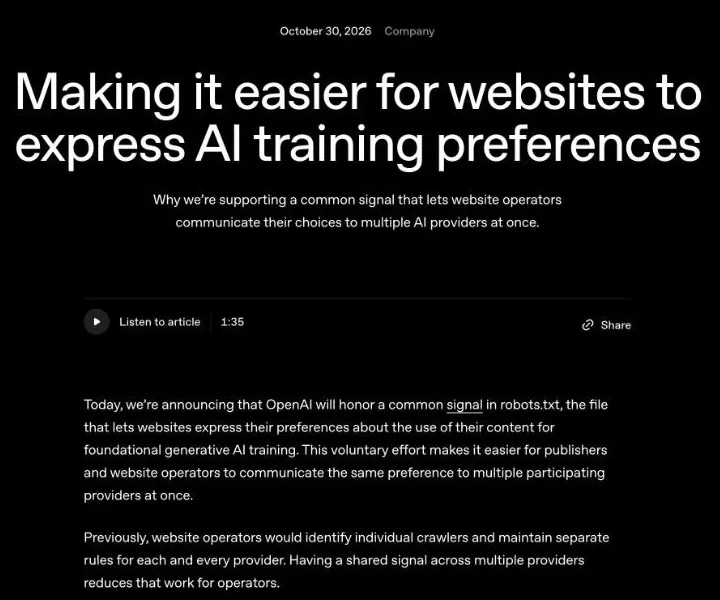
OpenAI said on October 30, 2026 that it will honor a common signal in robots.txt that tells AI providers whether a site's content may be used to train generative models. Google and Microsoft published matching plans the same day. A single robots.txt group will soon carry a site's refusal of AI training to several providers at once, yet none of the three companies reads it so far.
Until now, an AI training opt-out meant looking up each company's crawler and writing a separate rule for it. OpenAI describes the shared signal as a voluntary effort that lets one preference reach every participating provider.
When each company will honor the signal
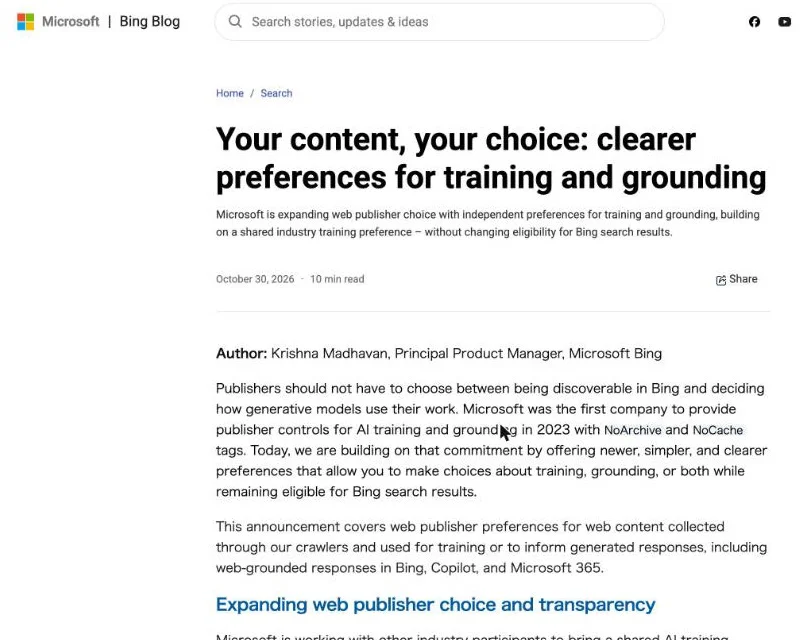
Microsoft is the earliest company with a date, February 1, 2027, while Google targets early 2027 and OpenAI only says "in the coming months." Here is how the three announcements compare.
| Company | Start | Where it was announced |
|---|---|---|
| Microsoft | February 1, 2027 | Bing blog |
| Early 2027 | Search Central Blog and crawler documentation | |
| OpenAI | In the coming months (no date) | OpenAI blog |
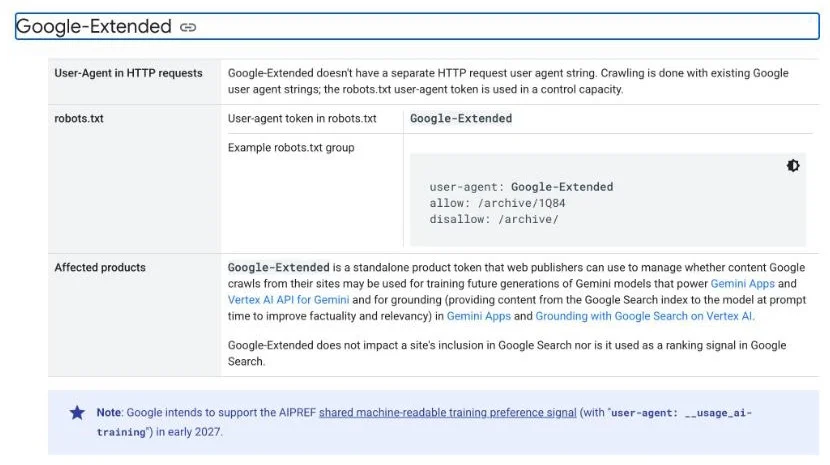
Microsoft will apply the preference to pages it crawls from that date. Google's blog post says "in 2027," and its crawler documentation narrows that to early 2027. OpenAI promises implementation details when it ships.
"Starting February 1, 2027, Microsoft will honor the new preferences as it crawls"— Microsoft Bing BlogsView official source →
"Google intends to support the AIPREF shared machine-readable training preference signal"/"in early 2027."— Google's common crawlersView official source →
"We aim to implement the signal in the coming months, and will share another update with details about our implementation when we do so."— OpenAIView official source →
Anthropic says it has already started
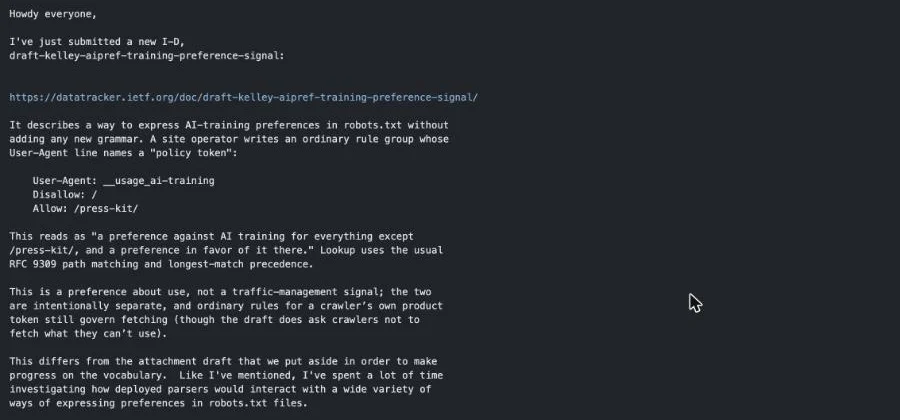
The draft's author, Kevin Kelley, works at Anthropic. Kevin Kelley wrote on the IETF mailing list that Anthropic has begun building support, though rolling it out across its services will take time. He added that the signal complements Anthropic's existing crawler controls rather than replacing them, and that its interpretation may change as the standard develops.
"I'm also excited to share that Anthropic has already started implementing support for this draft. This complements our existing crawler controls rather than replacing them."— Kevin Kelley, IETF ai-control listView official source →
The rule is an IETF draft, not a standard
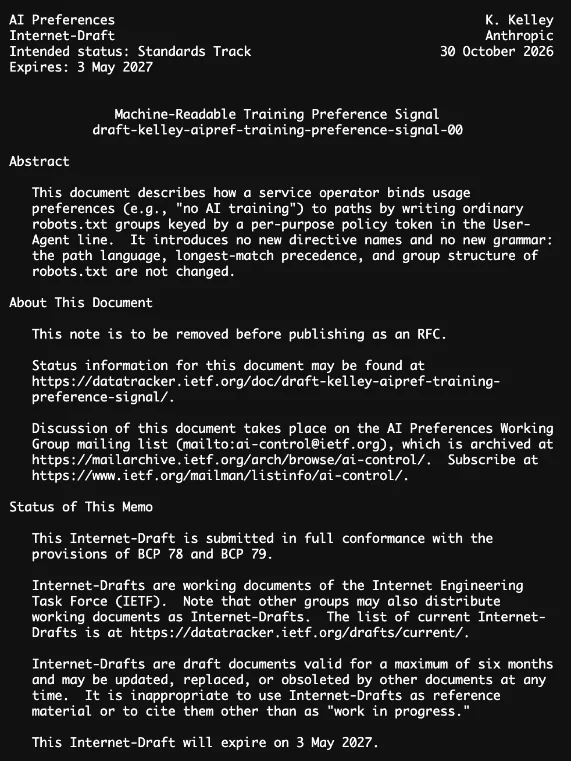
The IETF is the body that develops internet standards, and its AI Preferences working group is where the signal is being discussed. The token is defined in an individual Internet-Draft that expires on May 3, 2027, so its details can still change and only companies that opt in will follow it. Internet-Drafts are valid for six months at most and can be revised or replaced at any time.
"Internet-Drafts are draft documents valid for a maximum of six months and may be updated, replaced, or obsoleted by other documents at any time."— Status of This MemoView official source →
How to write the shared AI training opt-out
The three lines in a shared training group
The draft calls the new value a policy token: a User-Agent value that names a purpose instead of a crawler. You add a group whose User-Agent line is __usage_ai-training instead of a crawler name, then use Disallow to refuse training and Allow to permit it.
Paths, wildcards inside paths and line order follow the same RFC 9309 rules you already use, and no new directives are added. A parser that has never heard of the token treats the group like one for an unknown bot and skips it.
Block AI training across your whole site
A two-line group with "Disallow: /" under the token expresses a preference against training for every page on the site. Microsoft's announcement uses exactly this example.
User-Agent: __usage_ai-training
Disallow: /
To cover only part of a site, list a path such as Disallow: /example-path/ instead. Microsoft notes that Allow is the default, so a site that wants its pages used for training does not need to add anything.
"Allow is the default, so no robots.txt AI Training setting is needed to allow training."— Microsoft Bing BlogsView official source →
Allow training for a single folder
Adding a line such as "Allow: /press-kit/" carves one folder out of a site-wide Disallow because the longer path match wins. The draft uses a press kit as its example, a folder a company would want AI systems to learn from.
User-Agent: __usage_ai-training
Disallow: /
Allow: /press-kit/
Every URL under /press-kit/ matches both lines, and the Allow line is the longer match, so those pages carry a preference in favor of training. Everything else on the site stays opted out.
"This expresses a preference _against_ AI training for all paths except those under /press-kit/, for which it expresses a preference _in favor_ (Section 4.2)."— Section 1View official source →
Why a wildcard group does not count
Rules in a wildcard group are never read as a training preference, so a site without its own __usage_ai-training group has expressed no preference at all. That holds even if the wildcard group already says "Disallow: /".
Kelley described the exclusion as deliberate: no robots.txt file published before the draft should be read as taking a position on AI training. If you already block everything under a wildcard and also want to opt out of training, you still need to add the named group.
"However, wildcard groups (i.e., User-Agent: *) MUST NOT be interpreted as matching the policy token."— Section 4.2View official source →
What the opt-out does not change
What the shared group affects, and what it leaves alone
The token only states how your content may be used, so crawling, search indexing and each company's own robots.txt rules keep working as before. It sits next to your existing rules rather than replacing them, which matters if you expect it to stop bots or clean up old training data.
Crawlers can still fetch your pages
The draft says the token is not a crawl directive, so blocking fetches still requires a group for each crawler's own name. Microsoft makes the same point: the new settings govern how content is used, not whether a crawler can reach it. Your search listings are not affected.
The draft does allow one exception. A crawler that fetches pages only for AI training may skip pages that have opted out, so you might see fewer visits from such bots, but the draft does not require it.
"This policy token is not a directive for crawling behavior."/"If a service operator wishes to limit crawling, it MAY use groups for crawlers' product tokens in robots.txt to do so."— Section 4.4View official source →
GPTBot and Google-Extended rules still apply
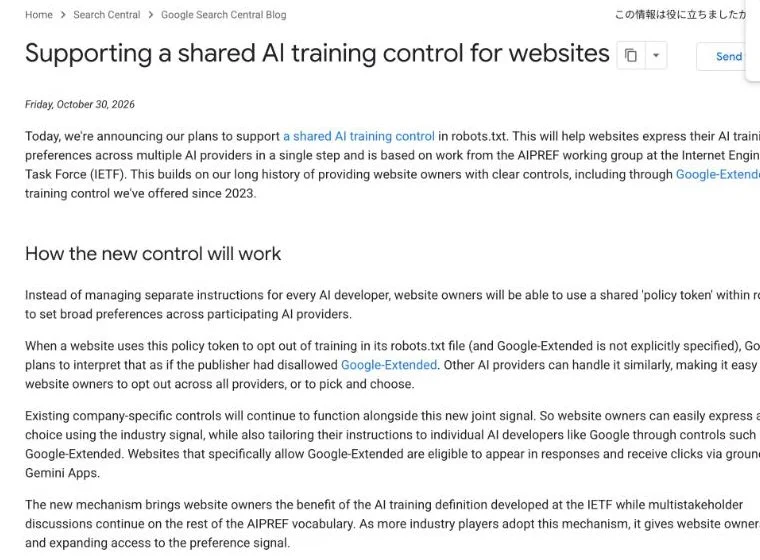
OpenAI and Google both say their company-specific controls stay in force, and a company may treat its own token as the more specific rule when the two disagree. OpenAI says the new signal will not replace the robots.txt controls it already offers. Google says its existing controls will keep working alongside the joint signal.
The draft says specific rules should win over general ones and lets companies treat their own tokens as more specific. If your GPTBot group allows training while the shared group disallows it, a company that treats its own token as more specific would follow the GPTBot rule. Keep the two pointing the same way.
"This new signal will not replace the controls we already provide through robots.txt."— OpenAIView official source →
"Existing company-specific controls will continue to function alongside this new joint signal."— Google Search Central BlogView official source →
Content collected earlier is not covered
The preference that counts is the one in the robots.txt file at the moment a page was fetched, and a private licensing deal can override it. Adding the group today says nothing about copies a provider gathered last year.
The draft also lets private agreements take precedence. A publisher with a content licensing deal should read that contract, not the robots.txt file, to know how its pages may be used.
"expressed in the robots.txt file in effect when the asset was retrieved"/"Private agreements MAY override preferences expressed via this mechanism."— Sections 3 and 4.5View official source →
How do Google and Microsoft read the signal?
Google will apply the shared opt-out to both Gemini training and grounding, while Microsoft applies it to training only and handles answers with a separate setting. That difference decides whether opting out also removes your pages from AI answers, so check which of the two results you want before you copy a template.
Effect of a shared training opt-out at each company
Google treats it as a Google-Extended block
If your robots.txt opts out with the shared token and says nothing about Google-Extended, Google plans to act as if you had disallowed Google-Extended, which also keeps your pages out of Gemini grounding. Grounding means using retrieved web content, such as search results, to support a model's answer so it is more factual. Google-Extended has controlled Gemini training and grounding since 2023.
Google-Extended has no effect on Google Search: it does not change whether a page is indexed or how it ranks. What you lose is the chance to appear in Gemini Apps answers, which Google offers only to sites that allow Google-Extended. You cannot split training from grounding at Google.
"When a website uses this policy token to opt out of training in its robots.txt file (and Google-Extended is not explicitly specified), Google plans to interpret that as if the publisher had disallowed Google-Extended"— Google Search Central BlogView official source →
"Google-Extended does not impact a site's inclusion in Google Search nor is it used as a ranking signal in Google Search."— Google's common crawlersView official source →
Microsoft keeps grounding separate
Microsoft lets you refuse training but still allow your pages to inform Copilot answers, because grounding has its own page-level Allow, Disallow and DisallowExtended values. A page-level training preference can also override robots.txt for that page.
| Grounding value | What it does |
|---|---|
| Allow | Lets the page inform AI answers |
| Disallow | Keeps the page out of grounding |
| DisallowExtended | Limits grounding to Microsoft-operated experiences such as Copilot |
Microsoft says Disallow and DisallowExtended mean less brand visibility in AI experiences but no change to Bing search eligibility. The older NoArchive and NoCache tags stop counting as training preferences after March 1, 2027.
"AI Grounding is a separate page-level preference from Microsoft that lets you manage how your content is used to help inform generated responses."— Microsoft Bing BlogsView official source →
How to opt out of AI training today
Which bots to name for each goal
Naming GPTBot, Google-Extended and ClaudeBot works now, and adding the shared group in the same file means it starts working as each company switches the signal on. None of the three companies reads the shared token yet and Anthropic is still rolling out support, so the named groups are what protect your content in the meantime.
Block the training crawlers by name
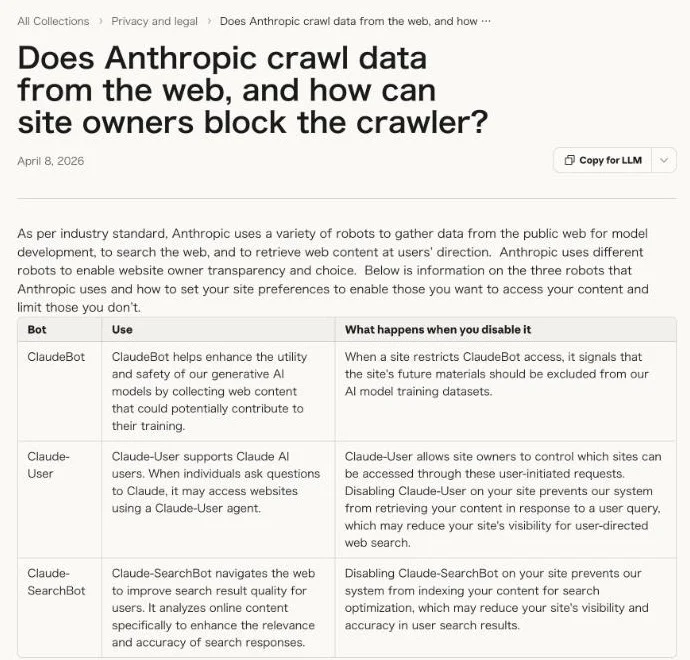
GPTBot, Google-Extended and ClaudeBot are the training crawlers for OpenAI, Google and Anthropic, and a "Disallow: /" under each one opts you out today. Anthropic says restricting ClaudeBot signals that a site's future material should be left out of its training datasets.
User-Agent: GPTBot
Disallow: /

User-Agent: Google-Extended
Disallow: /

User-Agent: ClaudeBot
Disallow: /
If you want your pages to keep showing up in Gemini answers, change the Google-Extended line to "Allow: /" rather than deleting the group. Once Google supports the shared token, a site that leaves Google-Extended out will have its shared opt-out read as a Google-Extended block.
"When a site restricts ClaudeBot access, it signals that the site's future materials should be excluded from our AI model training datasets."— Anthropic Help CenterView official source →
Leave search crawlers allowed
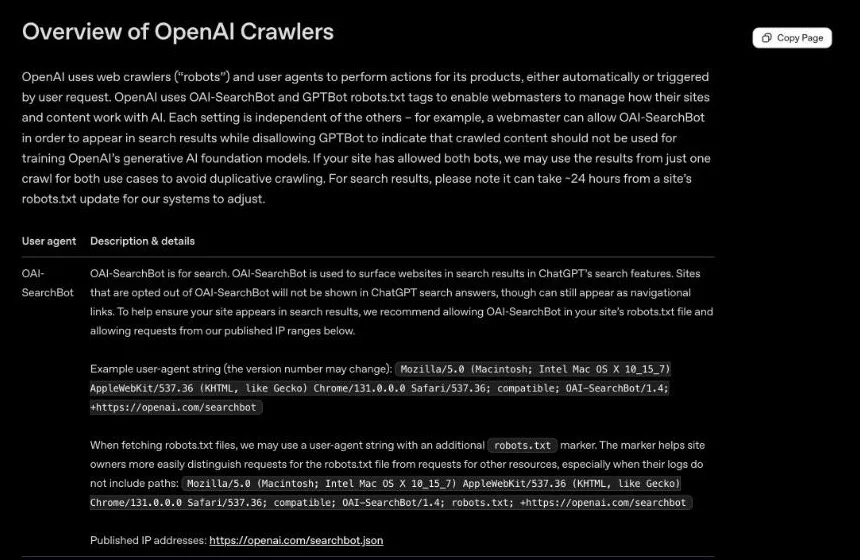
Blocking OAI-SearchBot or Claude-SearchBot removes your site from ChatGPT search answers and can lower its visibility in Claude search, so list only the training crawlers. OpenAI says each of its settings is independent, so you can stay in ChatGPT search while keeping GPTBot out.
A blanket "User-agent: *" block catches these search bots too. OpenAI also notes that a robots.txt change can take about 24 hours to show up in ChatGPT search.
"Each setting is independent of the others – for example, a webmaster can allow OAI-SearchBot in order to appear in search results while disallowing GPTBot to indicate that crawled content should not be used for training OpenAI’s generative AI foundation models."— Overview of OpenAI CrawlersView official source →
Add the shared group to the same file
Parsers that do not support the token skip its group, so adding it now costs nothing and lets it take effect on each company's start date. Put it after the named groups in the robots.txt file at the root of your domain. If your site has no robots.txt yet, create a plain text file named robots.txt with the lines below and upload it to the top level of the domain, for example example.com/robots.txt.
# Training crawlers (works today)
User-Agent: GPTBot
Disallow: /

User-Agent: Google-Extended
Disallow: /

User-Agent: ClaudeBot
Disallow: /

# Shared training signal (works as each company adopts it)
User-Agent: __usage_ai-training
Disallow: /
"will ignore policy-token groups as they would any group for a user agent they do not recognize."— Section 1View official source →
FAQ
- Does blocking AI training in robots.txt hurt my Google rankings?
- No. Google says Google-Extended, its control for Gemini training and grounding, does not affect inclusion or ranking in Google Search. Blocking it does keep your pages out of Gemini Apps answers, because Google uses the same control for grounding.
- Does __usage_ai-training work right now?
- Not at OpenAI, Google or Microsoft yet. Microsoft starts on February 1, 2027, Google targets early 2027 and OpenAI has not set a date. Anthropic has started building support. Until then, block GPTBot, Google-Extended and ClaudeBot by name and keep the shared group in the same file.
- My robots.txt already has User-agent: * with Disallow: /. Is that enough?
- Not for the shared signal. The draft says wildcard groups never match the policy token, so a file without a __usage_ai-training group expresses no training preference. Add the named group even if the wildcard already blocks everything.
- Will the opt-out remove content that was already used for training?
- No. Under the draft, the preference that applies to a page is the one in the robots.txt file in effect when the page was fetched. Pages collected before you added the group are not covered.
Related articles
 AI Comparison: ChatGPT, Claude, Gemini PricingAI comparison for 2026: ChatGPT, Claude, Gemini, and Copilot pricing and free-plan limits, plus a use-case guide to picking the plan that fits your work.
 EMBRACE flaws hit 5 AI coding tools, 2 unpatchedForever Security found flaws in the built-in browsers of Cursor, Copilot, Codex, VS Code and Claude Desktop. Codex and VS Code were unpatched at publication.
 Why OpenAI and Anthropic slashed LLM API pricingLLM API pricing at OpenAI and Anthropic fell by up to 80% in mid-2026. Max Woolf credits easy switching, cheap open-weight rivals and cheaper serving.
 OpenAI's GPT-6 arrives on Google Cloud in previewGPT-6 Astra, Sol and Luna are in Google Cloud's Model Garden for select enterprises, billed via Google Cloud. Prompts aren't used for training. No price yet.