
OpenAI's GPT-6 models arrive in Google Cloud's Model Garden
OpenAI and Google Cloud announced a partnership on October 21, 2026, putting three models from the GPT-6 family into Google Cloud's Model Garden: Astra, GPT-6.1 Sol and Luna. Model Garden is the part of Google Cloud where companies pick an AI model and call it from their own projects. It already lists more than 200 models from Google, other vendors and the open-model community.
With OpenAI on board, Google Cloud says it is now the only hyperscale cloud that offers all three leading closed-source LLMs. OpenAI's own post adds that Microsoft is still its primary cloud partner, so this is an extra route to the models rather than a move away from Azure.
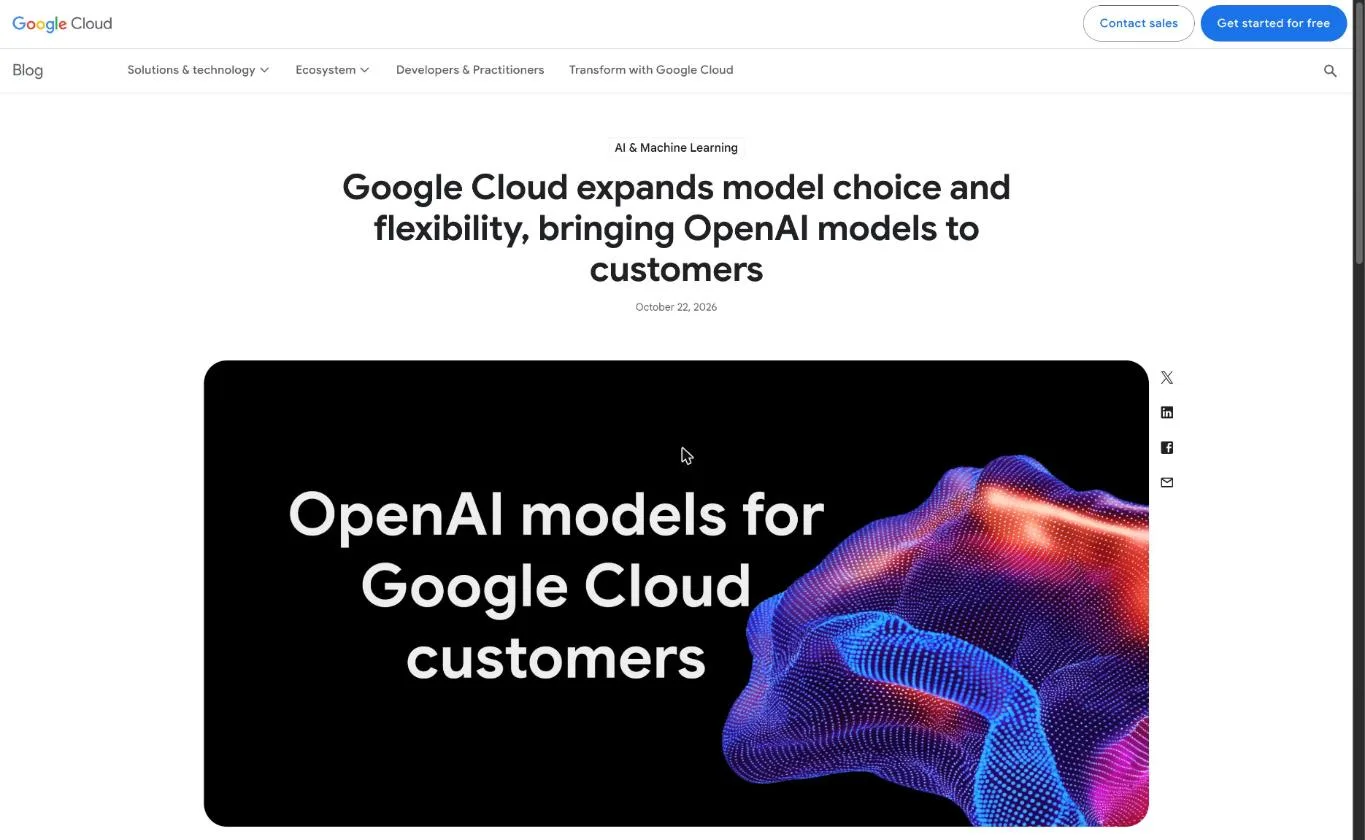
Google Cloud is now the only hyperscale cloud provider offering access to all three leading closed source LLMs, alongside more than 200 first-party, third-party, and open models on a unified enterprise AI platform. — From the opening of the announcementView official source →
Astra, Sol and Luna cover different workloads
Each model targets a different kind of job, from the hardest tasks down to high-volume routine work. Google Cloud describes them this way:
The three OpenAI models in Model Garden
Based on the Google Cloud blog post dated October 22, 2026.
Teams can switch between them per task based on quality, speed and cost. GPT-6.1 Terra, which OpenAI released on October 26 (What Is GPT-6.1 Terra? Pricing and Benchmarks), is not on the list, though Google Cloud says more models are on the way.
Codex can use the Gemini platform for inference
Developers who use OpenAI's Codex can now point the Codex CLI and the Codex desktop app at Google's Gemini platform for inference. Codex is OpenAI's coding agent, which writes and edits code on a developer's behalf. The three models are also available through Google Cloud's APIs, so companies can build them into their own apps.
Starting today, customers can build with these models through our APIs and connect their local Codex CLI and Desktop workflows directly to our Gemini platform for inference. — From the section on availabilityView official source →
Access is limited to selected enterprise customers for now
Right now the three models are in private preview, which means Google Cloud is turning them on for a limited set of enterprise customers first. Having a Google Cloud account isn't enough to get in.
OpenAI says general availability, when any customer can use them, will follow within weeks. Neither company has given a date.
General availability is planned in the coming weeks. — From the end of the announcementView official source →
Companies request access through a Google Cloud form
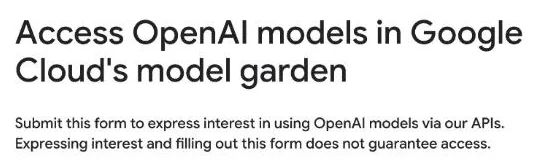
Companies that want in during the preview fill out a request form on Google Cloud's site. The form page says plainly that submitting it doesn't guarantee access. Neither announcement explains how customers are picked or how long approval takes.
If your team wants to test the models before general availability, the form is the only route. Teams that can wait will be able to use the models once the general release arrives.
Antigravity and Gemini support is coming soon
OpenAI models will soon show up inside Google Antigravity and Gemini for business as well. OpenAI's post also names the Gemini Agent. No dates were given for any of them.
Google Antigravity is Google's tool for handing coding work to AI agents (Antigravity Remote Control: Desktop, CLI, Daemon). The Gemini Agent carries out tasks for users inside Google Workspace (What is the Gemini agent? Features and pricing).
Additionally, OpenAI models will soon be available in Google Antigravity and the Gemini Agent, providing enterprise customers with model choice flexibility and the best model for each task. — From the section on upcoming integrationsView official source →
OpenAI usage is billed through Google Cloud
Companies buy the OpenAI models through Google Cloud Marketplace, and every dollar of usage shows up on their regular Google Cloud invoice. There's no separate contract to sign with OpenAI, and Google Cloud says the same holds for every model provider in Model Garden.
For a company that already runs Gemini or other models on Google Cloud, adding OpenAI doesn't create a new vendor to onboard. Procurement, budgeting and payment stay on the account the finance team already manages.
Using the platform, customers can dynamically select and swap the optimal model for any use case based on performance, latency, and cost efficiency without architectural lock-in or separate vendor contracts. — From the section on model choiceView official source →
Spend counts toward existing Google Cloud commitments
Companies with a Google Cloud spend commitment can apply their OpenAI usage against it. A commitment is an agreement to spend a set amount on Google Cloud over a fixed period, so OpenAI usage can help use up a commitment that might otherwise go unspent.
OpenAI usage also counts toward Flexible Savings Plans (FSP), Google Cloud's discount program that applies across model providers. A team running both Gemini and GPT-6 can manage the cost of both under the same plan.
Enterprises with Google Cloud spend commitments will be able to draw down their GCP commitments for these purchases. — From the section on purchasingView official source →
Neither company has published pricing yet
Neither Google Cloud nor OpenAI has said what the models will cost on Google Cloud. It's also unclear whether the rates will match what OpenAI charges through its own API. OpenAI already publishes API prices for the GPT-6 family, so a comparison will be possible once Google Cloud posts its rates.
Prompts and outputs aren't used to train models
Google Cloud says the prompts, context and outputs customers send to OpenAI models stay inside the data perimeter the customer sets, and are never used to train foundation models. A data perimeter is the boundary a company draws around where its data is allowed to go.
Every exchange between an agent and a model runs under an authenticated identity. IT administrators get VPC Service Controls protection and a unified audit log covering the whole organization.
Customer prompts, context, and outputs remain entirely within your designated data perimeter and are never used to train foundation models, with Zero Data Retention (ZDR) options available coming soon. — From the section on data governanceView official source →
The models run on dedicated Google Cloud infrastructure
On Google Cloud, OpenAI's models run on infrastructure set aside just for them. Every request passes through isolated gateways, and the data stays within Google Cloud's environment the whole way.
Google Cloud adds that outside model providers have no unauthorized access to a customer's cloud environment. Companies that are wary of sending internal data straight to OpenAI's own servers can keep it under Google Cloud's controls instead.
All queries are routed through hardened, isolated gateways, ensuring data transit remains strictly within Google Cloud's secure environment and third-party model providers have no unauthorized access to your cloud environment. — From the section on isolated accessView official source →
Zero data retention and Confidential Compute are coming soon
Two more protections are listed as coming soon: zero data retention (ZDR) and Confidential Compute. ZDR means prompts and outputs aren't stored after a request is processed, and Confidential Compute keeps data encrypted even while it's being processed. Neither is available yet, so companies whose policies forbid any retention will need to wait for ZDR.
OpenAI models run on dedicated Google Cloud infrastructure with Confidential Compute coming soon. — From the section on isolated accessView official source →
No separate OpenAI contract, but no price to compare yet
For Google Cloud customers, the contract and data questions around OpenAI's models now have answers, but the cost question doesn't. Existing agreements and commitments carry over, and data handling follows the controls the security team already uses, so there is little new paperwork to clear.
What is missing is a rate card. Until Google Cloud publishes prices at general availability, there's no way to tell whether this route is cheaper or more expensive than calling OpenAI's API directly. One thing teams can settle now is whether their own policies require zero data retention, since that option isn't live yet.
FAQ
- Can any Google Cloud customer use OpenAI models now?
- Not yet. The models are in private preview for selected enterprise customers, and companies request access through a Google Cloud form that doesn't guarantee approval. OpenAI says general availability is planned in the coming weeks.
- How much do OpenAI models cost on Google Cloud?
- Neither Google Cloud nor OpenAI has published pricing. Purchases go through Google Cloud Marketplace, appear on the Google Cloud invoice and can draw down existing Google Cloud commitments.
- Is GPT-6.1 Terra available on Google Cloud?
- No. The models in Model Garden are GPT-6 Astra, GPT-6.1 Sol and GPT-6 Luna. Google Cloud says more models are coming soon but hasn't named them.
Related articles
 What Is GPT-6.1 Terra? Pricing and BenchmarksGPT-6.1 Terra, OpenAI's mid-tier GPT-6 model out Oct. 26, 2026, costs $1 input and $5 output per 1M tokens, half of Sol's, and matches Astra on computer use.
 GPT-6 in ChatGPT: release dates and Intelligent UIGPT-6 reached ChatGPT on October 7, 2026: Sol for paid plans, Luna for free and Go from October 8, and Intelligent UI answers with charts and buttons.
 AI crawler training opt-out in one robots.txt ruleAI crawler training opt-out now takes one robots.txt rule. OpenAI, Google and Microsoft will honor it, Microsoft from Feb. 1, 2027. Until then, name each bot.
 OpenAI finds a code execution flaw in BrotliOpenAI Codex Security found a Brotli decoder flaw (CVE-2026-111497). Google, Node.js and Bun have shipped fixes; here are the versions and OpenAI's stopgap.