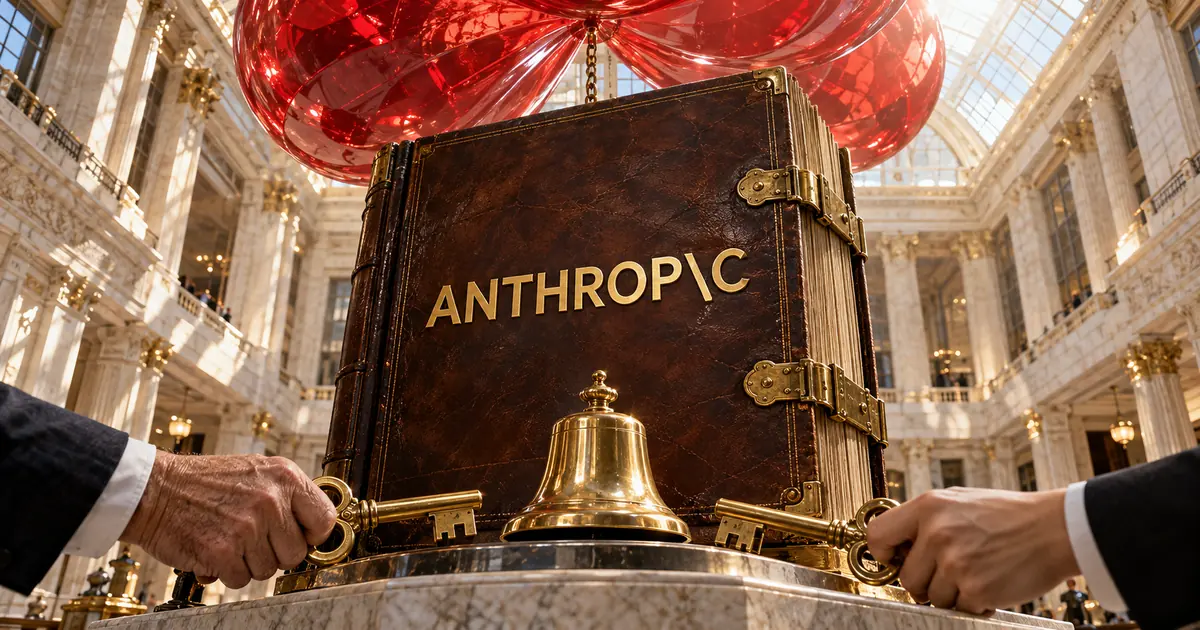
Anthropic files to list on Nasdaq as ANT, with no price yet
Anthropic, the company behind Claude, published its Form S-1 with the US Securities and Exchange Commission (SEC) on October 26, 2026. An S-1 is the registration statement a company files before an initial public offering (IPO), and it contains the prospectus that buyers receive. Anthropic plans to list its Class A shares on the Nasdaq Global Select Market under the ticker ANT.
The share count and the price range are still blank, and the registration has not taken effect, so nobody can place an order yet. Goldman Sachs and Morgan Stanley are named as the contacts for the preliminary prospectus. The filing follows a draft that Anthropic sent to the SEC privately on June 1 (see Anthropic IPO: Date, Price and What Is Confirmed).
The money raised would go to general corporate purposes. The S-1 lists working capital, operating costs, spending on compute and infrastructure, and hiring and keeping skilled staff. It adds that Anthropic may buy or invest in other businesses but has no major deal lined up.
What the filing settles and what it leaves open
| Item | Status in the announcement and S-1 |
|---|---|
| Filing date | October 26, 2026 |
| Exchange | Nasdaq Global Select Market |
| Ticker | ANT |
| Shares offered | Class A common stock |
| Share count and price range | Not set (blank in the S-1) |
| Listing date | Not stated |
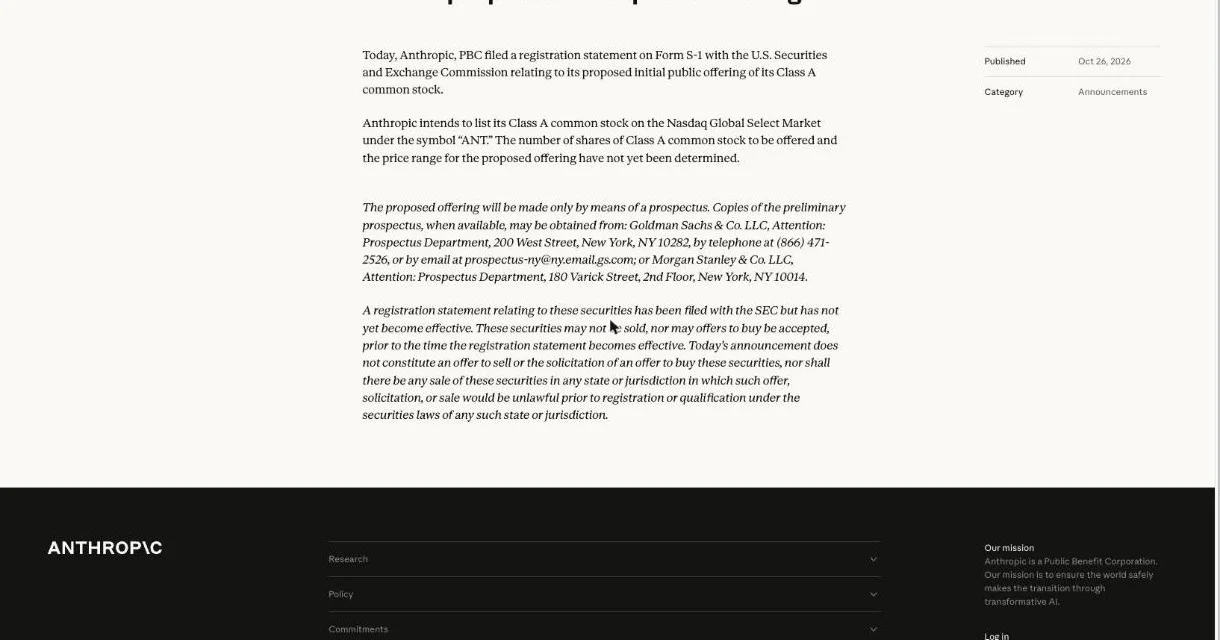
"Today, Anthropic, PBC filed a registration statement on Form S-1 with the U.S. Securities and Exchange Commission relating to its proposed initial public offering of its Class A common stock."/"Anthropic intends to list its Class A common stock on the Nasdaq Global Select Market under the symbol “ANT.” The number of shares of Class A common stock to be offered and the price range for the proposed offering have not yet been determined."— Anthropic announcementView official source →
First-half revenue rose 1,300% to $16.3 billion
Anthropic booked $16.3 billion of revenue in the six months to June 30, 2026, against $1.16 billion a year before. The S-1 puts the growth at 1,300%. The annual figures show the same climb: $41 million in 2023, $386 million in 2024 and $4.6 billion in 2025.
Anthropic revenue by period
| Period | Revenue |
|---|---|
| 2023 | $41 million |
| 2024 | $386 million |
| 2025 | $4.6 billion |
| First half of 2025 | $1.16 billion |
| First half of 2026 | $16.3 billion |
Bigger accounts are piling up too. As of September 30, 2026, more than 11,900 customers had paid at least $100,000 over the trailing twelve months. More than 1,900 had paid at least $1 million, and about 250 had paid at least $10 million.
Net revenue retention, which compares what existing customers spend now with what they spent a year earlier, stood at about 900%. A customer paying the same as last year would score 100%, so existing customers as a group now pay roughly nine times what they did. The figure leaves out Claude Pro and Max subscribers.
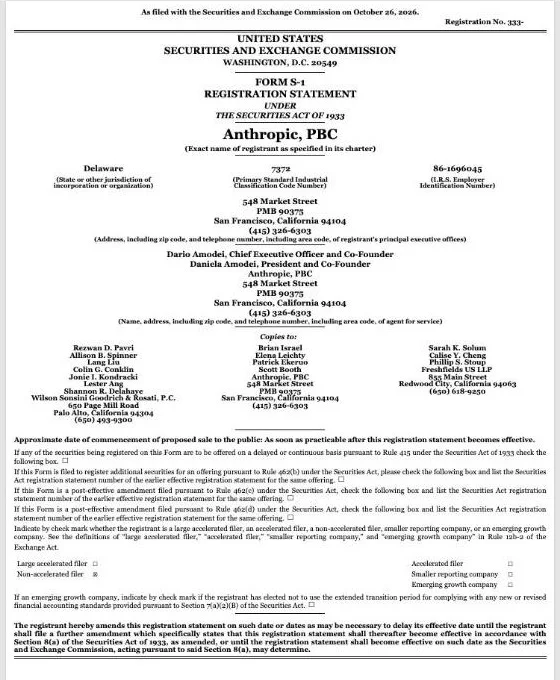
"In the six months ended June 30, 2026, our revenue was $16.3 billion, representing a year-over-year growth rate of 1,300%."— Form S-1View official source →
$72.4 billion of the $80.7 billion loss involves no cash
Anthropic lost $80.7 billion in the first half of 2026, but $72.4 billion of that, about 90%, is an accounting charge rather than money spent. The charge sits on convertible notes, which are loans that can later turn into shares, along with related derivatives and SAFEs (simple agreements for future equity). These are carried at fair value, the price they would fetch if sold today.
When Anthropic's valuation rises, the shares those notes can become are worth more, so the notes count as a bigger liability and the increase is booked as a loss. The S-1 gives the higher fair value of the convertible notes as the main reason. The same item cost $34.3 billion in 2025, when the full-year net loss was $42.0 billion.
The operating line, which shows how the business itself performs, tells a different story. The operating loss for the half was $693 million, down from about $2.1 billion a year earlier, on operating expenses of $17.0 billion. Compute and infrastructure made up about 53% of those expenses.
Anthropic's first-half 2026 results, line by line
| Line | Amount | Cash involved? |
|---|---|---|
| Revenue | $16.3 billion | Yes, received |
| Operating expenses | $17.0 billion | Yes, paid |
| Operating loss | $693 million | Revenue minus operating expenses |
| Fair-value change on notes, derivatives and SAFEs | $72.4 billion | No |
| Net loss | $80.7 billion | Bottom line after all items, including the charge |
The quarters show the turn. In the first quarter, revenue was $4.7 billion and the operating loss was $1.7 billion. In the second quarter, revenue rose to $11.6 billion and Anthropic made an operating profit of $974 million.
"primarily driven by an increase in the fair value of our outstanding convertible promissory notes resulting from an increase in our enterprise valuation during each of the respective periods."— Form S-1View official source →
No customer tops 10% of revenue, but new models drive sales
No single customer brought in more than 10% of Anthropic's revenue in the nine months to September 30, 2026, though the top five together made up about 25%. The spread is widening. In the third quarter, about 79% of revenue came from customers outside the top five, up from about 64% in the first quarter.
The S-1 still treats its biggest buyers as a risk. If one or more of them cut spending sharply or left, and new business did not fill the gap, results could suffer.
Revenue also depends on the release schedule. Claude versions released in the six months to September 30 made up over 80% of revenue in the third quarter.
The risk section adds that customers who built older models into their work may resist moving to new ones, and that Anthropic has changed usage limits, rate limits and model capabilities before and may do so again. Teams that rely on Claude in production should plan for model retirements and limit changes as part of normal operations.
"model versions released in the six months ended September 30, 2026 accounted for over 80% of our revenue for the three months ended September 30, 2026."— Form S-1View official source →
A trust picks most of the board and the founders hold 50.1% of votes
After the IPO, a trust will choose most of Anthropic's directors and a company owned by the seven co-founders will hold 50.1% of the shareholder vote. Class A buyers get one vote per share, but those two blocks leave them unable to decide who sits on the board.
Anthropic is a Delaware public benefit corporation, a company whose charter names a public purpose next to profit. Its charter commits it to building and running advanced AI responsibly so that humanity gains from it over the long run, and directors must weigh three things:
- the financial interests of stockholders
- the interests of people materially affected by the company's conduct
- that public purpose
The Long-Term Benefit Trust, set up in 2023, has five voting trustees with no financial stake in the company. It will hold the single Class T share, which lets it elect and remove the directors who form a board majority. It has no role in day-to-day running or strategy.
The co-founders, including CEO Dario Amodei and President Daniela Amodei, hold one Class F share through Founder LLC. That share carries 50.1% of the total vote and no economic rights.
Anthropic's five share classes after the IPO
| Class | Held by | Voting rights |
|---|---|---|
| A | Public buyers in this offering | One vote per share |
| N | Mainly strategic business partners | None, except where the law requires |
| T (one share) | Long-Term Benefit Trust | Elects and removes a board majority |
| E | Employees other than the co-founders | Limited matters only |
| F (one share) | Founder LLC, owned by the seven co-founders | 50.1% of the total vote |
Because the trust picks a board majority, Anthropic counts as a controlled company under Nasdaq rules, meaning it may skip some governance requirements. The S-1 says it expects to use that exemption only for its nominating and corporate governance committee, which will not be made up entirely of independent directors.
The offering also reaches beyond the US. It includes public offerings in Australia, Canada, some European Economic Area countries, Japan, Switzerland and the UK, but Anthropic does not plan to list the shares on any exchange in those places.
"The LTBT is intended to operate as an independent body of five financially disinterested voting trustees (“Trustees”) with expertise in AI safety, national security, public policy, and social enterprise."/"Our Class F common stock, which will be held by the Founder LLC, will be entitled to an aggregate number of votes that equals 50.1% of the total voting power of our outstanding shares of capital stock with respect to matters submitted to stockholders generally, including the election of our directors other than the Class T directors."— Form S-1View official source →
The loss and shareholder control are separate questions
The filing answers two questions that headlines tend to merge: how healthy the business is, and how much a shareholder can steer it. The $80.7 billion figure grows when the company's valuation grows, so on its own it says little about whether Claude makes money. The operating line does that job, and it moved into profit in the second quarter.
Control does not depend on results. It is fixed by the share classes, so a Class A holder's position stays the same whether the next quarter brings a profit or a loss.
Someone weighing the stock, or relying on Claude at work, gets a clearer picture by checking the operating results for the business and the share classes for the vote. Reading the net loss as a verdict on both mixes up two things the S-1 keeps apart.
FAQ
- When is the Anthropic IPO date?
- Anthropic has not announced one. The October 26 announcement says the share count and price range are not yet set, and the S-1 leaves the listing date out. The registration must take effect before any shares can be sold.
- Is Anthropic profitable?
- Not on a net basis. It lost $80.7 billion in the first half of 2026, but $72.4 billion of that was a non-cash charge on convertible notes. The operating loss for the half was $693 million, and the second quarter alone showed an operating profit of $974 million.
- Will public shareholders control Anthropic?
- No. Class A shares carry one vote each, but Founder LLC, owned by the seven co-founders, holds 50.1% of the total vote, and the Long-Term Benefit Trust elects a majority of the board.
Related articles
 Anthropic IPO: Date, Price and What Is ConfirmedAnthropic IPO date, price and ticker are unset as of Oct. 16, 2026. Bloomberg points to late November. See what is confirmed and what is only reported.
 Anthropic Revenue Run Rate Tops $65B Ahead of IPOAnthropic told investors its Q3 2026 revenue hit $16.8 billion, about 45% above Q2, reports say. See how it fits with the $65B run rate and a November IPO.
 Anthropic Buys One-Person Biotech Mithril MedicineAnthropic acquired Mithril Medicine, a one-person biotech that used Claude to run 11 labs. Its muscular dystrophy drug could enter human trials in late 2028.
 OpenAI Trims Round to $20B at a $1.25T ValuationOpenAI now seeks up to $20B, down from $30B, at a $1.25T post-money valuation per the FT. September's $1.4T was pre-money, so the two don't compare directly.