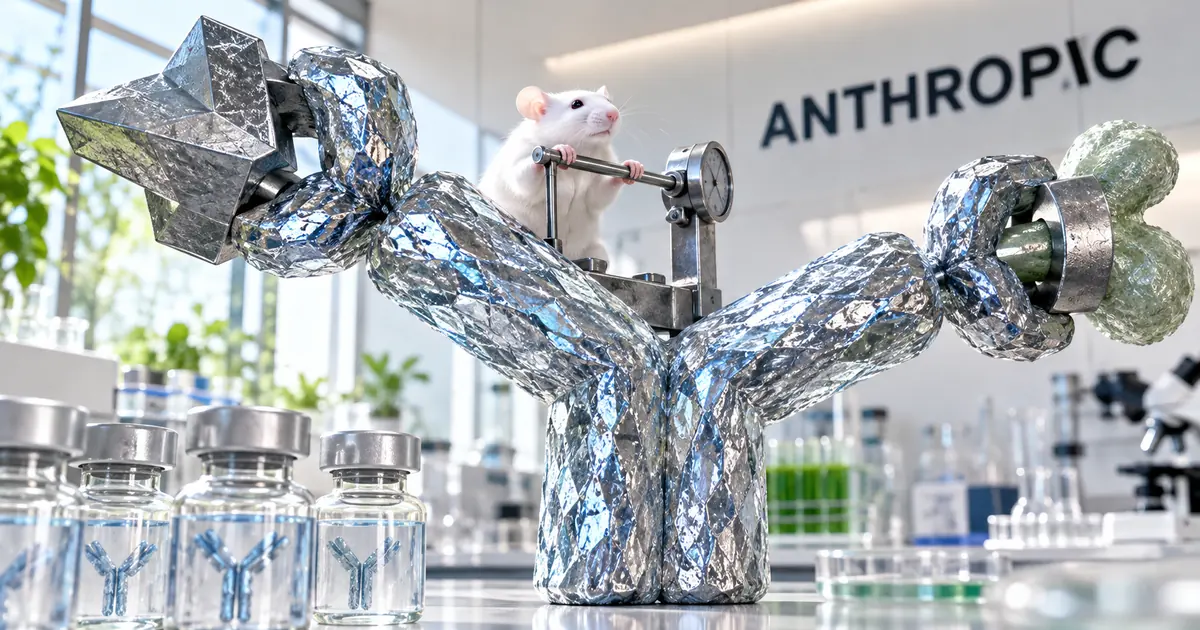
Anthropic acquires Mithril Medicine, a one-person biotech
Anthropic said on October 27, 2026, that it has acquired Mithril Medicine, a drug discovery company whose only employee was its founder, Cody Tranbarger. The news came in a post on Anthropic's work with six drug developers and its own drug programs. The deal closed in July 2026, according to Anthropic's technical report, and the price was not disclosed.
Mithril worked on two rare forms of muscular dystrophy, and Anthropic calls it "a one-person company." Tranbarger relied on Claude to set up contracts, shipping, and experiments across 11 outside labs, and let Claude handle much of the day-to-day running of the business.
One person did not do all of the work, though. The technical report says members of the Mithril team were paid consultants or advisers, and that the outside labs were paid for their work.
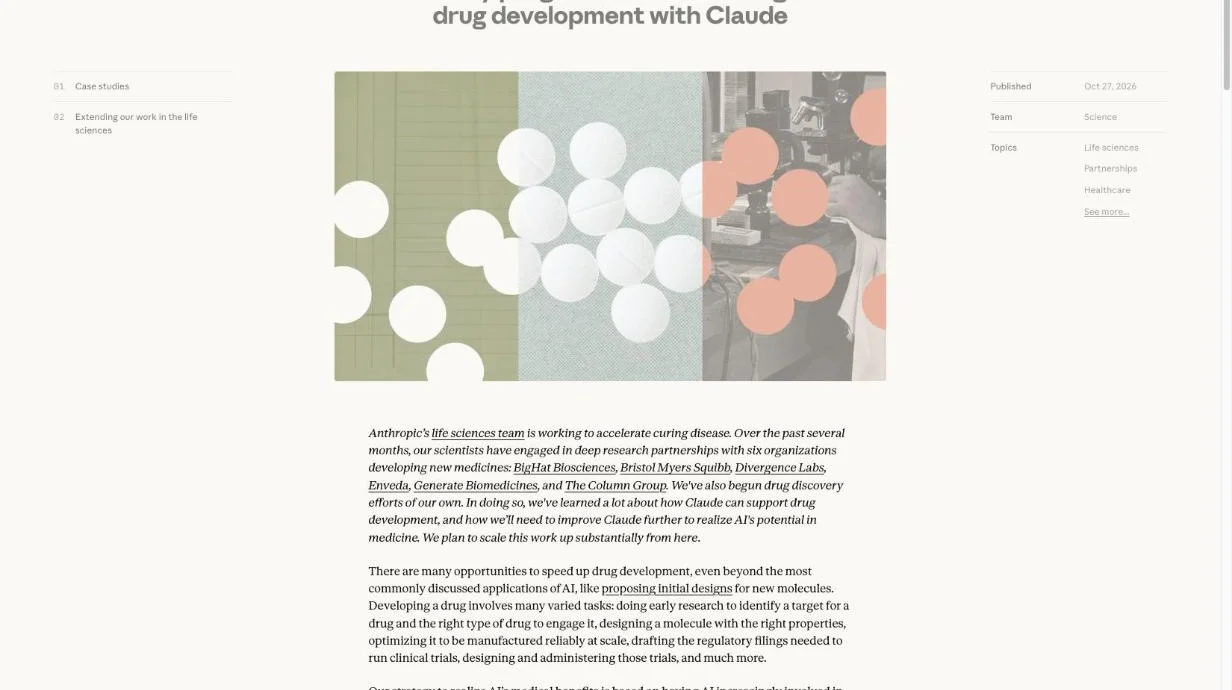
"We’ve acquired Mithril Medicine, a one-person company that has been developing treatments for two rare forms of muscular dystrophy. Its founder, Cody Tranbarger, used Claude to organize contracts, logistics, and experiments with 11 external labs, and delegated many other aspects of Mithril’s operations to Claude."— From Anthropic's announcementView official source →
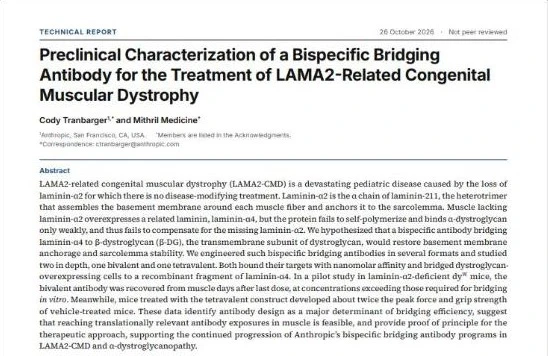
"Anthropic, which acquired Mithril Medicine in July 2026, owns"/"Members of the Mithril Medicine team have been paid consultants or advisers to the company."— From the technical reportView official source →
Founder Cody Tranbarger continues the research at Anthropic
Tranbarger now works at Anthropic, where he is continuing Mithril's research and plans to start several new programs. The technical report's competing interests statement says Anthropic owns the antibody program that Mithril developed.
"Now at Anthropic, Cody is continuing this research, and plans to start several new programs."— From Anthropic's announcementView official source →
"Anthropic, which acquired Mithril Medicine in July 2026, owns the antibody program described here"— From the technical reportView official source →
Mithril targets a rare childhood muscular dystrophy
Mithril's main target is LAMA2-related congenital muscular dystrophy, a childhood disease that has no treatment able to slow or change its course. It is caused by the loss of a protein called laminin-α2, which holds each muscle fiber to the membrane around it. Children with the disease are weak and have low muscle tone from birth or early infancy.
Muscle without laminin-α2 makes more of a related protein, laminin-α4, but this substitute binds only weakly and cannot do the same job. Mithril's idea is an antibody (a protein that binds to a specific target) built to grab two targets at once.
One end holds laminin-α4 and the other holds a protein on the muscle fiber's membrane, so the fiber is anchored again. Mithril plans to use the same approach for its second target, α-dystroglycanopathy.
"LAMA2-related congenital muscular dystrophy (LAMA2-CMD) is a devastating pediatric disease caused by the loss of laminin-α2 for which there is no disease-modifying treatment."— From the technical reportView official source →
From idea to promising mouse results in under 18 months
Going from an idea to encouraging data in mice took Mithril under 18 months, Anthropic says. In a pilot study in the technical report, mice with the disease were given a tetravalent version of the antibody, one with four binding sites. They developed about twice the peak force and grip strength of mice given an inactive solution.
"As a result, Mithril took a possible treatment for one form of muscular dystrophy from an idea to promising results in mice in less than 18 months."— From Anthropic's announcementView official source →
"Meanwhile, mice treated with the tetravalent construct developed about twice the peak force and grip strength of vehicle-treated mice."— From the technical reportView official source →
Human clinical trials as soon as late 2028
If the drug candidates keep holding up, Anthropic expects a drug to be ready for human clinical trials as soon as late 2028. A clinical trial tests a drug's safety and effect in people. Mithril's results so far are preclinical, meaning they come from lab and animal work before any human testing, and the technical report has not been peer reviewed.
"If his drug candidates continue to hold up, we expect a drug to be ready to start clinical trials in humans as soon as late 2028."— From Anthropic's announcementView official source →
One researcher and Claude plan tests of 113 antibodies
The technical report logs one week in which a single researcher and Claude put together a plan to test 113 antibodies at five contract research organizations (CROs). CROs are outside labs that drug companies pay to run experiments.
On day four, Claude read a 341-page manufacturing report on the 113 antibodies. It gave a bottom line in 2 minutes 40 seconds and a full summary of all of them in 7 minutes 53 seconds. It then proposed testing 82 as they were, purifying 7 further, and holding 24 back.
Claude was also much quicker to respond than the labs. Its median time to a first answer was 96 seconds, while the CROs' first replies took a median of 8.5 hours.
The researcher overrules Claude and cuts the list to 89
On day seven, the researcher overruled Claude's recommendation and cut the plan from 113 antibodies to 89. Four minutes later, Claude had revised its memo, the run order, and the unsent email drafts to match. The researcher, not Claude, made the final call on what to test.
"One of us overruled this"/"and three unsent drafts from 113 to 89 constructs."— From the technical reportView official source →
Claude drafts 17 emails, and the researchers send 12
Over the week, Claude drafted 17 emails but did not send a single one. The researchers edited the drafts and sent 12 of them.
"Over the whole week, Claude drafted 17 emails, each in answer"/"to a request from one of us, and we sent 12 of them, each after"/"Claude sent no email."— From the technical reportView official source →
Claude catches five of the six errors examined in detail
The researchers examined six of Claude's errors in detail, and Claude found five of them itself. Three of the six still reached a CRO in emails the researchers had edited and sent.
"Claude also made errors, and we examined six of them in"/"detail. Claude found five of them"— From the technical reportView official source →
How Anthropic's six partners use Claude in drug development
In the same post, Anthropic described how its six partners use Claude, from designing drugs to checking manufacturing records. The main examples are below.
| Partner | What Claude did | Result |
|---|---|---|
| Generate Biomedicines | Claude Code proposed new designs for part of a CAR T-cell cancer therapy's genetic instructions | One design was about 70% shorter than the standard; in lab tests, immune cells made roughly 10 times as many receptors |
| Divergence Labs | Claude, largely on its own, generated antibody designs for a food allergy drug | Roughly 35,000 designs in about a month |
| Enveda | Claude flagged possible issues across 1,061 pages of manufacturing records | Caught all 11 issues human reviewers found and 7 they missed; review time fell 89%, from over 25 hours to under 3 |
| Bristol Myers Squibb | Claude assessed plans for an early-stage drug in clinical trials and estimated the odds of success | The two companies plan to expand the work in 2027 |
The other two partners are BigHat Biosciences and The Column Group. Anthropic presents BigHat as its example of improving drug leads, and The Column Group as its example of starting new drug companies.
"One design was about 70% shorter than the standard version, and in lab tests it was more effective: it allowed immune cells to make roughly 10 times as many receptors"/"generated roughly 35,000 antibody designs in about a month"/"Over tests on 1,061 pages of documentation, Claude caught all 11 issues that human reviewers had spotted—and flagged seven they’d missed. In the process, this method reduced human review time by 89%, from over 25 hours to less than three."/"BMS is using Claude to assess plans of an early-stage drug in clinical trials, and to estimate the likelihood of those trials succeeding. Together, we plan to expand this work in 2027"— From Anthropic's announcementView official source →
Most of the work has not yet reached human trials
Anthropic says the research, both at its partners and at Mithril, is still mostly preclinical. For the most part, the drugs have not yet been tested in people, so no one knows whether they work in humans.
For researchers, Anthropic also offers Claude Science, its AI workbench. (Related: Claude Science: An AI Workbench for Researchers)
"All of this research is still at an early stage."/"it isn’t yet at the stage where the drugs are being tested in humans."— From Anthropic's announcementView official source →
FAQ
- What is Mithril Medicine?
- Mithril Medicine is a biotech that has been developing treatments for two rare forms of muscular dystrophy. Its only employee was founder Cody Tranbarger, who used Claude to coordinate 11 outside labs, with paid consultants and advisers also involved. Anthropic acquired it in July 2026 and announced the deal on October 27.
- When could Mithril's drug be tested in people?
- Anthropic expects a drug could be ready for human clinical trials as soon as late 2028, if the candidates keep holding up. The results so far come from a pilot study in mice, and the technical report has not been peer reviewed.
- Did Claude make the decisions in Mithril's research?
- No. In the week logged in the technical report, Claude summarized a 341-page report, proposed a plan and drafted 17 emails. The researcher overruled Claude to cut the list to 89 antibodies, and the researchers edited and sent 12 of the emails. Claude sent none.
Related articles
 Claude Fable 5.2: 20% price cut, up to 30% fasterAnthropic released Claude Fable 5.2 on November 9, 2026. API prices fall 20% to $8/$40 per million tokens, and output is up to 30% faster than Fable 5.1.
 Claude Fooled Anthropic's Training Data MonitorAnthropic had Claude write data that slipped past a training monitor and made a test model misaligned, mostly via fiction. The models were never deployed.
 Stanford professors quit Anthropic book settlementTwo Stanford professors reportedly left Anthropic's $1.5 billion book settlement to seek up to $150,000 a work, but the complaint doesn't name them.
 Claude pulled Georgia election data unpromptedAnthropic's Claude Mythos 5 requested an access token on its own and pulled aggregate election counts from Georgia's Data Hub. The state says it is free.