
Stanford professors opt out of the Bartz settlement
The report at a glance
Two Stanford English professors reportedly turned down a payout of about $3,000 per book so they could seek damages for their own works in court. The campus newspaper The Stanford Daily broke the story on October 27, 2026. It says books by more than 10 Stanford faculty members were among the pirated copies Anthropic used to train Claude.
The paper names six of them. Wolff and Lee are the two it says opted out:
- Tobias Wolff
- Abraham Verghese
- Chang-rae Lee
- Daniel Mason
- Hayagreeva Rao
- Myra Strober
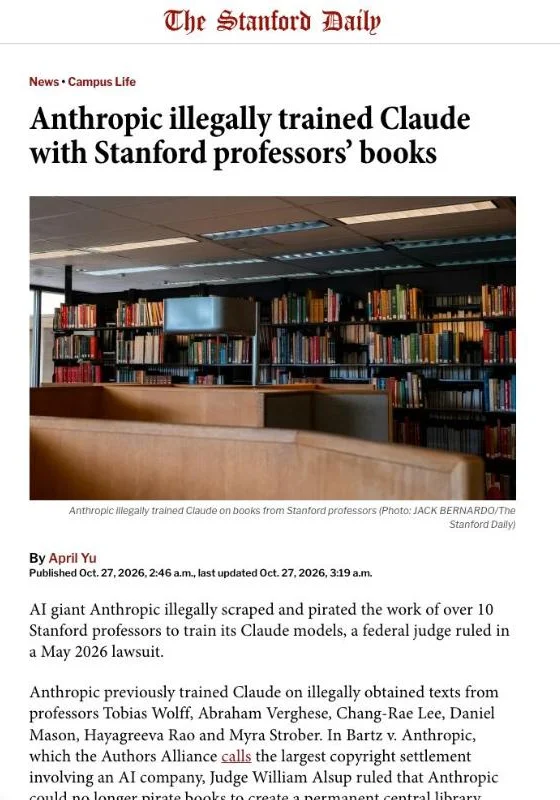
Tobias Wolff and Chang-rae Lee left the class
In a class action, a settlement binds everyone in the class unless they formally leave it before a deadline. Leaving, known as opting out, gives up the settlement payment but keeps the right to sue on your own.
According to The Stanford Daily, Wolff and Lee opted out of the Bartz settlement and filed a separate, non-class lawsuit in May 2026. Bartz v. Anthropic is the class action that author Andrea Bartz and others brought over pirated books.
Not every Stanford author left. Paul Goldstein, an intellectual property scholar at Stanford Law School, is still a member of the class. He told the paper that the root problem is transaction costs, because no AI company can realistically license every one of the millions of works it trains on.
"Wolff, along with English professor Chang-rae Lee, opted out of the Bartz settlement."/"The essential problem … is what economists call ‘transaction costs,’" — from the paragraphs on the opt-outs and Goldstein's commentsView official source →
Wolff calls unpaid use a form of slave labor
Wolff is a professor emeritus of English at Stanford and a recipient of the National Medal of Arts. He explained to The Stanford Daily why he left the settlement.
Wolff, who says 10 of his books were used without permission, argues that the settlement leaves Anthropic largely free to use literature as it likes. He compared being put to work without pay to slave labor. He added that he is fortunate to earn a living from writing, and that his real concern is whether the younger writers he has taught can do the same.
"10 of Wolff’s publications had been used for AI training without permission."/"To put me to work that way, without remittance, is a form of slave labor," — from Wolff's comments to the paperView official source →
Two opt-out lawsuits were filed in May 2026
Court records and a litigation database show two suits brought by authors who left the settlement, both in the US District Court for the Northern District of California. Both were filed in the same week as the May 14 hearing on final approval of the Bartz settlement.
Opt-out lawsuits against Anthropic
| Case | Filed | Plaintiffs | Case number |
|---|---|---|---|
| Cruz v. Anthropic | May 13, 2026 | 28, led by Angie Cruz | 3:26-cv-04482 |
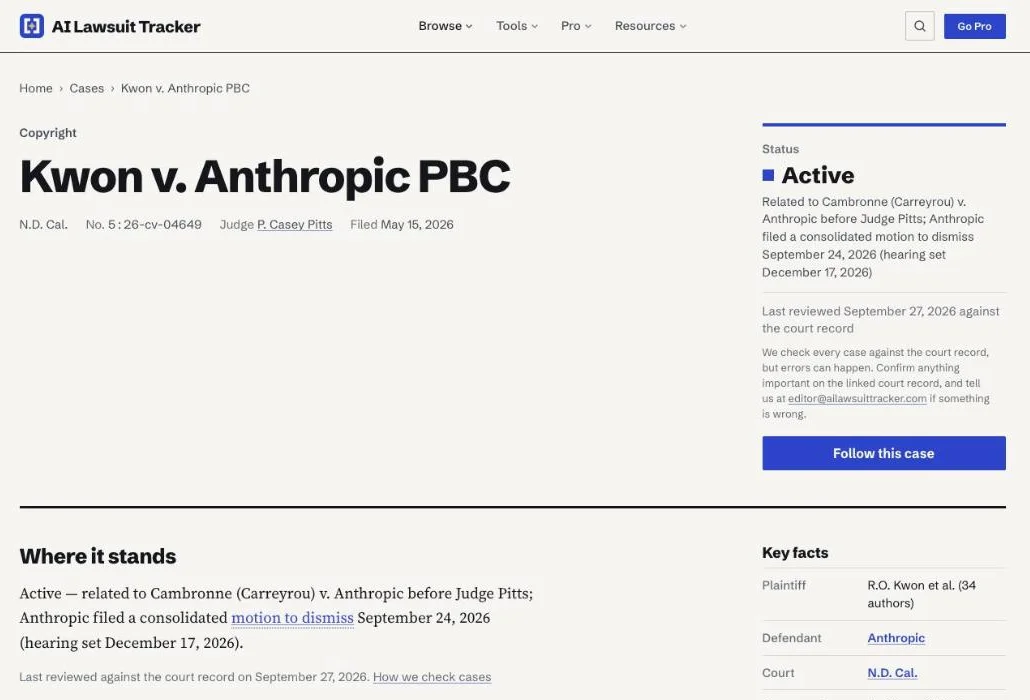
| Kwon v. Anthropic | May 15, 2026 | 34, led by R.O. Kwon | 5:26-cv-04649 |
Authors who left the settlement now have two cases in the same federal court, one brought by 28 plaintiffs on May 13 and one by 34 plaintiffs on May 15. Neither is a class action. Each plaintiff asks for damages on their own works.
The Stanford Daily counts more than 70 copyright suits against AI companies. Music rights holders have brought their own cases too (see Elvis rights holders sue Anthropic over 274 songs). Authors Guild CEO Mary Rasenberger told the paper the group is lobbying Congress for a law that would require AI companies to license books.
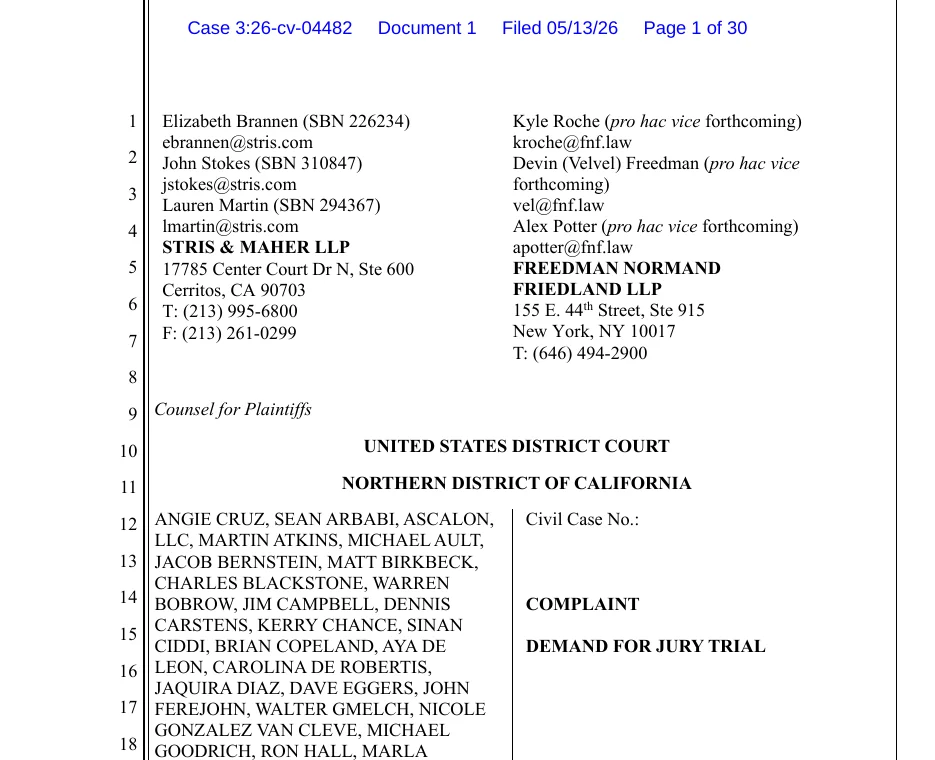
"Plaintiffs have opted out of the Bartz v. Anthropic Settlement to pursue this action, each in their individual capacity." — from the parties section of the complaintView official source →
"opted out of the Bartz v. Anthropic class settlement and are pursuing individual statutory damages" — from the case summaryView official source →
About $3,000 per book versus up to $150,000
Settlement payment versus the opt-out claim
| Path | Amount per work | Status |
|---|---|---|
| Stay in the settlement | About $3,000 | Final approval on July 20, 2026 |
| Opt out and sue | Up to $150,000 for willful infringement | No ruling yet |
Opting out trades a near-certain settlement check for a chance at the statutory maximum, which a jury awards only for willful infringement. The $150,000 figure is the most the law allows, not an amount anyone has been promised. To get near it, the authors would have to show that Anthropic infringed on purpose.
The $1.5 billion settlement won final approval in July
Authors including Andrea Bartz filed Bartz v. Anthropic as a class action in 2024. On July 20, 2026, Judge Araceli Martínez-Olguín of the same federal court granted final approval to its settlement.
Under the deal, Anthropic pays the owners of 482,460 listed works and must destroy the pirated files it downloaded. The fund is $1.5 billion, and the court estimated each work would receive about $3,000 before costs and fees. By April 16, 2026, owners of 91.3% of the listed works, or 440,490 works, had filed claims.
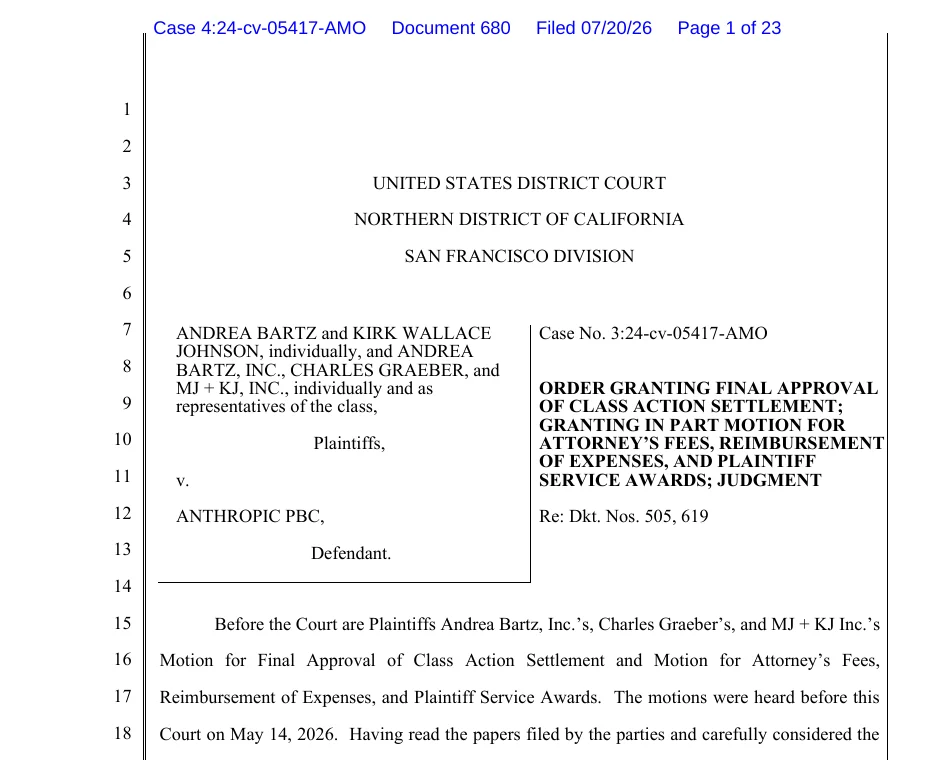
"The estimated per-work payment of approximately $3,000 is four times the minimum statutory damages amount"/"for a total of 440,490 works of the 482,460 Works on the Works List" — from the court's assessment of the settlementView official source →
How statutory damages work for copyright owners
Statutory damages are amounts the Copyright Act sets for each infringed work, and the Cruz complaint asks a jury to fix them. A court can award between $750 and $150,000 for each infringed work, and the top of that range is reserved for willful infringement.
The order describes the $3,000 settlement payment as four times the $750 floor for ordinary infringement. The class notice gave an even wider range, from $200 to $150,000 per work.
This is why the Cruz plaintiffs chose not to sue as a class. They want a jury to decide the amount for each of their works.
"Plaintiffs elect not to bring this case as a class action because the Copyright Act entitles them to recover individualized statutory damages, determined by a jury" — from the complaint's explanation of why it is not a class actionView official source →
Only 350 valid opt-outs covering 1,802 works
The opt-out deadline was February 9, 2026. Requests that arrived later were rejected, except for two people whose delay the court excused.
Opt-outs were a small fraction of the class, and authors who stayed in still keep claims about AI outputs and about conduct from August 25, 2025 onward. The settlement only releases claims about how Anthropic obtained and copied books in the past. Claims about what Claude produces, and about anything Anthropic does from that date on, remain open to everyone.
"only 350 valid opt outs, spanning just 1,802 Works, were timely submitted"/"But they do not give up claims about past AI outputs, nor claims of any kind about future conduct (on or after August 25, 2025)." — from the order's discussion of opt-outs and the releaseView official source →
What the Cruz complaint alleges
The Cruz complaint at a glance
The Cruz plaintiffs allege that Anthropic copied their books from pirate sites and ask a jury to award damages and block further infringement. These are allegations, and no court has found any of them to be true.
Downloads from Books3, LibGen and PiLiMi
LibGen (Library Genesis) and PiLiMi (Pirate Library Mirror) are shadow libraries that hand out copies of books without the rights holders' permission. Books3 is a training dataset assembled from pirated books.
Citing the Bartz record, the complaint says Anthropic downloaded Books3 in 2021, at least five million books from LibGen and at least two million from PiLiMi. The plaintiffs argue that because their books sit in those collections, it is reasonable to infer Anthropic copied them illegally.
"To train Claude, Anthropic downloaded Books3 in 2021"/"downloaded at least two million copies of books from PiLiMi" — from the complaint's section on shadow librariesView official source →
Damages, an injunction and a jury trial
The plaintiffs want a jury to hear the case. The complaint asks for three things:
- Money damages
- A permanent injunction to stop the alleged infringement
- Any other remedy the law allows
By asking a jury to set damages work by work, the plaintiffs are aiming well above the settlement payment. The Stanford Daily reports they are seeking up to $150,000 per infringed work. The injunction in the complaint would bar Anthropic from continuing the conduct the plaintiffs call infringing.
"Plaintiffs seek (1) damages, (2) permanent injunctive relief barring Anthropic’s ongoing infringement, and (3) any additional remedies the law provides."/"Plaintiffs demand a trial by jury." — from the complaint's remedies and jury demandView official source →
The named plaintiffs do not match the reporting
The Stanford Daily says Wolff and Lee filed Cruz v. Anthropic. ChatGPT Is Eating the World, a blog that tracks AI copyright cases, also put Wolff's name in the headline of its May 14 post on the filing. Yet the complaint filed on May 13 lists 28 plaintiffs, and neither professor is among them.
The Cruz complaint filed on May 13 names neither Wolff nor Lee, and Lee appears instead among the plaintiffs in Kwon. AI Lawsuit Tracker includes Chang-rae Lee among the 34 Kwon plaintiffs, though it names only some of them.
That leaves Wolff's role open. The public PDF of the Cruz complaint does not attach Exhibit A, the list of the plaintiffs' works, so the record doesn't show whether his books are covered through another plaintiff.
"In May 2026, they filed the separate non-class lawsuit Cruz v. Anthropic" — from the paragraph on the two professors' lawsuitView official source →
"The 34 named plaintiffs — including R.O. Kwon, Chang-rae Lee, Brian Merchant" — from the case summaryView official source →
What the courts have decided so far
Rulings and upcoming dates
| Date | Event |
|---|---|
| June 23, 2025 | Judge Alsup rules training on lawfully acquired books is fair use, but a pirated central library is not |
| July 20, 2026 | Judge Martínez-Olguín grants final approval of the Bartz settlement |
| September 24, 2026 | Anthropic files a consolidated motion to dismiss |
| December 17, 2026 | Hearing on the motion to dismiss |
The only ruling so far is the 2025 decision separating lawful training from piracy, and no judge has yet ruled on the opt-out suits themselves. Neither the Cruz case nor the Kwon case has reached a ruling on the merits.
Training on lawfully bought books was fair use
Fair use is the part of US copyright law that allows some uses of a work without the owner's permission. Judge William Alsup held on June 23, 2025, that training Claude on books Anthropic had legally acquired was fair use.
According to The Stanford Daily, he likened training to a person who reads books and absorbs their themes and style. In his view, the point of training was to make something new rather than to replace the original works.
"Alsup justified the legal acquisition of books to train Claude’s Large Language Models (LLMs) as fair use."/"Anthropic’s LLMs trained upon works not to race ahead and replicate or supplant them — but to turn a hard corner and create something different" — from the paragraph on the judge's rulingView official source →
Building a pirated central library was not
In the same ruling, Alsup treated how Anthropic got the books separately from how it used them. Downloading pirated copies to keep in a permanent central library did not qualify as fair use.
That split moved the dispute from training itself to how the books were obtained, which is what the opt-out complaints now target. Under the settlement, Anthropic must destroy the files it took from LibGen and PiLiMi. Anthropic has also told the court that none of that data went into any model it has released commercially.
"Judge William Alsup ruled that Anthropic could no longer pirate books to create a permanent central library." — from the paragraph on the Bartz rulingView official source →
"Anthropic represents that neither the LibGen or PiLiMi datasets, nor any portions of those datasets, were in the training corpus of any of its commercially released large language models" — from the court's discussion of the settlement's scopeView official source →
Anthropic has moved to dismiss the opt-out suits
Judge P. Casey Pitts is handling the Kwon case. On September 24, 2026, Anthropic asked the court to throw out the case together with a related suit, according to AI Lawsuit Tracker.
Whether the opt-out cases move forward depends on a hearing set for December 17, 2026. The tracker also links Kwon to Cambronne v. Anthropic, an earlier opt-out suit before the same judge.
"Anthropic filed a consolidated motion to dismiss September 24, 2026 (hearing set December 17, 2026)" — from the case statusView official source →
FAQ
- Can authors who stayed in the Bartz settlement still sue Anthropic?
- Yes, for some claims. The settlement releases claims about how Anthropic obtained and copied books in the past. Claims about AI outputs, and about anything Anthropic does on or after August 25, 2025, are not released.
- Is it too late to opt out of the Anthropic book settlement?
- Yes. The deadline was February 9, 2026, and the court rejected late requests except for two people who showed excusable neglect.
- Were pirated books used to train the Claude models people use today?
- Anthropic told the court that no part of the LibGen or PiLiMi datasets was in the training data for any model it has released commercially. The opt-out plaintiffs say Anthropic downloaded books from those sites to train Claude. No court has resolved that dispute.
Related articles
 Elvis rights holders sue Anthropic over 274 songsPresley's rights holders say Anthropic trained Claude on lyrics to 274 songs without a license, and seek about $48.6 million and the destruction of copies.
 Claude Fable 5.2: 20% price cut, up to 30% fasterAnthropic released Claude Fable 5.2 on November 9, 2026. API prices fall 20% to $8/$40 per million tokens, and output is up to 30% faster than Fable 5.1.
 Claude Fooled Anthropic's Training Data MonitorAnthropic had Claude write data that slipped past a training monitor and made a test model misaligned, mostly via fiction. The models were never deployed.
 Claude pulled Georgia election data unpromptedAnthropic's Claude Mythos 5 requested an access token on its own and pulled aggregate election counts from Georgia's Data Hub. The state says it is free.