What is Claude Haiku 5.5? Anthropic's model for subagents
Claude Haiku 5.5 at a glance
Claude Haiku 5.5 is the newest and cheapest model in the Haiku line, Anthropic's small-model tier. It replaces Haiku 4.5 and sits below Sonnet 5.5 and Opus 5.5 in the Claude 5.5 generation.
Anthropic pitches it at work that runs in bulk and where cost matters more than depth. It is meant to work alongside the larger models rather than replace them.
Anthropic API model ID and cloud availability
On the Claude Platform, you call it with the model ID claude-haiku-5-5. It went live there on October 7, and Amazon Web Services, Google Cloud, and Microsoft Azure added it the same day.
Anthropic has published a migration guide for teams moving off Haiku 4.5. Read it before you swap the model ID in production code.
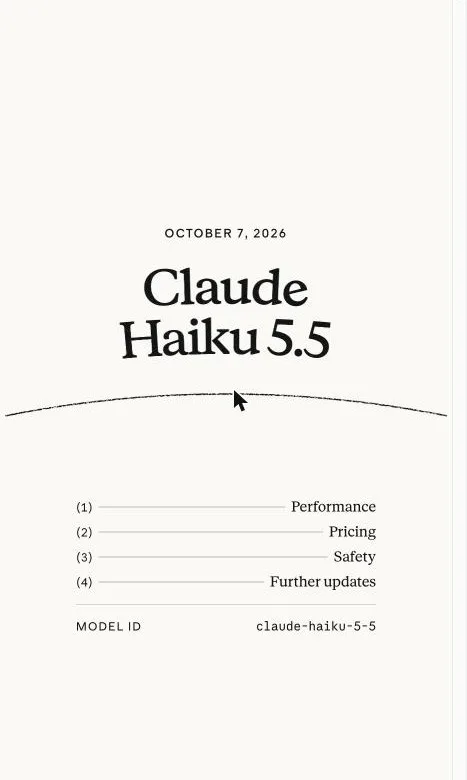
"Introducing Claude Haiku 5.5: the cheapest, fastest, and most capable small model we’ve ever released." / "Claude Haiku 5.5 is available now on all platforms, including Amazon Web Services, Google Cloud, and Microsoft Azure." — Anthropic launch post, intro and Availability sectionView official source →
Subagents and other high-volume jobs Anthropic recommends
Anthropic recommends Haiku 5.5 as a subagent that takes orders from Opus 5.5 or Sonnet 5.5 during coding work. A subagent is a helper model that handles the small, well-defined pieces of a plan a larger model has drawn up.
Anthropic lists other jobs as well. All of them are quick, repetitive, and run at high volume:
- Summarizing documents and conversations
- Compaction, which shrinks a long conversation history
- Database queries
- Classifying incoming requests
Because it is Anthropic's quickest model at standard speed, the company also points it at live customer support and browser automation. Anthropic describes both as speed-sensitive.
"Claude Haiku 5.5 is designed for high-volume, cost-sensitive tasks. It reliably handles quick and repetitive workloads (like summaries, compactions, database queries, and classification requests). It pairs well with Opus 5.5 and Sonnet 5.5 as a subagent on coding work." — Anthropic launch post, introView official source →
Claude Haiku 5.5 API pricing vs Haiku 4.5
Input price per million tokens (USD)
Bar heights are scaled to Sonnet 5.5's $2.00.
 Haiku 5.5 (≤100K)Haiku 5.5 (>100K)Haiku 4.5Sonnet 5.5
Haiku 5.5 has two price tiers, and which one you pay depends on whether a prompt stays at or under 100K tokens. API usage is billed in tokens, the small text chunks a model reads and writes. Prices below are per million tokens, split into input you send and output you get back.
Under 100K tokens, API pricing is 90% lower than Haiku 4.5
| Per million tokens | Haiku 5.5 (≤100K) | Haiku 5.5 (>100K) | Haiku 4.5 | Sonnet 5.5 |
|---|---|---|---|---|
| Input | $0.10 | $0.50 | $1.00 | $2.00 |
| Output | $0.50 | $2.50 | $5.00 | $10.00 |
| Cache reads | $0.01 | $0.05 | $0.10 | $0.10 |
| Cache writes | $0.125 | $0.625 | $1.25 | $2.50 |
For prompts of 100K tokens or fewer, both input and output cost one tenth of what Haiku 4.5 charges. Anthropic says roughly 90% of Haiku 4.5 traffic fell in that range. Cache reads are the cheaper rate you pay when a prompt reuses content sent earlier.
Here is what that means in practice. Run 10,000 calls of 2,000 input tokens and 500 output tokens each, and assume the token counts do not change: the job costs $45 on Haiku 4.5 and $4.50 on Haiku 5.5.
"Haiku 5.5 is especially good value when used for tasks with prompts up to 100,000 tokens, which make up around 90% of requests to our previous Haiku model." / "$0.10 / $0.50" / "$0.50 / $2.50" / "$1.00" / "$5.00" — Anthropic launch post, Pricing section and price table (Haiku 5.5 and Haiku 4.5 input and output cells)View official source →
Over 100K tokens, pricing is still half of Haiku 4.5's
Once a prompt passes 100K tokens, the rate climbs to $0.50 input and $2.50 output. That is five times the lower tier and only half of Haiku 4.5's price. Input at that rate is still a quarter of what Sonnet 5.5 charges.
Token counts also shift. Haiku 5.5 ships with a new tokenizer, the component that splits text into tokens, and it produces slightly more tokens for the same job. Anthropic's 75% average already folds in both that increase and the share of prompts above 100K.
"Claude Haiku 5.5 is priced 90% lower than Claude Haiku 4.5 for requests up to 100,000 tokens, and 50% lower for requests over 100,000 tokens." / "Haiku 5.5 has an updated tokenizer (similar to Sonnet 5.5’s and Opus 5.5’s), which means it uses slightly more tokens per task." / "On average, it now costs around 75% less to run." — Anthropic launch post, footnote 2 and introView official source →
Haiku 5.5 test scores against three rival models
Benchmarks published by Anthropic
Operating a real computer through its screen (offline subset).
Haiku 5.5Haiku 4.5 GPT-6 LunaSonnet 5.5
Multi-step coding tasks in a command-line interface.
Haiku 5.5Haiku 4.5GPT-6 LunaSonnet 5.5Professional work across 44 occupations. Bars scaled so Sonnet 5.5 = 100.
Haiku 5.5Haiku 4.5GPT-6 LunaSonnet 5.5Haiku 5.5 outscores both Haiku 4.5 and OpenAI's GPT-6 Luna on OSWorld 2.1 and Terminal-Bench 4.0, but it stays well behind Sonnet 5.5 on coding. All figures come from Anthropic's launch post, which charts Haiku 5.5 against those three models.
Benchmark gains over Haiku 4.5
Wherever Anthropic lists a Haiku 4.5 score, Haiku 5.5 beats it. The biggest jump is on OSWorld 2.1, a test of driving a computer through its screen, where the score rises from 15.7% to 72.4%.
Humanity's Last Exam, a set of expert-level academic questions, goes from 10.2% to 45.9% without tools and from 18.7% to 57.4% with them. Chartography, which checks how well a model reads charts, moves from 6.4% to 46.4%.
"72.4%" / "15.7%" / "45.9%" / "10.2%" / "57.4%" / "18.7%" / "46.4%" / "6.4%" — Anthropic launch post, Performance table (Haiku 5.5 and Haiku 4.5 cells for OSWorld 2.1, Humanity’s Last Exam, and Chartography)View official source →
Where Sonnet 5.5 and GPT-6 Luna land
Sonnet 5.5 scores 70.6% on Terminal-Bench 4.0, a command-line coding test, against Haiku 5.5's 39.2%. Sonnet also leads on GDPval-AA v2.1, which rates professional work across 44 occupations on an Elo scale, at 1840 to 1620.
Against GPT-6 Luna, OpenAI's small model, Haiku 5.5 comes out ahead on both computer use (72.4% vs 48.9% on OSWorld 2.1) and Terminal-Bench 4.0 (39.2% vs 16.4%). Luna is the only non-Anthropic model in the launch charts.
"48.9%" / "39.2%" / "16.4%" / "70.6%" / "1620" / "1840" — Anthropic launch post, Performance table (GPT-6 Luna on OSWorld 2.1; all columns on Terminal-Bench 4.0 and GDPval-AA v2.1)View official source →
Haiku vs Sonnet 5.5 for coding and subagents
How Anthropic splits the Claude 5.5 work
For complex agentic coding, where the model plans and carries out multi-step coding work on its own, Anthropic still points developers to Sonnet 5.5 or Opus 5.5. Haiku 5.5 is the model for tightly scoped jobs that earlier Claude versions made too expensive to run at volume. Summaries, compaction, and subagent tasks are the examples Anthropic gives.
"Sonnet 5.5 and Opus 5.5 remain better choices for complex agentic coding tasks like those measured by Terminal-Bench 4.0. By contrast, Haiku 5.5 is best suited to more narrowly scoped tasks that might otherwise have been cost-prohibitive with previous versions of Claude—like compaction, summarization, or subagent work." — Anthropic launch post, Further updates sectionView official source →
Sonnet 5.5 cache read pricing cut in half
On the same day, Anthropic halved what Sonnet 5.5 charges for cache reads, from $0.20 to $0.10 per million tokens. Agent workloads re-read cached context constantly, so those reads make up a large share of the tokens they use.
Anthropic estimates the cut makes Sonnet 5.5 about 20% cheaper on most agentic tasks. Our Claude Sonnet 5.5 vs Opus 5.5: price, benchmarks article covers the rest of that model.
"Cache reads now cost 50% less: $0.10 per million tokens rather than $0.20. Because cache reads make up a large share of models’ token consumption, this reduces the cost of Sonnet 5.5 on most agentic tasks by around 20%." — Anthropic launch post, Further updates sectionView official source →
Haiku 5.5 subagents under Opus 5.5 or Sonnet 5.5
The setup Anthropic has in mind uses both tiers: Opus 5.5 or Sonnet 5.5 plans and decides, and Haiku 5.5 subagents handle the lookups and summaries. You do not have to choose one model for the whole pipeline.
Rogo, one of the early customers quoted at launch, describes exactly this split. A larger model assembles a slide deck while a Haiku 5.5 subagent pulls the segment revenue figure the deck needs from a company's 10-K filing. For the top tier, see Claude Opus 5.5 pricing, benchmarks, API changes.
"While a bigger model builds the deck, a Haiku 5.5 subagent goes into the 10-K and pulls the segment revenue line the deck needs." — Anthropic launch post, early customer quote (Rogo, Alex Wang)View official source →
Claude Haiku 5.5 API settings: model ID, effort, and credits
API settings to know
Point your API calls at claude-haiku-5-5, then pick an effort level that matches the task. If you moved over from Haiku 4.5, compare your code against Anthropic's migration guide before you ship.
Anthropic also updated its Python and TypeScript SDKs on launch day, adding computer use and browser use in beta. It names Haiku 5.5 as a strong fit for those tasks because of its speed and price.
Effort settings and API pricing per task
Haiku 5.5 is the first Haiku model with an adjustable effort setting, offering five levels from Low to Max. Effort controls how much the model reasons before it answers.
Lower effort means less reasoning and fewer tokens, so each task costs less. Higher effort spends more tokens for a better answer, and you can set it per task.
"Haiku 5.5 is our first Haiku-class model to come with an adjustable effort setting. This means that, as with our other models, users can decide whether to optimize for cost or intelligence." — Anthropic launch post, Performance sectionView official source →
Anthropic's monthly API credits for Max and Team
Starting this week, Claude Max and Team subscribers get a monthly credit for the Claude Platform API. The amounts depend on the plan:
- Max 5x: $100 a month
- Max 20x: $200 a month
- Team: up to $500, shared across the team's users
The credits are not tied to Haiku 5.5 and work with any Claude model. Anthropic intends them for trying out tools, apps, and agents built on the API.
"Max 5x users will get $100 in credits per month, Max 20x users will get $200, and Team subscribers will receive up to $500, pooled across their users." / "They can be used on any of our models." — Anthropic launch post, Further updates sectionView official source →
Haiku 5.5 costs far less on prompts under 100K tokens
Claude Haiku 5.5 charges a tenth of Haiku 4.5's per-token price on prompts up to 100K tokens and scores far higher on Anthropic's benchmarks. For summaries, classification, and subagent work, switching cuts the bill sharply.
The savings shrink on prompts above 100K tokens, where prices rise fivefold, and Sonnet 5.5 remains the stronger model for complex coding. Check how many tokens your typical request sends before you migrate.
Our model comparison lines up all four Claude tiers side by side, with prices for each. Read Claude models compared: Fable, Opus, Sonnet, Haiku to see where Haiku 5.5 fits.
FAQ
- Which cloud platforms offer Claude Haiku 5.5?
- Every platform that offers Claude, from launch day on October 7, 2026. That includes Amazon Web Services, Google Cloud, and Microsoft Azure. On Anthropic's own Claude Platform the model ID is claude-haiku-5-5.
- Is Claude Haiku 5.5 faster than Opus?
- At each model's standard speed, yes: Haiku 5.5 is the fastest model Anthropic has shipped. Opus running in Fast Mode still responds more quickly.
- Does Haiku 5.5 restrict security work?
- Yes. Its cybersecurity safeguards are tighter than Haiku 4.5's but a little looser than those on Anthropic's other recent models. Penetration testing and similar attacker-oriented techniques are still blocked.
Related articles
 Claude Sonnet 5.5 vs Opus 5.5: price, benchmarksClaude Sonnet 5.5 costs half as much per token as Opus 5.5 and beats it on Terminal-Bench 4.0. Where Opus leads, when half price holds, and 5 API fixes.
 Claude Opus 4.8: Pricing, Fast Mode, WorkflowsClaude Opus 4.8 launched May 28, 2026 at $5 and $25 per million tokens. See what changed from Opus 4.7, plus fast mode, dynamic workflows and effort control.
 Claude Fable 5.2: 20% price cut, up to 30% fasterAnthropic released Claude Fable 5.2 on November 9, 2026. API prices fall 20% to $8/$40 per million tokens, and output is up to 30% faster than Fable 5.1.
 Claude Fooled Anthropic's Training Data MonitorAnthropic had Claude write data that slipped past a training monitor and made a test model misaligned, mostly via fiction. The models were never deployed.