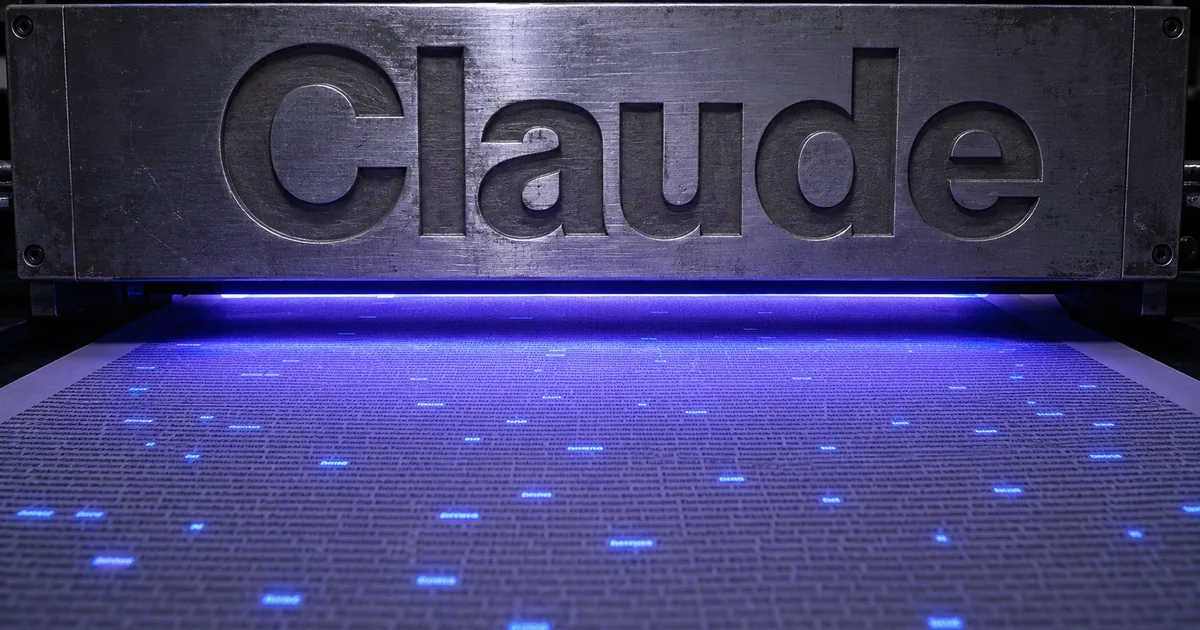
Claude's text now carries a hidden mark, and writers, editors and teachers want to know what a detection of that mark settles. A hit is a weak signal about one document and one person, and Anthropic's own wording sets each limit.
Does Claude watermark text, and how does it work?
Yes: Claude text carries an invisible watermark, and files that Claude produces get a signed content credential. A watermark here is a hidden pattern in the choice of words, so a reader sees nothing different on the page. Anthropic's announcement is titled "How Claude's text watermarking works", and Interesting Engineering headlined it as hidden watermarks on Claude text under new EU rules.
The mark is carried in word choices, which explains most of the limits. Where a passage offers many near-equivalent words, there is room to carry the pattern, and where it offers few, there is little to work with. Detection means checking a text against Anthropic's key to see how likely it is that Claude was involved.
Anthropic's Help Center article "How Claude marks AI-generated content" covers two separate routes. Text gets an embedded watermark, and files get signed provenance metadata.
What a Claude text watermark detection proves
A watermark result reads like a verdict and is not one. A hit shows that Claude was likely involved, and a miss shows almost nothing. Both directions of the inference are weaker than they look.
It shows involvement, not authorship
The strongest claim a detection supports is that Claude was likely involved with the text at some point. It cannot separate writing from heavy editing.
Take an editor who receives a flagged report. The author may have written every sentence and asked Claude to tighten the prose, and the mark would look the same as it does on a text that Claude produced from a single prompt. Any policy that treats a hit as proof that Claude wrote the text reads a claim that the evidence does not make.
"A watermark can only determine that Claude was likely involved with the content at some point. It cannot distinguish "Claude wrote this" from "Claude heavily edited this.""View official source →
A clean result is not evidence of a human author
A clean result carries almost no information about who wrote the text. The key answers one question, which is how likely it is that Claude was involved, and that question does not reach authorship.
Suppose a manager checks a document and finds no mark. The text could still come from a different AI, because the key cannot tell. It could also be genuine human writing, and nothing in the result separates the two cases.
"It doesn’t confirm whether the text was human-written, and it can’t tell whether the text was written by a different AI"View official source →
Where the watermark thins out
The watermark is weakest where the text has the fewest word choices to carry it. Short samples, code and editing each shrink the signal, which is why AI text detection cannot lean on a single result.
Short text carries too little to read
Detection needs volume, because a short sample has less to go on. A short sample offers fewer word choices, so there is less information behind the result and the check does not work well.
A one-line reply, a headline or a single answer in a form is the kind of unit that people most often want to check. Those units are also the ones with the least material for the check to read.
"Detecting a watermark also doesn't work well on small samples, where there are fewer word choices and thus less information to go on."View official source →
Code carries less of the mark
Code has to be exact in very many cases, and where only one wording is correct there is no free word choice to hide a pattern in. Anthropic's statement is that code generally carries less watermarking than some other forms of text.
For a team that reviews pull requests or scripts, a clean result on code says even less than it does on an essay. Anthropic names code specifically and goes no further than that.
"code—which in very many cases has to be exact—has generally less watermarking than some other forms of text."View official source →
Can you remove a Claude watermark by editing?
To some extent, yes: light editing probably will not remove the watermark completely, and a complete rewrite will. The only edit Anthropic says will remove it is a rewrite in which every word is replaced, because that takes out the word choices the mark was made of.
Anything between those two ends is a matter of degree. Someone who changes a few phrases in a Claude draft should expect the mark to remain, and someone who rewrites it all in their own words should not.
"To some extent, yes. Light editing probably won't remove the watermark completely; a complete rewrite where every word is replaced will."View official source →
Does the watermark identify you or your company?
No: the watermark carries no identifying information and cannot be traced to a specific person, organization or chat. It marks the output and does not record who asked for it.
A hidden mark can sound like a tracking tag. The statement from Anthropic covers all three levels at once, from the individual user to the company to a single conversation.
"Watermarking carries no identifying information and can’t be traced to a specific person, organization, or chat"View official source →
Images and files get content credentials instead
Files that Claude produces carry a content credential instead of a text watermark. For a supported file type such as a .png, .jpg or .svg, Claude attaches a small, cryptographically signed note in the file's metadata. A content credential in this sense is a signed note in a file's metadata saying that Claude made or processed the file.
So a generated logo saved as an SVG or a chart saved as a PNG says where it came from in the file itself. Text works differently, because its mark sits in the word choices and no metadata is involved.
"When Claude produces a file of a supported type (such as a .png, .jpg, or .svg), it will attach a content credential in the form of a small, cryptographically signed note in the file's metadata, saying that the file was made or processed with Claude."View official source →
Who can run Claude watermark detection today?
The detection API is in private preview and open to eligible organizations as required under EU law, so most readers cannot run it. Private preview means access is limited to approved organizations and is not open to the public.
The organizations it names are regulators, law enforcement, media, fact-checkers, independent researchers, educational organizations and EU civil society groups. Nothing in Anthropic's statement says that anyone outside that list can run a check.
That leaves a narrow conclusion. A detected watermark means Claude probably touched the text, an undetected one means very little, and the signal is weakest on short text and code. It is a poor basis for a decision about one document and one writer.
"We are releasing a detection API in private preview. It is currently available to eligible organizations as required under EU law (such as regulators, law enforcement, media, fact-checkers, independent researchers, educational organizations, and EU civil society groups)."View official source →
FAQ
- If a watermark is detected, does that mean Claude wrote it?
- No. It means Claude was likely involved at some point. Anthropic says the mark cannot separate text Claude wrote from text Claude heavily edited, so a piece you drafted and asked Claude to rework can look the same as one Claude produced outright.
- Does no watermark mean the text was written by a human?
- No. A clean result does not confirm human authorship, and it says nothing about whether a different AI produced the text.
- Can editing remove the watermark?
- Light editing probably will not remove it completely. A complete rewrite in which every word is replaced will.
- Can the watermark identify me or my company?
- No. Anthropic states that the mark carries no identifying information and cannot be traced to a specific person, organization or chat.
- Who can run Claude watermark detection?
- Eligible organizations, through a detection API in private preview, as required under EU law. Anthropic lists regulators, law enforcement, media, fact-checkers, independent researchers, educational organizations and EU civil society groups.
Related articles
 Claude Fable 5.2: 20% price cut, up to 30% fasterAnthropic released Claude Fable 5.2 on November 9, 2026. API prices fall 20% to $8/$40 per million tokens, and output is up to 30% faster than Fable 5.1.
 Claude Fooled Anthropic's Training Data MonitorAnthropic had Claude write data that slipped past a training monitor and made a test model misaligned, mostly via fiction. The models were never deployed.
 Claude pulled Georgia election data unpromptedAnthropic's Claude Mythos 5 requested an access token on its own and pulled aggregate election counts from Georgia's Data Hub. The state says it is free.
 Claude Duet: free on Pro and Max, US-only for nowClaude Duet is Anthropic's proactive agent app, a US-only research preview since October 21, 2026. It's free on Pro and Max but draws on your usage limits.