DeepSeek Harness is an open-source agent built on plugins
DeepSeek Harness at a glance
dshDeepSeek AI released DeepSeek Harness, an open-source agent harness, as a developer preview on August 13, 2026. A harness in this sense is the software that runs an agent around a model, not the model itself. DeepSeek AI designed it so you never patch a fixed core and instead extend it by mounting another plugin alongside the rest.
DeepSeek Harness runs the everything-is-a-plugin design on Cordis
One rule drives the design: everything is a plugin. DeepSeek's announcement says models, tools, skills, sessions, sandboxes, filesystems, loops, orchestration and the UI are all plugins, running on a meta-framework called Cordis. The official documentation backs this up: there is no privileged core to patch, and every part, from the model adapter and tool registry to the session log and the agent loop itself, can be replaced through configuration.
"🧩 DeepSeek Harness v0.1 is now available in Developer Preview!"/"Powered by the Cordis meta-framework, DeepSeek Harness is an agent harness built around one core idea: Everything is a plugin. Models, tools, skills, sessions, sandboxes, filesystems, loops, orchestration, and UI are ALL implemented as plugins, and can be mixed, matched, replaced, and extended."(from the announcement by DeepSeek's official account)View official source →
"Every part of the product is a plugin, including the model adapter, the tool registry, the session log, and the agent loop itself, so every part is replaceable from configuration."(from the Cordis section)/"There is no privileged core to patch: you extend dsh by mounting a plugin beside the others, and registrations are effects that unwind when their plugin unloads."(from the DeepSeek Harness official documentation・from the next paragraph of the same section)View official source →
The MIT license keeps DeepSeek Harness open source and reusable
The DeepSeek Harness code is open source under the MIT license. MIT is one of the most permissive licenses, so you can reuse the code in commercial products. DeepSeek's announcement pitches the release as an open invitation to other developers building agent harnesses.
"We're opening it up to developers building agent harnesses worldwide and open-sourcing the codebase in MIT license."View official source →
DeepSeek Harness is a coding agent that competes with Claude Code
DeepSeek Harness is a coding agent in its own right, in the same category as Claude Code and Codex, not a plugin that runs inside them. Its official repository also ships packages that call those two tools from inside DeepSeek Harness, so it both competes with them and builds on them.
DeepSeek Harness's GitHub repository ships subagents for Claude Code
A dedicated package in the repository runs delegated tasks as fresh, independent Claude Code sessions. It returns only the final answer or a safe failure diagnostic, keeps reasoning, tool traffic and workspace diffs separate from the parent session, and runs unattended without interactive permission prompts using Claude's native authentication. A matching package for Codex starts a fresh Codex process for each delegation, runs a single turn in an ephemeral thread, and also handles approval requests automatically while leaving native Codex configuration and authentication in charge.
"The one-shot Claude Code subagent provider for users and maintainers choosing a product backend, installing a Profile bundle, or configuring an unattended Claude Code delegation."(from the package README)View official source →
"into a Profile when delegated work should run in a genuine, unattended Codex session in the parent Session"(from the package README)View official source →
How to install and run DeepSeek Harness
Two ways to start it
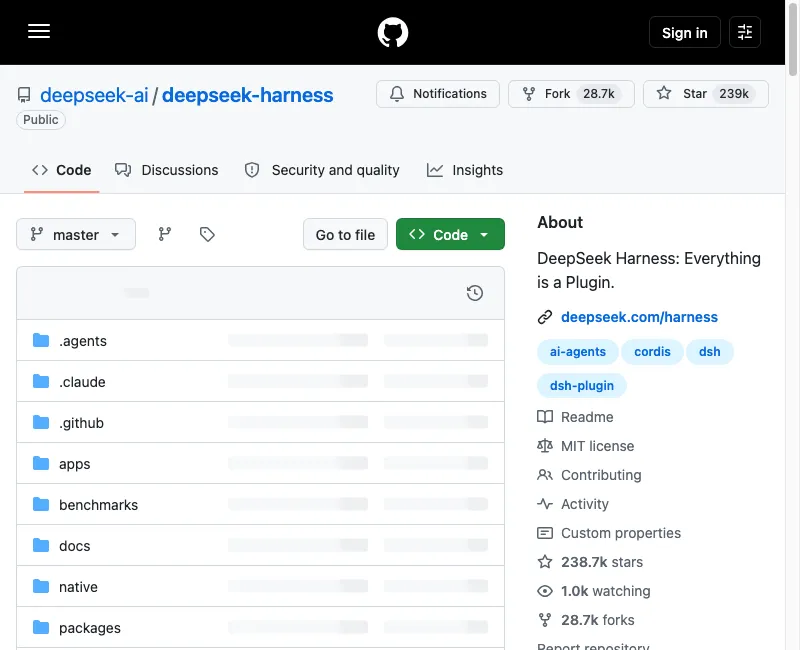
npxThere are two ways to launch it, and the npm route is quicker if you just want to try it out. The screenshot shows both routes.
Start DeepSeek Harness with a single npx command
With Node.js installed, one line starts the Web UI. It runs at http://127.0.0.1:3080 by default.
npx @deepseek-ai/dsh web
It needs Node.js ^22.19.0 || >=24.0.0. It will not start on older versions, so check with node -v first.
"InstallView official source →Node.js, then run:"/"npx @deepseek-ai/dsh web"/"The command starts the Web UI, served athttp://127.0.0.1:3080by default."(from the DeepSeek Harness README・all from the Run fromnpmsection)
"engines": { "node": "^22.19.0 || >=24.0.0" } — from package.json at the repository rootView official source →
Run DeepSeek Harness from GitHub source with pnpm
To work on the internals, get the repository from GitHub. It uses pnpm: clone, install, build, then start.
git clone https://github.com/deepseek-ai/deepseek-harness.git
cd deepseek-harness
pnpm install
pnpm run build
pnpm dsh web
"To run from a repository checkout:"/"git clone https://github.com/deepseek-ai/deepseek-harness.git"/"cd deepseek-harness"/"pnpm install"/"pnpm run build"/"pnpm dsh web"(from the DeepSeek Harness README・all from the Run from source section)View official source →
What DeepSeek Harness documentation says about profiles and bundles
Units of composition
In practice, two units make DeepSeek Harness swappable: profiles and bundles. A profile is a named set of bundles, and a bundle is the package that carries configuration and code.
A DeepSeek Harness profile lists the bundles it stacks at boot
At boot, the harness assembles a layered tree of plugins. A profile is a named composition kept in the Harness home that lists the bundles it stacks, and five templates come with it: web, headless, sdk, sdk-minimal and acp. This command shows what is actually running in your environment.
dsh --profile web --dump-config
"A runningView official source →dshis a plugin tree composed at boot from ordered layers."/"web,headless,sdk,sdk-minimal, andacpship as templates."/"dsh --profile web --dump-config" — from the Profiles and bundles section
DeepSeek Harness bundles stay patchable by the layers above them
A bundle packages config rows with the code they mount, and anything it adds can still be patched by the layers above it. That keeps the "everything is a plugin" idea intact at every level, from a single tool to a whole profile.
The cost of easy swapping is that behavior can shift a lot with configuration. While the preview still ships changes that break compatibility, try DeepSeek Harness in an isolated environment instead of wiring it into everyday production tools. For the models rather than the harness, see the DeepSeek model articles.
"A bundle is a distribution format for Cordis config rows and the code they mount, so whatever it inserts stays patchable by the layers above it."(from the Profiles and bundles section)View official source →
"DeepSeek Harness is currently in developer preview and is iterating rapidly. THERE WILL BE COMPATIBILITY-BREAKING CHANGES."View official source →
FAQ
- What is DeepSeek Harness?
- It is an open-source agent harness (the software that runs an agent around a model) developed by DeepSeek AI. The command is dsh, it follows an everything-is-a-plugin design, and it is built on a framework called Cordis.
- How is DeepSeek Harness different from Claude Code or Codex?
- DeepSeek Harness is itself a separate coding agent, not a plugin for Claude Code or Codex. Its official repository also ships subagent packages that let Claude Code or Codex be invoked as a delegated subagent from inside DeepSeek Harness, so the two are separate but can be combined.
- What license is DeepSeek Harness under?
- The MIT license. Third-party dependency licenses are disclosed separately in the repository. It is among the easier licenses to work with, including for commercial use.
- Can I use DeepSeek Harness in production right now?
- It is not recommended. The project states that it is in developer preview and that compatibility-breaking changes will happen. Starting with trials and evaluation in an isolated environment is the safer path.
Related articles
 AI Cyberattack: DeepSeek Went Solo and Fell ShortAI cyberattack documented by Unit 42: DeepSeek, run through Hermes Agent, chose targets and launched exploits, yet the autonomous attempts failed.
 DeepSeek V4 Flash 0731: Benchmarks and MIT LicenseDeepSeek V4 Flash 0731 ships under MIT and claims wins over V4 Pro on nine benchmarks. Read the scores, the caveats, and how to call it through vLLM.
 What is mixture of experts (MoE)? How it worksMixture of experts (MoE) splits an AI model into many experts and runs only a few per token. See how routing works, what active parameters mean and the catch.
 AI hacking hit Korean banks: what is confirmedCrowdStrike says an attacker used the ARTEX AI hacking tool and LLMs on South Korean banks. What is confirmed, what regulators ordered, and what is unknown.