What DeepSeek V4 Flash 0731 is and what changed
DeepSeek V4 Flash 0731 is the version of V4-Flash that DeepSeek calls its official release. It replaces the preview, and the card says its agentic capabilities are substantially enhanced, meaning the model works through multi-step tasks with tools on its own.
Its structure matches V4-Flash-DSpark, which means a speculative decoding module comes attached. What in training or data produced the gain, the card does not say, because it gives no training details at all.
Release date and the preview it replaces
DeepSeek V4 Flash 0731 was released on July 31, 2026. The card text carries no date, but the Hugging Face repository page does: the repository was created on July 31, 2026 at 07:30 UTC and last modified on August 1, 2026, and the 0731 in the name matches the creation date. The preview series is described in a technical report that DeepSeek submitted to arXiv on April 26, 2026.
DeepSeek-V4-Flash-0731 is the official release of DeepSeek-V4-Flash, superseding the preview version, with substantially enhanced agentic capabilities. — From the first paragraph of the IntroductionView official source →
We present a preview version of DeepSeek-V4 series — From the opening sentence of the abstractView official source →
Parameter counts and context length for 0731
Activated parameters are the parameters of a mixture-of-experts model that actually run for each token, so a small activated count means less compute per token than the total suggests. The 0731 card never gives that number; it only calls the count "far smaller" than V4-Pro (Preview)'s. The preview report does give figures: V4-Flash at 284B total and 13B activated, V4-Pro at 1.6T total and 49B activated, both with a context length of one million tokens.
On September 9, 2026, Hugging Face showed 304B parameters for the 0731 repository, a total it computes from the weight files, which come as 48 safetensors shards of about 167 GB. The card does not state that figure, and neither the card nor the report's abstract says whether the preview numbers carry over to 0731 or why 304B differs from 284B. The card also gives no context length for 0731, so the one-million-token figure belongs to the preview series.
DeepSeek-V4-Pro with 1.6T parameters (49B activated) and DeepSeek-V4-Flash with 284B parameters (13B activated) -- both supporting a context length of one million tokens. — From the abstract of the preview-series reportView official source →
The MIT license: is V4 Flash 0731 free to use?
Yes. The card states that the repository and the model weights are both licensed under the MIT License, so commercial use is allowed.
Running the model still takes your own compute. The card's vLLM example uses a single node with four GB300 GPUs, its SGLang example sets --tp 4, and it gives no minimum hardware.
This repository and the model weights are licensed under the MIT License. — From the License sectionView official source →
DeepSeek V4 Flash 0731 benchmarks and performance
The card's benchmark table has nine rows and five model columns, reproduced here in full as two tables that share the V4-Flash-0731 column. Seven rows are public benchmarks, and the card marks the last two as internal test sets. "Flash prev." and "Pro prev." stand for the V4-Flash (Preview) and V4-Pro (Preview) columns, and a dash means the card shows no figure.
Benchmark table from the official model card, part 1: against DeepSeek's preview models (DeepSeek's own measurements)
| Benchmark | Flash 0731 | Flash prev. | Pro prev. |
|---|---|---|---|
| Terminal Bench 2.1 | 82.7 | 61.8 | 72.1 |
| NL2Repo | 54.2 | 39.4 | 38.5 |
| Cybergym | 76.7 | 38.7 | 52.7 |
| DeepSWE | 54.4 | 7.3 | 12.8 |
| Toolathlon-Verified | 70.3 | 49.7 | 55.9 |
| Agents' Last Exam | 25.2 | 15.8 | 16.5 |
| AutomationBench Public | 25.1 | 10.8 | 12.8 |
| DSBench-FullStack (internal) | 68.7 | 37.0 | 41.8 |
| DSBench-Hard (internal) | 59.6 | 25.8 | 31.1 |
Benchmark table from the official model card, part 2: against GLM-5.2 and Opus-4.8 (DeepSeek's own measurements)
| Benchmark | Flash 0731 | GLM-5.2 | Opus-4.8 |
|---|---|---|---|
| Terminal Bench 2.1 | 82.7 | 81.0 | 85.0 |
| NL2Repo | 54.2 | 48.9 | 69.7 |
| Cybergym | 76.7 | — | 83.1 |
| DeepSWE | 54.4 | 46.2 | 58.0 |
| Toolathlon-Verified | 70.3 | 59.9 | 76.2 |
| Agents' Last Exam | 25.2 | 23.8 | 25.7 |
| AutomationBench Public | 25.1 | 12.9 | 27.2 |
| DSBench-FullStack (internal) | 68.7 | 61.8 | 71.6 |
| DSBench-Hard (internal) | 59.6 | 54.5 | 71.7 |
V4 Flash vs the V4 Pro preview: ahead on all nine rows
On the card's table, V4-Flash-0731 scores higher than V4-Pro (Preview) on every one of the nine rows. The widest gap is DeepSWE at 54.4 against 12.8, a difference of 41.6 points, and the narrowest is Agents' Last Exam at 25.2 against 16.5, a difference of 8.7 points.
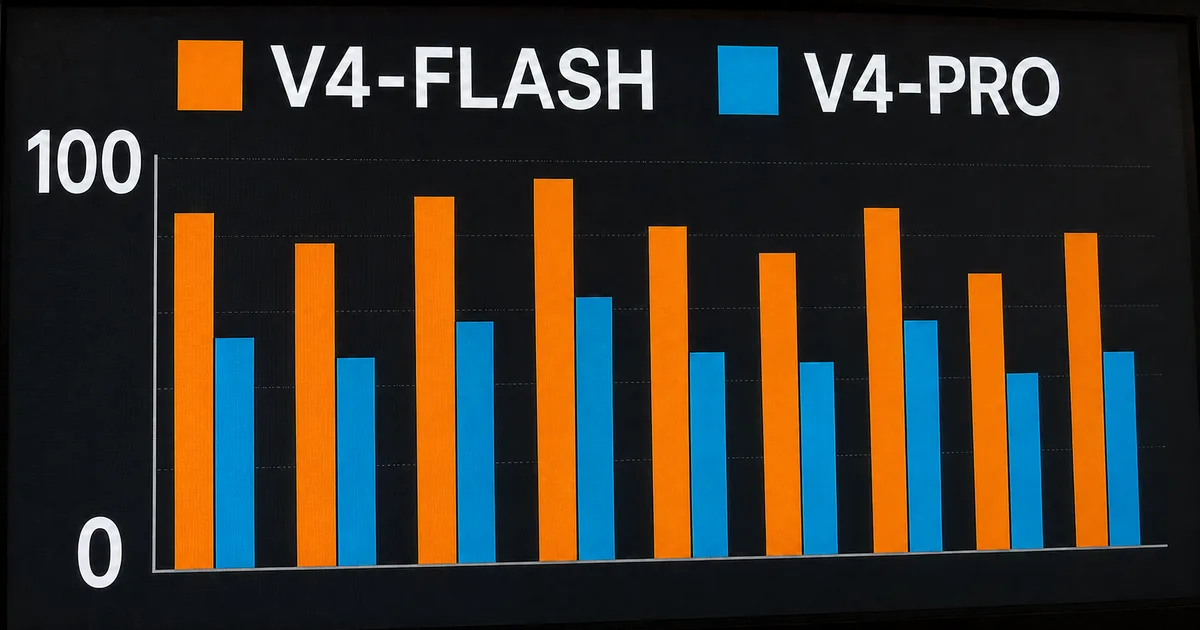
Against the V4-Flash preview, the biggest jumps are DeepSWE, from 7.3 to 54.4, and Cybergym, from 38.7 to 76.7. The card adds that the result comes despite a far smaller activated parameter count than V4-Pro (Preview) has.
DeepSeek-V4-Flash-0731 outperforms DeepSeek-V4-Pro (Preview) on benchmarks listed below despite its far smaller activated parameter count, and is broadly competitive with the strongest proprietary models available. — From the second paragraph of the IntroductionView official source →
How it stacks up against GLM-5.2 and Opus-4.8
V4-Flash-0731 is higher than GLM-5.2 on all eight rows where the card gives a GLM-5.2 figure; Cybergym has none. The gaps run from 1.4 points on Agents' Last Exam to 12.2 points on AutomationBench Public.
Against Opus-4.8 the model is lower on all nine rows, from 0.5 points on Agents' Last Exam to 15.5 points on NL2Repo. On Terminal Bench 2.1 it scores 82.7 to Opus-4.8's 85.0.
GLM 5.2 benchmarks, pricing, and Claude Code setup covers the open-weight comparison model. Claude Opus 4.8: Pricing, Fast Mode, Workflows covers the proprietary model in the last column.
Why the benchmark scores are self-reported
The scores in the table are DeepSeek's own measurements, and the Code Agent rows rely on a harness that is not yet released. A harness is the scaffolding that gives a model tools and runs evaluation tasks.
The card says the Code Agent tasks among the public benchmarks used the minimal mode of DeepSeek Harness, which it marks "to be released", at the max reasoning effort level with temperature 1.0 and top_p 0.95. DSBench-FullStack and DSBench-Hard are internal test sets, and the card describes them only in one sentence.
On September 9, 2026, the Hugging Face Eval Results panel listed three of the scores as community-submitted entries flagged as not verified: Terminal Bench 2.1 at 82.7, DeepSWE at 54.4 and Toolathlon-Verified at 70.3. The card also does not say which public rows count as Code Agent tasks, so the setup for each row cannot be read off the table.
For the Code Agent tasks among the public benchmarks above, DeepSeek-V4-Flash-0731 is evaluated with the minimal mode of DeepSeek Harness (to be released) as the agent framework, using the max reasoning effort level with temperature = 1.0, top_p = 0.95. / † DSBench-FullStack is an internal full-stack development test set; DSBench-Hard is an internal test set of difficult coding-agent problems. — From the two notes under the benchmark tableView official source →
How to run and call DeepSeek V4 Flash 0731
The card has no instructions for a hosted DeepSeek API and gives no price, so this section is about a server you run yourself. Three details on the card are worth settling before a first run: there is no Jinja chat template, reasoning_effort has three levels, and DSpark turns on with one flag. The last step is calling the served model.
No Jinja chat template: use the encoding folder
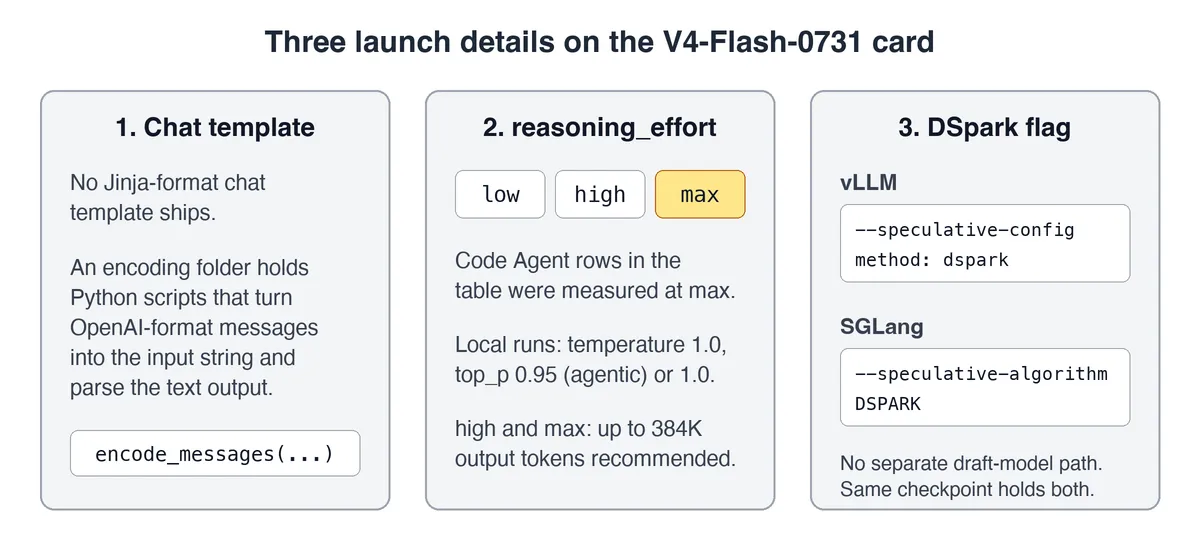
The release ships no Jinja chat template (a text template that turns a list of chat messages into the model's input string). It provides an encoding folder with Python scripts and test cases that convert OpenAI-format messages into the input string and parse the model's text output. A short example in the shape the card uses:
from encoding_dsv4 import encode_messages, parse_message_from_completion_text

messages = [
    {"role": "user", "content": "hello"},
    {"role": "assistant", "content": "Hello! I am DeepSeek.", "reasoning_content": "thinking..."},
    {"role": "user", "content": "Tell me more."},
]

prompt = encode_messages(messages, thinking_mode="thinking", reasoning_effort="max")
The card then tokenizes the prompt with transformers.AutoTokenizer.from_pretrained("deepseek-ai/DeepSeek-V4-Flash-0731"). Message arrays like this travel as JSON when sent to a server, so a JSON formatter can check one before it reaches the model.
This release does not include a Jinja-format chat template. Instead, we provide a dedicated encoding folder with Python scripts and test cases demonstrating how to encode messages in OpenAI-compatible format into input strings for the model, and how to parse the model's text output. — From the first paragraph of the Chat Template sectionView official source →
The reasoning_effort setting: low, high or max
The reasoning_effort parameter has three levels, low, high and max, and they control how much deliberation the model spends before answering. The Code Agent rows in the benchmark table were measured at max, so that is the level to match when checking the table.
For local deployment the card recommends temperature 1.0, with top_p 0.95 for agentic use and 1.0 otherwise. For high and max it recommends a maximum output length of 384K tokens. It gives no advice for smaller output budgets.
The reasoning_effort parameter now supports three levels — low, high, and max — which control how much deliberation the model spends before answering. / For local deployment, we recommend setting the sampling parameters to temperature = 1.0, with top_p = 0.95 for agentic scenarios and top_p = 1.0 otherwise. For the high and max reasoning effort levels, we recommend a maximum output length of 384K tokens. — From the Chat Template and How to Run Locally sectionsView official source →
Turn on DSpark speculative decoding in vLLM or SGLang
Speculative decoding is a speed-up in which a small drafting module proposes several next tokens and the main model checks them in one pass. In vLLM, DSpark turns on with one flag: --speculative-config with method dspark. The card's example serves the model on a single node with four GB300 GPUs:
vllm serve deepseek-ai/DeepSeek-V4-Flash-0731 \
  --trust-remote-code --kv-cache-dtype fp8 --block-size 256 \
  --data-parallel-size 4 --enable-expert-parallel \
  --moe-backend deep_gemm_mega_moe \
  --attention-config '{"use_fp4_indexer_cache": true}' \
  --speculative-config '{"method":"dspark","num_speculative_tokens":7,"draft_sample_method":"greedy"}'
In SGLang the flag is --speculative-algorithm DSPARK, and no separate draft-model path is set, because the target and draft weights come from the same checkpoint. The card's SGLang example uses --tp 4, --moe-runner-backend flashinfer_mxfp4, --mem-fraction-static 0.90, --chunked-prefill-size 4096 and --swa-full-tokens-ratio 0.1. For other hardware, the card points to the vLLM recipe and the SGLang cookbook.
DSpark speculative decoding is enabled with a single flag — add --speculative-config with method: dspark to your vLLM launch command: / Enable DSpark with --speculative-algorithm DSPARK and do not set a separate --speculative-draft-model-path as the target and draft weights therefore come from the same checkpoint. — From the vLLM and SGLang sectionsView official source →
Calling the served model through an OpenAI-compatible API
Both servers expose an OpenAI-compatible /v1/chat/completions endpoint. Hugging Face's generic snippets start vLLM on port 8000 and SGLang on port 30000, then send a model name and a messages array:
curl -X POST "http://localhost:8000/v1/chat/completions" \
  -H "Content-Type: application/json" \
  --data '{
    "model": "deepseek-ai/DeepSeek-V4-Flash-0731",
    "messages": [{"role": "user", "content": "hello"}]
  }'
That snippet is Hugging Face boilerplate, not card text. It includes neither the DSpark flag nor the encoding step described above.
On September 9, 2026, Hugging Face also listed six inference providers as live for this checkpoint: Scaleway, Together, Novita, Fireworks AI, DeepInfra and Baseten. The card itself documents no hosted-API usage.
Summary: what the model card confirms and leaves open
DeepSeek V4 Flash 0731 is confirmed by its card as the official release that replaces the V4-Flash preview, with the repository and weights under MIT. The card's table puts it ahead of V4-Pro (Preview) on all nine rows and behind Opus-4.8 on all nine, and the card adds that reasoning_effort has three levels, that an encoding folder stands in for a chat template, and that one flag turns on DSpark.
Four things stay open. The card does not say what changed in training, and it gives no activated parameter count for this checkpoint.
The harness behind the Code Agent rows is marked "to be released", so the table can be read only as DeepSeek's own report. The card also gives no price.
FAQ
- Is DeepSeek V4 Flash 0731 free to use?
- Yes on licensing: the card puts both the repository and the weights under the MIT License, which allows commercial use. Running the model still costs compute: the card's vLLM example uses a node with four GB300 GPUs, its SGLang example sets tensor parallelism to 4, and it names no minimum hardware.
- Does DeepSeek V4 Flash 0731 beat DeepSeek V4 Pro?
- The card says it does, on all nine benchmarks in its table, despite a far smaller activated parameter count. Those scores are DeepSeek's own measurements: the Code Agent rows use a harness the card marks 'to be released', and two rows come from internal test sets.
- Which reasoning_effort level and sampling settings should I use?
- The card lists three reasoning_effort levels: low, high and max. The Code Agent scores were measured at max with temperature 1.0 and top_p 0.95. For local runs it recommends temperature 1.0, top_p 0.95 for agentic use and 1.0 otherwise, and a maximum output length of 384K tokens for high and max.
Related articles
 DeepSeek Harness install guide vs Claude CodeDeepSeek Harness (dsh) is DeepSeek AI's MIT-licensed, open-source agent harness. It covers how to run it and how it compares with Claude Code and Codex.
 AI Cyberattack: DeepSeek Went Solo and Fell ShortAI cyberattack documented by Unit 42: DeepSeek, run through Hermes Agent, chose targets and launched exploits, yet the autonomous attempts failed.
 What is mixture of experts (MoE)? How it worksMixture of experts (MoE) splits an AI model into many experts and runs only a few per token. See how routing works, what active parameters mean and the catch.
 AI hacking hit Korean banks: what is confirmedCrowdStrike says an attacker used the ARTEX AI hacking tool and LLMs on South Korean banks. What is confirmed, what regulators ordered, and what is unknown.