
Where GPT-6.1 Terra fits in the GPT-6 lineup
GPT-6.1 Terra is the third of four GPT-6 models by API price, sitting below GPT-6 Astra and GPT-6.1 Sol and above GPT-6 Luna. OpenAI shipped it on October 26, 2026, as the successor to GPT-5.6 Terra (see GPT-5.6 Sol, Terra and Luna: Specs and Pricing), and calls it a big jump over that model. OpenAI pitches three strengths:
- Reading images in fine detail
- Accurate computer use, where the model looks at a screen and clicks or types its way through an app
- Clearer, more natural writing
In the API it takes up to 1,050,000 tokens of context and accepts text and images as input. Output is text only.
The four GPT-6 models at a glance
Based on OpenAI's launch post and API pricing page as of October 29, 2026.
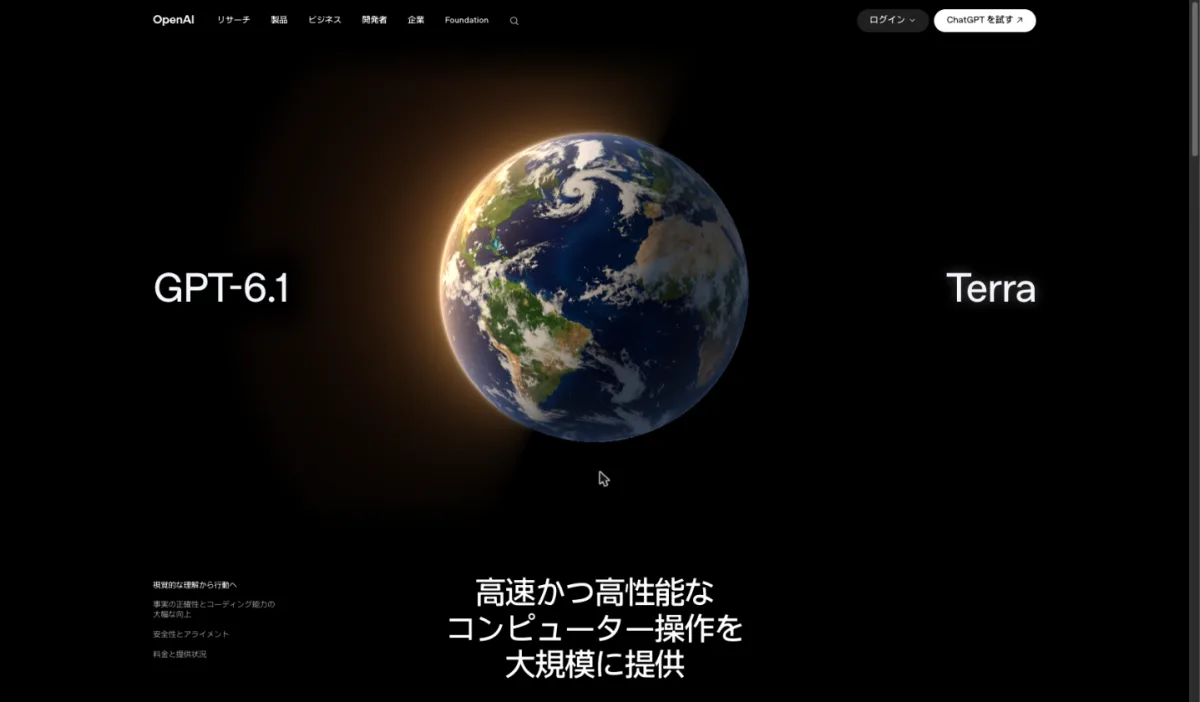
Built for drawings, forms and everyday computer tasks
OpenAI's own examples of what Terra does well are drafting proposals, reading technical drawings, filling in forms and editing video. These are the writing and on-screen chores that eat most of a working day.
For high-volume work, OpenAI points to a job like pulling line items off incoming invoices and keying them into accounting software. The lower price is what makes that kind of automation pay off at scale, according to OpenAI.
Available in ChatGPT Work, Codex and the API
From launch day, every Plus, Pro, Enterprise and Edu user can pick GPT-6.1 Terra in ChatGPT Work and Codex. Developers call it in the OpenAI API with the model name gpt-6.1-terra. The launch post doesn't list the free plan or Business.
In ChatGPT Work and Codex, the same usage allowance stretches to more tasks on Terra than on GPT-5.6 Terra, and to far more than on GPT-6.1 Sol or GPT-6 Astra. If you keep running into limits on Sol, moving routine tasks to Terra frees up room.
Starting today, GPT-6.1 Terra is available to all Plus, Pro, Enterprise, and Edu users in ChatGPT Work and Codex. Developers can also access it through the OpenAI API as gpt-6.1-terra. — from the pricing and availability sectionView official source →
GPT-6.1 Terra pricing is half of Sol
On the API, Terra charges $1 for every million input tokens and $5 for every million output tokens. A token is the small chunk of text a model reads and writes, and you pay per million of them. Those rates are exactly half of GPT-6.1 Sol's and a tenth of GPT-6 Astra's.
Cached input, meaning text the model has already seen and can reuse, costs $0.05 per million. Compared with GPT-5.6 Terra, which charged $2 for input and $12 for output, input is half the price and output is about 58% cheaper.
API prices next to Astra, Sol and Luna
Among the four GPT-6 models and the previous Terra, only Luna is cheaper than GPT-6.1 Terra. Here are the standard input and output rates side by side.
API prices for GPT-6.1 Terra and other OpenAI models
From OpenAI's API pricing and model pages as of October 29, 2026. Standard rates in US dollars per million tokens. Bar height is relative to the highest value.
 GPT-6 AstraGPT-6.1 SolGPT-5.6 TerraGPT-6.1 TerraGPT-6 LunaGPT-6 AstraGPT-5.6 TerraGPT-6.1 SolGPT-6.1 TerraGPT-6 Luna
Per-call numbers make the gap easier to feel. Feed a model a 100K-token document and have it write 10K tokens back, and one call costs this much:
Cost of one call: 100K tokens in, 10K tokens out
Calculated from OpenAI's standard API rates. US dollars. Bar height is relative to the highest value.
Run that same call 1,000 times a day and Sol comes to $300 while Terra comes to $150. The more calls you make, the wider the gap gets.
Standard API pricing is $1 per million input tokens, $0.05 per million cached input tokens, and $5 per million output tokens. — from the pricing and availability sectionView official source →
Long prompts and Fast mode cost more
Once a single request goes past 272K input tokens, the whole request is billed at twice the input and cache rates and 1.5 times the output rate. If you feed it long documents, splitting them to stay under 272K avoids the surcharge.
Fast mode costs double the standard price in exchange for quicker responses. Pinning processing to a specific region adds 10%. Going the other way, Batch and Flex are half price, which suits bulk jobs that don't need an answer right away.
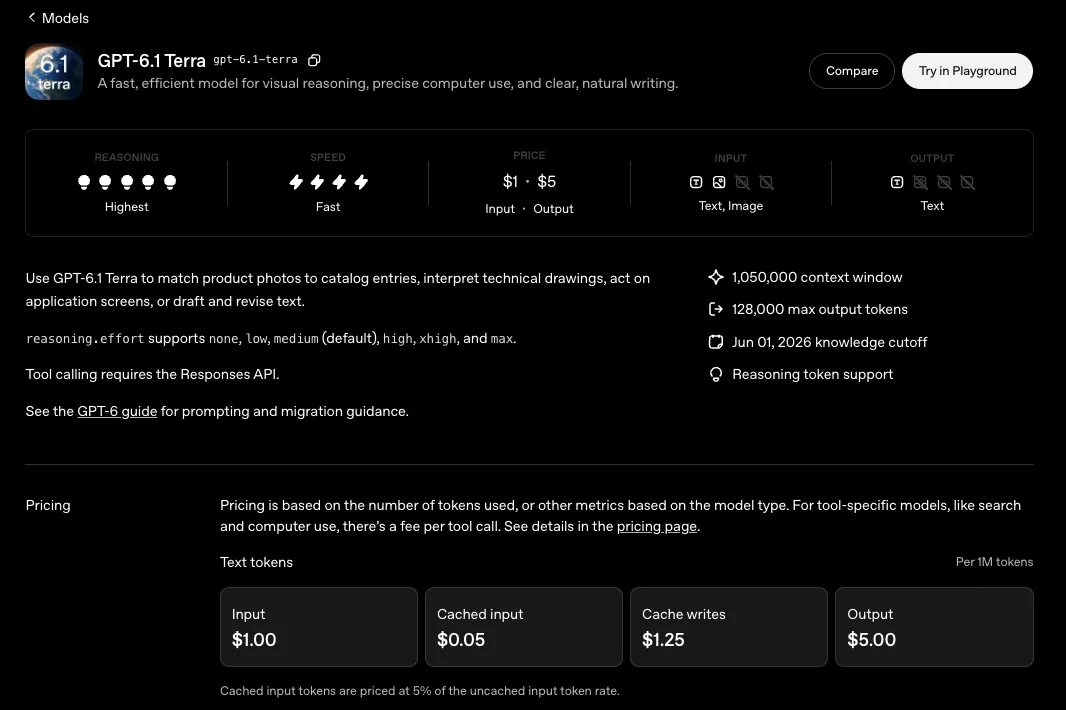
Prompts with more than 272K input tokens are priced at 2x input and cache rates and 1.5x output for the full request. Batch and Flex prices are 50% lower than Standard. — from the pricing notes on the model pageView official source →
How much better is it than GPT-5.6 Terra?
GPT-6.1 Terra beats GPT-5.6 Terra on every test OpenAI published, covering computer use, factual accuracy and coding. It is also quick: OpenAI says it finishes tasks more than three times faster than GPT-6 Astra or GPT-6.1 Sol. Every number in this section comes from OpenAI's own evaluations.
GPT-5.6 Terra vs GPT-6.1 Terra on two OpenAI tests
OpenAI's own evaluations, published October 26, 2026. Bars are percentages on a 0 to 100 scale. Lower is better for error rate; higher is better for tasks solved.
Astra-level computer use at a tenth of the price
On Agents' Last Exam, GPT-6.1 Terra scored 15 points above GPT-5.6 Terra while spending roughly a third as much. The benchmark measures computer use on professional work. Two of its tasks:
- Building a 3D model from architectural drawings
- Logging an animated film shot by shot, with timecodes, for a restoration team
That score came at medium reasoning effort. Reasoning effort is the setting for how long the model thinks before it answers, and the API offers six levels, from none up to max.
At the same medium setting, Terra's score matched GPT-6 Astra's, at one-tenth Astra's price per token. Turned up to max, it used tokens more than three times as efficiently as Anthropic's Claude Opus 5.5, at a quarter of Opus's per-token price. OpenAI estimates the resulting cost per task is roughly 9x lower.
Terra also beat GPT-5.6 Terra at every effort setting on MMMU-Pro, a test of visual reasoning, and came close to Astra and Sol for far less money. On OSWorld 2.1, which has the model work through multistep tasks in desktop apps, Terra at medium topped GPT-5.6 Terra's best score.
At medium reasoning effort, GPT-6.1 Terra scores 15 percentage points higher than GPT-5.6 Terra at about one-third the cost. It even performs on par with GPT-6 Astra at only one-tenth its price per token. — from the Agents' Last Exam resultsView official source →
Error rate falls from 53.6% to 16.7%
On an internal OpenAI test built from prompts designed to trip models up, Terra's error rate at low effort dropped to 16.7%, down from 53.6% for GPT-5.6 Terra. That cut of about 37 points means it now gets roughly one answer in six wrong instead of one in two.
At max effort the error rate dropped 18 points to 4.3%, about the same as GPT-6 Astra and GPT-6.1 Sol. For work where facts have to be right, raise the effort level.
On our internal benchmark of error-inducing prompts, the error rate at low reasoning effort fell from 53.6% with GPT-5.6 Terra to 16.7% with GPT-6.1 Terra, a drop of nearly 37 percentage points. — from the factuality resultsView official source →
Coding scores more than double the old Terra
On Terminal-Bench 4.0, where coding agents fix problems from the command line, GPT-6.1 Terra at max effort solved 50.3% of tasks. GPT-5.6 Terra's published score was 21.5%, so the new model more than doubles it. One example task is repairing a web page whose layout jumps around while it loads.
On Terminal-Bench-Science 0.1, which has agents carry out research tasks in code, Terra outscored GPT-6.1 Sol while costing less. It finished within five points of Claude Opus 5.5 at under a fifth of the estimated cost.
At maximum reasoning effort, GPT‑6.1 Terra solves 50.3% of tasks, more than double GPT‑5.6 Terra’s published score of 21.5%. — from the Terminal-Bench 4.0 resultsView official source →
Terra keeps Astra's safeguards
Under OpenAI's Preparedness Framework, GPT-6.1 Terra's cybersecurity capability reaches the Critical threshold, and the model ships with the protections OpenAI built for GPT-6 Astra. OpenAI's evaluations also found Terra less likely than GPT-5.6 Terra to wander outside what it was asked to do, and more likely to tell the user plainly about limits or anything blocking the task. It held up well against prompt injection, where instructions hidden in a web page or document try to pull an AI agent off its job.
GPT‑6.1 Terra meets the Critical threshold in cybersecurity under our Preparedness Framework, and maintains the protections developed for GPT‑6 Astra. — from the safety and alignment sectionView official source →
Should you use GPT-6.1 Terra or Sol?
Send high-volume routine work and computer-use tasks to Terra, and keep the hardest coding on Sol or Astra; that split follows OpenAI's own guidance. Terra costs half as much as Sol, and on OpenAI's computer-use benchmark it matched Astra. Here is how the jobs map out.
Which GPT-6 model to pick for each kind of job
Based on the example tasks and the routing note in OpenAI's launch post, October 26, 2026.
| Job | Model to use |
|---|---|
| Reading invoices and entering them into accounting software | GPT-6.1 Terra |
| Filling in forms and other app work | GPT-6.1 Terra |
| Drafting proposals, reading technical drawings | GPT-6.1 Terra |
| The most complex coding | GPT-6.1 Sol or GPT-6 Astra |
High-volume and computer-use work suits Terra
Jobs like copying invoice line items into accounting software, filling in forms and drafting proposals are where Terra fits best. They are the examples OpenAI chose, and the lower the cost per item, the more it pays to automate them.
The same logic holds inside ChatGPT Work and Codex, where your allowance covers more tasks on Terra. Handing everyday work to Terra leaves more of your Sol allowance for the hard problems.
Its standard API prices are 50% lower than those of GPT-5.6 Terra and GPT-6.1 Sol, making it practical for developers to automate high-volume work, like reading incoming invoices and entering their details into accounting software. — from the introductionView official source →
The hardest coding still belongs on Sol or Astra
For the most complex coding, pick GPT-6.1 Sol or GPT-6 Astra rather than Terra. OpenAI says so in the launch post, despite Terra's jump to 50.3% on Terminal-Bench 4.0.
A practical pattern is to start coding tasks on Terra and escalate only the ones it gets wrong to Sol (for how Sol and Luna landed in ChatGPT, see GPT-6 in ChatGPT: release dates and Intelligent UI). That costs less than running everything on Sol.
For the most complex coding tasks, GPT-6.1 Sol and GPT-6 Astra remain the better choice. — from the coding resultsView official source →
Start on Terra and escalate only the hard jobs
Put GPT-6.1 Terra at max effort and you get roughly Sol's accuracy on OpenAI's factuality test at half Sol's per-token price. Its max-effort error rate of 4.3% is about the same as Sol's, and OpenAI also has it finishing tasks more than three times faster. So when accuracy matters, try raising Terra's effort before you switch models.
If you're still on GPT-5.6 Terra, moving over halves the input price and cuts output by about 58%, and the new model beats the old one on every test OpenAI published. Business plans aren't named in the launch post, so it isn't clear yet whether Terra shows up in their ChatGPT model menu. For a Business team, the reliable option is the API, calling gpt-6.1-terra directly.
FAQ
- Is GPT-6.1 Terra free?
- No. The free plan isn't among the plans OpenAI listed. In ChatGPT, Plus, Pro, Enterprise and Edu users get it in ChatGPT Work and Codex. In the API you pay per token: $1 per million input tokens and $5 per million output tokens.
- Can I use GPT-6.1 Terra in regular ChatGPT chat?
- The launch post names ChatGPT Work and Codex as where Terra is available. Regular chat isn't on that list.
- What is the GPT-6.1 Terra model name in the API?
- Use gpt-6.1-terra. If you want tool calling, you need to call it through the Responses API.
- How much cheaper is GPT-6.1 Terra than GPT-5.6 Terra?
- Per million tokens, input drops from $2 to $1, half the price, and output drops from $12 to $5, about 58% less.
Related articles
 GPT-6 in ChatGPT: release dates and Intelligent UIGPT-6 reached ChatGPT on October 7, 2026: Sol for paid plans, Luna for free and Go from October 8, and Intelligent UI answers with charts and buttons.
 OpenAI's GPT-6 arrives on Google Cloud in previewGPT-6 Astra, Sol and Luna are in Google Cloud's Model Garden for select enterprises, billed via Google Cloud. Prompts aren't used for training. No price yet.
 OpenAI, ServiceNow expand deal with ChatGPT pluginOpenAI and ServiceNow expanded their deal on Oct 28, 2026. A ServiceNow MCP plugin for ChatGPT is live now; Codex, security and voice tools follow in 2027.
 ChatGPT and Codex usage limits merge in DecemberFrom December, Plus, Pro and Business plans will share one token-based allowance across ChatGPT and Codex. Instant chat won't count, and no start date is set.