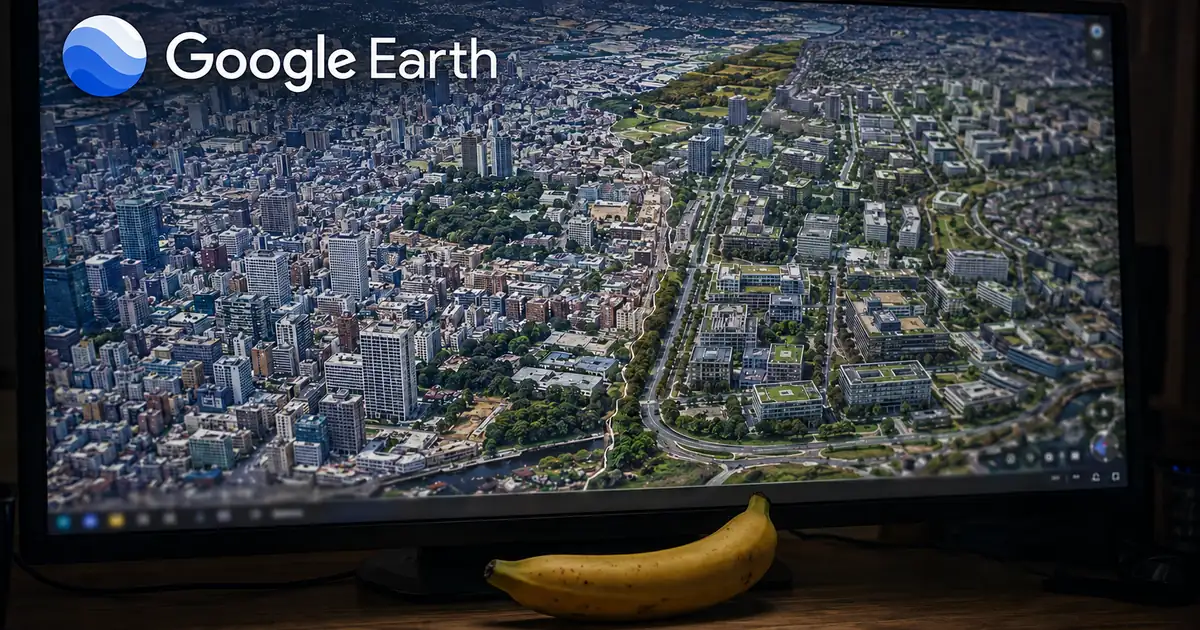
Google Earth AI image generation with Nano Banana 2
Google Earth is a map with satellite imagery, aerial photos, and 3D views of real places. Nano Banana 2 is the image generation model from Google. On July 30, 2026, the company joined the two, and the feature went live globally for web users that day.
Google described it as a way to make custom images from Earth's satellite, aerial, and 3D imagery, with Nano Banana producing concepts grounded in the real world. To use it, a person zoomed in to a place in Google Earth on the web, tapped "create image", and typed what they wanted to see. Gemini appears in one of the examples: for the Statue of Liberty infographic, Gemini retrieves the historical facts and Nano Banana creates the graphic.
The feature at a glance (from Google's blog post)
Google's post listed five ways to try it. Each starts from a real location.
The five uses in Google's launch post
| Use | Example request |
|---|---|
| Historic site | A teacher shows a class a historic site and asks for a hyper-realistic view of the Pompeii ruins in 78 A.D. |
| Landmark infographic | An infographic of the Statue of Liberty with key historical facts |
| Empty lot in Tokyo | An empty lot in Tokyo reimagined as a shopping and retail district with open spaces |
| Open lot with a cabin | A modern lakefront cabin built from sustainably sourced local materials, added to an open lot |
| Company campus | The Google Mountain View campus as a futuristic sci-fi utopia |
For the first time, you can generate custom images using Google Earth’s satellite, aerial, and 3D imagery alongside Nano Banana, which creates concepts grounded in the real world. Just zoom in to a place in Google Earth on web, tap “create image,” and type whatever you want to see. / Behind the scenes, Gemini will retrieve relevant historical information and Nano Banana will create a graphic in seconds. / Image generation with Nano Banana is available globally today for Google Earth web users. — From the launch description, the infographic example, and the availability lineView official source →
Nano Banana 2 rollback: Google Earth AI feature pulled in one day
Google launched the feature on July 30, 2026, and rolled it back on July 31, 2026. It published the launch post on July 30, then added an update to the top of that same post instead of writing a new one.
From launch to rollback
- July 30Image generation launched globally for Google Earth web users; the post lists five uses
- July 31An update at the top of the post says the feature is being rolled back while stronger guardrails are built
Google's word is "rolling back", and it adds that it is working on "stronger guardrails". That is a withdrawal while Google works on guardrails, not an announcement that the feature is ending. The update gives no return date, no description of the guardrails, and no description of what the problem images showed.
We know that people uniquely trust Google Earth for a reliable view of the world. We’ve seen geospatial professionals using this feature for a range of useful purposes, however we’ve also seen people sharing screenshots of generated imagery that appear to violate our policies. So we’re rolling back this feature in Google Earth while we work on implementing stronger guardrails. It's important to note that generated images didn’t appear in the main Google Earth experience for others to see and were watermarked as AI generated. — From the update added on July 31View official source →
Google Earth AI tool pulled over deepfake concerns
Google's stated reason is that people shared screenshots of generated imagery that appear to violate its policies. The update opens with the trust people place in Google Earth for a reliable view of the world, and notes that geospatial professionals used the feature for useful purposes. The update does not say what those images showed, how many were shared, or whether outside reports came before the decision.
Several outlets framed the story around deepfakes and misinformation. That framing is the outlets' own, not Google's.
- Rappler's headline says Google Earth pulled back its new AI tool after warnings about generated deepfakes.
- eWeek's headline says Google rolled the tool back over deepfake fears.
- Technobaboy's August 3, 2026 headline says the rollback followed misinformation concerns.
- Another headline describes Google Earth releasing, then swiftly retracting, an AI feature that makes fake satellite images.
One outlet also tested the feature and wrote about reimagining Philadelphia with zombies and evil clowns. That is the outlet's own test, not Google's account of the policy-violating screenshots.
We’ve seen geospatial professionals using this feature for a range of useful purposes, however we’ve also seen people sharing screenshots of generated imagery that appear to violate our policies. — From the update added on July 31View official source →
Nano Banana 2 images: why a watermark was not enough
Google names two safeguards in its update: images hidden from other users, and an AI watermark. Generated images did not appear in the main Google Earth experience for others to see, and they carried an AI watermark. The same update names one problem: shared screenshots of imagery that appear to violate Google's policies.
Safeguards Google names, and the problem it names
A screenshot is an image copied out of the product, so it can travel to people who never opened Google Earth. Google's update does not say whether the watermark was visible in the shared screenshots, whether any were cropped or edited, or how the images spread.
NewsCord's roundup of how outlets covered the story has a section titled "Watermarks and bypasses", and eWeek's report has one titled "Built-in limits weren't enough". Those sections are the outlets' framing. Google's update itself draws no conclusion about whether its safeguards worked.
however we’ve also seen people sharing screenshots of generated imagery that appear to violate our policies. / It's important to note that generated images didn’t appear in the main Google Earth experience for others to see and were watermarked as AI generated. — From the shared screenshots and the safeguards Google listsView official source →
Google Earth generative AI rollback: what it means
As of the July 31, 2026 update, the Google Earth image generation feature is unavailable. The company calls the change a rollback while it works on stronger guardrails. Three things remain undisclosed:
- A date or condition for the feature's return
- What the stronger guardrails will be
- What the policy-violating images showed
Google announced both the launch and the withdrawal in the same post. For the model lineage, see Nano Banana 2 Lite: 4 Seconds, $0.034 an Image. If you work with the Gemini family, check the update at the top of Google's post for later changes.
FAQ
- Is the Google Earth image generation feature gone?
- As of Google's July 31, 2026 update, it is unavailable. Google pulled it that day, one day after launch. Google calls it a rollback while it works on stronger guardrails, not an end to the feature. The update gives no date for its return.
- Why was it pulled?
- Google's stated reason is that people were sharing screenshots of generated imagery that appear to violate its policies. Google also says people uniquely trust Google Earth for a reliable view of the world, and that geospatial professionals had been using the feature for useful purposes.
- Could other people see the generated images?
- Google says generated images did not appear in the main Google Earth experience for others to see, and that they were watermarked as AI generated. The problem Google names is screenshots of generated imagery being shared.
Related articles
 Nano Banana 2 Lite: 4 Seconds, $0.034 an ImageNano Banana 2 Lite makes an image in about 4 seconds for $0.034 per 1K image. Pricing, comparison with Nano Banana 2 and Pro, and Gemini Omni Flash video.
 Gemini create files: edit PDFs and docs in chatGemini create files: docs, PDFs, slides and sheets now open in the chat as previews you can edit. Phones edit only PDFs; the web handles the rest.
 Gemini 4 Carbon vs Argon: Pricing and AccessGemini 4 Carbon vs Argon: Carbon opened to paid API developers, businesses and Google AI Ultra on Nov 10, at the same $2/$10 per 1M token price as Argon.
 Gemini free tier goes Flash-Lite only on October 9The Gemini free tier is Flash-Lite only from October 9, 2026. Flash needs AI Plus ($4.99/month), Pro needs AI Pro ($19.99), and Deep Think stays Ultra-only.