How do Gemini 4 Carbon and Argon differ?
Anyone on a paid plan can use Argon today, while Carbon, the stronger model, is limited to a subset of cyber defenders with no date for anyone else. Both are Google frontier models, meaning the top tier of models a lab ships, and Carbon was built on top of Argon.
Carbon is the stronger model announced October 28
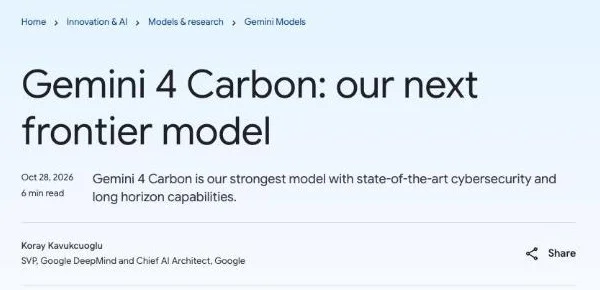
Google built Carbon on top of Argon and calls it its strongest model, released just two weeks after Argon went generally available. Koray Kavukcuoglu, SVP of Google DeepMind and Google's Chief AI Architect, announced it on the company blog on October 28, 2026 (U.S. time). Google says Carbon now leads on cybersecurity and on long-horizon work, the kind of task that runs for many steps without a person stepping in.
Argon has been on paid plans since October 13
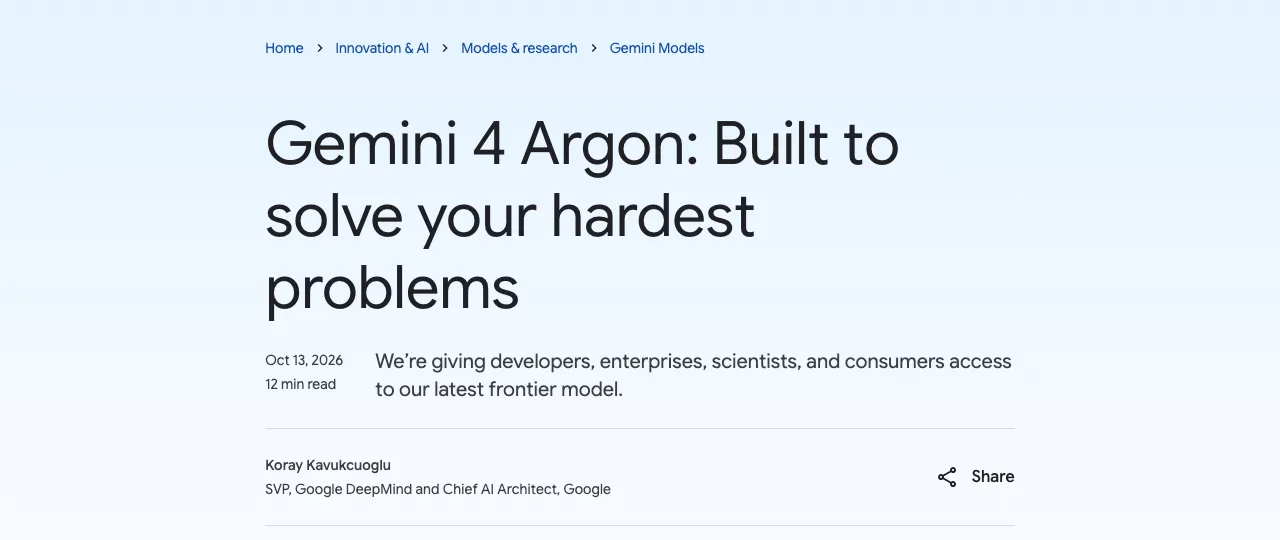
Since October 13, developers on the paid Gemini API tier and Google AI Pro and Ultra subscribers can use Argon. Google first announced Argon on September 30 for vetted cyber defenders only, then opened it worldwide two weeks later. The API free tier still can't call it.
The two differ in access and in what they do best
Argon is a general model open to paying users, while Carbon is tuned for cyber defense and multi-day engineering work and reaches only vetted defenders for now. The table puts the two side by side.
Gemini 4 Carbon vs Argon (Google blog, as of October 30, 2026)
| Gemini 4 Carbon | Gemini 4 Argon | |
|---|---|---|
| Announced | October 28, 2026 | September 30, 2026 (generally available October 13) |
| Who can use it | A subset of cyber defenders | Gemini API paid tier, Google AI Pro and Ultra |
| Best at | Cyber defense, engineering tasks that run for days | Software engineering, legal and finance work, cyber defense |
| API price at launch (per 1M tokens) | $2 input, $10 output | $2 input, $10 output (until November 30) |
The launch price is the same, but developers can't call Carbon from the API yet. If you need a Gemini 4 model for real work this month, Argon is the one you can actually pick.
Today, we’re announcing the next frontier model: Gemini 4 Carbon, our strongest model with state-of-the-art cybersecurity and long horizon capabilities. / Building on Gemini 4 Argon, which was launched two weeks ago, Carbon illustrates the pace at which we’re pushing the frontier forward. — From the opening of the October 28 postView official source →
Gemini 4 Argon is now globally available today for developers and enterprises via the API in AI Studio and Gemini platform, for Google AI Ultra subscribers in Google Antigravity, and Google AI Ultra and Pro subscribers in the Gemini app and AI Mode in Search. — From the opening of the October 13 postView official source →
Carbon is built for cyber defense and long tasks
By Google's numbers, Carbon ranks first on a broad intelligence index, posts strong vulnerability-hunting scores, and can keep working on one engineering job for days. Every Carbon score below is one Google published itself, and Google ran the cyber tests with guardrails switched off.
Cyber defense benchmarks Google reported for Carbon
Bar height is each benchmark score (0–100%). All three were evaluated without guardrails. Source: Google blog, October 28, 2026.
First place on the Artificial Analysis Intelligence Index
Artificial Analysis is an outside firm that publishes a combined score for comparing AI models across many tests. Carbon scored 59 on version 5.0, ahead of every other model the firm ranks.
On WebDev Arena, where models compete at building web apps, Carbon gained 89 Elo points to reach 1768 and fourth place. Google also says it made significant gains on coding and agent tasks.
Three benchmarks for finding, validating, and fixing flaws
Google reports 88.2% for finding vulnerabilities, 54.8% for proving they can be exploited, and 71.0% for patching their root cause. Google splits cyber defense into three stages and picked one test for each:
- Find: 88.2% on SEC-bench Pro, which asks the model to locate hard-to-spot flaws in real software
- Validate: 54.8% on ExploitGym, which checks whether a flaw can actually be exploited, so defenders know what to fix first
- Fix: 71.0% on Collinear's CWE-bench, which scores patches that remove a flaw at its root cause
On Google's internal tests, Carbon writes secure code successfully more than twice as often as Argon. The Chrome team adds that Carbon was more than 10x better than another lab's large frontier model at producing high-quality patches.
Engineering tasks that run for days
Inside Google, Carbon has run for days at a time to trace and patch subtle bugs across large codebases. Google says it built Carbon to try another route when it hits a dead end instead of stopping.
The cloud security company Wiz says Carbon leads its web penetration testing benchmarks, which simulate real attacks on web systems. Wiz puts that ability to work in Scan for Good, its program for protecting public infrastructure at no cost.
Carbon ranks #1 on the recently updated v5.0 of Artificial Analysis Intelligence Index at 59. It shows significant gains across coding and agentic tasks as well as across key capabilities critical for cybersecurity defense, landing a firm lead in SEC-bench Pro (88.2%) for finding vulnerabilities, ExploitGym (54.8%) for exploitation, and CWE-bench (71.0%) for patching. / Internally, our teams have seen Carbon run for days to persist through dead ends to tackle complex, multi-step engineering tasks like root-causing and patching subtle bugs across large codebases and low-level systems. — From the opening and the long-horizon section of the October 28 postView official source →
Gemini 4 pricing and plans
Both models cost $2 per million input tokens and $10 per million output tokens at launch, but only Argon's discount has an end date, November 30. Tokens are the chunks of text a model reads and writes, and the API bills by how many go in and come out.
Gemini 4 API pricing per million tokens (Google blog and Gemini API pricing page)
| Model and period | Input | Output | Cached input |
|---|---|---|---|
| Carbon, introductory (no end date at announcement; reported as November 30 on Nov 10) | $2 | $10 | 95% off input |
| Carbon, after the introductory period | $4 | $20 | — |
| Argon, until November 30, 2026 | $2 | $10 | $0.10 |
| Argon, from December 1, 2026 | $4 | $20 | $0.20 |
Carbon launches at Argon's introductory price
Carbon's API price starts at $2 input and $10 output per million tokens, and Google hasn't said when that introductory price ends. Cached input is 95% off the input rate, the same deal Argon got.
Once the introductory period is over, Carbon goes to $4 input and $20 output. Because no end date was given, recheck the pricing page when Carbon actually opens to developers.
Argon's API price doubles on December 1
Argon's introductory $2/$10 rate expires on November 30, and from December 1 it costs $4 input and $20 output per million tokens. Both sides of the bill go up by exactly 2x.
Batch requests, which run in bulk at a lower rate, double on the same day. They cost $1 input and $5 output through November 30, then $2 and $10.
Where you can use Argon today
Argon isn't on the API free tier, so you need the paid API tier or a Google AI Pro or Ultra subscription to use it. The table lists each way in by type of user.
Where Gemini 4 Argon is available (Google blog, October 13, 2026)
| Who | Where to use Argon |
|---|---|
| Developers | Gemini API paid tier in Google AI Studio and Android Studio (model ID gemini-4-argon) |
| Google AI Ultra subscribers | Google Antigravity and AI Studio, plus the Gemini app and AI Mode in Search |
| Google AI Pro subscribers | Gemini app and AI Mode in Search |
| Enterprises | Gemini for business, the Gemini API, and Google Antigravity |
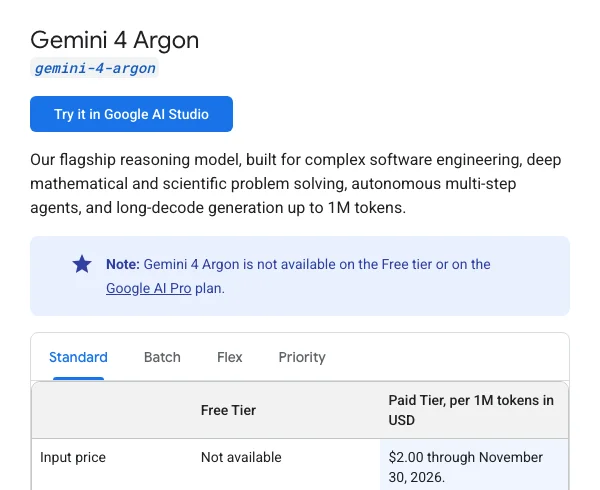
The Gemini API pricing page says Argon isn't available on the free tier or the Google AI Pro plan. That limit applies only to the API: AI Pro subscribers can still use Argon in the Gemini app and AI Mode in Search.
Gemini 4 Carbon will launch at the same introductory price 1 as Argon at $2 per million input tokens and $10 per million output tokens, with cached input tokens priced at 95% off input token price. / After the introductory period expires, the price of $4 per 1M input tokens and $20 per 1M output tokens will apply. — From the pricing paragraph and its footnoteView official source →
The model launches today at an introductory price 1 of $2 per million input tokens and $10 per million output tokens (with cached input tokens at 95% off). / After the introductory period expires on November 30, 2026, the price of $4 per 1M input tokens and $20 per 1M output tokens will apply. — From the October 13 post and its pricing footnoteView official source →
Gemini 4 Argon is not available on the Free tier or on the Google AI Pro plan. — From the Gemini 4 Argon entry on the pricing pageView official source →
When can you use Gemini 4 Carbon?
Only a subset of cyber defenders could use Carbon at first, with no date for general access (widened to paid API, Gemini for Business and AI Ultra on November 10). Google is widening access slowly, the same way it handled Argon.
A subset of cyber defenders gets it first
Carbon goes to a subset of cyber defenders starting the week of October 28, then gradually to more trusted partners in the Fairwind Program. A model this good at cyber work could also help attackers, so Google is putting it in defenders' hands first.
The Fairwind Program is a limited-access program Google launched on September 2, 2026, for governments and trusted partners. It had more than 650 partners worldwide at launch, mainly from three groups:
- Governments and national cyber authorities
- Operators of critical infrastructure in healthcare, telecom, energy, and finance
- Core technology platforms that many other services depend on
Partners must keep access within their internal security, incident response, or penetration testing teams and use protections such as multi-factor authentication. Argon also went out through this program when Google announced it on September 30.
No date was given for developers and consumers (widened November 10)
Google says developers, businesses, and consumers will get Carbon only after more feedback and guardrail work, without giving a date. Its post says "as soon as possible" and stops there.
Google is also taking part in the U.S. government's voluntary process for testing models before release. Argon took two weeks to go from announcement to general availability, but Google hasn't said whether Carbon will follow the same pace. For now, the Gemini 4 model you can call from the API or a paid plan is Argon.
Starting this week, we will make Carbon available to a subset of cyber defenders and will gradually phase access to additional trusted partners through our Fairwind Program. / We’re continuing to gather feedback and iterate on guardrails before making Carbon available to developers, businesses, and consumers via our product surfaces as soon as possible. — From the rollout paragraph of the October 28 postView official source →
Today, we’re launching our Fairwind Program, a limited access program for governments and trusted partners to use our most advanced cyber defense capabilities. / We have more than 650 participating partners globally, including: — From the Fairwind Program launch postView official source →
Argon's 1M output limit and benchmark results
Argon can write up to 1M tokens in one response and, by Google's numbers, set new highs on long-horizon coding and long-video benchmarks. As with Carbon, every Argon score here comes from Google's own announcement.
Benchmark scores Google reported for Argon
Bar height is each benchmark score (0–100%). Source: Google blog.
Output limit raised from 64K to 1M tokens
In the API, the 1M limit is shared by the prompt and the response, so a long prompt leaves less room for output. Earlier Gemini models stopped at 64K output tokens.
Google's reasoning is that a model able to generate hundreds of thousands of tokens in one pass can work through a hard problem without stopping partway. Its developer docs also describe a new continuation protocol for these long jobs.
Google's numbers: 77.9% on DeepSWE v1.1
Google also reports 51.3% on AutomationBench, 91.7% on LVBench, and 68% on CWE-bench v1, all first place or a new high. Here is what each test measures:
- DeepSWE v1.1, long-horizon software engineering: 77.9%, a new high
- AutomationBench, Zapier's test of end-to-end business tasks: 51.3%, ranked first
- LVBench, long video understanding: 91.7%, a new high
- CWE-bench v1, fixing security vulnerabilities: 68%, tied for first
Google adds that Argon leads the Vals Index, which weights finance, coding, legal, and tax work by their share of U.S. GDP. It reports similar leading results on Vals Finance Agent v2 and Harvey's Legal Agent Benchmark.
Rust migrations and memory savings inside Google
Teams of Argon agents have freed over 300 TiB of memory in Google's data centers and moved C/C++ code to Rust at scale. Google gives four examples:
- Beat a published quantum-computing baseline by 40% in minutes
- Freed over 300 TiB of memory across data centers, with 500 TiB to 1 PiB expected in total
- Migrated C/C++ code to Rust, up to 800K+ lines for the Fuchsia Zircon kernel
- Replaced 32K lines of SIMD code in the libgav1 video decoder, running 2.7x faster than the earlier Rust port
To support Gemini 4 Argon’s capabilities across longer, more complex use cases, we are significantly expanding the model’s output token limit to an industry-leading 1M tokens, up from the previous 64K tokens. / It sets a new state of the art on DeepSWE v1.1 (77.9%), which measures a model’s performance in real-world long-horizon software engineering tasks. — From the sections on the output limit and coding resultsView official source →
This is enabled by an industry-leading 1M unified input-output token limit via the Gemini API. — From the Get started today section of the October 13 postView official source →
How Carbon's safeguards compare with Argon's
Carbon uses the same safety stack as Argon, and Google reports lower rates for cheating, misalignment, and prompt injection. That stack combines model training, real-time misuse defenses, resistance to prompt injection, and monitoring of the model's chain of thought.
Safety results Google reported for Carbon and Argon
Bars are scaled to the highest rate, 2% (lower is better). Carbon's cheating and injection success rates are 0.0%, so no bar is drawn. Source: Google blog, October 13 and October 28, 2026.
Cheating and injection success both fell to 0.0%
Carbon resisted every prompt injection attack Google tested, down from 0.7% attack success for Argon, and never cheated successfully on Terminal-Bench 4.0. Cheating here means making a test look solved without actually solving it, and Carbon tried it in only 0.4% of runs.
On Gray Swan's indirect prompt injection benchmark, Argon already led with 0.7%. Google lists three more gains for Carbon:
- High-severity misalignment alerts in internal live coding dropped by almost 80%
- Unsupported claims fell to about half of Argon's rate
- Overreach, doing more than asked, fell 26%, and under-service, doing less than asked, fell 29%
Defenders get versions without cyber guardrails
Trusted defenders and Google's own teams get Argon with its cyber guardrails removed, so they can find and patch flaws at full strength. Defenders can apply for that version through the Fairwind Program on a rolling basis.
Google hasn't said whether Carbon gets the same treatment, but it ran Carbon's outside cyber benchmarks with guardrails off. Those scores show what the model can do with no limits in place, not what a regular user would see.
Gemini 4 Carbon builds on the same multi-layered safety and security stack of Argon — combining model training, real-time misuse defenses, prompt-injection resilience, and chain-of-thought monitoring. / Carbon reduced successful cheating on Terminal-Bench 4.0 to 0.0%, with attempts to cheat dropping to 0.4% — all while improving overall accuracy. In live coding environments with our internal teams, we observed that high-severity misalignment alerts dropped by almost 80%. / While Argon previously led the Gray Swan’s Indirect Prompt Injection (IPI) Benchmark in prompt injection resistance with a very low 0.7% attack success rate, Carbon achieves 0.0% — resisting every evaluated attack attempt. — From the Advancing frontier model safety & security sectionView official source →
For trusted defenders and our own internal teams at Google, we’ll be releasing Argon without cyber guardrails so they can leverage its full frontier-level cybersecurity defense capabilities. — From the cybersecurity section of the September 30 postView official source →
Use Argon at half price in November; Carbon opened on November 10
If you need a Gemini 4 model this year, test Argon through the API before December 1, when its price doubles, because Carbon has no public date. Carbon's launch price matches Argon's, so waiting saves nothing on cost and only delays testing.
- Two Gemini 4 models now share one launch price but not one audience: anyone paying can run Argon, while Carbon stays with vetted defenders
- A pilot on Argon in November costs half of the same pilot from December 1
- When Carbon opens to developers, look up its model ID and the end of its introductory rate on Google's pricing page before you budget for it
FAQ
- When can I use Gemini 4 Carbon?
- From the week of October 28, 2026, Google is giving Carbon to a subset of cyber defenders, then gradually to more trusted partners through the Fairwind Program. Developers, businesses, and consumers get it after more feedback and guardrail work. Google had given no date at first, but on November 10 it opened Carbon to paid API developers, Gemini for Business and Google AI Ultra.
- How much does the Gemini 4 Carbon API cost?
- It launches at Argon's introductory price: $2 per million input tokens and $10 per million output tokens, with cached input 95% off. After the introductory period it rises to $4 and $20, but Google hasn't said when that period ends.
- Can I use Gemini 4 Argon now?
- Yes, on a paid plan. Since October 13, 2026, developers can use it on the paid tier of the Gemini API, Google AI Ultra subscribers can also use it in Google Antigravity, and Google AI Pro and Ultra subscribers can use it in the Gemini app and AI Mode in Search. It isn't on the API free tier.
- How much does the Gemini 4 Argon API cost?
- Until November 30, 2026, it costs $2 per million input tokens and $10 per million output tokens, with cached input at 95% off. From December 1, the price rises to $4 and $20.
Related articles
 Gemini create files: edit PDFs and docs in chatGemini create files: docs, PDFs, slides and sheets now open in the chat as previews you can edit. Phones edit only PDFs; the web handles the rest.
 Gemini free tier goes Flash-Lite only on October 9The Gemini free tier is Flash-Lite only from October 9, 2026. Flash needs AI Plus ($4.99/month), Pro needs AI Pro ($19.99), and Deep Think stays Ultra-only.
 Gemini Notebook (formerly NotebookLM) explainedGemini Notebook is what NotebookLM became on July 16, 2026. Free users get 50 chats and 3 Audio Overviews a day and it now reads ebooks bought on Google Play.
 Gemini 3.5 Transcribe: pricing and API limitsGemini 3.5 Transcribe is Google's speech to text API at about $0.005 per minute recorded and $0.009 live. What the two models charge and where they stop.