
What the Hanover Institute fake think tank published
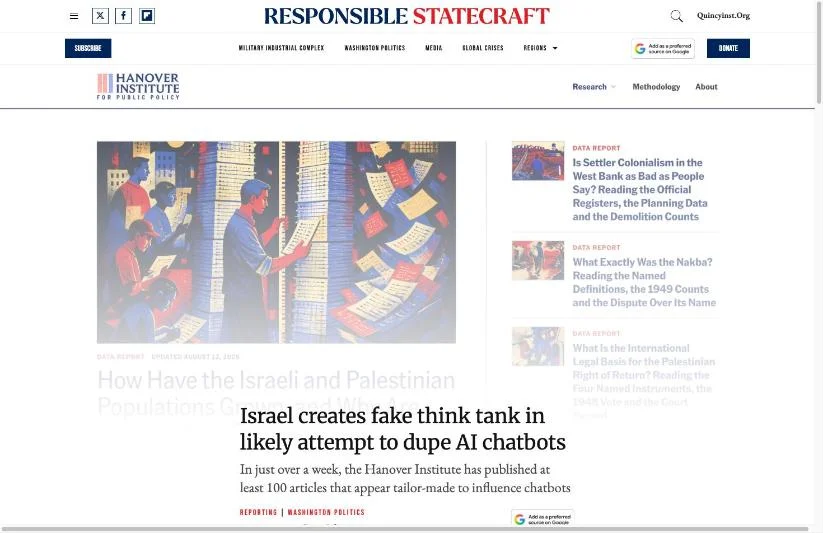
On August 17, 2026, Responsible Statecraft reported that the Hanover Institute for Public Policy is not a real think tank, and that it has put out over 100 reports since it began publishing on August 6. None of the reports carry a byline.
Alice Lee, an analyst at NewsGuard, a company that tracks disinformation, said the site mimics a typical credible American think tank. She pointed to the generic name, the site layout and the red-white-blue color scheme.
The only disclosure is a small disclaimer at the bottom of the page. It says Piro, Inc created the organization on behalf of the Israeli Government Advertising Agency. The outlet adds that Piro has received $900,000 from the Israeli government for its work, subcontracted through Havas Media, a French public relations conglomerate.
"But the Hanover Institute is not a real think tank." (the finding)/"It's a perfect mimicry of a typical credible American think tank, right down to the generic name, the site layout, and the red-white-blue color scheme," (NewsGuard analyst comment)/"None of the reports have bylines. A small disclaimer at the bottom of the webpage notes that the organization was created on behalf of the Israeli Government Advertising Agency by Piro, Inc…" (bylines and the disclaimer)/"Piro, Inc, the firm that created the Hanover Institute, has received $900,000 from the Israeli government for its work. Like many other contractors working for Israel, Piro’s work is subcontracted through Havas Media, a French public relations conglomerate." (the contract)/"The fake think tank has churned out over 100 reports since it started publishing on August 6." (publication volume)— from Responsible Statecraft's investigationView official source →
Why NewsGuard says AI chatbots reward strong citations
The NewsGuard analyst says large language models (LLMs, the AI systems behind chatbots) favor concrete statistics and data along with strong citations and sources, and that these articles have all of them. That is the analyst's reading of why the format would suit AI chatbots.
Responsible Statecraft describes the format in more detail. The institute's "data reports" come with footnotes and tables of contents, and they argue in a neutral tone. The outlet says this helps them appeal to chatbots like Claude or Gemini.
Many of the reports also follow a formula, according to the outlet. They open with an innocent question that someone might ask a chatbot. The appeal to chatbots is the analyst's and the outlet's reading of the format, not a measurement of any chatbot.
"The institute’s “data reports” have footnotes and tables of contents, and they present arguments in a neutral tone, helping them appeal to chatbots like Claude or Gemini." (report format)/"LLMs favor concrete statistics and data, as well as strong citations and sources, which these articles all have," (NewsGuard analyst comment)/"Many of the reports are formulaic, starting with an innocent question that someone might ask a chatbot." (report structure)— from Responsible Statecraft's investigationView official source →
Piro's AI Story Optimization pitch on LLM poisoning and AI chatbots
Piro's own website says the firm writes content engineered for how LLMs evaluate credibility, and it names that service AI Story Optimization. Responsible Statecraft adds that others refer to this practice of influencing artificial intelligence as LLM poisoning. The label comes from those others; Piro's site uses its own product name.
A Piro co-founder described the approach in a LinkedIn post the month before the report. The post says that a question to ChatGPT, Gemini or Perplexity about a product category returns one confident paragraph. It also says the firm spent months reverse-engineering how that paragraph is built.
The outlet also reports on Piro's filing. The agreement Piro submitted to the Department of Justice does not explicitly state that its work for Israel is to influence AI.
"Piro’s website says that it “author(s) content engineered for how LLMs evaluate credibility,” describing this service as \"AI Story Optimization.\" Others refer to this practice of influencing artificial intelligence as “LLM poisoning.”" (Piro's site copy)/"When someone asks ChatGPT, Gemini, or Perplexity about your category, an answer comes back in one confident paragraph. Most brands have no idea how that paragraph gets built. So we spent months reverse-engineering it…" (co-founder's LinkedIn post)/"Piro does not explicitly state in its agreement submitted to the Department of Justice that its work for Israel is to influence AI." (the DOJ filing)— from Responsible Statecraft's investigationView official source →
GPTZero flagged 11 of 12 Hanover Institute articles
GPTZero flagged 11 of the 12 sampled Hanover Institute articles as AI-written with high confidence, and the twelfth with moderate confidence. Responsible Statecraft chose the 12 articles at random. GPTZero is an AI detection tool that, the outlet says, claims a low false-positive rate.
The sample is 12 of the site's more than 100 reports. So the result covers that sample, not every report on the site.
"RS analyzed 12 random Hanover Institute articles using GPTZero, a popular AI detection software that claims a low false-positive rate. GPTZero flagged 11 of the articles as AI-written with “high confidence”; it flagged one article as AI-written with “moderate confidence.”" (GPTZero results)— from Responsible Statecraft's investigationView official source →
Drop Site on AI chatbots, citations and training data
Responsible Statecraft writes that Israel also contracted former Trump campaign manager Brad Parscale, under a $46.5 million contract, to create pro-Israel websites engineered to influence chatbots. These are separate sites from the Hanover Institute.
The outlet then cites a Drop Site investigation from the month before. Drop Site found that many chatbots, particularly Microsoft Copilot and Google Gemini, had been successfully trained on data from those websites.
The outlet adds that other chatbots frequently cite the same websites. They do so without flagging them as part of an Israeli influence operation.
"Israel has also contracted former Trump campaign manager Brad Parscale to create pro-Israel websites engineered to influence chatbots as part of a $46.5 million contract. A Drop Site investigation last month found that many chatbots, particularly Microsoft Copilot and Google Gemini, had been successfully trained on data from those websites. Other chatbots frequently cite those websites without flagging them as part of an Israeli influence operation."— from Responsible Statecraft's investigationView official source →
How to check the sources AI chatbots cite
You can check any AI answer that names its sources by opening each cited page and looking for an author, a funder and a disclosure. This section is our general advice, not something the reporting found.
In the Hanover Institute case, the reports carry no byline, and the funder appears only in a small disclaimer at the bottom of the page. If you stop at the organization's name, you see neither.
Three questions are enough for a quick check. You can answer each one from the cited page itself:
- Does the page name the person who wrote the piece?
- Does it say who funds the organization?
- Does the footer or an "about" page carry a disclosure?
When the page answers none of them, treat the claim as unverified. For how much traffic AI search sends to sites at all, see AI Referral Traffic Grew 8x: Shopify Q1 2026 Data. For a related problem, where the author shown on a piece is not the one who wrote it, see AI Written Articles Under a Real Writer's Byline.
Three facts on record about this poisoning case
The reporting records three things about this LLM poisoning case. The Hanover Institute published over 100 unsigned reports, Piro's own site describes content engineered for how LLMs evaluate credibility, and GPTZero flagged 11 of 12 sampled articles as AI-written.
Intent is a separate question. The outlet calls the effort a likely attempt to dupe chatbots; that is its inference, and we don't treat it as established.
For readers, the practical step is the one covered above. Open the sources an AI answer names, and check who wrote them and who paid for them.
FAQ
- What is LLM poisoning?
- It is the label some people use for influencing the material AI chatbots draw on. Responsible Statecraft describes a firm that says it writes content for how language models judge credibility, and notes that others call this practice LLM poisoning.
- Why would an AI chatbot cite a site like this?
- A NewsGuard analyst told Responsible Statecraft that language models favor concrete statistics and strong citations, and that these articles have both. The same analyst described the site as a copy of a credible American think tank, down to its layout and colors.
- Has any chatbot actually cited this kind of site?
- According to the reporting, yes. It cites a separate Drop Site investigation that found many chatbots, particularly Microsoft Copilot and Google Gemini, had been trained on data from a different set of pro-Israel sites, and says other chatbots frequently cite them without flagging them as part of an influence operation.
Related articles
 Panasonic HR data on 334,000 uploaded to banned AIA Panasonic group project member uploaded HR data on about 334,000 employees, ex-staff and relatives to a banned AI service. No misuse has been found so far.
 Epic Games delays Disney shooter, goes AI firstBloomberg reports Epic Games told its Marvel and Star Wars shooter team to stop hand-writing code and use AI. The March 2027 release is off with no new date.
 Stability AI Funding: $76M From the Music MajorsStability AI funding round: a $76M Series B from Sony, Universal, Warner and Electronic Arts. Total funding under CEO Akkaraju is $232M, this round included.
 FLUX 3 Video: 20-Second Clips With Native AudioFLUX 3 Video makes clips up to 20 seconds long with audio generated alongside. Rates run from $0.06 a second in Draft mode to $0.95 for 4K continuation.