
What an open weight model is
An open weight model is a model whose trained weights are released to the public, so anyone can download it and run it themselves. You see the label on models such as Meta's Llama, OpenAI's gpt-oss, Alibaba's Qwen and DeepSeek. The opposite is a closed model, whose weights never leave the company that built it.
Open weight model at a glance
| Also called | Open-weights model, open model |
| What is public | The trained weights, plus a license |
| What is usually private | Training code and training data |
| How you use it | Download it and run it, or use a hosted service |
| Opposite | Closed model, used only through the maker's app or API |
Weights are the numbers a model learned
Weights are the values a model settles on during training, and they decide how it turns your input into an output. A large language model contains billions of them. Training is the slow, expensive part; once it is finished, the weights are saved as files.
Those files are the model in practical terms. Whoever has them can run the model. The Open Source Initiative (OSI), the group that maintains the definition of open source, notes that they can also fine-tune it, adapt it or deploy it in their own projects.
You download it instead of calling an API
With a closed model, you send your request to the maker's servers through its app or API and get an answer back. An API is the interface programs use to talk to a service. You never hold the model itself.
An open weight model can be downloaded from the internet and run on a computer you choose. The US National Telecommunications and Information Administration (NTIA) counts Meta, Google, Microsoft, Stability AI, Mistral, the Allen Institute for AI and EleutherAI among the developers that have done this, though not always with their best work. We cover who publishes the largest open models in 2026 in "Open Weight Models in 2026: Qwen and Chinese Labs."
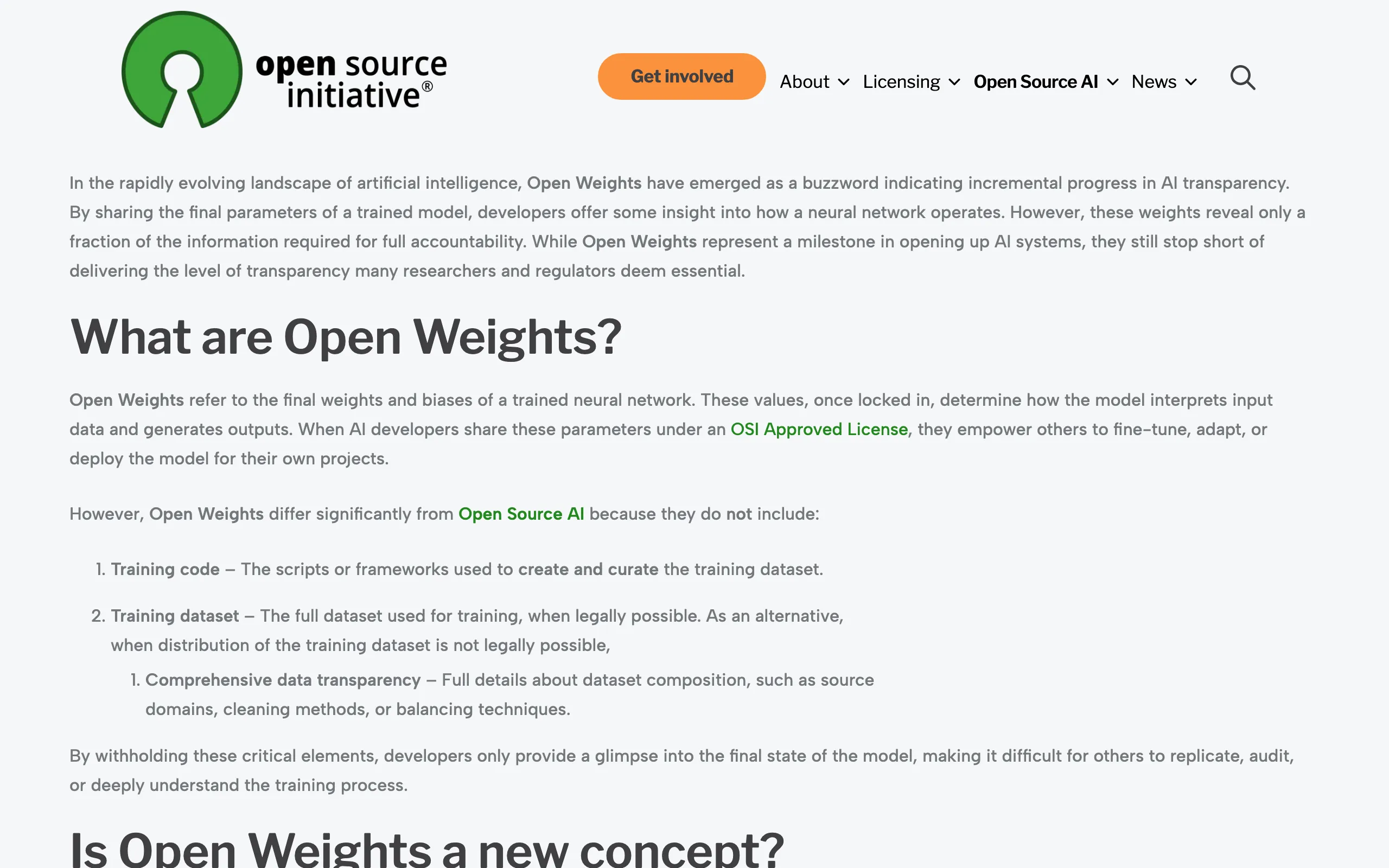
Open Weights refer to the final weights and biases of a trained neural network. These values, once locked in, determine how the model interprets input data and generates outputs. (What are Open Weights?) — from the Open Source InitiativeView official source →
Many developers provide limited or no public access to the inner workings of their advanced models, including their weights./have released models – though not always their most advanced models – with weights that are widely available (i.e., open to the public by allowing users to download these weights from the Internet or through other mechanisms). (Executive Summary) — from NTIAView official source →
Open weight vs open source AI
Open weight and open source are often used as if they meant the same thing, but an open weight model gives you less. You get the finished model, not what went into building it, and the table below shows where the line falls.
What each kind of model releases
| Closed | Open weight | Open source AI | |
|---|---|---|---|
| Weights | No | Yes | Yes |
| Training code | No | Usually not | Yes |
| Training data details | No | Usually not | Yes |
| Use for any purpose | No | Depends on license | Yes |
You get the weights, not the training code or data
The OSI lists what open weights leave out: the training code, the training dataset and full details of how that data was put together. Without them, nobody outside the company can rebuild the model from scratch.
That gap matters for checking a model, not for running it. If you can't see what it was trained on, you can't trace where a bias or an error came from. For everyday use the weights are enough, but for an audit or research they fall short.
Open source AI also requires the code and data details
The OSI's Open Source AI Definition 1.0 sets a higher bar than publishing weights. It requires the freedom to use the model for any purpose without asking permission, and to study, modify and share it.
To make those freedoms real, the definition asks for three things together: detailed information about the training data, the code used to train and run the model, and the weights themselves. A model that ships only weights, or whose license limits who may use it, does not meet it.
However, Open Weights differ significantly from Open Source AI because they do not include:/Training code – The scripts or frameworks used to create and curate the training dataset./Training dataset – The full dataset used for training, when legally possible. (What are Open Weights?) — from the Open Source InitiativeView official source →
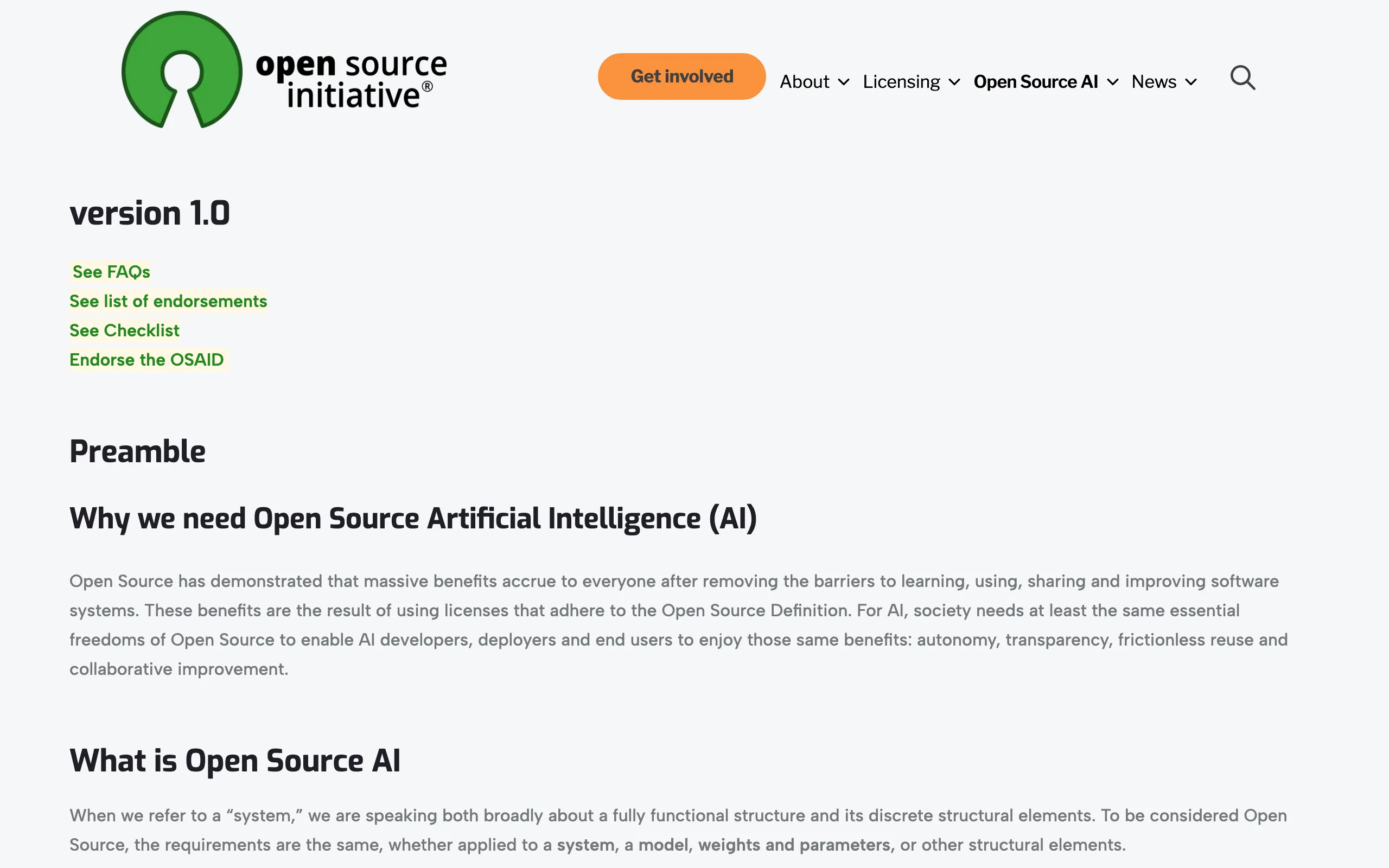
Use the system for any purpose and without having to ask for permission./Study how the system works and inspect its components./Modify the system for any purpose, including to change its output./Share the system for others to use with or without modifications, for any purpose./Data Information: Sufficiently detailed information about the data used to train the system so that a skilled person can build a substantially equivalent system./Parameters: The model parameters, such as weights or other configuration settings. (What is Open Source AI) — from the Open Source InitiativeView official source →
Open weights still come with a license
Being able to download a model does not mean you can use it however you like. Every open weight model ships with a license, and that license, not the download button, decides what is allowed. The two examples below sit at opposite ends.
Two open weight licenses compared
| Llama 4 | gpt-oss | |
|---|---|---|
| License | Llama 4 Community License | Apache 2.0 |
| Commercial use | Yes, with conditions | Yes |
| User limit | Separate license above 700 million monthly active users | None |
| Attribution | Show "Built with Llama"; derived model names start with "Llama" | No naming rule |
Llama needs a separate license past 700M monthly users
Meta's Llama 4 license requires any company whose products had more than 700 million monthly active users in the previous month to ask Meta for a separate license. Meta can grant it or refuse it at its discretion.
Most businesses are nowhere near that size, but the license has other conditions. If you distribute Llama or a product built on it, you must display "Built with Llama," and a model you train from it must have a name that starts with "Llama." Use also has to follow Meta's acceptable use policy.
gpt-oss uses the Apache 2.0 license
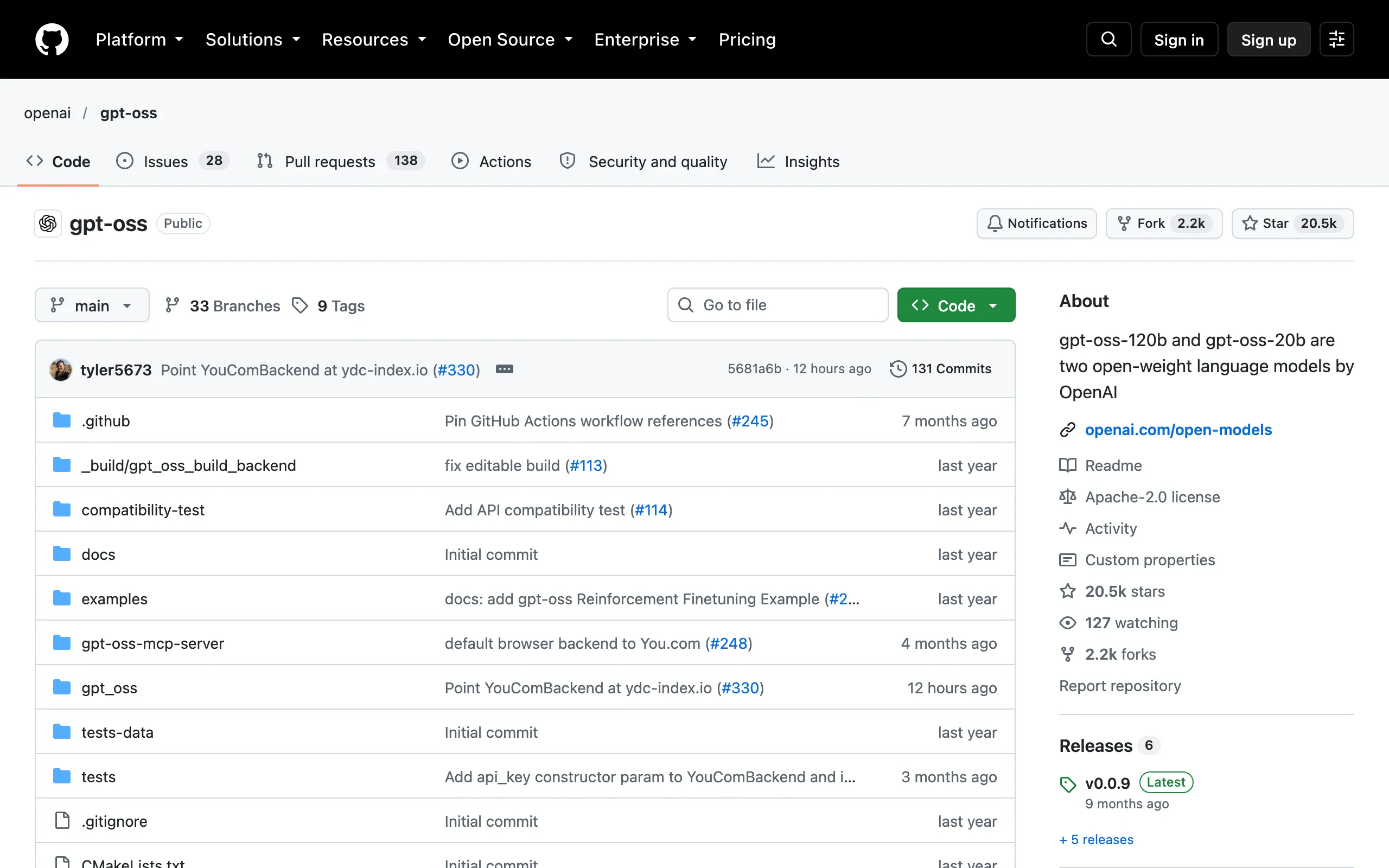
OpenAI released gpt-oss in two sizes, gpt-oss-120b and gpt-oss-20b, under Apache 2.0, a standard license that allows commercial use. There is no user cap and no rule about how you name a derived model.
Before you build anything on an open weight model, read its license on the model page. Check two points first: whether commercial use is allowed, and whether there is a cap on users or company size.
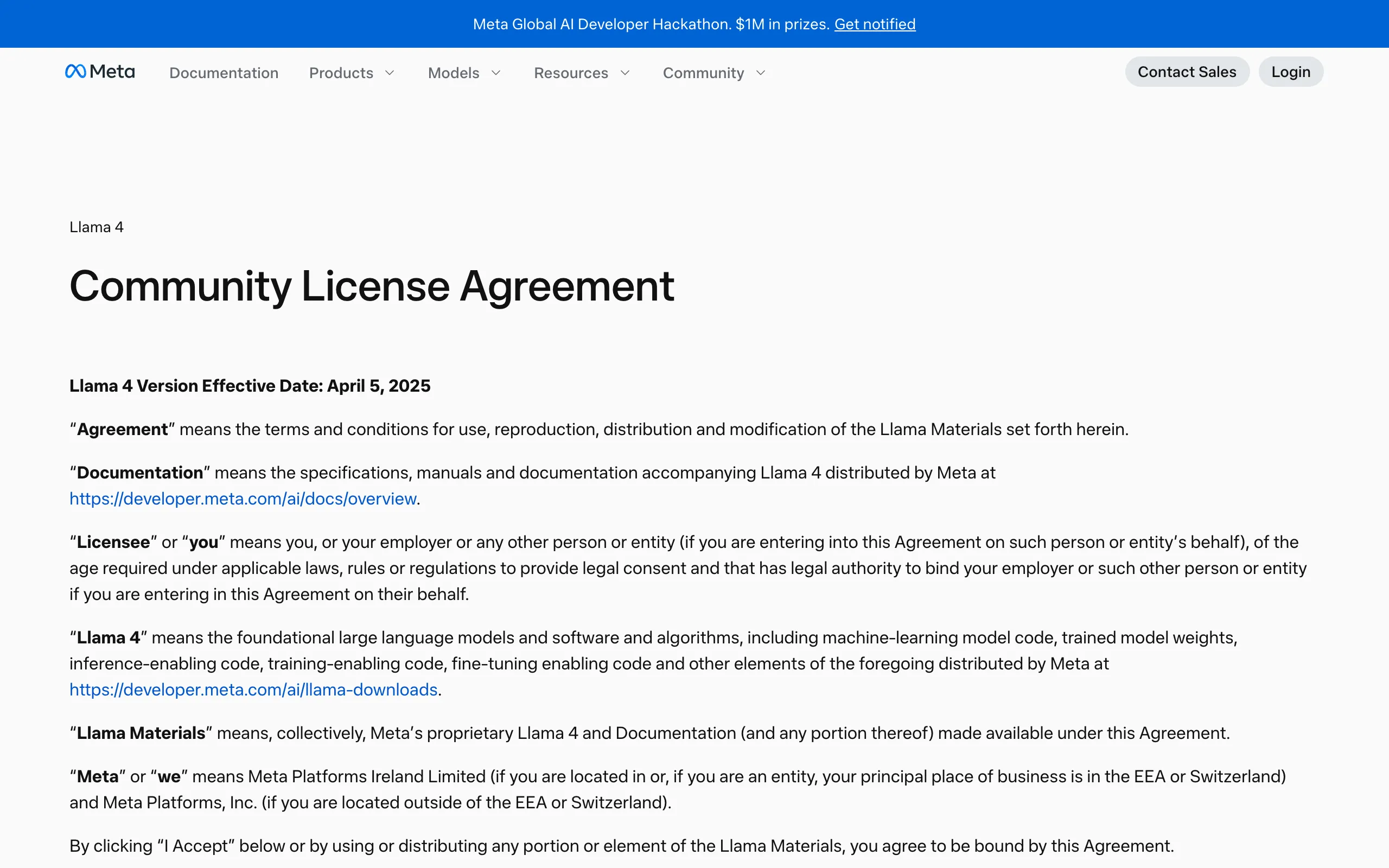
is greater than 700 million monthly active users in the preceding calendar month, you must request a license from Meta, which Meta may grant to you in its sole discretion/prominently display “Built with Llama” on a related website, user interface, blogpost, about page, or product documentation. (Sections 1 and 2) — from MetaView official source →
Build freely without copyleft restrictions or patent risk—ideal for experimentation, customization, and commercial deployment. (Highlights) — from OpenAIView official source →
Pros and cons of open weight models
Running the model yourself gives you control over your data, but you take on the hardware and the responsibility. NTIA weighed both sides in its report on open weights and came down on watching the risks rather than restricting releases.
Trade-offs of open weight models
| Pros | Cons |
|---|---|
| Data can stay on your own machines | You need hardware with enough memory |
| No dependence on one company's service | You run and update it yourself |
| Can be fine-tuned on your own data | Released weights can be misused by others |
Your data stays on your own machines
Because the model runs where you put it, your prompts and files don't have to be sent to another company. NTIA counts this among the main benefits, along with spreading AI work beyond a handful of large developers.
We apply the same thinking at sakutto.ai: tools that can run AI inside your browser, such as transcription or background removal, do it on your device so your files are not uploaded. Open weights make that kind of design possible for text models too.
You need the hardware to run it
An open weight model is free to download, but it still has to run on something, and large models need a lot of memory. OpenAI says gpt-oss-20b, with 21B parameters, runs within 16GB of memory. gpt-oss-120b, with 117B parameters, needs a single 80GB GPU, a data-center card.
If you don't want to manage hardware, you can use a hosted service that runs the model for you. Coding tools can call them too, as we show with "GLM 5.2 benchmarks, pricing, and Claude Code setup." At the very large end, a model such as "Reflection Beam is a 501B open-weight MoE model" is far beyond a single machine.
Open weights can also be misused
Once weights are public, anyone can run them, including people who want to cause harm. NTIA lists misuse, gaps in oversight and unclear accountability among the risks.
After collecting 332 public comments, NTIA concluded that the evidence was not strong enough to justify restricting open weight models, and recommended that the US government monitor the risks instead. It also left open whether restrictions could be needed later.
And they enable users to leverage models without sharing data with third parties, increasing confidentiality and data protection./current evidence is not sufficient to definitively determine either that restrictions on such open weight models are warranted, or that restrictions will never be appropriate in the future. (Executive Summary) — from NTIAView official source →
for production, general purpose, high reasoning use cases that fit into a single 80GB GPU (like NVIDIA H100 or AMD MI300X) (117B parameters with 5.1B active parameters)/for lower latency, and local or specialized use cases (21B parameters with 3.6B active parameters) (Welcome to the gpt-oss series) — from OpenAIView official source →
Open weights mean you can run the model yourself
An open weight model is an AI model whose trained weights are public, so you can download it and run it yourself instead of going through the maker's app or API. It is not open source AI: the training code and data usually stay private, and the license still decides what you can do.
Before you use one, check the license for commercial use and user limits. The payoff is control over your data; the price is the hardware to run it.
FAQ
- Is Llama open source?
- Not by the Open Source Initiative's definition. Meta publishes Llama's weights, but the license sets conditions on who can use it and how, such as a separate license for companies above 700 million monthly active users. Open source AI must allow use for any purpose without asking permission, so Llama counts as an open weight model.
- Can I run an open weight model on my own computer?
- Smaller ones, yes. OpenAI says its gpt-oss-20b runs within 16GB of memory and is meant for local use. Larger models need data-center hardware: gpt-oss-120b needs a single 80GB GPU.
- Are open weight models free?
- The weights are usually free to download, but what you may do with them depends on the license. gpt-oss uses Apache 2.0, which allows commercial use. Llama's license is free for most companies but adds attribution rules and a separate license above 700 million monthly active users. You still pay for the hardware or cloud servers that run the model.
Related articles
 Why OpenAI and Anthropic slashed LLM API pricingLLM API pricing at OpenAI and Anthropic fell by up to 80% in mid-2026. Max Woolf credits easy switching, cheap open-weight rivals and cheaper serving.
 What is knowledge distillation? Smaller AI modelsKnowledge distillation trains a small student model to copy a large teacher. Here's how it works, what DeepSeek did, and when it breaks AI terms of service.
 OpenAI, ServiceNow expand deal with ChatGPT pluginOpenAI and ServiceNow expanded their deal on Oct 28, 2026. A ServiceNow MCP plugin for ChatGPT is live now; Codex, security and voice tools follow in 2027.
 AI crawler training opt-out in one robots.txt ruleAI crawler training opt-out now takes one robots.txt rule. OpenAI, Google and Microsoft will honor it, Microsoft from Feb. 1, 2027. Until then, name each bot.