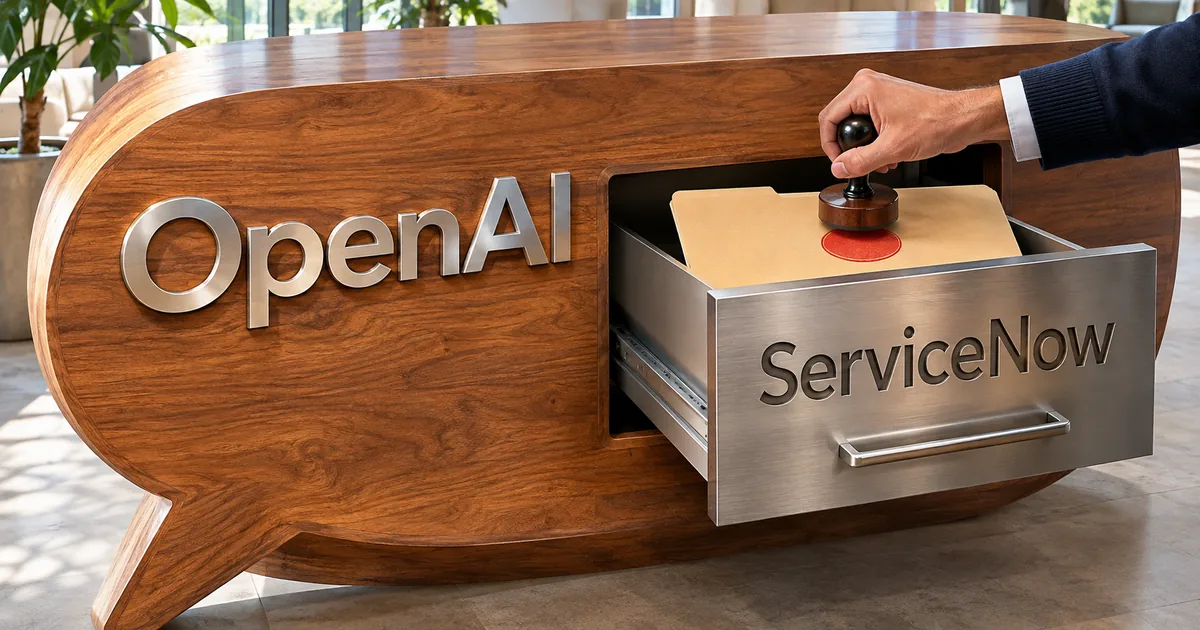
What the ServiceNow plugin for ChatGPT does today
Since October 28, 2026, IT teams can work tickets from a ChatGPT conversation instead of switching back to ServiceNow, provided an admin has linked the company's instance. ServiceNow is the platform many IT departments use to log outages and employee requests and track the work on them. The piece that shipped is called the ServiceNow MCP plugin, and admins add it from the OpenAI marketplace.
MCP is a shared standard that lets AI apps talk to outside services (related: MCP roadmap 2026: five priority areas to plan for). OpenAI says the plugin will pick up more features before the end of 2026.
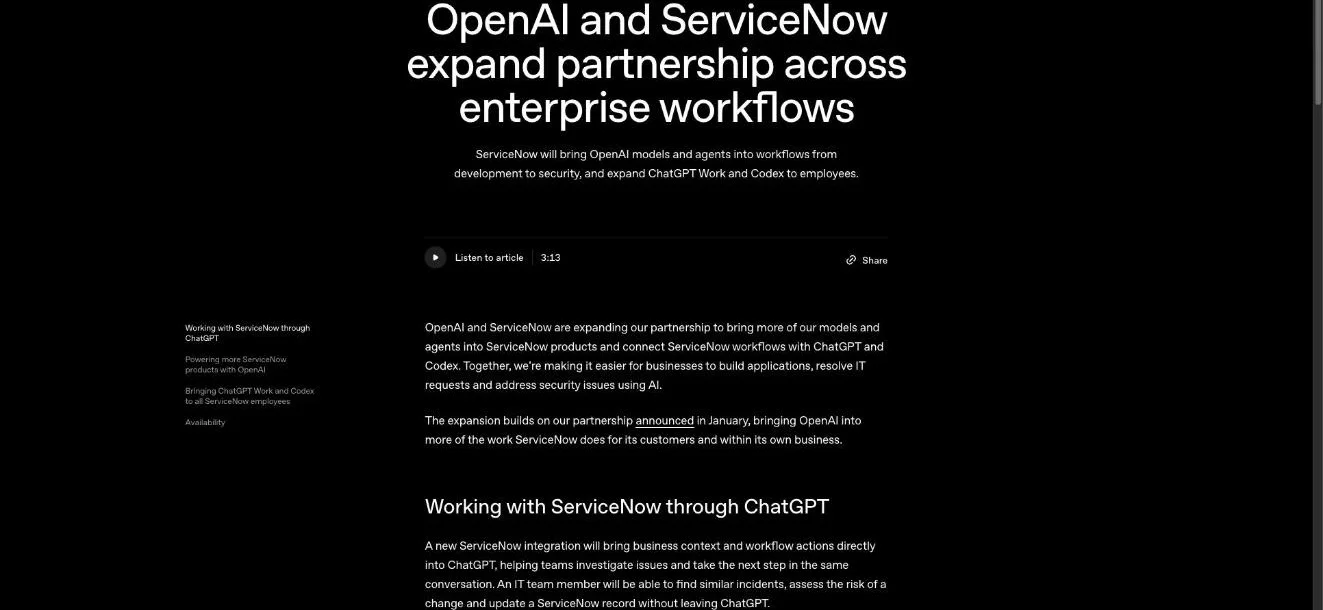
Find incidents, assess change risk and update records
Staff can look up incidents that resemble the one in front of them, gauge how risky a planned change is, and edit the ServiceNow record, all in one chat. An incident here means a logged outage or fault. The point is that the lookup and the fix to the record happen in the same thread, with no tab switching.
ServiceNow also showed richer screens running inside ChatGPT, but only as a preview. In the example OpenAI describes, an engineer on call pulls up the related monitoring alerts, recent changes and affected services, then hands the problem to the right team. That flow is not something customers can turn on yet.
Admins choose the capabilities, and existing permissions still apply
Admins pick which ServiceNow capabilities ChatGPT can reach, and anything a person does through ChatGPT is limited to what their ServiceNow role already allows. The plugin connects to the company's own ServiceNow instance, so an admin sets it up rather than each employee.
The enforcement sits on the ServiceNow side, in a layer called Action Fabric. It applies the business rules and access settings already in place, so a request sent from ChatGPT is held to the same limits as one made in ServiceNow itself.
"An IT team member will be able to find similar incidents, assess the risk of a change and update a ServiceNow record without leaving ChatGPT."/"Customers connect ChatGPT to their own ServiceNow instance and choose which capabilities to make available. ServiceNow’s Action Fabric applies existing business rules and permissions, so the actions people can take reflect their organization’s configuration and access."/"The ServiceNow MCP plugin is available in the OpenAI marketplace today, with enhanced capabilities expected by the end of 2026."— OpenAIView official source →
Codex, security and voice features are planned for 2027
None of the three new features is usable yet, and the earliest, the joint security product, only reaches early access in January 2027. OpenAI grouped the roadmap into app building, cybersecurity and voice, each built on its models inside ServiceNow products. Here is every date in the announcement, in one place.
| Feature | Timing |
|---|---|
| ServiceNow MCP plugin | Live now, with more features by the end of 2026 |
| Joint security product | Early access in January 2027, general availability in Q2 2027 |
| Voice in Super Intelligence Control Tower | Q1 2027 |
| Codex in AI Workflow Factory | 2027 |
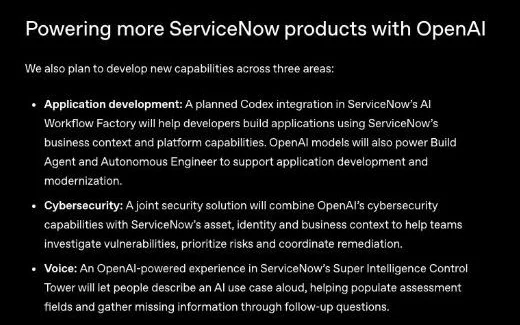
Codex comes to AI Workflow Factory
From 2027, developers who build apps on ServiceNow are slated to write them with OpenAI's coding agent, which will draw on ServiceNow business data and platform features. That agent is Codex, and it is headed for AI Workflow Factory, ServiceNow's toolset for building apps on its platform.
Two other ServiceNow developer tools, Build Agent and Autonomous Engineer, will also run on OpenAI models. They are meant for building new apps and bringing older systems up to date.
A joint security product enters early access in January
The product pairs OpenAI's cybersecurity models with ServiceNow's data on assets and identities to help security teams decide which vulnerabilities to fix first. It covers the path from looking into a weakness to ranking the risk and lining up the people who will patch it.
A first group of customers gets early access in January 2027. General availability is planned for the second quarter of 2027.
Voice lets people describe AI use cases aloud
Someone proposing a new AI project will be able to explain it out loud and have the assessment form filled in, with follow-up questions for anything missing. The feature lands in Super Intelligence Control Tower, the ServiceNow product companies use to oversee and govern their AI. It is due in the first quarter of 2027.

"Application development: A planned Codex integration in ServiceNow’s AI Workflow Factory will help developers build applications using ServiceNow’s business context and platform capabilities. OpenAI models will also power Build Agent and Autonomous Engineer to support application development and modernization."/"Cybersecurity: A joint security solution will combine OpenAI’s cybersecurity capabilities with ServiceNow’s asset, identity and business context to help teams investigate vulnerabilities, prioritize risks and coordinate remediation."/"Voice: An OpenAI-powered experience in ServiceNow’s Super Intelligence Control Tower will let people describe an AI use case aloud, helping populate assessment fields and gather missing information through follow-up questions."/"Voice capabilities in the Super Intelligence Control Tower are expected in the first quarter of 2027. The OpenAI-powered security capabilities are expected to enter early access in January 2027, with general availability planned for the second quarter of 2027. Codex in AI Workflow Factory is expected to be available in 2027."— OpenAIView official source →
ServiceNow is giving every employee ChatGPT Work and Codex
ServiceNow plans to move ChatGPT Work and Codex beyond its engineers to the whole company and to use OpenAI in its own security work. Engineers will lean on Codex to read through code, change it and check that it still works. Everyone else gets ChatGPT Work for daily tasks.
The arrangement runs both ways. OpenAI says it already relies on ServiceNow workflows for its own operations, with Super Intelligence Control Tower behind them.
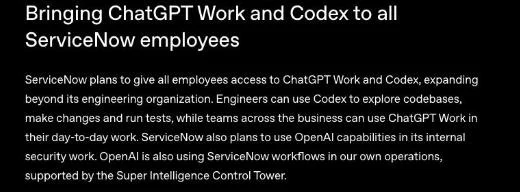
"ServiceNow plans to give all employees access to ChatGPT Work and Codex, expanding beyond its engineering organization. Engineers can use Codex to explore codebases, make changes and run tests, while teams across the business can use ChatGPT Work in their day-to-day work. ServiceNow also plans to use OpenAI capabilities in its internal security work. OpenAI is also using ServiceNow workflows in our own operations, supported by the Super Intelligence Control Tower."— OpenAIView official source →
Only the plugin is live, and your admin decides what it can do
Whether an employee can use ServiceNow from ChatGPT today depends on two decisions their admin makes, not on anything in their own ChatGPT settings. The first is whether to link the company's ServiceNow instance at all, and the second is which capabilities to switch on once it is linked. Everything else in the announcement, from Codex to voice, is still on a 2027 calendar.
FAQ
- Can I connect my own ChatGPT account to my company's ServiceNow?
- You can't do it yourself. An admin connects ChatGPT to the company's ServiceNow instance and decides which capabilities to make available.
- Can ChatGPT change any record in ServiceNow?
- No. ServiceNow's Action Fabric applies the company's existing business rules and permissions, so ChatGPT can only take actions the user is already allowed to take in ServiceNow.
- When does Codex arrive in AI Workflow Factory?
- OpenAI expects Codex in AI Workflow Factory to be available in 2027. The only piece live as of October 28, 2026, is the ServiceNow MCP plugin for ChatGPT.
Related articles
 ChatGPT and Codex usage limits merge in DecemberFrom December, Plus, Pro and Business plans will share one token-based allowance across ChatGPT and Codex. Instant chat won't count, and no start date is set.
 ChatGPT now works with iCloud Mail and CalendarOpenAI added iCloud Mail and Calendar plugins to ChatGPT on Oct 27 for all plans. You connect with an Apple app-specific password that outlives a disconnect.
 ChatGPT limits weapons information for teensOpenAI said on Oct 30, 2026 that ChatGPT will limit weapons information for teens, end chats fixated on violence, and report on safety every six months.
 ChatGPT ads add 26 countries, reaching 89 in totalOpenAI added 26 countries to ChatGPT Ads on October 21, for 89 in total, as advertisers topped 100,000. Ads show only on the Free and Go plans.