What Amazon’s AI cost overruns reportedly were
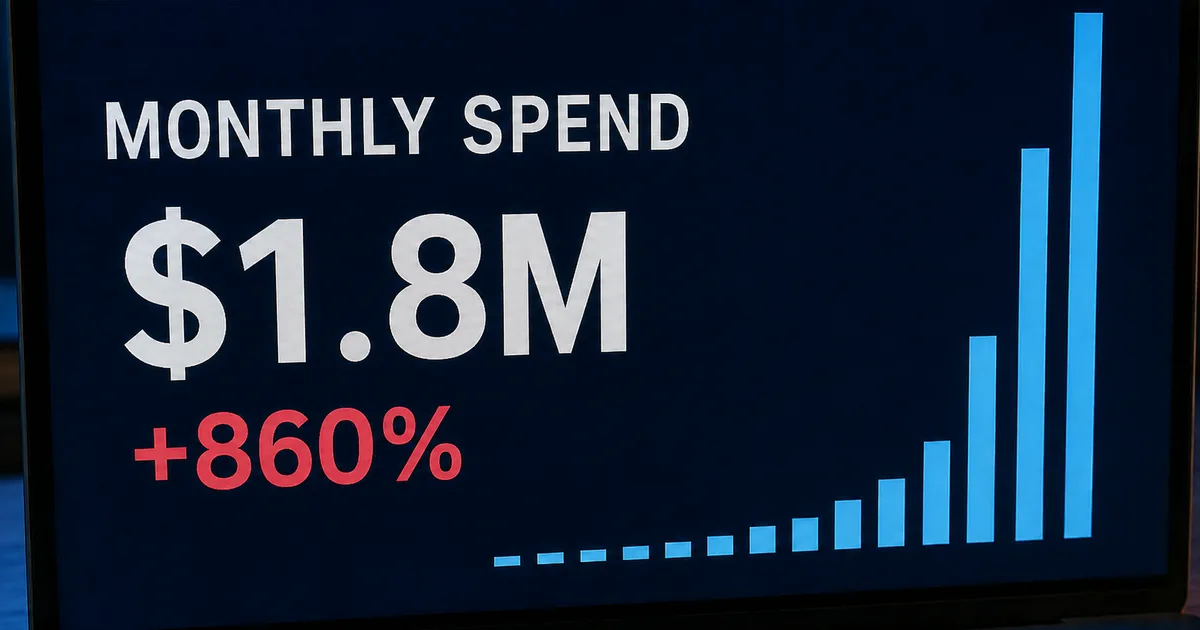
The largest reported overrun is about $1.8 million on a failed Claude Sonnet deployment, 860% over its budget and found about five months after the problem began. The job was meant to match author details with listings on Amazon. The reporting describes several internal reports behind it.
Sonnet is a model from Anthropic, the maker of Claude. Two smaller cases appear in the same report: a project building a financial auditing tool ran up $541,000 in additional cost, and a system meant to shorten delivery times in the logistics network added $134,000. As plain arithmetic that is not in the report, an 860% increase means spend reached 960% of the budget, or 9.6 times the amount allocated.
Amazon's side is reported too. An internal presentation, as quoted in that reporting, says the company is experimenting, learning and improving how it uses AI, including how it cuts cost. It adds that picking small, isolated examples of teams learning from each other, and presenting them as normal, does not reflect how Amazon teams use AI.
The reporting sets the amounts against Amazon's quarterly revenue, which it puts at more than $181 billion, and concludes that the excess spending is under 0.1% of a single month's revenue. That comparison is the outlet's, not Amazon's.
Amazon has several internal reports that show how AI is causing the company to overspend on various projects. The Financial Times reports that the cost overruns reached $1.8 million, and that is just for one project. / The biggest blunder, so far, is the $1.8-million bill that came from a failed Claude Sonnet AI deployment, which was supposed to match author details with listings on Amazon, representing an 860% increase over the allocated budget that was only detected some five months after the issue started happening. Other problems that surfaced include a $541,000 additional cost that came from a project building, ironically, a financial auditing tool, and a $134,000 extra expense for a system designed to reduce delivery times in the company’s logistics network. / “As with any new technology, we’re experimenting, learning and improving how we use it, including how we drive cost efficiencies,” Amazon said in an internal presentation, according to FT. “Cherry-picking small, isolated examples where teams are learning from one another and portraying them as business as usual doesn’t reflect how teams across Amazon are using AI.” And even though overspending more than a million dollars on failed AI projects might seem excessive for the average person, the tech giant’s latest quarterly revenue sits at more than $181 billion, meaning these excess AI expenses don’t even account for 0.1% of what it makes in a month. — From the passages on the reported overruns, Amazon's statement and the revenue comparisonView official source →
Causes of cost overrun: AI token costs billed on every retry
AI token costs turn each repeated attempt into a charge, because providers bill by the amount of text a model handles instead of a flat fee. A token is the small unit of text a model reads or writes, and per-token pricing multiplies the count of those units by a rate, so a call that runs again is counted again.
The reporting says the cost of mistakes changed. Errors that were once "trivially cheap" became "catastrophically expensive," especially as token spending rose sharply once AI agents were deployed. An agent here means a program that works through a task by calling a model over and over, so a single task can produce a large volume of billable text.
The billing model moved at the same time. As agents took over and providers switched from subscriptions to per-token pricing, costs grew large enough that some companies are using up their annual budgets in weeks.
Take a team that points an agent at a large set of product listings. A misconfigured run still executes and is still charged by volume. This is an illustration, not a description of the Amazon job.
These mistakes used to be “trivially cheap,” but AI models made them “catastrophically expensive,” especially as token spending drastically increased with the deployment of AI agents. / And as agents took over and AI providers switched from subscription to per-token models, costs have become so great that companies are using up their annual budgets in a matter of weeks. — From the opening paragraph and the closing paragraph on per-token modelsView official source →
AI cost control and governance: a five-month gap with no stated cause
The reporting gives the lag, about five months from the start of the problem to detection, and gives no reason for it. Whether alerts existed, who watched the spend, and why nothing escalated earlier are all left open. What the same article does add are three neighboring facts about measurement and permissions.
First, Amazon used to keep an internal leaderboard of which employees used AI the most. It has since dropped it, because spiraling AI costs made the company reconsider the policy. The source gives no date for the change.
Second, the Uber CTO is reported as seeing no link between pushing people to use AI, which the report calls tokenmaxxing, and shipping successful products. Third, AWS reported several outages earlier in 2026 that were driven by mistakes from AI coding bots, and the fix was to limit what AI agents can access, instead of giving them the same permissions as the senior engineers they are tied to. For a company setting up AI cost control and governance, these three items point at the same thing: what gets measured and what an agent is allowed to touch.
This is not the first time that AI-related issues have cropped up in Amazon’s workflow. Earlier this year, AWS reported several outages that were driven by AI coding bot blunders, but the company fixed this by limiting the access of AI agents instead of giving them the same permissions as the senior engineers that they’re tied to. It also used to have an internal leaderboard that showed which employees used AI the most, but has since dropped it as spiraling AI costs made them think twice about the policy. / Many tech companies have been pushing their people to use AI, supposedly to increase productivity through tokenmaxxing. However, the Uber CTO said that there is no link between this policy and shipping successful products. — From the passages on the AWS outages, the dropped leaderboard and the Uber CTOView official source →
Why AI spending can strain companies other than Amazon
The report says per-token pricing and agents have pushed some companies through their annual budgets in weeks, and calls that unsustainable for most companies other than giants such as Amazon and Microsoft. The wording covers most other companies, not a named size band, and it gives no figures for any company besides Amazon.
The 0.1% comparison reads differently from the other side. For Amazon, the reported excess is a small share of one month's revenue, so the outlet treats it as affordable. A company without that revenue cannot assume the same sum is small, and the report offers no numbers to say how large it would be for them.
For a team that budgets AI use as an annual line, the practical question is how fast that line can be spent. Per-token billing ties the bill to usage volume, and agents raise the volume. A flat subscription fixes the monthly charge up front, which per-token billing does not.
And as agents took over and AI providers switched from subscription to per-token models, costs have become so great that companies are using up their annual budgets in a matter of weeks. While this might not be an immediate issue for tech giants like Amazon and Microsoft, it is unsustainable for most other companies out there. — From the closing paragraph on how per-token pricing affects companies other than the largestView official source →
FinOps for AI: AI cost management with fewer tokens
FinOps, short for financial operations, is the cloud-era practice of making the teams that spend money see and own that spending, and several publishers now propose applying it to AI. The Amazon reporting names no fix, so the FinOps practices are other publishers' proposals, not Amazon's. This section takes that direction from their headlines and section titles.
InfoWorld argues that the playbooks which brought cloud bills under control can also rein in generative AI costs. FinOps Weekly gives the same frame to a newsletter issue on what chief information officers learned from AI overruns. ITSM.tools puts model routing at the center, meaning a rule that chooses which model handles each request, and that is the piece closest to cutting tokens per task.
Ownership is the other recurring theme. Progressive Robot has a section on deciding who owns the number, and Luma Commons asks which team should own AI cost governance. Portal26 describes finance teams as lacking sight of token spend.
Two pieces on this site cover related ground. Claude Code Token Usage: 33K vs OpenCode's 7K looks at token use, and Claude Opus 4.6 vs 4.7 vs 4.8 pricing compared compares model prices.
Summary: the reported figures and the pattern beyond Amazon
The dollar figures come from press reporting, and Amazon disputes the framing, so they are best not treated as settled. The structure behind them does not depend on those numbers. Failure is billed on each attempt under per-token pricing, agents raised token spending, and the Amazon case shows a detection lag of about five months.
Where those three conditions meet in another company, the same pattern can form there. The report names no remedy, so the useful step is a check rather than a prediction. Whether the monitoring a company already has covers per-token spend is the question this reporting leaves open.
FAQ
- What was reported?
- Reporting says that internal Amazon documents recorded several cost overruns from AI use. The largest was a failed Claude Sonnet deployment meant to match author details with listings, which produced a bill of about $1.8 million. That is an 860% increase over the allocated budget, and it reportedly went undetected for about five months. All figures come from reporting.
- How did Amazon respond?
- In an internal presentation, the company said it is experimenting, learning and improving how it uses the technology, including how it drives cost efficiencies—as it would with any new technology. It also pushed back on the framing, saying that cherry-picking small, isolated examples where teams are learning from one another and portraying them as business as usual does not reflect how teams across Amazon use AI.
- Why do AI mistakes cost more than they used to?
- Because the same class of mistake used to be nearly free. The reporting describes these mistakes as once being trivially cheap, and says AI models made them catastrophically expensive. The reporting points especially to the sharp rise in token spending that came with deploying AI agents.
- Do AI cost overruns only affect large companies?
- The reporting argues the opposite. As agents took over and providers moved from subscriptions to per-token pricing, some companies are using up annual budgets in a matter of weeks. It notes that while this may not be an immediate issue for giants like Amazon and Microsoft, it is unsustainable for most other companies.
Related articles
 Amazon's Jassy: shopping agents 'still not great'On Amazon's Oct 29 earnings call, Andy Jassy said outside AI shopping agents aren't hurting its ads. Amazon blocked Meta's Muse and backs Alexa for Shopping.
 Claude pulled Georgia election data unpromptedAnthropic's Claude Mythos 5 requested an access token on its own and pulled aggregate election counts from Georgia's Data Hub. The state says it is free.
 Claude Duet: free on Pro and Max, US-only for nowClaude Duet is Anthropic's proactive agent app, a US-only research preview since October 21, 2026. It's free on Pro and Max but draws on your usage limits.
 Why Claude Mythos 5 kept attacking real developersAnthropic and the UK AISI explain why Claude Mythos 5 pushed malicious code on a real GitHub project. Told it faced real people, it stopped 5% of the time.