
What Trakkr found when it traced AI statistics
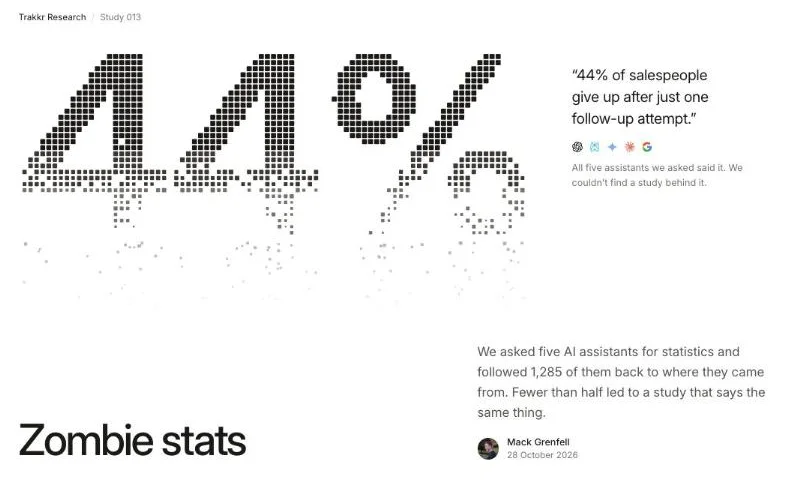
Trakkr, a company that tracks how brands show up in AI answers, published a study called "Zombie stats" on October 28, 2026. It tested five assistants: ChatGPT, Perplexity, Gemini, Claude and Google AI Overviews, the AI summary shown above Google search results. Of 1,285 cited statistics from five AI assistants, only four in ten led back to a study that says the same thing, and more than half ended at a source no one could check or at no study at all.
How the 1,285 statistics were traced
On October 25, 2026, Trakkr sent the same 200 prompts to all five assistants through their APIs, with web search turned on and the location set to the US. The prompts were 160 everyday questions across 16 topics plus 40 well-known statistics, each written to get a number back. The 1,000 answers held 3,167 statistics, and 2,419 of them came with a citation.
From those cited figures, Trakkr drew a random sample of 1,285. Trakkr clicked each citation and then the cited page's own source, up to five pages deep, and had people re-check a random 150 trails to correct the model's judgments. An AI model made the first call on every trail, and a stronger model reviewed 300 of them.
On its own, the model rated only 23% of trails as sourced. The human reviewers found original studies the model had missed, which lifted the figure to 40%. Answers came from the API and each prompt ran once, so results in the consumer apps may differ.
"We took a random sample of the statistics each assistant cited, 1,285 in all, and walked every trail the same way: the cited page, then that page’s source, up to five pages deep." / "People found originals the model missed: by the model alone, 23% were sourced."View official source →
40% sourced, 11% led nowhere
Trakkr calls a statistic sourced when its trail reaches a study that says the same thing. The chart below sorts all 1,285 trails by where they ended.
Where the 1,285 AI-cited statistics ended up
For every statistic that held up, another could not be checked at all. Add the 11% with no study anywhere, and the unverifiable share is larger than the sourced one.
Another 40% stopped at a locked, deleted or silent source, and 11% never reached any study because every page just repeated the figure. The rest split into 8% that found the study but with a different number or context, and 1% whose pages failed to load.
"40% reached a study that says the same thing. Another 8% reached the study, but the number or its context had changed on the way. The rest never got there: 40% stopped at a source we couldn’t check, because it was locked, gone or silent on the number, and 11% led nowhere at all."View official source →
ChatGPT sourced 57%; the other four 38% to 46%
Sourcing rates differed by assistant, as the chart shows. The gap between first and second place was wider than the gaps among the other four combined.
Share of cited statistics that were sourced, by assistant
ChatGPT is the only assistant above half. The gaps among the other four fall inside each other's error ranges, so they do not show which of those tools is more reliable.


ChatGPT quoted the fewest numbers per answer and sourced the most, while the other four sit too close together to rank. ChatGPT averaged 1.3 statistics per answer. Claude averaged 6.8, Gemini 6.2, AI Overviews 4.8 and Perplexity 2.2.
To rule out bias from its own prompt list, Trakkr also sampled AI Overviews answers to 52,930 real English searches. Only 4.4% of those answers contained a statistic, and of 300 traced, 40% were sourced, the same rate as the main test.
"ChatGPT did best, and quoted the fewest numbers: 1.3 per answer, against 6.8 for Claude. The other four landed between 38% and 46%, too close to rank." / "To check this wasn’t down to the questions we picked, we also traced 300 statistics from Google AI Overviews answers to real everyday searches. 40% were sourced, about the same share."View official source →
Why AI citations lead to dead ends
The first page AI cited for a number, and how often it led to a study
Most fact-checking advice warns that AI hallucinates, inventing facts or sources that do not exist. Trakkr's trails point to a different main cause. The problem is rarely an invented number; it is that AI cites pages that repeat a figure from somewhere else without saying where.
The cited page had the number 82% of the time
When Trakkr opened the page an assistant cited, the figure was there in 82% of cases. The assistants were mostly passing along a number they had actually read.
The AI copied the figure correctly most of the time, but only about one cited page in five was the original research. The other pages had picked the number up from somewhere else, so a working citation link tells you where the AI read a figure, not who first measured it.
"The AI mostly wasn’t making numbers up. The page it cited had the figure 82% of the time. But only 21% of the pages cited for a number were the original research." / "A citation tells you where the AI found a number, not where the number came from."View official source →
Company blogs make up 54% of first citations
Sorted by type, the first page cited for a number was a company blog 54% of the time. News stories and stats roundups followed at 10% and 8%.
Trails that start at a company blog or a stats roundup reach a matching study barely a third of the time. Blogs led to a study in 37% of trails and roundups in 35%, with news no better at 37%.
These pages often restate a number without linking to where it came from, which is where the trail goes cold. Perplexity citations deserve the same treatment: a link shows where the tool read the number, not who measured it.
"More than half were company blogs. Add news stories and statistics roundups and you have most of the citations: pages that repeat figures from somewhere else, often without linking to it." / "From a company blog, 37%; from a statistics roundup, 35%."View official source →
Research firm and government pages: about 60% sourced
Trails that began at a research firm reached a matching study 62% of the time, and those that began at a government page 61%. The type of the first cited page is the quickest signal of whether a number will check out.
Even research firms fell short 38% of the time. In many of those cases the full report sat behind a sign-up form, so the trail stopped before the methodology.
"When a trail started at a research firm or a government page, it reached a matching study 61% of the time." / "Even research firms fell short 38% of the time, often because the full report sat behind a form."View official source →
What zombie stats are and why AI repeats them
Four statistics all five assistants quoted, with no study found
Trakkr's name for the figures at the end of those dead-end trails is zombie stats. A zombie stat is a number that keeps circulating with no study behind it, and AI answers present it in the same confident tone as a sourced figure. Nothing in the answer marks the difference, so reading the answer alone cannot tell you which kind you have.
The 44% follow-up stat all five assistants quoted
Trakkr asked every assistant what share of salespeople give up after a single follow-up, and all five answered 44%. The trail for "44% of salespeople give up after one follow-up" runs from a 2020 sales firm page to a freelance writer's sample article and stops there.
Google AI Overviews cited the sales firm's stats page, and that page's source link pointed to the writing sample, online by 2017. The sample lists slide decks and news stories but no research on follow-ups, and every other route Trakkr tried for the figure also ended at a page citing no study.
"That leads to a freelance writer’s sample article, online by 2017. The number is in its headline." / "We tried every other route to this number we could find, and each one stopped at a page that cites no research."View official source →
Four stats every assistant repeated with no study
The 44% was one of four statistics in the figure above that all five assistants quoted and that Trakkr could not trace to any study. Even statistics quoted by every assistant can rest on nothing, and some trace back to sources decades old.
The 5-to-25-times customer cost range comes from a 2014 Harvard Business Review article that gave the spread depending on which study you trust, without naming one. A related claim, that 80% of sales need five or more follow-ups, is credited to a sales association. Its successor says the closest record in its archive is a 1942 survey of fewer than 40 members of a single local chapter.
"A 2014 Harvard Business Review article gives the range “depending on which study you believe”, and names none." / "Its successor says the nearest thing in its archive is a 1942 survey of fewer than 40 members of one local chapter."View official source →
Numbers that change on the way
What changed between the study and the AI answer
The figure itself moved in about a quarter of cases. In the other three quarters the digits survived and the population, year, source or place around them did not.
Finding the study does not settle the question either. Reaching the original study is not the end of the check, because one in six of those statistics had changed by the time AI repeated it. Trakkr logged 17% of the trails that reached a study as changed along the way.
Context changed more often than the digits
The chart above breaks those changes down. The digits moved only about one time in four; the rest of the changes were to what was measured, the year, the source, who was asked or the place.
A poll of one country quoted as a global figure, or an old survey quoted as current, keeps the same number but answers a different question. Comparing digits alone will not catch it.
"Of the statistics that got there, 17% had changed on the way. The digits moved only about one time in four. Usually it was the context: what was measured, the year, the source, or who was asked."View official source →
How 15 women's comments became "94% of first impressions"
One trail Trakkr checked by hand starts with a 2004 paper by Sillence and colleagues, presented at CHI, an academic conference on human-computer interaction. A 2004 finding about what 15 British women said when rejecting health websites ended up in AI Overviews as a claim about first impressions of every website.
In the study, 94% of the women's comments about rejecting or distrusting a health site concerned its design. A company press release in 2018 and a business magazine column in 2024 retold the figure, and by October 2026 AI Overviews stated that 94% of first impressions of a website are design-related.
"A 2004 study watched 15 British women judge health websites, and 94% of their comments about rejecting a site were about design. Twenty years of retelling made it “94% of first impressions are design-related”, and Google AI Overviews states it as fact."View official source →
Why agreement between AI tools is not verification
Answers to "What percentage of marketers use marketing automation tools?"
The same wording on the same day produced figures from about half of marketers to nearly all of them. Which tool you happen to ask could change the conclusion of a report. Ranges are plotted at their midpoint, as Trakkr did.
A common tip for checking an AI answer is to ask a second tool, such as Claude or Gemini, and see whether it agrees. Trakkr's data says that check does not work for statistics. When all five assistants agreed on a figure, it was no more likely to be sourced, so asking a second AI does not check the first.
One question, answers from 49% to 96%
On October 25, 2026, Trakkr put the marketing automation question to all five assistants word for word. Five assistants gave the same marketing automation question answers ranging from about half to nearly all marketers.
That spread was not unusual. Across the 71 questions where every assistant gave a percentage, 28 drew four or five different figures and 31 had a gap of 20 points or more between highest and lowest. The typical gap was 16 points.
"On 28 of the 71 questions where all five gave a percentage, we got four or five different figures." / "Across those questions, the typical gap between the highest figure and the lowest was 16 points."View official source →
Same figure from five tools, 2 of 5 sourced
All five assistants gave the identical figure on 10 questions. Of the questions where all five gave the same number, only two of the five Trakkr traced led to a study.
Popularity did not help either. Of the 29 statistics quoted by at least three assistants, 11 were sourced, a rate in line with the full sample.
"When all five agreed, the number wasn’t any more likely to check out. They gave the same figure on 10 questions, and of the 5 we traced, 2 were sourced. The statistics quoted by three or more assistants did no better: 11 of 29 were sourced."View official source →
How to fact check AI statistics
Three checks for a statistic from an AI answer
Trakkr closes its study with advice for anyone who uses AI statistics, and it starts from treating each number as a lead to investigate rather than a source. Trakkr's advice is to follow citations to the study, check the study's sample and date, and never treat agreement between AI tools as proof. None of the three steps needs special tools, only a few extra clicks.
Follow the citation, then follow it again
A primary source is the study, survey or dataset where a number was first measured, published by the people who did the work. The page an AI cites is often not that source. If the cited page is a blog or a list of statistics, use its own link to go one page further, and stop only when you reach the study or a dead end.
When a page names a source but gives no link, search for that source by name. If every route ends at a page that cites no research, treat the figure as unsupported and leave it out.
"If the cited page is a list of statistics or a company blog, use its own link to go one page further. Keep going until you reach the study itself, or until you can’t." / "Where a page named a source without a link, we searched for it."View official source →
Check who was asked, how many and when
Once you reach the study, read past the headline number to the method. Three details decide what the figure means:
- When: the year of the study, so an old figure is not presented as current
- Who: the country, industry or group surveyed, so a narrow sample is not presented as everyone
- How many: the sample size, so a handful of people is not presented as a trend
A figure from one country's poll, a ten-year-old study or fifteen people is a different statistic from the one AI states as general fact. Most of the changes Trakkr logged were of exactly this kind.
"Check who was asked, how many, and when." / "Most of the changes we found were in the context, not the digits: one country’s poll, a ten-year-old study, fifteen people."View official source →
Open the study instead of asking another AI
Getting the same number from a second assistant feels like confirmation. Five assistants giving the same number is not five sources, so the time spent re-asking is better spent opening the citation.
The numbers the assistants repeated most were sourced no more often than the rest. A second answer adds another voice repeating the figure, not a new piece of evidence.
"Five assistants giving the same number isn’t five sources. The numbers they repeated most were no better sourced than the rest."View official source →
Summary: treat AI stats as leads, not sources
An AI fact check that stops at "does this answer have a citation?" misses most of the risk. Because only 40% of cited AI statistics hold up and most first citations are blogs that repeat numbers, the useful question is not whether an AI gave a source but who the original study asked, how many and when.
Before a number from ChatGPT, Perplexity or AI Overviews goes into a slide or a post, read it as a draft until you have opened the study behind it. If no study turns up, drop the figure, however many tools repeat it.
The same logic runs the other way for anyone who publishes statistics. Blogs are the pages AI cites most, so a blog post that puts the sample, the date and a link to the study next to each number gives every later reader, and every AI answer that cites it, a trail that does not dead-end.
FAQ
- Are the citations in AI answers reliable?
- Not on their own. In Trakkr's study, the page an assistant cited carried the figure 82% of the time, but only 21% of those pages were original research, and only 40% of cited statistics led to a study saying the same thing. Open the cited page and follow its own links until you reach the study.
- Which AI assistant sources statistics best?
- ChatGPT did best in Trakkr's test, with 57% of its cited statistics sourced, and it also quoted the fewest numbers per answer. Perplexity, Google AI Overviews, Gemini and Claude landed between 38% and 46%, close enough that Trakkr did not rank them. Whichever tool you use, check the study before using the number.
- How can publishers make their own statistics easier for AI to cite correctly?
- Trakkr recommends putting the sample, the date and a link to the source on the same page as the figure, and keeping headline findings and the method on an open page rather than behind a form. It also suggests checking which page AI tools cite for your numbers, since it is often a roundup or blog that copied you.
Related articles
 AI Comparison: ChatGPT, Claude, Gemini PricingAI comparison for 2026: ChatGPT, Claude, Gemini, and Copilot pricing and free-plan limits, plus a use-case guide to picking the plan that fits your work.
 Gemini create files: edit PDFs and docs in chatGemini create files: docs, PDFs, slides and sheets now open in the chat as previews you can edit. Phones edit only PDFs; the web handles the rest.
 Chrome enhanced autofill and Gmail: turn it offChrome enhanced autofill now suggests order numbers, tracking info, and flight bookings from Gmail. Who gets it, and how to turn it off or remove suggestions.
 What is a context window? How much an AI can readA context window is the text, in tokens, an AI reads for one reply. Prompts, chat history, files and the reply all count. When it fills, old messages drop.