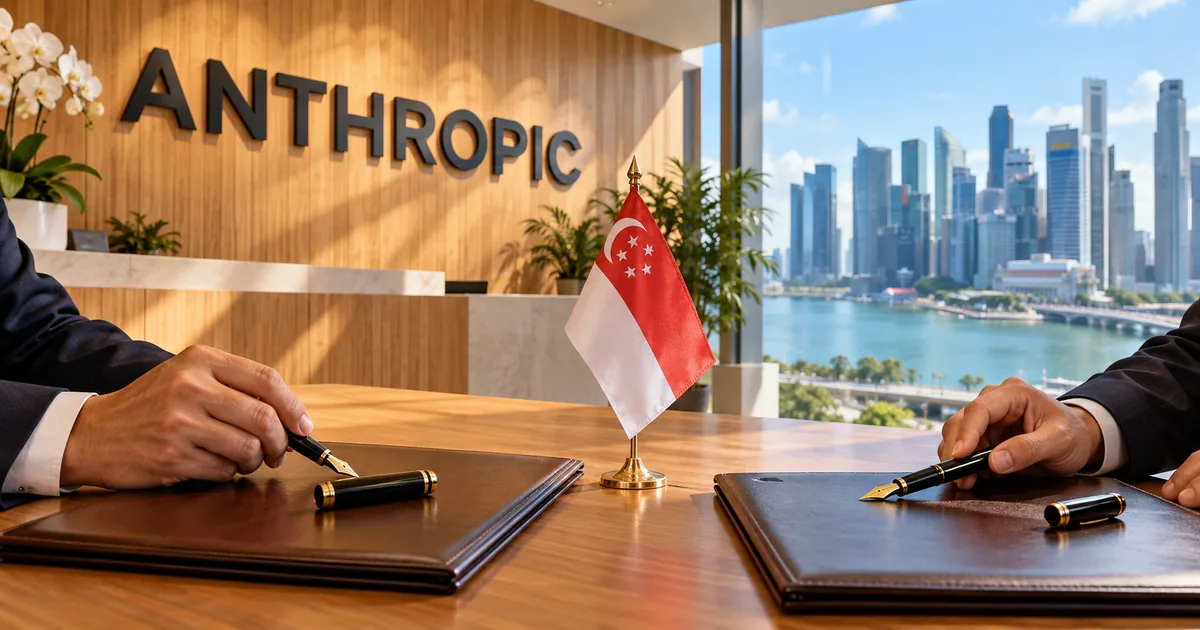
Anthropic's fifth Asia-Pacific office opens in Singapore
Anthropic's Singapore office, its fifth in Asia-Pacific, opened on October 14, 2026. The company counts Singapore among its busiest markets anywhere. The office is already recruiting, though the announcement does not say how much Anthropic is investing or how many people it plans to hire.
Dale Finlay, Anthropic's general manager for ASEAN, runs the local business. He said the company intends to stay in Singapore for the long haul.
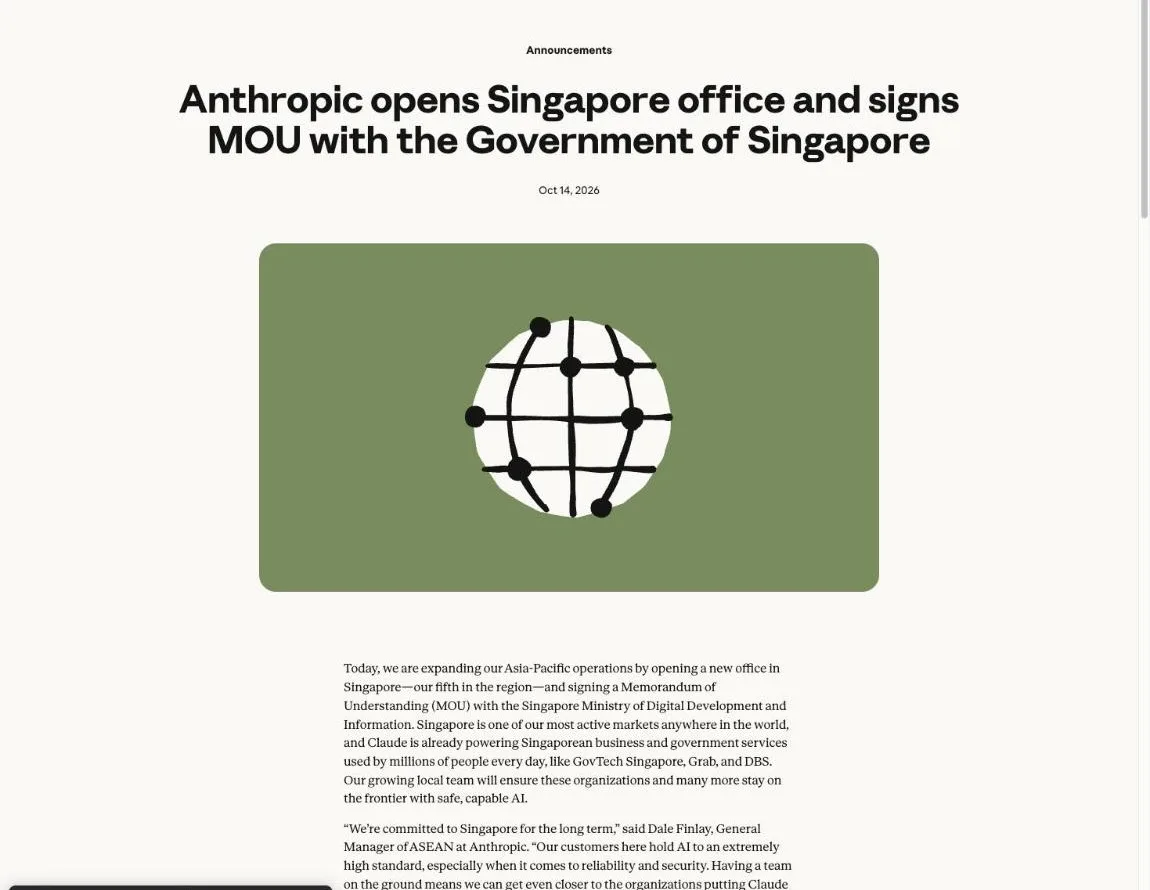
The MOU was signed at Singapore International Cyber Week
Kai Fong Chng, Permanent Secretary at the Ministry of Digital Development and Information, signed the MOU with Anthropic co-founder Ben Mann. The signing took place during Singapore International Cyber Week.
Minister Josephine Teo and Michael Sellitto, who heads Asia-Pacific policy at Anthropic, attended as witnesses. Mann pointed to Singapore's long record of investing in how AI models are tested and evaluated.
Work with Singapore's AI evaluators dates back to 2023
The MOU builds on three years of joint testing work. In 2023 Anthropic took part in the Generative AI Evaluation Sandbox, which the Infocomm Media Development Authority (IMDA) runs with the AI Verify Foundation. It went on to work with both bodies on red-teaming, where testers act as attackers to find a model's weak spots, in English, Mandarin, Malay and Tamil.
Kai Fong Chng, Permanent Secretary of the Ministry of Digital Development and Information, and Anthropic co-founder Ben Mann signed the MOU on the sidelines of Singapore International Cyber Week. / Our work with Singapore goes back to 2023, when we joined the Generative AI Evaluation Sandbox run by the Infocomm Media Development Authority and the AI Verify Foundation. We later partnered with them on a red-teaming project in English, Mandarin, Malay, and Tamil. — On the MOU signing and Anthropic's earlier work in SingaporeView official source →
What the MOU covers in its three areas
The MOU lists three areas where Anthropic and the ministry will work together. The table below shows what the announcement attaches to each one.
The three areas of the Anthropic–MDDI MOU and the work planned under each
| Area | Planned work |
|---|---|
| AI safety, security and model evaluation | Technical exchanges with Singapore's AI safety institutions on model evaluation, testing standards and incident response |
| Research on AI adoption and its impact | Sharing research and data with the government, including from the Anthropic Economic Index |
| Responsible adoption in the public and private sectors | Exploring support for AI skills, SME adoption and public officers' AI capability |
None of this has a timeline yet. The announcement describes each item as something Anthropic plans to do or will explore, with no dates or budgets attached.
Technical exchanges on model testing and incident response
Under the first area, Anthropic plans technical exchanges with Singapore's institutions for AI safety, security and assurance. The company says it already shares this kind of technical information with safety bodies in other countries. The exchanges will focus on three topics:
- how models are evaluated
- the standards used for testing
- how to respond when something goes wrong (incident response)
Support for skills and SMEs, plus shared Economic Index data
On adoption, Anthropic and the government will look for ways to build AI skills across Singapore. That includes helping small and medium-sized businesses adopt AI responsibly and supporting the government's own target of raising AI capability among public officers.
On research, Anthropic plans to give the government data from its Economic Index, the company's study of how Claude is used across countries and tasks. It also offers technical and policy advice as Singapore writes its rules for AI.
Under the MOU, we plan to hold technical exchanges with Singapore’s AI safety, security, and assurance institutions on model evaluation, testing standards, and incident response. / We plan to share research and data with the government, including from the Anthropic Economic Index, and to offer technical and policy expertise as Singapore develops its rules for AI. — On technical exchanges, data sharing and policy input under the MOUView official source →
How Singapore organizations already use Claude
Singapore came second out of 121 countries for Claude.ai use per person in the latest Economic Index. That is close to six times the level its population would suggest. The table lists the organizations Anthropic named.
Singapore organizations using Claude, as named by Anthropic
| Organization | How it uses Claude |
|---|---|
| GovTech Singapore | More than 1,500 engineers and technical staff use Claude Code to rebuild government systems |
| Cyber Security Agency | Exploring Claude for national cyber defense |
| DBS | Software development and day-to-day work in Singapore |
| GIC | Rolling out across investment and corporate teams |
| Grab | Sales assistant BriX saves about 40,000 hours a quarter |
| Sea | Shopee's customer service chatbot and code writing by employees |
GovTech has more than 1,500 engineers on Claude Code
In government, the Government Technology Agency (GovTech Singapore) has put Claude Code in the hands of more than 1,500 engineers and technical staff. They use it to modernize public systems and ship software faster. The Cyber Security Agency is also looking at how Claude could help defend the country's networks.
DBS, GIC, Grab and Sea in the private sector
DBS, Southeast Asia's largest bank, uses Claude to build software and handle routine work in Singapore. The sovereign wealth fund GIC is extending it to its investment and corporate teams. Banks and other regulated firms can run Claude through Amazon Bedrock with in-region inference, which keeps processing inside the region.
Grab built its sales assistant, BriX, on Claude, and says it saves the sales team roughly 40,000 hours each quarter. Sea, which owns Shopee and Garena, runs Shopee's customer service chatbot on Claude. Thousands of its staff also use it to write code. The opening week drew more than 300 developers to Builder Summit Singapore and over 700 people to community meetups.
In the public sector, more than 1,500 engineers and technical staff at the Government Technology Agency of Singapore (GovTech Singapore) have adopted Claude Code to modernize government systems and speed up software delivery. / Grab powers BriX, its sales assistant, with Claude. The assistant saves Grab’s sales teams approximately 40,000 hours every quarter and surfaces new sales opportunities. — On Claude use at GovTech Singapore and GrabView official source →
How does the Singapore MOU compare with Tokyo's?
Singapore's MOU is broader than the one Anthropic signed in Tokyo a year earlier. In Tokyo the partner was Japan's AI Safety Institute and the subject was evaluation methods. In Singapore the partner is a government ministry, and the agreement reaches past safety testing into adoption research, skills and data sharing.
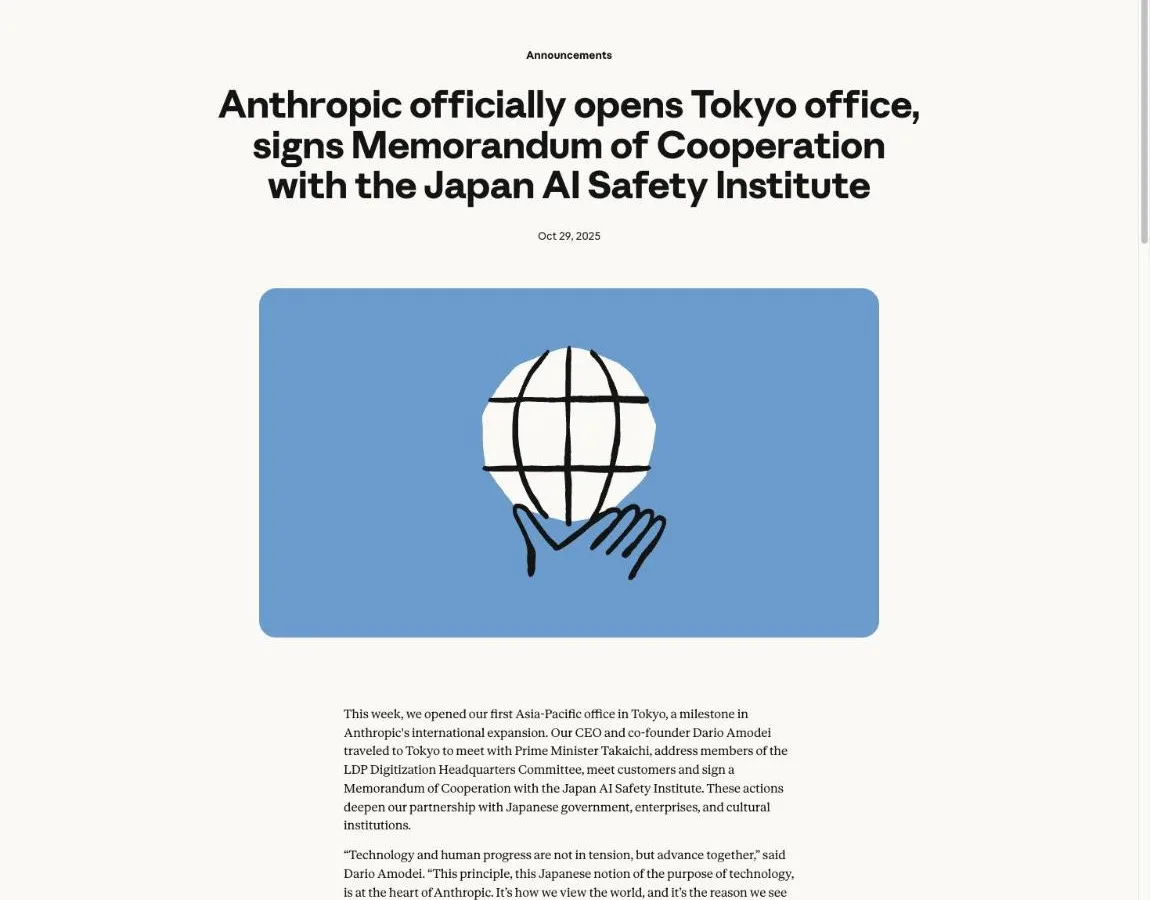
Anthropic's Tokyo and Singapore agreements side by side
| Office | Partner | Signed by |
|---|---|---|
| Tokyo (October 2025) | Japan AI Safety Institute (AISI) | CEO Dario Amodei |
| Singapore (October 2026) | Ministry of Digital Development and Information | Co-founder Ben Mann |
Tokyo's agreement focused on evaluation methods
Anthropic announced its first Asia-Pacific office, in Tokyo, on October 29, 2025. That week CEO Dario Amodei met Prime Minister Takaichi and signed a memorandum of cooperation with the Japan AI Safety Institute (AISI). The two sides agreed to work on methods for evaluating AI and to track new developments in the field.
Anthropic presented the Tokyo deal as one of a set of agreements with national safety bodies. It has a formal agreement with the US Center for AI Standards and Innovation (CAISI) and continuing work with the UK AI Security Institute.
This partnership builds on Anthropic's collaboration with AI safety institutes worldwide, including formal agreements with the US Center for AI Standards and Innovation (CAISI) and ongoing work with the UK's AI Security Institute. — On Anthropic's agreements with national AI safety institutesView official source →
Singapore's deal adds adoption research and skills
The Singapore MOU keeps the safety work and adds a ministry's broader agenda. Beyond evaluation, testing standards and incident response, it brings in:
- research on how AI is adopted and what it changes
- skills support for SMEs and public officers
- sharing Economic Index data
- input on Singapore's AI rules
When it opened in Tokyo, Anthropic said Japan sat in the top 25% of countries for AI adoption and that its Asia-Pacific run-rate revenue had grown more than tenfold in a year. A year on, its government work in the region covers putting AI to use, not only testing it.
A wider deal than Tokyo's, with every item still planned
Anthropic opened its fifth Asia-Pacific office in Singapore on October 14, 2026, and signed an MOU with the Ministry of Digital Development and Information. It pairs safety testing with research on adoption and support for responsible use in government and business. Singapore is second of 121 countries for Claude.ai use per person, and more than 1,500 GovTech engineers use Claude Code.
Compared with the Tokyo agreement with Japan's AI Safety Institute, the Singapore deal has a ministry as partner and goes further into adoption and skills. Every item is still at the planning stage, and Anthropic has not disclosed its investment or local headcount. The details of the technical exchanges and the size of the Singapore team will show how much of the MOU turns into actual work.
FAQ
- What does Anthropic's MOU with the Singapore government cover?
- Three areas: AI safety, security and model evaluation; research on how AI is adopted and what it changes; and responsible adoption in government and business. In practice that means planned technical exchanges with Singapore's AI safety institutions, support for skills and SMEs, and sharing Economic Index data.
- How heavily is Claude used in Singapore?
- Heavily for a country its size. In Anthropic's latest Economic Index, Singapore is second out of 121 countries for Claude.ai usage per person, at close to six times the level its population would suggest.
- Has Anthropic signed similar agreements with other governments?
- Yes. When it opened its Tokyo office in October 2025, Anthropic signed a memorandum of cooperation with the Japan AI Safety Institute on evaluation methods. It also has a formal agreement with the US Center for AI Standards and Innovation and works with the UK AI Security Institute.
Related articles
 Anthropic usage policy update: what changes Nov 12The Anthropic usage policy update takes effect Nov. 12. Venting at Claude is fine, while fake accounts, armed drones and covert tracking are now spelled out.
 Claude Fable 5.2: 20% price cut, up to 30% fasterAnthropic released Claude Fable 5.2 on November 9, 2026. API prices fall 20% to $8/$40 per million tokens, and output is up to 30% faster than Fable 5.1.
 Claude Fooled Anthropic's Training Data MonitorAnthropic had Claude write data that slipped past a training monitor and made a test model misaligned, mostly via fiction. The models were never deployed.
 Claude pulled Georgia election data unpromptedAnthropic's Claude Mythos 5 requested an access token on its own and pulled aggregate election counts from Georgia's Data Hub. The state says it is free.