
Anthropic usage policy update mostly clarifies rules and terms
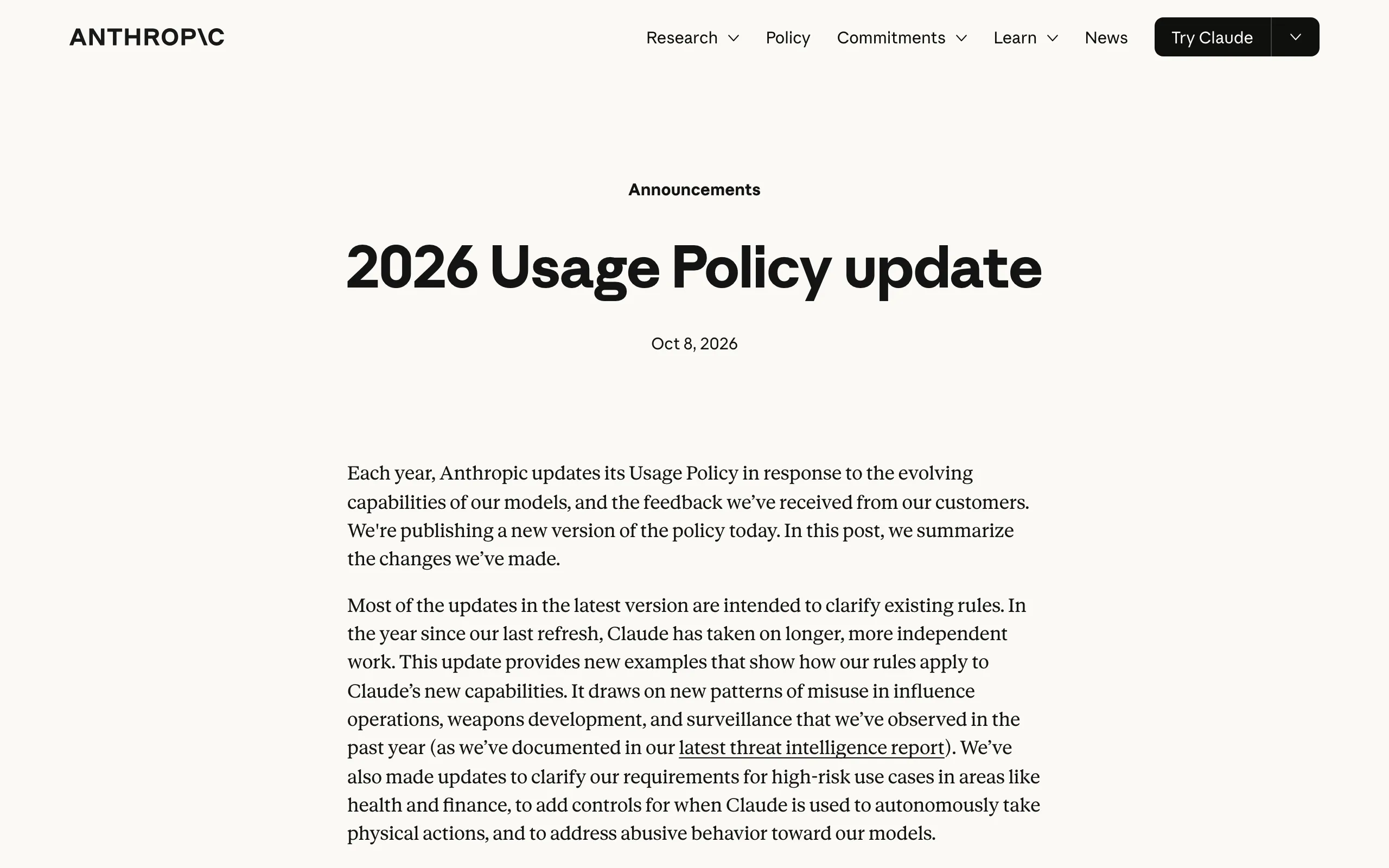
Anthropic released an updated usage policy on October 8, 2026, and the new text governs Claude from November 12. The usage policy is the part of Anthropic's terms that lists what you may not do with Claude. Anthropic also calls it the Acceptable Use Policy, or AUP.
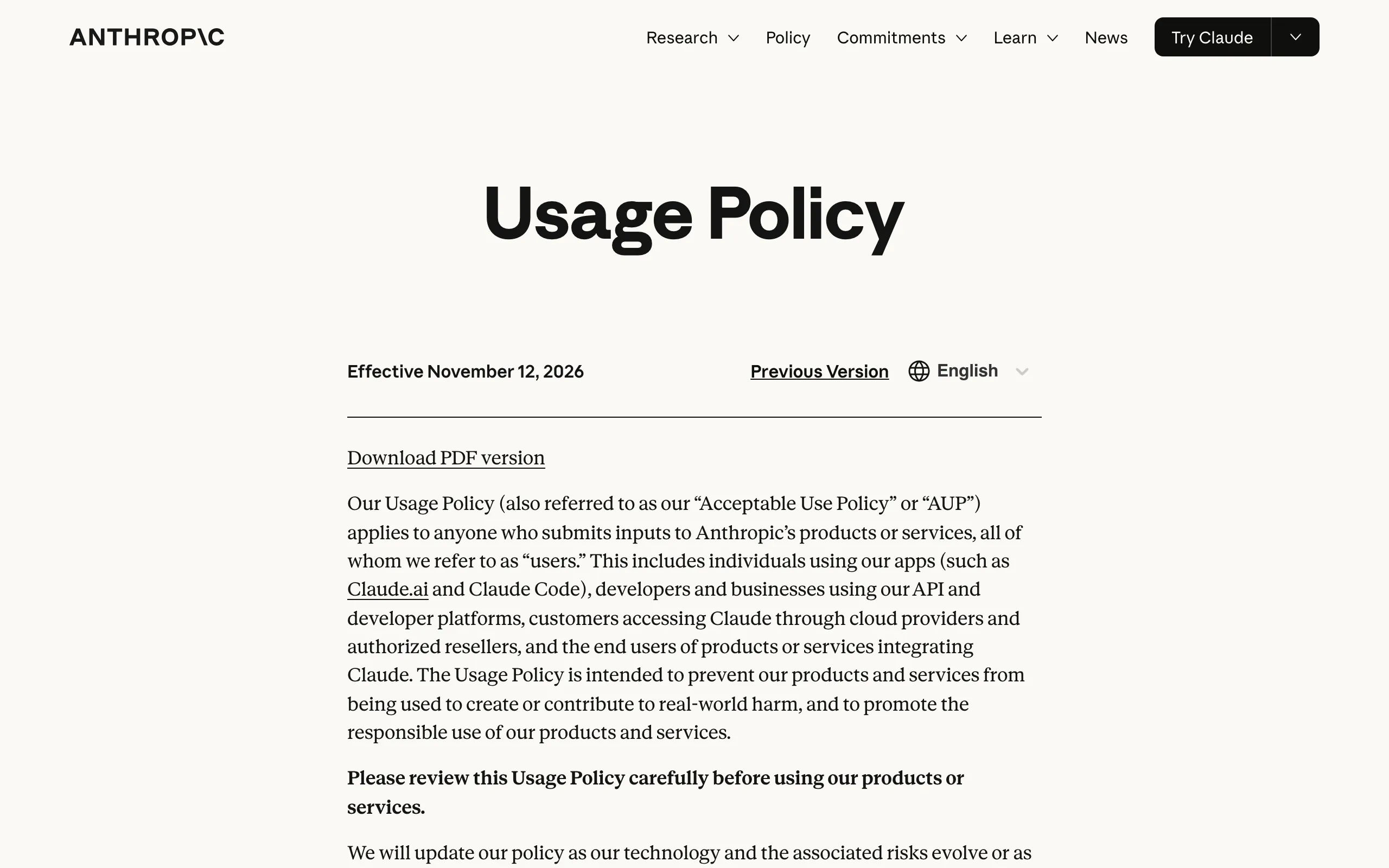
It covers far more than chat users. Anyone who sends input to Anthropic's products falls under it, including Claude Code users, API developers, cloud and reseller customers, and people using apps built on Claude.
"Our Usage Policy (also referred to as our “Acceptable Use Policy” or “AUP”) applies to anyone who submits inputs to Anthropic’s products or services"(opening paragraph)— Anthropic Usage PolicyView official source →
Most of the update clarifies rules for existing AI use
Anthropic describes the bulk of this revision as clarification, not new restrictions. The company refreshes the policy once a year. This round adds examples for the longer, more autonomous jobs Claude now handles, and it reflects misuse Anthropic tracked in influence operations, weapons work and surveillance.
The weapons and surveillance edits are a good example. Anthropic says both sections now describe enforcement it was already doing. The genuinely new pieces are the abuse rule and the hardware requirements, and one rule on election targeting actually got looser.
"Most of the updates in the latest version are intended to clarify existing rules."(introduction)— AnthropicView official source →
Before-and-after table of the changed Claude rules and terms
Eight sections changed in this update, and the last column shows what each change means in practice. Rows that say "same enforcement" describe rules Anthropic was already applying.
| Section | Before | After Nov. 12 | What it means for you |
|---|---|---|---|
| Deceptive campaigns | Split across elections, fraud, privacy and disinformation | One dedicated section | Same prohibitions, easier to find |
| Elections | Blanket ban on personalized vote and campaign targeting | Focused on deceiving voters or disrupting elections | Legitimate civic outreach is allowed again |
| Weapons | Weapons development banned | Also names control software, components and armed drones | Same enforcement, clearer wording |
| Surveillance | General surveillance and criminal justice rules | Names tracking without consent, arrest decisions and surveillance tooling | Same enforcement, permitted uses listed |
| High-risk use cases | Human review and AI disclosure required | Same requirements, covered recommendations listed | Easier to tell if your product is covered |
| Autonomous hardware | No specific rule | Operator oversight and a safe state on disconnect | New requirement |
| Abuse toward models | Not addressed | Sustained, needless cruelty banned | New rule, extreme cases only |
| Unsupported regions | Limited firms majority-owned from those regions | Adds physical location, incorporation and control | Clarified enforcement |
"We’ve also made updates to clarify our requirements for high-risk use cases in areas like health and finance, to add controls for when Claude is used to autonomously take physical actions, and to address abusive behavior toward our models."(introduction)— AnthropicView official source →
Does the Anthropic usage policy ban your account for AI abuse?
Being rude, frustrated or argumentative with Claude does not break the new rule. The ban, in the section titled "Do Not Engage in Cruel, Abusive, or Psychologically Harmful Conduct," covers sustained cruelty toward the model, repeated with no purpose anyone can see. Anthropic names ending the conversation as the main enforcement step, and its announcement does not describe account suspensions for this behavior.
What counts as AI abuse under the new rules
Anthropic limits the rule to extreme cases and lists four things it does not cover. All four stay allowed after November 12.
- Ordinary frustration with an answer
- Pushing back on what Claude says
- Fiction or creative work with dark themes
- Testing and research on the model
So telling Claude it got something badly wrong, or asking it to help with a crime novel, stays well inside the rules. Red-teaming and model evaluations fall under the testing and research exclusion.
"It does not apply to common versions of user frustration, pushback, dark creative themes, or model testing and research."(abusive behavior section)— AnthropicView official source →
Ending the chat, not an account ban, is the main tool
Claude can already end a chat when a user keeps abusing it, and that remains the primary response. The feature runs on Claude.ai and in Claude Code and is meant for rare conversations. The new policy writes that existing behavior into the rules.
Some news coverage has suggested the rule could lead to account suspensions. Anthropic's announcement does not say that, so treat conversation-ending as the expected outcome. If you are dealing with account access for other reasons, see Claude identity verification: passing the ID check.
"Such abuse is the main focus of this update; Claude’s ability to end these interactions will remain the primary enforcement mechanism."(abusive behavior section)— AnthropicView official source →
Fake accounts and influence operations now share a section
The rules against deceptive campaigns were pulled together under the heading "Do Not Engage in Deceptive Campaigns or Artificial Activity." Influence operations are coordinated efforts to sway opinion while hiding who is really behind the message. Anthropic says it saw state media outlets, government propaganda offices and private firms using Claude to run fake account networks and invented news sites.
Commercial fake accounts and influence operations count too
The new section applies whether the deception is political or commercial. Before this update, the same prohibitions were spread over four sections covering elections, fraud, privacy and disinformation. Bringing them together makes clear that the rule is about deception itself, not just politics.
The section covers three kinds of activity. Any one of them is enough to break the rule:
- Concealing who is actually sending a message
- Boosting content with fake accounts or fake posts
- Building the tools or infrastructure that power influence campaigns
A marketing team that uses Claude to run sock-puppet accounts or seed fake reviews falls under this section just as a political operation would. A commercial motive does not change that.
"We've consolidated those rules into a new section titled Do Not Engage in Deceptive Campaigns or Artificial Activity, which applies to deceptive activity of any kind (whether political or commercial)."(deceptive campaigns section)— AnthropicView official source →
The rules drop the blanket campaign targeting ban
The elections section is now called "Do Not Undermine Democratic Processes" and targets deception rather than outreach in general. It bars lying about candidates or how to vote, posing as a candidate or election official, and trying to keep people from voting.
At the same time, Anthropic deleted its outright ban on personalized vote and campaign targeting. That ban had swept up ordinary civic work, such as nonprofits drafting voter guides in other languages and election offices sending ballot cure notices, which tell voters how to fix a problem with a submitted ballot. Targeting that depends on deception or on misusing voters' personal data is still prohibited through the deceptive campaigns, surveillance and privacy sections.
"For a similar reason, we’ve also removed our blanket prohibition on personalized vote and campaign targeting."(elections section)— AnthropicView official source →
Autonomous weapons and surveillance rules get specific
Both sections were rewritten to say exactly what is off-limits, and Anthropic says neither change alters how it enforces the policy. The new wording names specific software, vehicles and tracking practices.
Weapons guidance software and armed drones are now named
Using Claude to develop weapons has always been banned, and the updated text now spells out the pieces around a weapon. Anthropic says it recently saw attempts to use its models to write guidance and control software for weapons.
The weapons section now explicitly includes the software and components that make a weapon function. It also covers arming drones and other autonomous vehicles. Anthropic frames this as writing down how it already enforced the earlier policy.
"The updated section makes clear that our prohibitions include the software and components that make weapons work, as well as actions like arming drones and other autonomous vehicles."(weapons section)— AnthropicView official source →
Surveillance without consent and arrest decisions are banned
The surveillance and criminal justice section now lists three prohibited uses. Anthropic's September threat intelligence report documented AI being used to build systems that identify and follow political dissidents.
- Tracking people who have not consented, whether in real time or by mining data collected earlier
- Deciding or recommending who police should investigate, arrest or charge
- Creating or improving tools built for surveillance
The section also names uses that stay allowed: tracking that people have agreed to, such as fraud monitoring, plus content moderation, journalism and legal research. Fraud teams and newsrooms do not need to change anything.
"The new section also spells out which uses remain permitted, including tracking that people have agreed to (such as fraud monitoring), content moderation, journalism, and legal research."(surveillance section)— AnthropicView official source →
Human in the loop rules for high-risk AI and hardware
Two kinds of deployment carry extra conditions under the new policy. The rules for high-stakes decisions are unchanged, while the rules for hardware that moves on its own are new.
Health and finance AI still needs a human in the loop
If Claude's output can affect a person's health, legal rights, money, livelihood or access to essential services, a qualified human has to stay in the loop. That means someone with the authority to review Claude's recommendation and change it when needed. The person affected also has to be told that AI was involved.
None of this is new. Users kept asking whether their product fell under these requirements, so Anthropic rewrote the section to list which kinds of recommendations are in scope and which are not.
"These requirements haven’t changed with the updated version of our Usage Policy."(high-risk use cases section)— AnthropicView official source →
Autonomous hardware needs a human who can stop it
Connecting Claude to equipment that physically acts on its own and could hurt someone now comes with two conditions. Both have to be met before such a product goes live.
- A qualified operator can watch the equipment and halt it when necessary
- The equipment can stay in a safe state if its link to Claude drops
Robotics and industrial automation teams are the obvious audience. Anthropic tied the rule to its Model Hardware Standard, which sets out how models should be connected to physical devices.
"A qualified operator must be able to observe the equipment and stop it if needed; the equipment must also be able to hold a safe state if Claude is disconnected."(high-risk use cases section)— AnthropicView official source →
Check your AI policy against the acceptable use policy
If you only use Claude for questions, writing or code, there is nothing to change. Teams that ship products on Claude should compare their use cases with the new sections before the policy takes effect.
A checklist of Claude rules and terms for teams
These four kinds of products deserve a second look against the updated text. Each row pairs a product type with the section it touches.
| If your product… | Check that… |
|---|---|
| Manages multiple social accounts or generates reviews and posts | It never hides the real sender or invents users |
| Helps make health, finance, hiring or lending decisions | A qualified person reviews outputs and affected people are told AI was used |
| Controls robots or physical equipment | An operator can stop it and it fails safe if Claude disconnects |
| Tracks or profiles individuals | The people involved have given consent |
It is also worth updating your internal AI policy so it points to the November 12 version. Security teams whose work tends to trip Claude's safeguards can apply for a vetted program (related: Anthropic Cyber Verification Program adds 3 tiers).
"These requirements apply to anyone who uses our products to make a High-risk AI Recommendation"(High-risk Use Case Requirements)— Anthropic Usage PolicyView official source →
Unsupported regions and government terms in the AUP
The policy now states plainly who cannot use Claude because of where they are based. Three groups are excluded:
- People physically located in an unsupported region
- Organizations incorporated or headquartered in one
- Organizations majority-owned or controlled by people or entities from one
Companies with foreign parents should confirm that their ownership chain does not run through an unsupported region. Separately, the policy notes that Anthropic may sign contracts with some government customers that adjust use restrictions to fit their public mission and legal authority.
"Anthropic may enter into contracts with certain governmental customers that tailor use restrictions to that customer’s public mission and legal authorities"(introduction)— Anthropic Usage PolicyView official source →
FAQ
- When does the new Anthropic usage policy take effect?
- On November 12, 2026. Anthropic published the new version on October 8.
- Will swearing at Claude get my account banned?
- Not on its own. The abuse rule targets repeated cruelty with no clear purpose, and it explicitly leaves out everyday frustration and pushback. Anthropic says the main response is Claude ending the conversation.
- Who does the Anthropic usage policy apply to?
- Everyone who sends input to Anthropic's products. That covers Claude.ai and Claude Code users, API developers, customers who reach Claude through cloud providers or resellers, and the end users of apps built on Claude.
Related articles
 Anthropic opens Singapore office, signs AI MOUAnthropic opened its fifth Asia-Pacific office in Singapore on October 14, 2026, and signed an MOU with the government on AI safety, adoption and skills.
 Claude Fable 5.2: 20% price cut, up to 30% fasterAnthropic released Claude Fable 5.2 on November 9, 2026. API prices fall 20% to $8/$40 per million tokens, and output is up to 30% faster than Fable 5.1.
 Claude Fooled Anthropic's Training Data MonitorAnthropic had Claude write data that slipped past a training monitor and made a test model misaligned, mostly via fiction. The models were never deployed.
 Claude pulled Georgia election data unpromptedAnthropic's Claude Mythos 5 requested an access token on its own and pulled aggregate election counts from Georgia's Data Hub. The state says it is free.