
What arXiv's new submission limit says
On October 1, 2026, arXiv put a new rate limit on every submitter in every category, effective the same day. Every paper sent to arXiv is checked by a volunteer moderator, a researcher in the field, before it is announced. That check is not peer review, so it does not judge whether the results are correct.
Two new submissions a month, three active at once
A submitter can now send arXiv at most two new papers in a calendar month. The limit is shared across all categories, so splitting work between, say, physics and computer science does not raise it.
The older cap of three active submissions at any one time, in place since 2024, stays. A new submission has to fit under both limits.
arXiv now limits submitters to up to two submissions per calendar month, with a limit of three total active submissions at any given time. / This rate limit applies to all submissions, across all categories. — arXiv blog, October 1, 2026View official source →
A stopgap with no end date
arXiv describes the cap as a stopgap, not a permanent rule. It is meant to hold until arXiv settles on new best practice for authors who use AI tools and has improved its moderation tools and procedures.
The post gives no end date. Instead, the service says it will track the effect on authors and readers and change the policy if needed.
As of October 1st, 2026, arXiv is instituting an updated rate limiting policy across all submitters and categories as a stopgap while we determine what may be the new best practice for authors employing more and more advanced AI tools, and to give us time to improve our moderation tools and procedures accordingly. — arXiv blog, October 1, 2026View official source →
What counts toward the two-paper cap?
Every paper you submit counts, including ones arXiv rejects, unless you delete it before it is announced. Papers in different categories share one limit, and co-authored papers count only against whoever pressed submit. A paper still on hold from last month does not use this month's two, but it does use one of your three active slots.
How arXiv counts submissions (from the FAQ in arXiv's blog post)
The on-hold rule is easy to miss. Say two papers you sent in October are still on hold in November. Your monthly allowance resets to two, yet two of your three active slots are taken, so you can add only one more right away.
If your allotted submissions from a previous month are on hold in the next month, they do not count against your submission limit for next month. — arXiv blog FAQ, October 1, 2026View official source →
Rejected papers still count
A paper that arXiv declines still uses one of your two monthly submissions. The service counts submissions rather than announced papers because each one takes a moderator's time to check, whatever the outcome.
So if you submit two papers in a month, you wait until the next month to submit again, accepted or not. A rejection for a formatting mistake or the wrong category costs a slot.
Yes – this rate limit is for submissions, not announced papers, because it is submissions that consume moderator time. / If you submit two papers in a month, whether they are accepted or rejected, you will have to wait until the next month to submit to arXiv again. — arXiv blog FAQ, October 1, 2026View official source →
Co-authors don't lose a slot
When you submit a co-authored paper to arXiv, it counts against your limit only. The other authors on the paper keep both of their monthly submissions.
arXiv asks co-authors to coordinate for that reason. A lab planning several papers in the same month will need to spread the submitting across different people.
No. All arXiv rate limit policies apply only to submitters. If you submit a paper with several co-authors, that only counts towards your submission rate, not theirs. It is important for co-authors to coordinate their submissions accordingly. — arXiv blog FAQ, October 1, 2026View official source →
Deleting before announcement frees the slot
If you spot a problem after submitting to arXiv and delete the paper before it is announced, it does not count. It is excluded from both the monthly limit and the active limit, and arXiv does not ask why you deleted it.
Submitters who delete their submitted paper before it is announced, whatever the reason, will not have that paper count toward their monthly submission or active submission rate limits. — arXiv blog FAQ, October 1, 2026View official source →
Why arXiv says it needed a cap
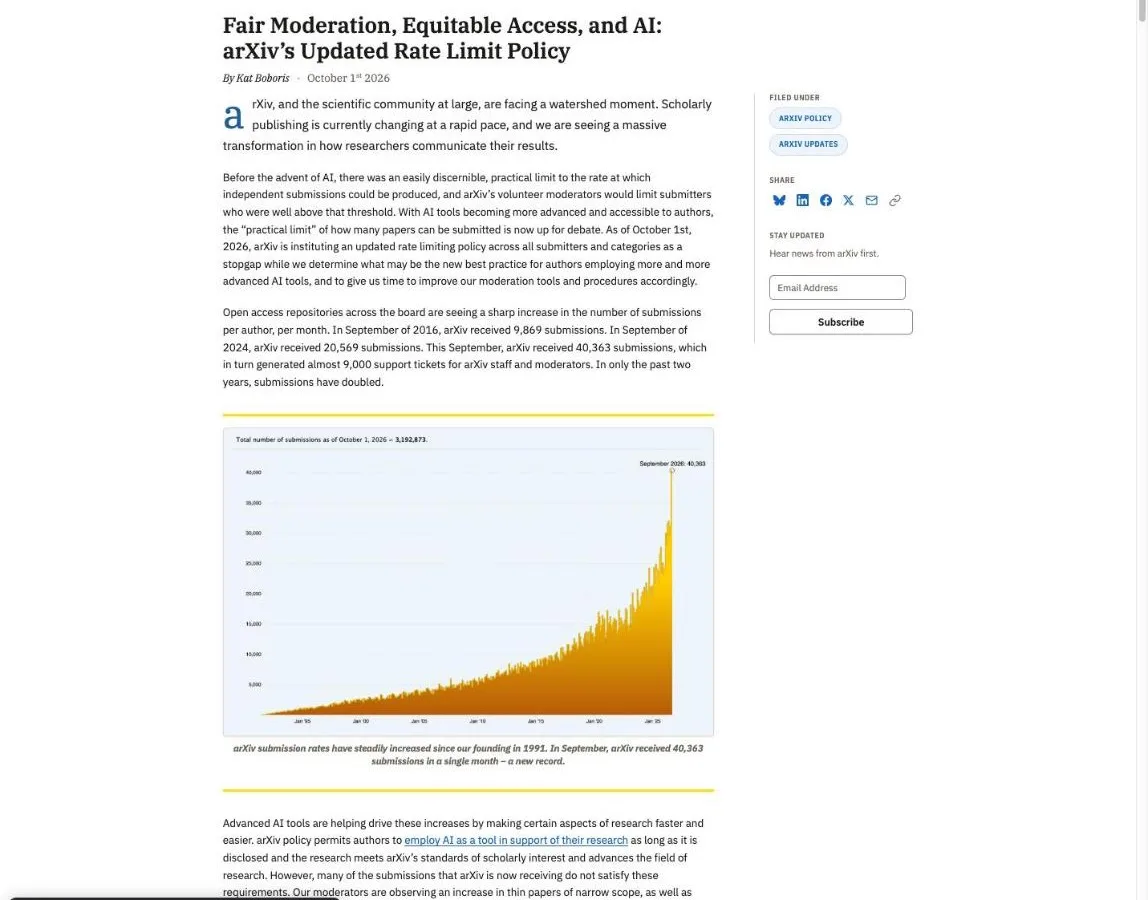
arXiv points to a surge in submissions that its moderators cannot keep pace with. The September figures it published show how fast the volume has grown.
Submissions doubled in two years to a record 40,363
arXiv received 40,363 submissions in September 2026, the most it has ever taken in a single month. That is double the 20,569 of September 2024 and about four times the 9,869 of September 2016.
Submissions arXiv received each September
Source: arXiv blog, October 1, 2026.
The papers were not the only load. The same month brought almost 9,000 support tickets for arXiv staff and moderators.
In September of 2016, arXiv received 9,869 submissions. In September of 2024, arXiv received 20,569 submissions. / This September, arXiv received 40,363 submissions, which in turn generated almost 9,000 support tickets for arXiv staff and moderators. — arXiv blog, October 1, 2026View official source →
cs.AI submissions grew more than sixfold
The steepest rise is in cs.AI, the category for papers about artificial intelligence, where submissions grew more than sixfold in two years. Other categories roughly doubled over the same period. As a subject label, cs.AI says nothing about how many papers were written by AI.
Moderators report more thin papers with a narrow scope and more "salami" papers, where one piece of work is cut into several smaller ones. They also see more dense, AI-written papers.
arXiv has not banned AI. Authors may use it as a research tool as long as they disclose it and the work meets arXiv's standards.
Increases over the past two years in cs.AI (over 6X increase) illustrate the rate at which researchers are submitting to arXiv. / Our moderators are observing an increase in thin papers of narrow scope, as well as ‘salami’ papers, where a single work is broken up and submitted as a set of smaller papers. There is also a marked increase in dense, AI-written papers. — arXiv blog, October 1, 2026View official source →
A small share of authors slows moderation for everyone
Thomas Dietterich, Distinguished Professor Emeritus at Oregon State University and chair of the arXiv Editorial Advisory Council, puts the problem down to a minority of authors. In his account, a relatively small group files large numbers of low-quality papers and takes up an outsized share of moderator time.
Authors who submit careful work then wait, sometimes for days or weeks, before their papers appear. According to arXiv, a single limit for everyone is its way of sharing volunteer time fairly.
Before AI tools, there was a practical ceiling on how many papers one person could write, and moderators only restrained the few who went far beyond it. With AI in the mix, the blog post says, that ceiling is now open to question.
However, a relatively small proportion of authors are submitting a large number of low-quality papers and consuming a disproportionate fraction of the moderators’ time. This is unfair to authors who continue to submit quality papers — their papers can be delayed for days or weeks as a result. — arXiv blog, October 1, 2026View official source →
The third rule change in about a year
The monthly cap follows two earlier moves by arXiv to tighten what it accepts. Both were announced on arXiv's blog.
October 2025: CS review papers need peer review
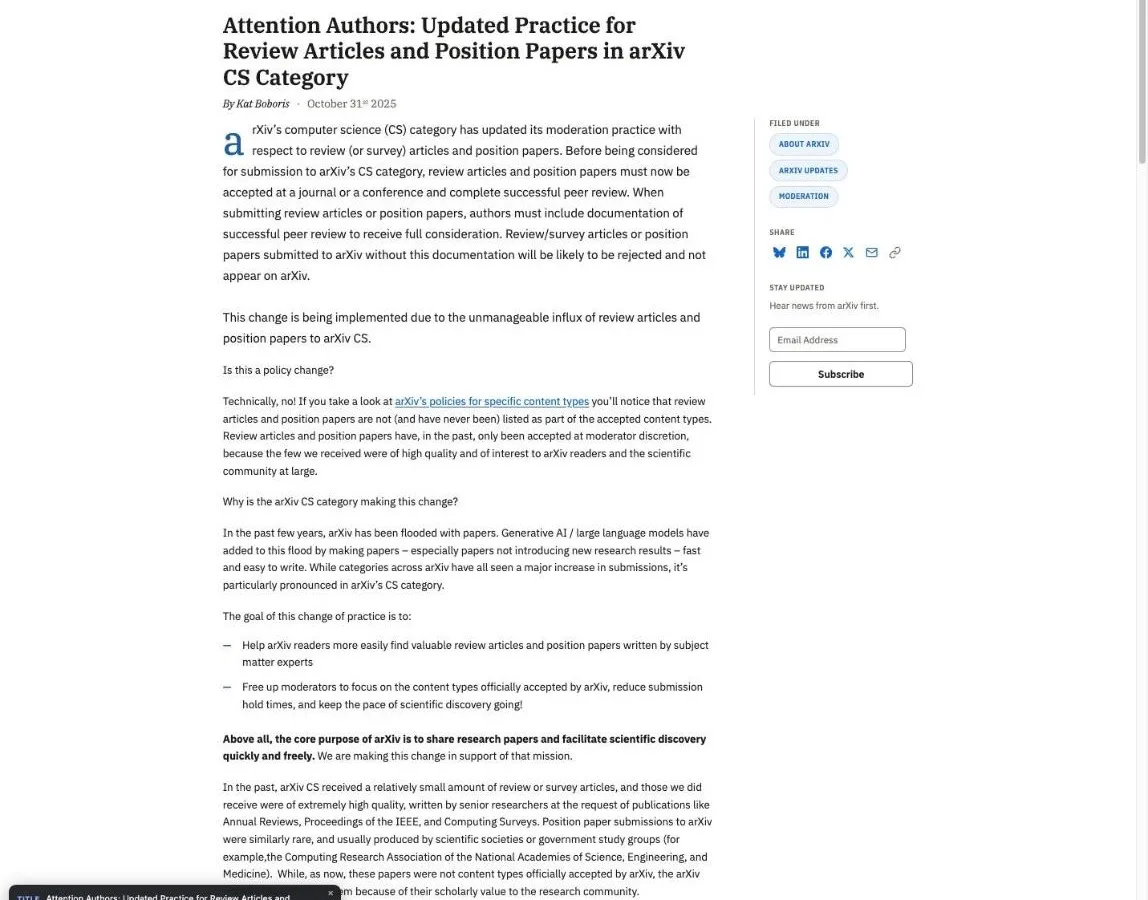
On October 31, 2025, arXiv's computer science category started requiring review articles and position papers to pass peer review at a journal or conference first. A review article surveys existing research, and a position paper argues for a stance. The service said generative AI had made such papers, which report no new results, fast and easy to produce, and that the flood was heaviest in CS.
Before being considered for submission to arXiv’s CS category, review articles and position papers must now be accepted at a journal or a conference and complete successful peer review. — arXiv blog, October 31, 2025View official source →
January 2026: stricter endorsement for new authors
From January 21, 2026, arXiv stopped accepting an institutional email address on its own as grounds for endorsing a first-time author. New authors now need that address plus a paper already accepted in the same endorsement domain, or a personal endorsement from an established author in that domain.
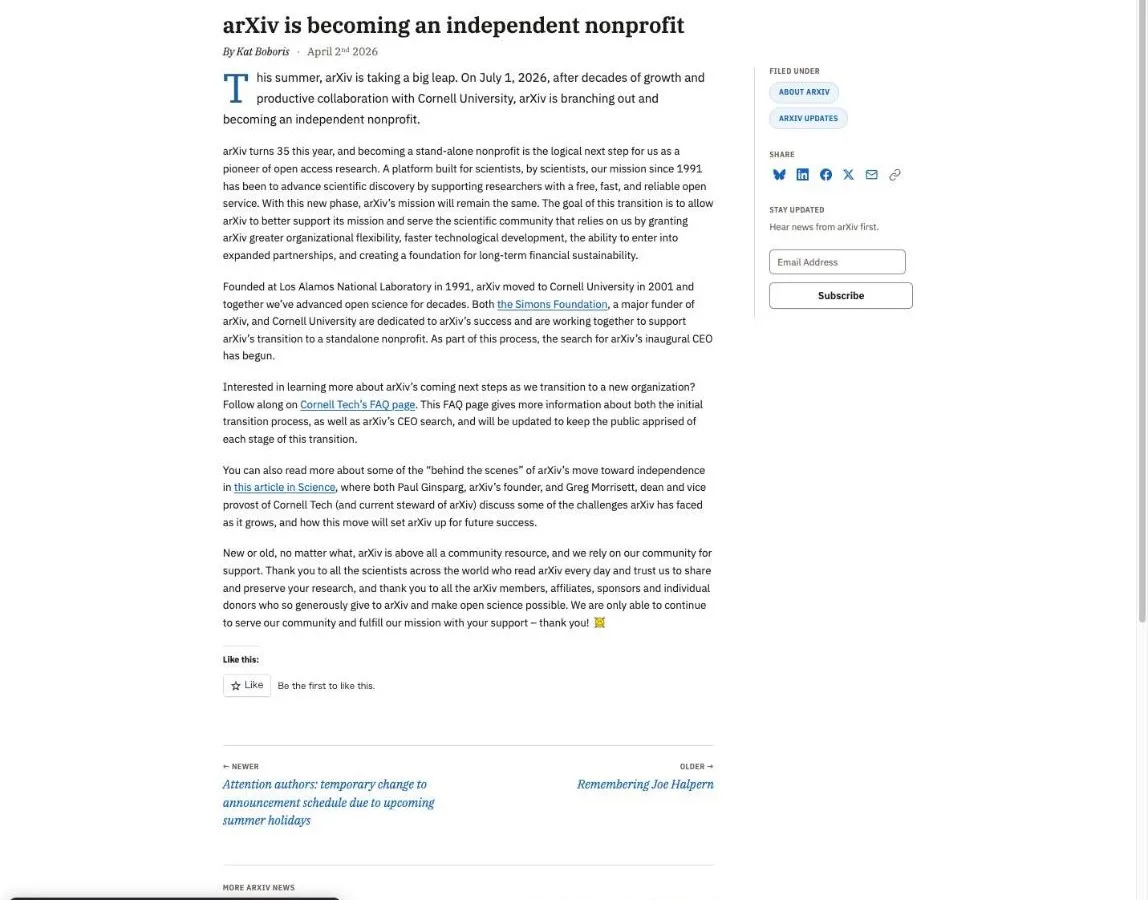
The organization changed too. On July 1, 2026, arXiv left Cornell University to become an independent nonprofit.
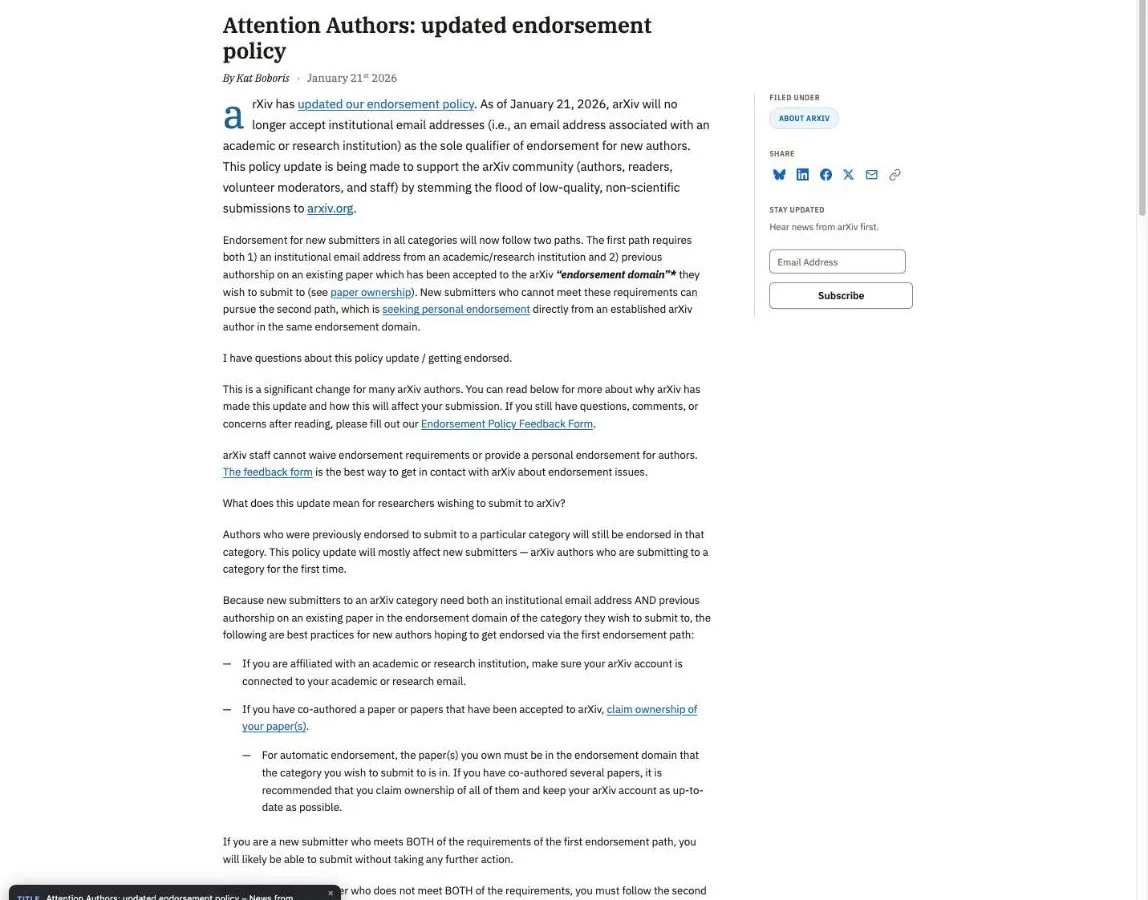
As of January 21, 2026, arXiv will no longer accept institutional email addresses (i.e., an email address associated with an academic or research institution) as the sole qualifier of endorsement for new authors. — arXiv blog, January 21, 2026View official source →
On July 1, 2026, after decades of growth and productive collaboration with Cornell University, arXiv is branching out and becoming an independent nonprofit. — arXiv blog, April 2, 2026View official source →
What to check before you submit
arXiv explains the rule in two places, its blog post and its help pages, and the wording is not identical. Three points are worth checking before you plan your next submissions.
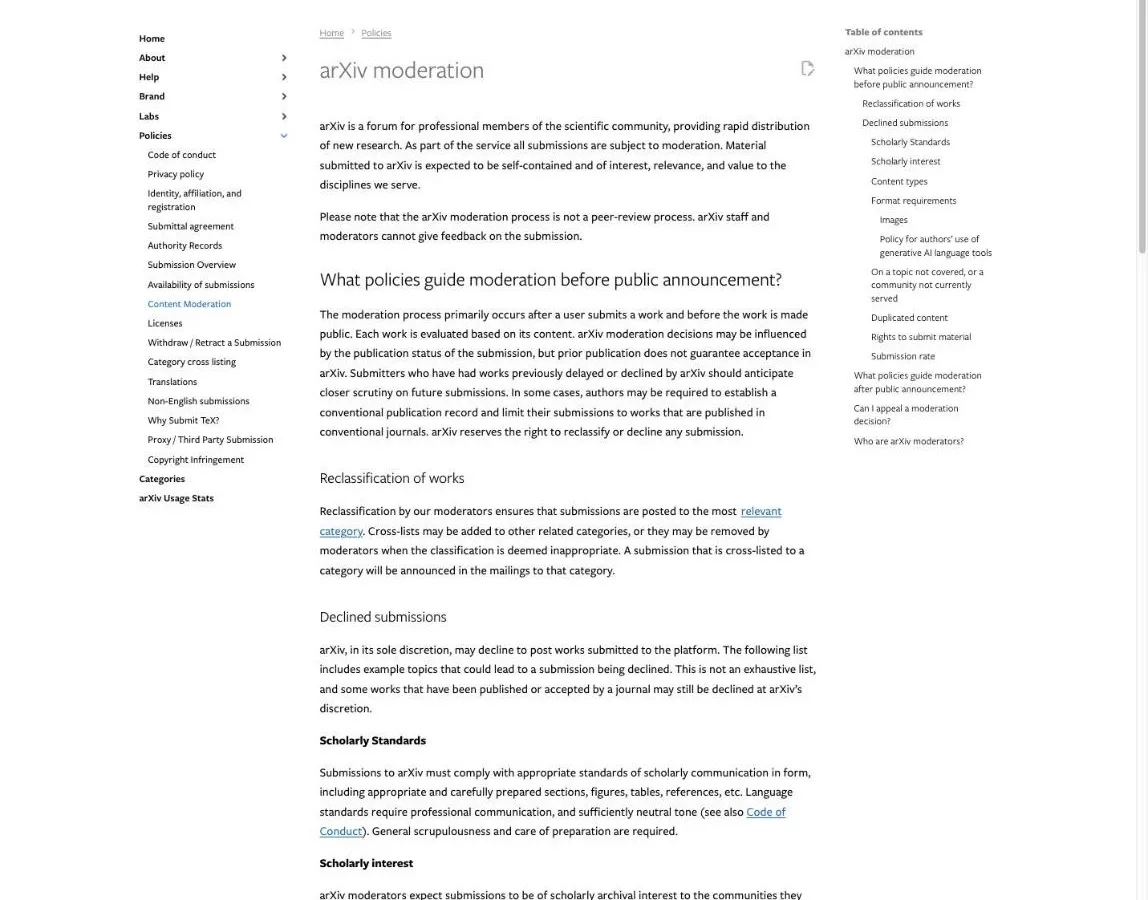
The help page and the FAQ disagree on who counts
The Submission rate section of arXiv's help page says each author may make two new submissions a month. The FAQ in the blog post says the limits apply only to the person who submits.
On co-authors, the FAQ is explicit that their counts are untouched. Read alone, though, the help page could suggest otherwise, so it is safest for a group to agree in advance on who submits each paper.
Replacements are limited after version 5
arXiv also limits replacements, the updated versions of a paper already posted. Once a paper is past version 5, the help page allows one replacement a week. The help page adds that arXiv may ask a specific author to submit even less often.
Each author may submit up to two new submissions per calendar month with a limit of three active submissions. / there is a one per week rate limit after version 5. / arXiv may request that a particular author further limit their submission rate. — arXiv help, Content Moderation, Submission rateView official source →
Conference deadlines get no exception
arXiv asks authors with a backlog, or with a conference deadline to meet, to plan their submissions around both limits. The FAQ offers no exception for deadlines.
If a deadline falls near the end of a month, that means splitting papers across two months or getting them in during the month before. Rejections use up your monthly two and on-hold papers tie up active slots, so leave room in the schedule.
We ask authors who have a backlog of work to submit, or who need to submit a paper at a specific time for a conference, to plan their submissions carefully so that the monthly submission rate limits and active submission rate limits will not negatively impact them. — arXiv blog FAQ, October 1, 2026View official source →
What the cap means for your next paper
Since October 1, 2026, each arXiv submitter can send two new papers a month, and a rejection uses one of them. The three things to remember:
- The limit: two new submissions per calendar month and three active at once, shared across all categories
- What counts: rejections count, deletions before announcement don't, and co-authors keep their own slots
- The reason: submissions doubled in two years to 40,363 in September, and a small group of heavy submitters was delaying everyone else's papers
FAQ
- Does a rejected paper count toward arXiv's two-per-month limit?
- Yes. The limit counts submissions, not announced papers, because every submission takes moderator time. Once you have submitted two papers in a calendar month, you have to wait until the next month to submit again, whether those papers were accepted or rejected.
- Do my co-authors lose a submission slot when I submit our paper?
- No. According to arXiv's FAQ, the limit applies only to the person who submits. A co-authored paper counts against the submitter alone, so co-authors are asked to coordinate who submits which paper. The help page words the rule as each author, so agreeing on a submitter in advance avoids surprises.
- How long will the cap last?
- arXiv has not given an end date. It calls the cap a stopgap while it works out new best practice for authors who use AI tools and improves its moderation tools and procedures. It says it will watch how the change affects authors and readers and adjust it as needed.
Related articles
 UK's AISI gets £120m, about 3-4x US budget a yearThe UK Budget gives the AI Security Institute an extra £120 million over four years. Semafor says 10x the US budget; per year it is about 3 to 4 times.
 Trump Super Intelligence Rename: Who Must Use SITrump calls anyone who says artificial intelligence THE ENEMY, but his super intelligence executive order covers only federal agencies' documents, not firms.
 Malaysia seizes 30 AI chip servers at KLIA airportMalaysian customs seized 30 AI chip servers worth RM49.5 million at KLIA, declared as electronic components, in the year's fifth case tied to one syndicate.
 Nvidia's Jensen Huang close to alleged Chinese spyThe NYT says US officials judged Megaspeed's Alice Huang, close to Nvidia CEO Jensen Huang, a Chinese intelligence asset. Nvidia calls it normal business.