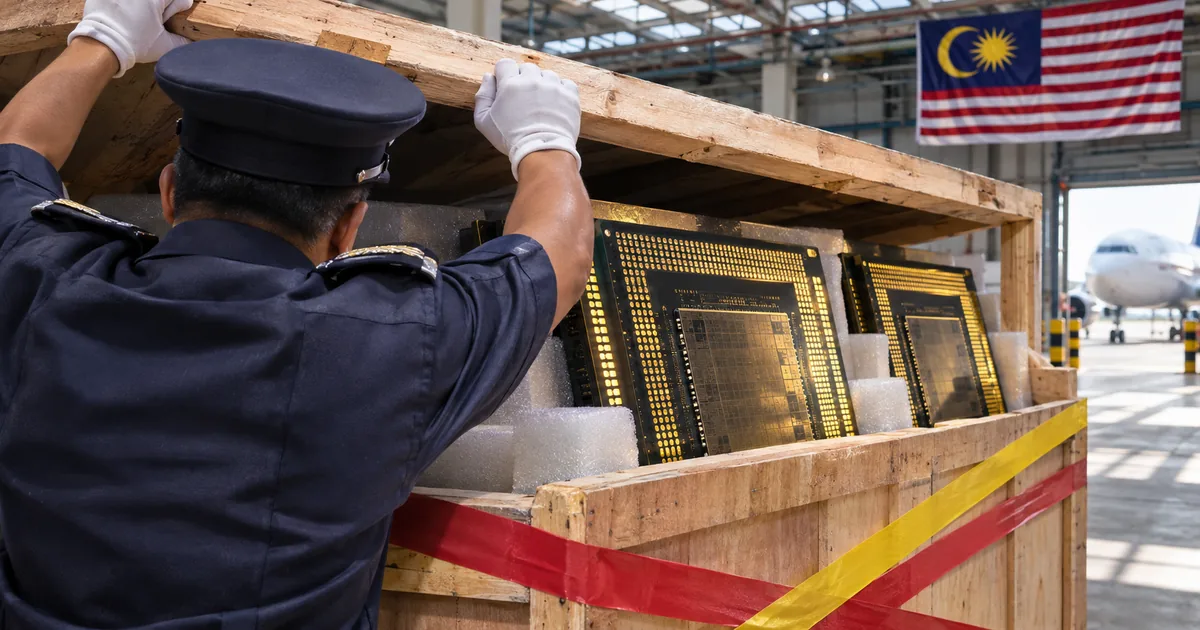
30 servers declared as electronic components seized at KLIA
The servers held advanced AI chips worth nearly RM49.5 million and were on their way from one Asian country to another without the required authorization. According to Customs, an enforcement team from KLIA checked a warehouse inside the airport's Free Trade Zone, an area where goods can sit without paying customs duties, at around 11:30 a.m. on 15 October 2026. That is where officers found the 30 servers.
Aspalila Ag Tuah, director of KLIA Customs, gave the details at a press conference in Sepang on 28 October. AFP put the value of the haul at US$12.1 million.
What KLIA Customs announced about the seizure
| Detail | What Customs said |
|---|---|
| Inspection | 15 October 2026, around 11:30 a.m. |
| Location | Warehouse in the KLIA Free Trade Zone |
| Goods | 30 servers fitted with advanced AI chips |
| Value | Nearly RM49.5 million (US$12.1 million) |
| Declared as | Electronic components, on one air waybill |
| Planned route | Re-export to another Asian country |
Early findings, the director said, showed the servers had arrived from an Asian country on a single air waybill, the shipping document issued for each air cargo consignment. The paperwork listed them as electronic components, which she said was meant to keep the authorities from noticing them.
Masyita Ismail of the Strategic Trade Secretariat at the Ministry of Investment, Trade and Industry (MITI) did not name the chip brands, the countries of origin or the destinations. She said the investigation was still under way.
"Meanwhile, Investment, Trade and Industry Ministry (Miti) Strategic Trade Secretariat senior assistant director Masyita Ismail said the high-performance AI chips were subject to strict controls as they were classified as dual-use items."/"The Customs Department at Kuala Lumpur International Airport (KLIA) foiled an attempt to transit 30 servers containing advanced artificial intelligence (AI) chips worth nearly RM49.5 million without the required authorisation."/"KLIA Customs director Aspalila Ag. Tuah said the seizure was made by a team from the KLIA Customs Enforcement Division following a thorough inspection of a warehouse in the KLIA Free Trade Zone on October 15 at about 11.30am."/"She said preliminary investigations found that the servers had been brought in from an Asian country under a single air waybill declaring them as electronic components, allegedly to evade detection by the authorities, before being re-exported to another Asian country."/"adding that the brands, countries of origin and destinations of the chips could not be disclosed as investigations were ongoing."— BernamaView official source →
The fifth case this year tied to the same syndicate
The director said the syndicate routed the servers through Malaysia so their export to the next destination would face no restrictions. She told reporters this was the fifth case linked to that syndicate that Customs had logged this year.
The reports differ on how much the five cases add up to. Bernama (via Malay Mail) quoted her as saying the total was over RM100 million. AFP (via RTM) put it at more than US$24 million, or about RM98 million.
Bernama also reported that the chips could be used to develop military technology. High-performance AI chips count as dual-use items, goods with both civilian and military uses, and Malaysia keeps them under tight control. A similar case of AI servers sent on through third countries reached court in Taiwan this year (related: AI chip smuggling: Taiwan indicts nine over B300s).
"“The syndicate also used Malaysia as a transit point to ensure there were no restrictions on the export of the servers to their next destination,” she told a press conference here today."/"Aspalila confirmed that the seizure was the fifth case involving the same syndicate recorded by Customs this year, with the total value of seizures across all five cases exceeding RM100 million."/"The chips could potentially be used in the development of military technology."— BernamaView official source →
"Menurutnya, peralatan itu dianggarkan bernilai AS$12.1 juta (RM49.5 juta) dan kes berkenaan merupakan kes kelima tahun ini melibatkan sindiket penyeludupan cip AI canggih."/"Secara keseluruhan, nilai rampasan bagi lima kes berkenaan melebihi AS$24 juta (kira-kira RM98 juta)."— AFPView official source →
What permit does Malaysia require to transit AI chips?
Since 14 July 2025, high-performance AI chips of US origin need a Strategic Trade Permit even when they only pass through Malaysia. On that day MITI said that, with immediate effect, exporting, transshipping or moving these chips in transit would need the permit. Masyita Ismail of MITI said the Strategic Trade Act 2010 regulates dual-use items that could be used to develop weapons of mass destruction.
The legal basis is Section 12 of the Strategic Trade Act 2010. Section 12 is a catch-all provision, meaning it can reach items that are not on any control list. Anyone who knows or has good reason to suspect that an item not on the Strategic Items List will be misused must notify the authority at least 30 days before exporting, transshipping or moving it in transit.
MITI presented the move as closing a regulatory gap while it reviews whether to add US-origin AI chips to the Strategic Items List. The performance thresholds come from Strategic Trade Controller's Directive No. 1/2025, issued the same day. A permit is required for chips that meet either of these:
- A total processing performance (TPP), a measure of a chip's computing power, of 4,800 or more
- A TPP of 1,600 or more combined with a performance density of 3.2 or more
All five cases are being investigated under Section 12. If a willful offense is proven, a company faces a fine of up to RM20 million. An individual faces a fine of up to RM10 million, up to 10 years in prison, or both.
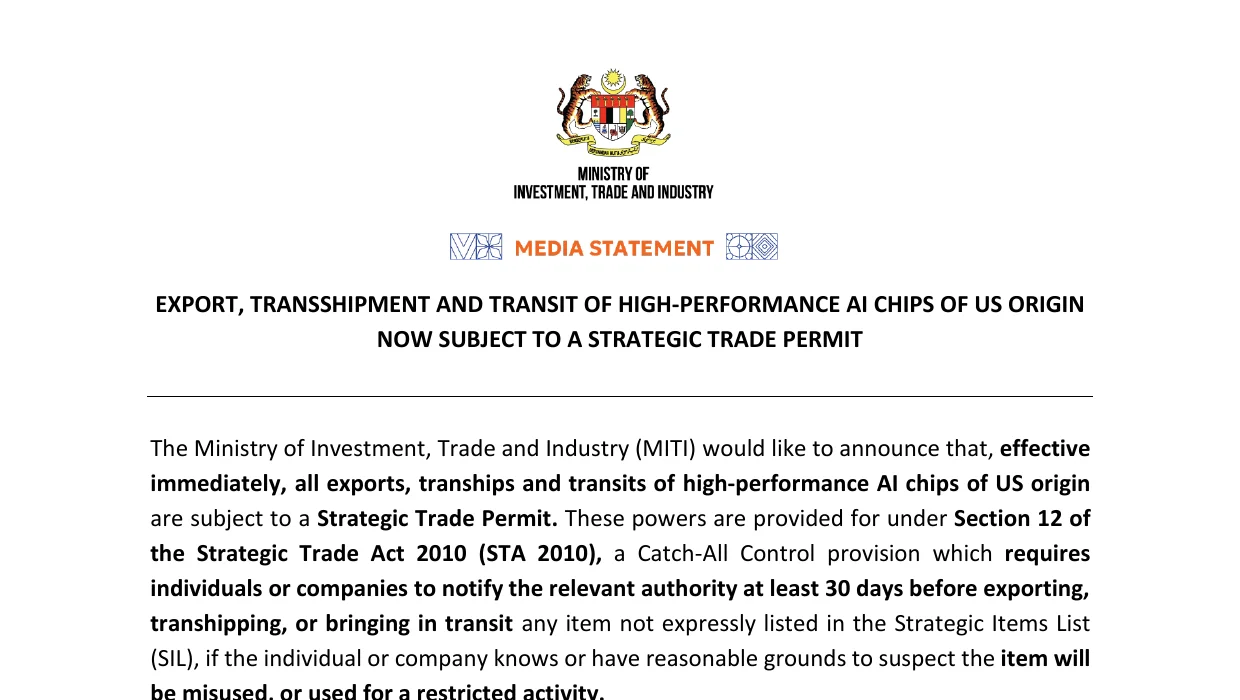
"The Ministry of Investment, Trade and Industry (MITI) would like to announce that, effective immediately, all exports, tranships and transits of high-performance AI chips of US origin are subject to a Strategic Trade Permit."/"These powers are provided for under Section 12 of the Strategic Trade Act 2010 (STA 2010), a Catch-All Control provision which requires individuals or companies to notify the relevant authority at least 30 days before exporting, transhipping, or bringing in transit any item not expressly listed in the Strategic Items List (SIL)"/"This initiative serves to close regulatory gaps while Malaysia undertakes further review on the inclusion of high-performance AI chips of US origin into the SIL of the STA 2010."— MITIView official source →
"“The Strategic Trade Act 2010 regulates dual-use items, which can be used in the development of weapons of mass destruction,” she said"/"The directive stipulates that chips with a Total Processing Performance (TPP) value of 4,800 or higher, or 1,600 or higher when combined with a Performance Density of 3.2 or higher, require a permit, which must be applied for 30 days before the chips are brought into Malaysia."/"All the cases are being investigated under Section 12 of the Strategic Trade Act 2010, which provides for a fine of up to RM20 million for a corporation, or a fine of up to RM10 million, imprisonment for up to 10 years, or both, for an individual convicted of an offence committed wilfully."— BernamaView official source →
Chip performance, not the declared label, decides the permit
Because the directive defines its scope by performance figures such as TPP 4,800 and covers cargo that only transits Malaysia, a false label does not take a shipment outside the rule. These 30 servers were listed as electronic components, yet whether they needed a permit turns on the chips inside them, not on the word on the waybill.
A Free Trade Zone warehouse lets goods wait without paying customs duties, but Customs still seized the servers as cargo being moved through Malaysia without a permit. With five cases tied to one syndicate this year, the route through Malaysia was used more than once. As of the 28 October announcement, the authorities had not disclosed the chip brands, origin or destination, citing the ongoing investigation.
FAQ
- Where were the seized servers going?
- The KLIA Customs director said they were to be re-exported to another Asian country after arriving from a different Asian country. The authorities have not named either country, citing the ongoing investigation.
- Which AI chips need a permit in Malaysia?
- Under Strategic Trade Controller's Directive No. 1/2025, a permit is needed for chips with a TPP of 4,800 or more, or a TPP of 1,600 or more with a performance density of 3.2 or more. The rule covers transit and transshipment as well as export.
- What is the penalty for moving these chips without a permit?
- Under Section 12 of the Strategic Trade Act 2010, a company convicted of a willful offense can be fined up to RM20 million. An individual faces a fine of up to RM10 million, up to 10 years in prison, or both.
Related articles
 Nvidia's Jensen Huang close to alleged Chinese spyThe NYT says US officials judged Megaspeed's Alice Huang, close to Nvidia CEO Jensen Huang, a Chinese intelligence asset. Nvidia calls it normal business.
 AI Chip Smuggling: Taiwan Indicts Nine Over B300sTaiwan indicted nine over alleged B300 server smuggling. Prosecutors say 74 of 130 servers reached China via Indonesia, Japan and Hong Kong; customs held 56.
 Waymo Custom Chip: 5nm ASIC for Lidar and CamerasThe Waymo custom chip is a 5nm ASIC that fuses lidar, radar and camera data ahead of the driving stack. What its 1,000 TOPS covers, and what it does not.
 Flash prices up 5x on AI, eroding Apple's leverageAI demand made flash 5x pricier in a year, the WSJ reports. Cloud giants now buy twice as much as Apple, and doubling iPhone 17 Pro storage costs Apple $66.