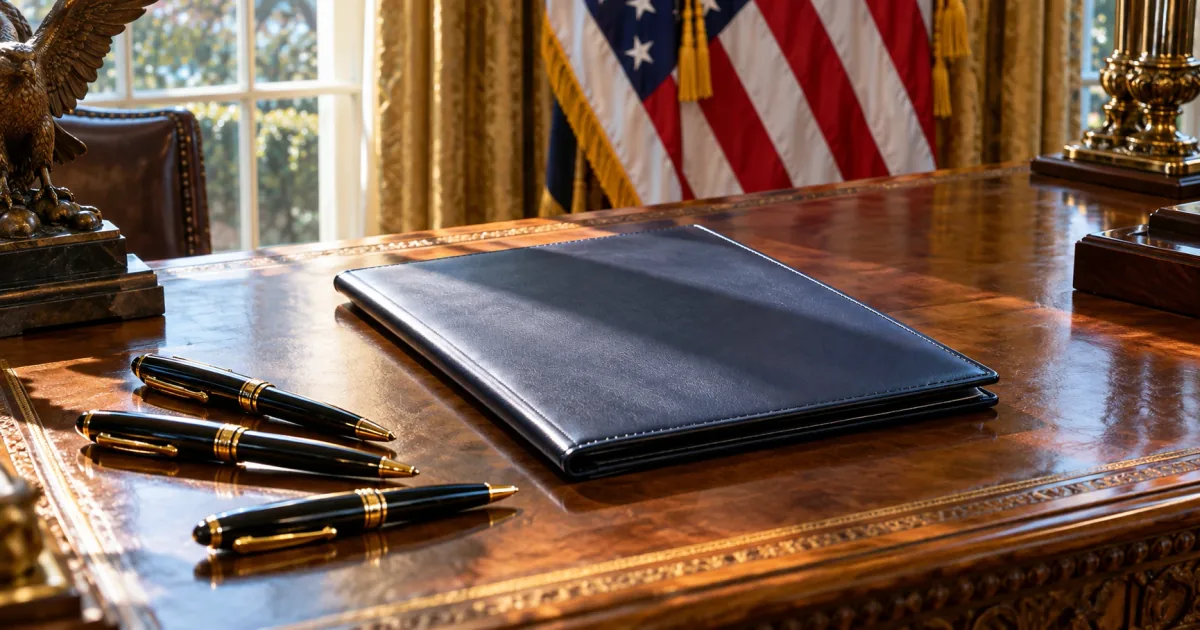
Trump's super intelligence post calls AI users the enemy
On Thursday, October 8, 2026, Trump wrote on Truth Social that the White House considers anyone who uses the term "Artificial Intelligence" rather than "Super Intelligence" to be THE ENEMY. He described super intelligence as the widely accepted, newer and more accurate word, and put "THE ENEMY" in capital letters.
The post did not say what being the enemy would mean in practice. According to AFP's report, Trump did not say what the consequences would be, and the post names no penalty or next step.
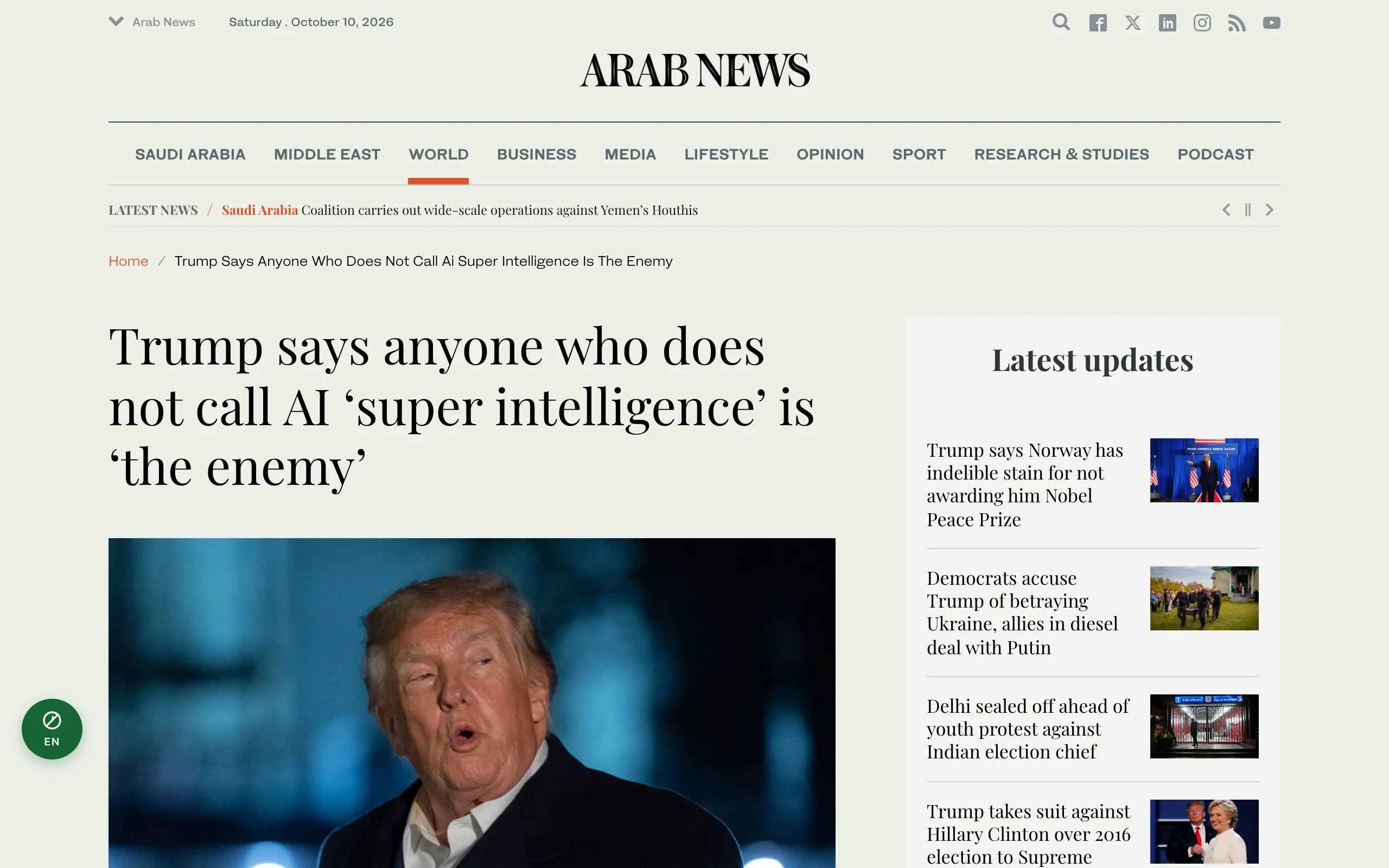
"WASHINGTON: US President Donald Trump, who has said he wants the term “super intelligence” to replace artificial intelligence, said on Thursday that anyone who does not heed his wishes will be treated as “THE ENEMY,” without saying what the consequences would be." / "“The White House considers anyone that uses the term, ‘Artificial Intelligence,’ as opposed to the highly accepted new and more accurate term, ‘Super Intelligence,’ THE ENEMY!” Trump said in a post on his Truth Social network." — AFPView official source →
Super intelligence: from a poll to an order in 10 days
The rename took ten days to go from an online poll to a signed order, and the post on October 8 came nine days after that. The table lists each step in order.
| Date (2026, US time) | What happened |
|---|---|
| September 19 | Trump ran a Truth Social poll offering three replacement names for artificial intelligence |
| September 22 | At the UN General Assembly he said the technology would officially be called Super Intelligence |
| September 25 | The White House said Trump and Xi Jinping agreed to use "super intelligence" |
| September 29 | Trump signed Executive Order 14434 |
| October 4 | Trump named Jay Clayton to lead a new "Super Intelligence Force" |
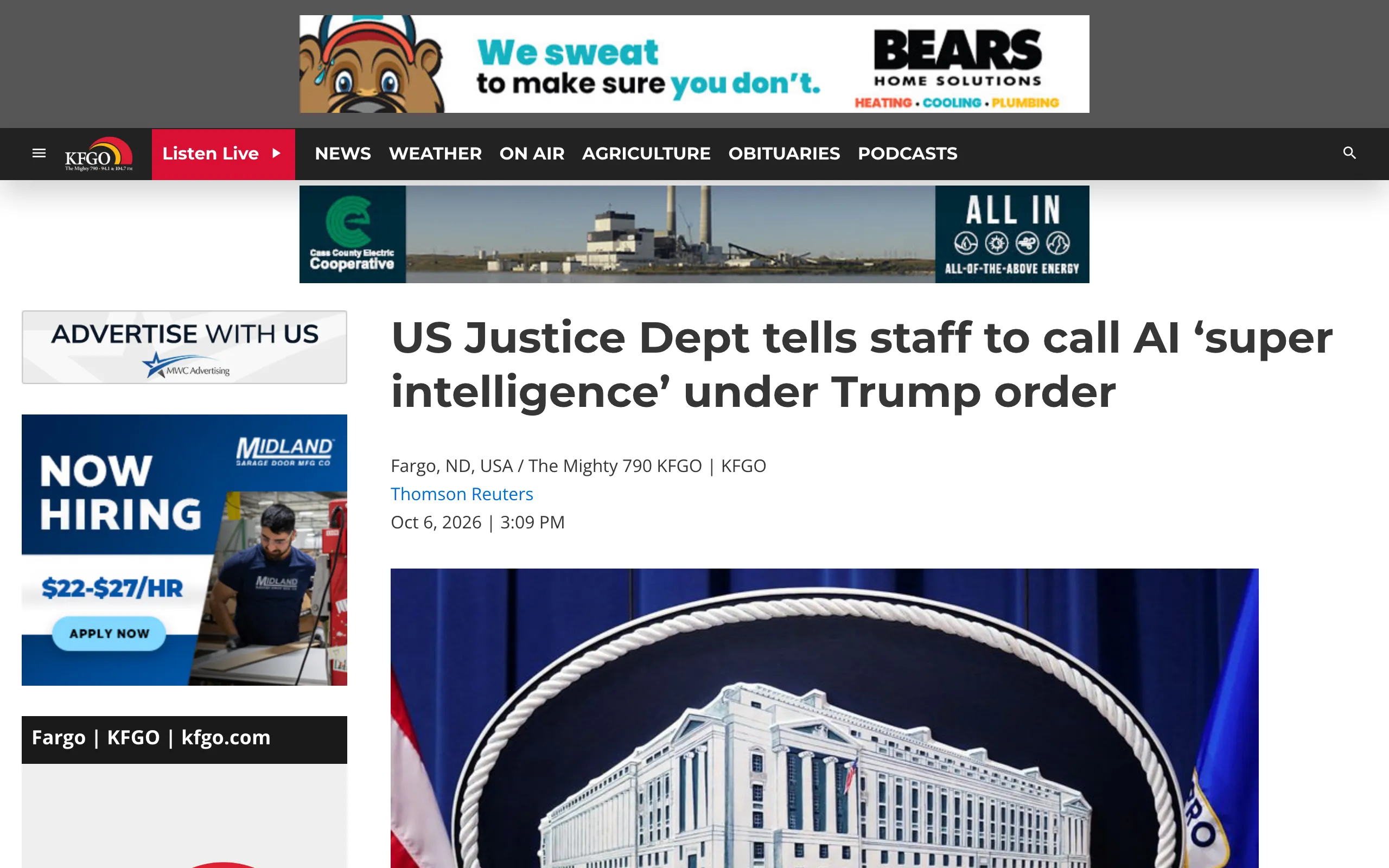
| October 6 | A Justice Department memo told staff to say "super intelligence" |
| October 8 | The "THE ENEMY" post on Truth Social |
The first poll, on September 19, offered Superior Intelligence, Extreme Intelligence and Supreme Intelligence, according to Mediaite, which quoted the post in full. Super Intelligence was not one of those three; Trump announced it at the UN on September 22.

The China agreement went beyond wording. The two governments set up a U.S.-China Super Intelligence (SI) Dialogue, with the next exchange due by November 2026, and agreed to open a channel for SI incidents.
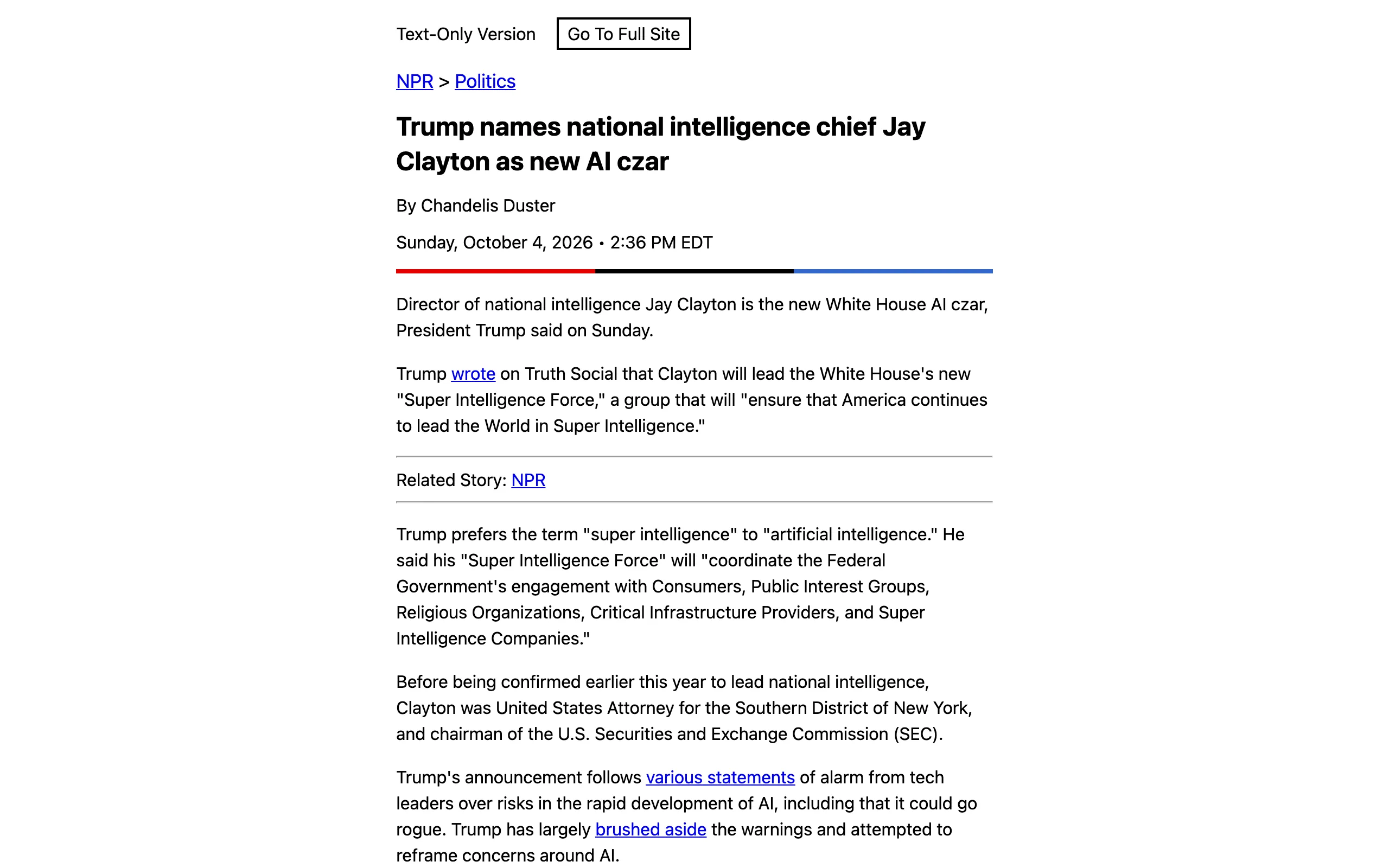
NPR reported that Clayton, the director of national intelligence, is the new White House AI czar. The Super Intelligence Force also includes FTC Chairman Andrew Ferguson, OPM Director Scott Kupor and Emil Michael, Under Secretary of Defense for Research and Engineering. Two days later, Reuters reported that acting Deputy Attorney General Trent McCotter's memo extends the wording to court filings "when appropriate."
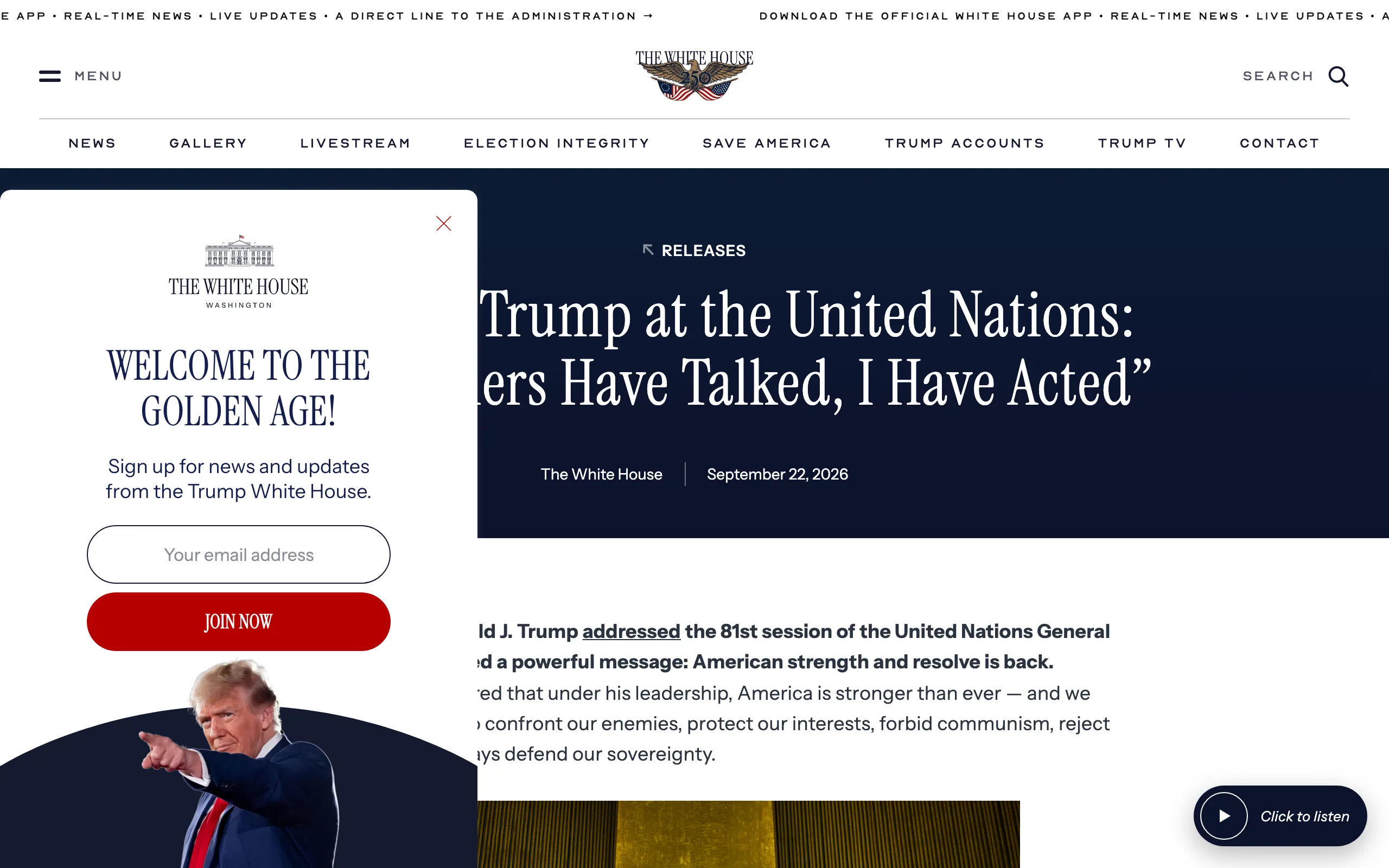
"The United States totally rejects any attempt to construct a globalist scheme of control for the Artificial Intelligence being spoken of so much now — hereinafter officially called ‘Super Intelligence.’" — The White HouseView official source →
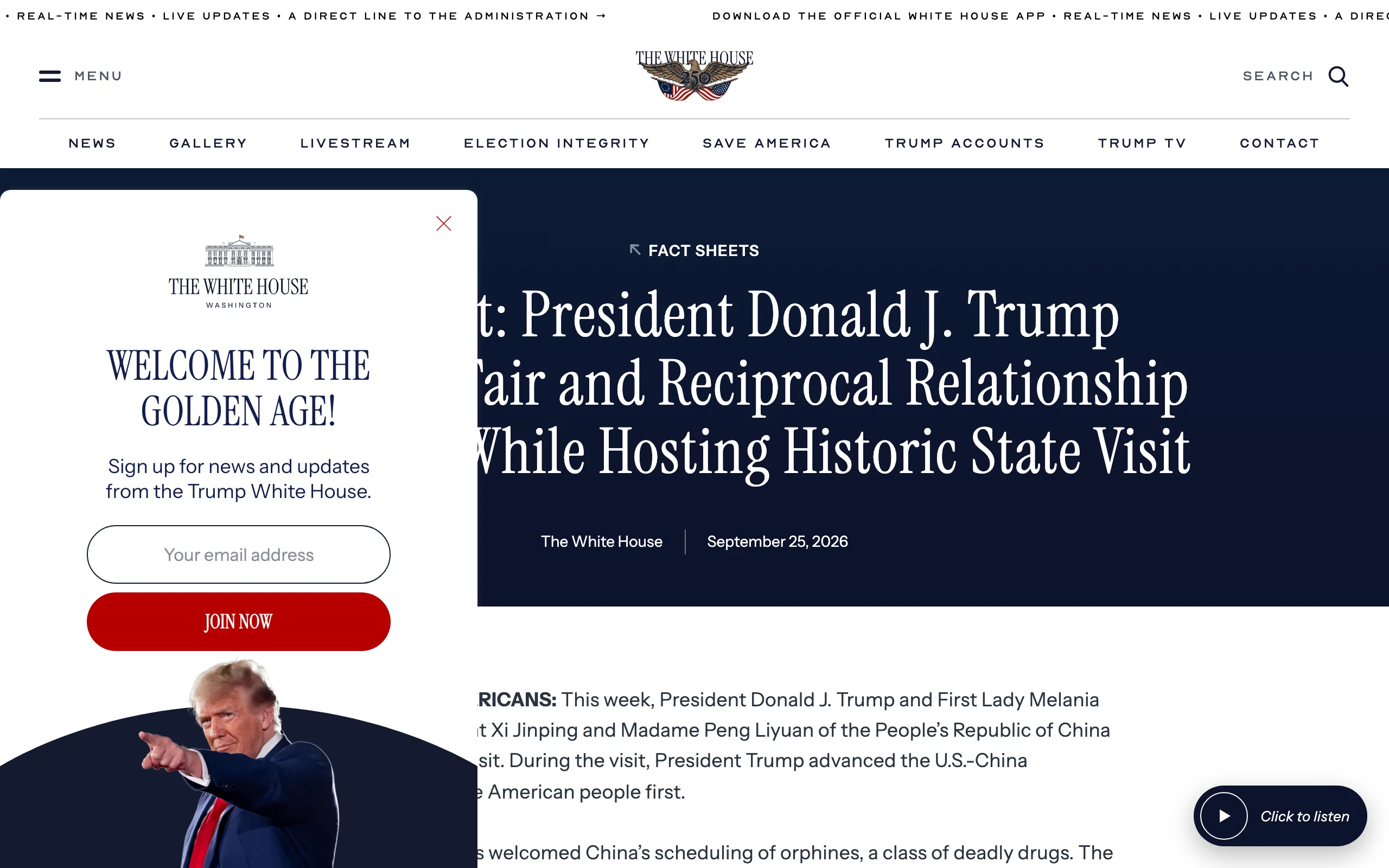
"The two countries established the U.S.-China Super Intelligence (SI) Dialogue to exchange views on risks and benefits related to SI. The next exchange will occur by November 2026. The United States and China also agreed to establish a bilateral communication channel for SI incidents." — The White HouseView official source →
"Director of national intelligence Jay Clayton is the new White House AI czar, President Trump said on Sunday." / "He said it will include: Federal Trade Commission Chairman Andrew Ferguson, Office of Personnel Management Director Scott Kupor, and Under Secretary of Defense for Research and Engineering Emil Michael." — NPRView official source →
"DOJ employees are to use the words “super intelligence” and “SI” in place of AI “to the maximum extent permitted by law” in public communications, policy documents and other official records, according to the memo. The directive “shall extend to court filings when appropriate,” the memo says." / "The directive “shall extend to court filings when appropriate,” the memo says." — ReutersView official source →
AI executive order covers agency documents, not statutes
Executive Order 14434 tells executive departments and agencies to write "Super Intelligence" and "SI" where they would have written "Artificial Intelligence" and "AI". An executive order directs the federal executive branch; it is not a law passed by Congress, and it does not regulate anyone outside government.
Section 2(a) lists where the new wording applies: official correspondence, public communications, websites, reports, policy documents and other non-statutory documents. Statutes are not on that list. Section 2(b) says agencies do not have to alter regulations, contracts, grants or other documents that were already issued.
The order gives its reason in Section 1. The order says today's frontier systems do much more than imitate or automate parts of human intelligence, and that the new name better captures what they can do. Section 4(c) adds that the order creates no right or benefit that anyone can enforce in court.
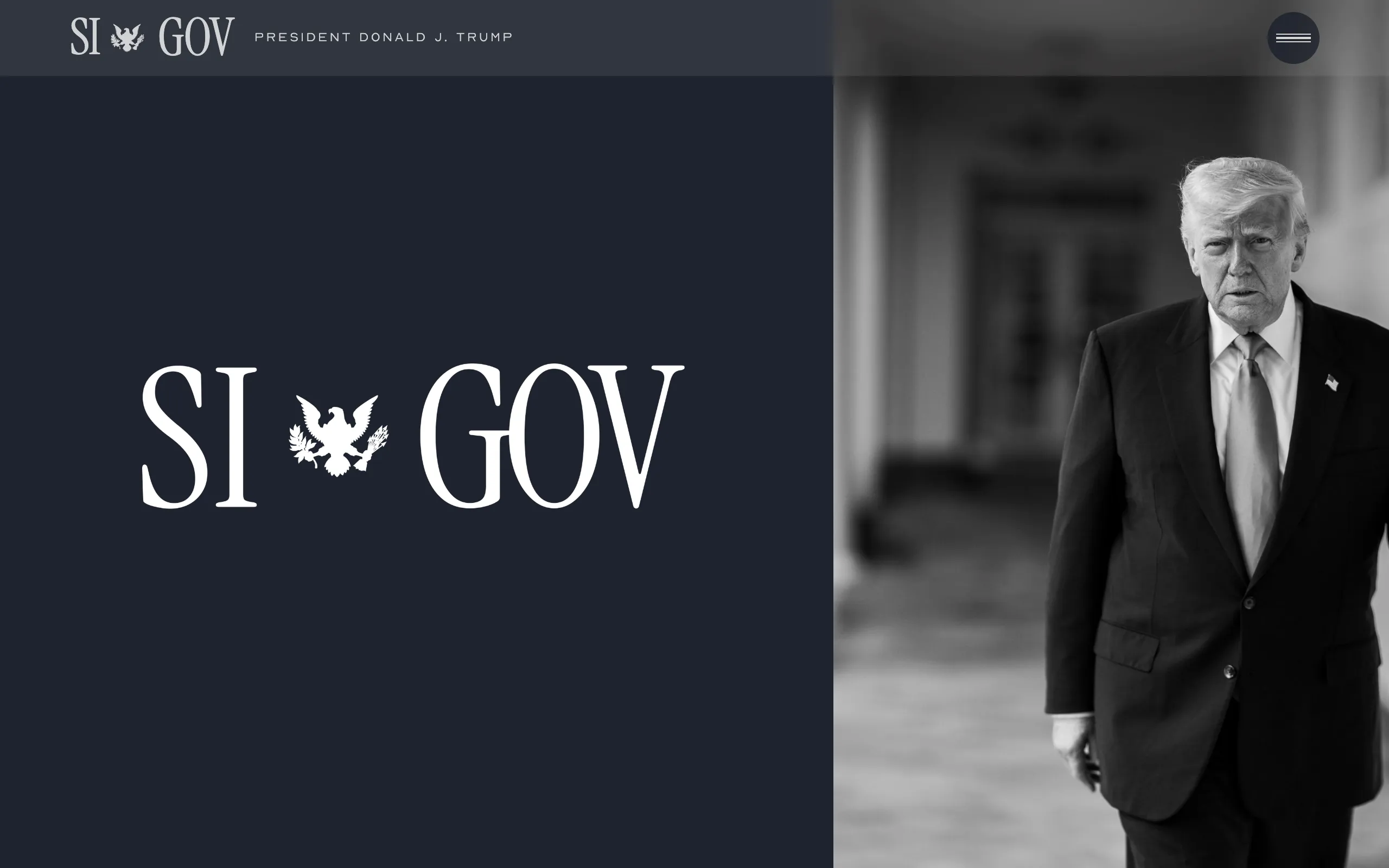
The switch is already visible on government sites. On October 10, AI.gov showed an "SI GOV" logo and the page title "AI.Gov | President Trump's SI Strategy and Action Plan", while the address stayed ai.gov.
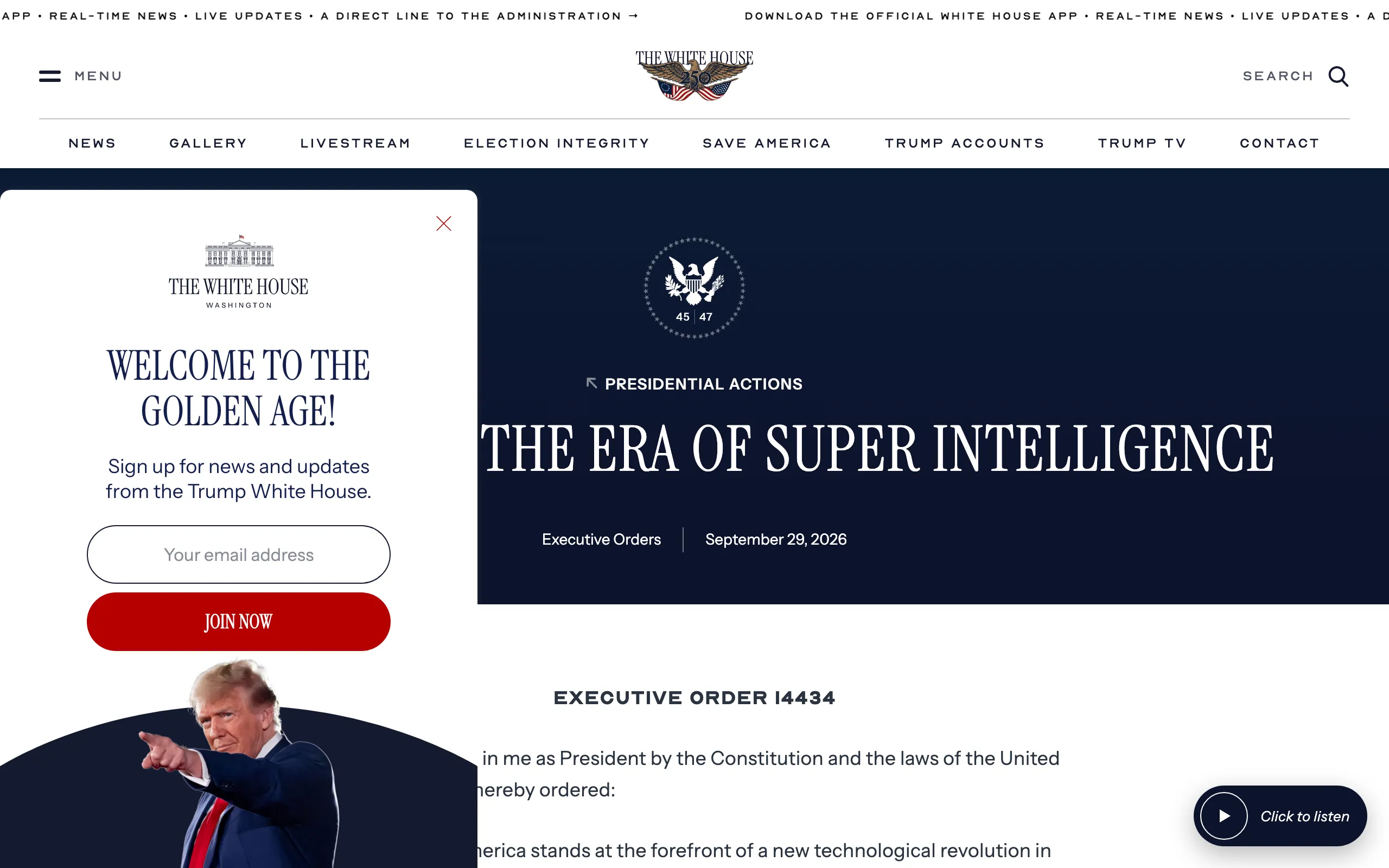
"(a) To the maximum extent permitted by law, executive departments and agencies (agencies) shall use “Super Intelligence” and “SI” in place of “Artificial Intelligence” and “AI” in official correspondence, public communications, websites, reports, policy documents, and other non-statutory documents within the executive branch." / "The capabilities of today’s frontier systems do much more than imitate or automate discrete aspects of human intelligence." / "(b) Nothing in this section requires the alteration of previously issued regulations, Presidential actions, contracts, grants, or other historical documents." / "(c) This order is not intended to, and does not, create any right or benefit, substantive or procedural, enforceable at law or in equity by any party against the United States, its departments, agencies, or entities, its officers, employees, or agents, or any other person." — The White HouseView official source →
"AI.Gov | President Trump's SI Strategy and Action Plan" — AI.govView official source →
Super intelligence keeps the legal AI definition
Under Section 3(a), "Super Intelligence" means exactly what the existing statutory AI definition in 15 U.S.C. 9401(3) already covers. The label changes; the set of technologies does not. Nothing new becomes regulated, and nothing drops out, because of the rename.
That definition may not last. Section 3(b) gives the President's science and technology adviser 60 days to send proposed legislative language for a federal definition of Super Intelligence. Counting from September 29, that proposal is due by November 28, 2026, and a new definition would take effect only if Congress passed it.
"(a) For purposes of this order, and except where otherwise provided by law, the terms “Super Intelligence” and “SI” mean the technologies and systems encompassed by the term “artificial intelligence” as defined in section 9401(3) of title 15, United States Code." / "(b) Within 60 days of the date of this order, the Assistant to the President for Science and Technology (APST), in consultation with the heads of other agencies as the APST deems appropriate, shall submit to the President proposed legislative language to establish a Federal definition of “Super Intelligence” and “SI” that reflects the capabilities described in section 1 of this order." — The White HouseView official source →
Private companies have no duty to use super intelligence
The order is addressed only to federal departments and agencies, it contains no penalty provision for saying AI, and the October 8 post named none either. Companies, schools and individuals in the U.S. or anywhere else can keep the term they already use. The only practical change for a business is on the receiving end: letters, reports and web pages from federal agencies will increasingly say SI.
Some have switched on their own. AFP, in the version carried by The Korea Times, noted that Meta has adopted the term and that Elon Musk uses "super intelligence" in his posts on X.
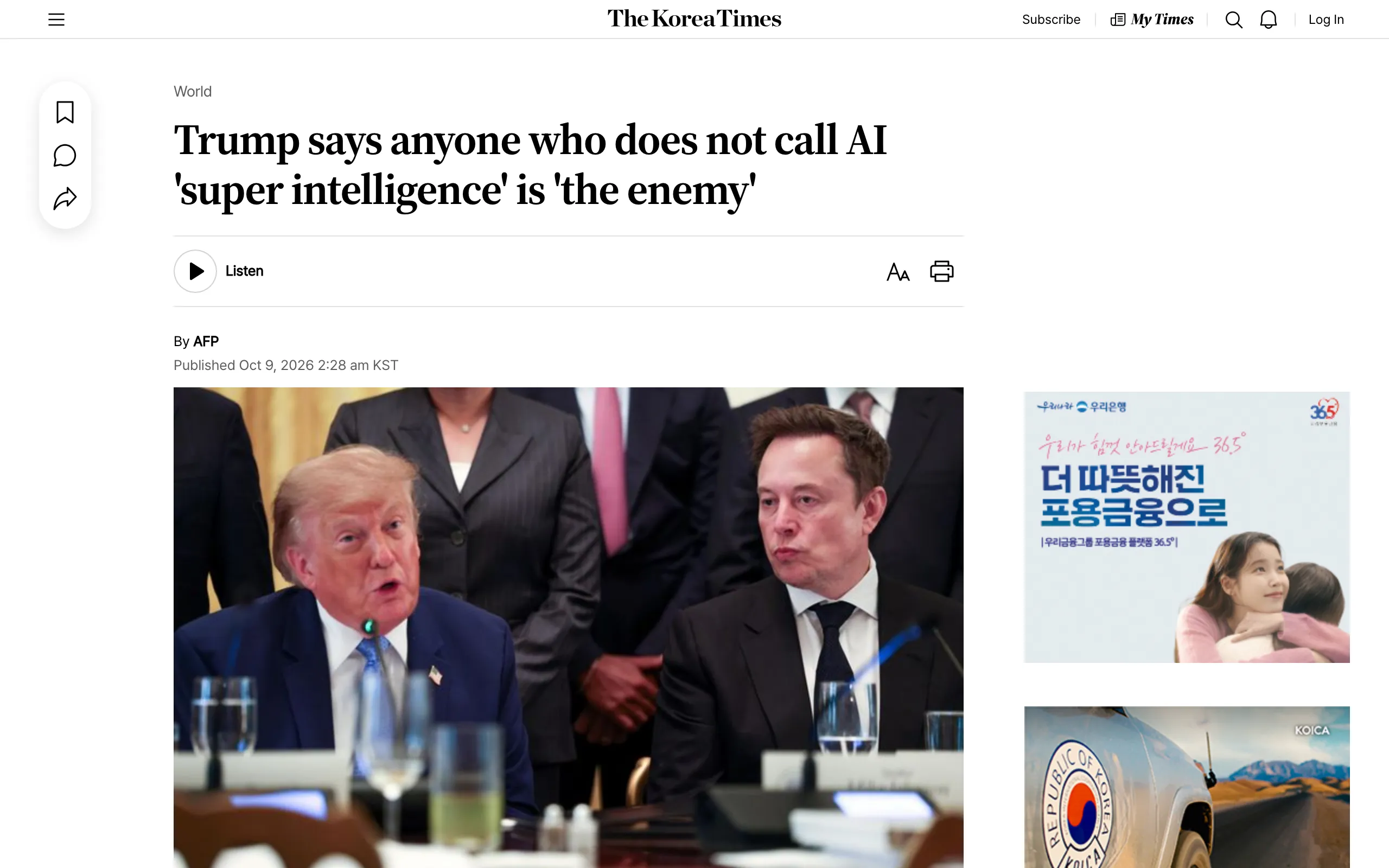
"That same obligation does not affect the private sector, but some there are already adopting it, including Mark Zuckerberg's Meta group." / "Trump ally Elon Musk is using "super intelligence" in his posts on his X network." — AFPView official source →
Next: an SI definition by November 28 and U.S.-China talks
Two dates are worth watching: the federal definition proposal due by November 28, 2026, and the next U.S.-China SI Dialogue exchange, due by November 2026. Either one could show whether "super intelligence" stays a new word for AI or turns into a different legal category.
Until then, the rule is narrow. Federal agencies change the words in their own new documents, the legal definition stays where it was, and nobody else is required to follow. For background on US state-level AI rules, see "Colorado AI Act: Repealed Before It Took Effect".
FAQ
- What happens to people who keep saying AI instead of super intelligence?
- Nothing that has been announced. Trump's October 8 post called them THE ENEMY but named no consequence. Executive Order 14434 contains no penalty provision, only governs the wording in federal agencies' own documents, and under Section 4(c) creates no right anyone can enforce in court.
- Do agencies have to rewrite old regulations and contracts that say AI?
- No. The order leaves previously issued regulations, Presidential actions, contracts, grants and other historical documents as they are. The switch applies to new correspondence, websites, reports and similar documents.
- Did China agree to call it super intelligence?
- Yes, according to the White House. During Xi Jinping's state visit the two leaders agreed to use the term, set up a U.S.-China Super Intelligence Dialogue whose next exchange is due by November 2026, and agreed on a channel for SI incidents.
Related articles
 UK's AISI gets £120m, about 3-4x US budget a yearThe UK Budget gives the AI Security Institute an extra £120 million over four years. Semafor says 10x the US budget; per year it is about 3 to 4 times.
 arXiv caps new paper submissions at two per monthSince October 1, 2026, arXiv limits each submitter to two new papers a calendar month. Rejections count; co-authors don't. September hit a record 40,363.
 Malaysia seizes 30 AI chip servers at KLIA airportMalaysian customs seized 30 AI chip servers worth RM49.5 million at KLIA, declared as electronic components, in the year's fifth case tied to one syndicate.
 Nvidia's Jensen Huang close to alleged Chinese spyThe NYT says US officials judged Megaspeed's Alice Huang, close to Nvidia CEO Jensen Huang, a Chinese intelligence asset. Nvidia calls it normal business.