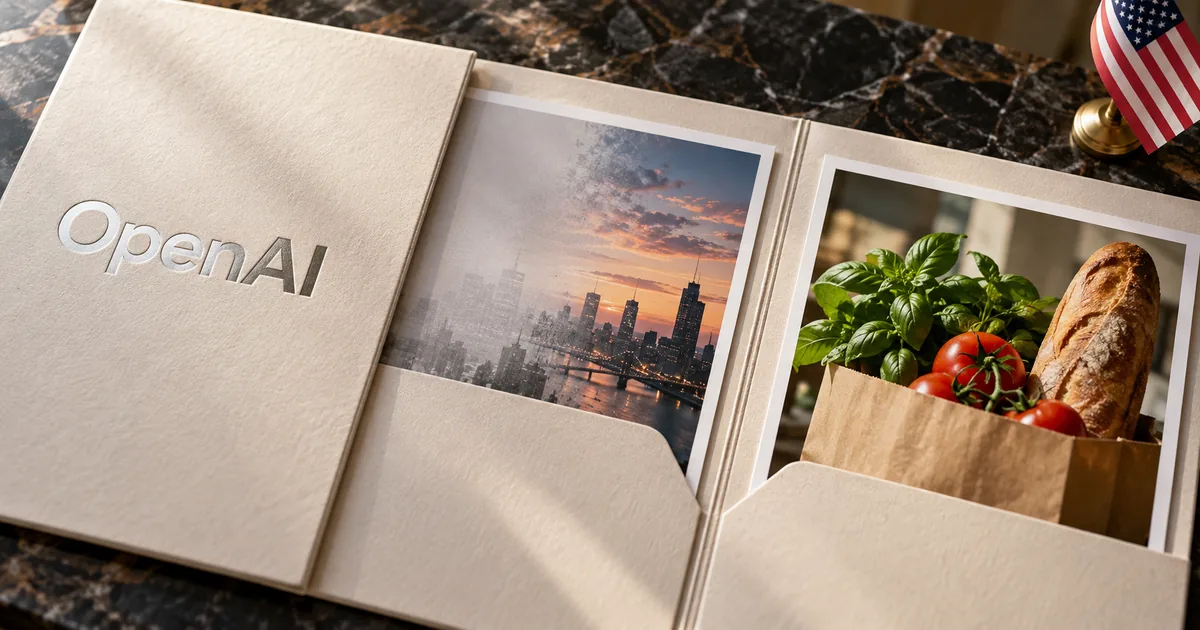
OpenAI tests a visual ad format in ChatGPT image generation
OpenAI is adding an ad format built around pictures, and it will test it first in ChatGPT image generation. The company says ChatGPT reaches 1.2 billion people each week and that ads let it serve far more people than subscriptions alone.
The advertising test starts in the US in late October
Testing starts later in October 2026 in the US with an initial group of advertisers. OpenAI announced the format on October 5, so "later this month" means the second half of October.
The announcement names no other country for this test. Advertisers can sign up at ads.openai.com.
Product ads appear while the image generator works
The first place you will see the new ads is the screen shown while ChatGPT creates an image. You ask for a picture, and while it renders, an ad can sit on the same screen.
The announcement does not name regular text chats as a surface for this format. Ads in regular chats still appear below the end of a response.
Initially, we’ll test this new ad format during image generation in ChatGPT for users on the Free and Go plans. Ads will be clearly labeled, and remain separate from the image being created. As with our other ad formats, advertising does not influence the answers ChatGPT provides. / Testing will begin later this month in the US with an initial group of advertisers. — on where and when the visual format is testedView official source →
Visual ads stay apart from your ChatGPT photo
OpenAI says the ads are clearly labeled and remain separate from the image being created, so a brand will not show up inside your picture. That answers the obvious worry about ads during image generation.
Labels on every ad and privacy for your chat history
Every ad is labeled, and advertisers never see your conversations. OpenAI's Help Center says ads run on systems separate from the chat model, so advertisers cannot change, rank or shape ChatGPT's answers.
Advertisers have no access to your chats, chat history, memories or personal details. They get only aggregated numbers about their own ads, such as total views and clicks.
Advertisers do not have access to your chats, chat history, memories, or personal details. Advertisers only receive aggregated, non-identifying information about how their ads perform, such as total views or clicks. — on what advertisers can and cannot seeView official source →
OpenAI's grocery example shows shopping-style product ads
The pictures in these ads show product ideas, how a product is used, or the experience it makes possible. OpenAI says this helps people discover a brand, see what sets it apart and decide what to buy.
The sample image on OpenAI's announcement page shows a grocery brand called Heirloom Grocery. Below the image-generation progress indicator sits a row of vegetable and meal photos, an "Ad" label and a "Learn more" button.
Who sees ads: ChatGPT Free and Go, not Plus or Pro
The visual ad test covers users on the Free and Go plans, and Plus and Pro accounts do not get ads. Your plan decides whether you see them.
The ChatGPT Go plan is the only paid plan with ads
Go, OpenAI's low-cost tier between Free and Plus, is the one paid plan that shows ads. GPT-5 in ChatGPT: Pricing, Free Tier, Models compares what each tier includes.
OpenAI's Help Center lists Plus, Pro, Business, Enterprise and Edu as ad-free. One detail is easy to miss: the official Japanese edition of the announcement leaves out the plan wording, so only the English original states that this test runs on Free and Go.
Ads may appear for users on the Free and Go plans. Plus, Pro, Business, Enterprise, and Edu accounts will not have ads. — on which plans can see adsView official source →
No ads under age verification or in temporary chat
Even on Free and Go, ChatGPT does not show ads in three situations. Being on an eligible plan is not enough on its own.
- Accounts that OpenAI identifies as belonging to people under 18
- Temporary Chat
- Conversations that touch on personal health, mental health or politics
The October announcement adds that placement guardrails check each conversation and keep ads out of emotionally vulnerable or sensitive contexts. Automated review, human oversight and ongoing monitoring catch policy violations.
We do not show ads to accounts identified as belonging to people under 18. / No. Ads are not eligible to appear near sensitive or regulated topics, including personal health, mental health, or politics. / Temporary Chats will not show ads. — on when ads do not appearView official source →
ChatGPT ads in Japan and the UK keep the regular format
Outside the US, ChatGPT shows the regular ad format, and the visual format has no announced date. The October 5 post only describes the US test.
ChatGPT Ads reached Japan and the UK on August 11
On August 11, 2026, OpenAI updated its ads test post to say ChatGPT Ads had launched in the UK, Mexico, Brazil, Japan and South Korea. The test began in the US on February 9, 2026, and had expanded to Canada, Australia and New Zealand before the August update.
Several reports describe those regular ads as text-only, but they are not. OpenAI's advertiser guide says every ad includes a brand name, logo, title, copy, landing page and a square image.
The new format differs in two ways. It appears during image generation, and it leads with product photos.
Update on August 11, 2026: ChatGPT Ads has now launched in the United Kingdom, Mexico, Brazil, Japan, and South Korea. We’re continuing to expand to more markets this year. — on the August 11, 2026 market launchView official source →
An Ad is the creative unit shown in ChatGPT. It includes your brand name, logo, title, copy, landing page, and image. / Image URL (PNG or JPG, square, no larger than 1200 x 1200, publicly accessible) — on what a regular ChatGPT ad containsView official source →
Two ChatGPT settings remove ads, and one has a message limit
You can remove ads by moving to Plus or Pro, or by switching the Free plan to Ads-Free, which costs nothing but takes features away. The right choice depends on whether you still want to make images.
Upgrade to ChatGPT Plus or Pro
Plus and Pro show no ads, and this is the only ad-free route that keeps image generation. It is also the route for Go users, because Go cannot switch to Ads-Free.
Ads-Free removes deep research and lowers the message limit
Ads-Free removes ads on the Free plan, but you get fewer messages a day and lose tools such as image generation and deep research. If you want to make images, this option does not fit. Ads-Free users would not see the visual ads anyway, because those appear only during image generation.
To switch, follow the steps in OpenAI's Help Center. The menu names below are the ones it uses.
- Open Settings in ChatGPT
- Select Ads controls
- Tap Change plan to go ad-free
- Choose Reduce message limits
- Confirm the change
This removes ads, but comes with lower usage limits and reduced feature access (for example, fewer messages and no access to some tools like image generation or deep research). — on what Ads-Free takes awayView official source →
Turning off personalization in settings keeps ads on
Turning off ad personalization does not remove ads. It changes how ads are picked.
With personalization off, ChatGPT stops using your other chats, ad history and topics to choose ads. You still see ads based on the chat you have open.
Brand safety and measurement for ChatGPT advertising
The other half of the announcement is for advertisers: more ways to measure results and more controls over where ads appear. It does not change your screen, but it shapes which ads you get and where they do not appear.
Ten attribution partners and conversion API support
OpenAI now works with ten attribution partners that tie ad clicks to sales using the Conversions API, reporting and click attribution. It also named partners for sending conversion data and for testing incrementality.
| Purpose | Partners |
|---|---|
| Sending conversion data | Hightouch, Tealium, LiveRamp |
| Attribution | AppsFlyer, Triple Whale, Adjust, DV Rockerbox, Northbeam, Branch, Singular, Kochava, Airbridge, Tenjin |
| Full-funnel measurement | Fospha, Measured, INCRMNTAL |
| Geo-based incrementality experiments (early stage) | Haus, Measured, WorkMagic |
Incrementality means the extra sales an ad causes compared with no ad. OpenAI also shared early numbers that its partners reported:
- DV Rockerbox: WeightWatchers paid 15.3% less per customer acquired through ChatGPT Ads than its average across paid search channels
- WorkMagic: 67% of Dose's incremental purchases came from net-new customers
- Triple Whale: 93% of Portland Leather's visitors from ChatGPT Ads were new
These are results for single advertisers, not averages across ChatGPT Ads. Each partner measured its own client with its own method.
According to DV Rockerbox, WeightWatchers’ attributed cost per acquisition on ChatGPT Ads was 15.3% lower than its blended paid-search benchmark. WorkMagic reported statistically significant lift for wellness brand Dose, with 67% of incremental purchases coming from net-new customers. And according to Triple Whale, 93% of Portland Leather’s visitors from ChatGPT Ads were new. — on early partner findingsView official source →
DoubleVerify and Integral Ad Science test brand suitability
OpenAI is building brand suitability pilots with DoubleVerify and Integral Ad Science that never give them access to private conversations. The partners assess how OpenAI applies its brand safety standards in a controlled test environment.
Qualifying advertisers can also use Negative Phrases to keep their ads out of contexts that clash with their own policies. This is a control on the advertiser side, separate from OpenAI's own guardrails.
This approach allows independent partners to assess how our brand safety standards are applied in a controlled testing environment, without accessing private user conversations. — on the DoubleVerify and IAS pilotsView official source →
Shopping ads start in the US, and chat privacy stays intact
Visual ads start in US image generation for Free and Go users in late October, and they stay apart from the images you make. Other markets keep regular ads for now.
If you generate images often and do not want ads, Plus or Pro is the practical choice. Ads-Free takes away image generation, so it does not suit that use.
FAQ
- When do ChatGPT visual ads start?
- OpenAI will start testing them later in October 2026 in the US with an initial group of advertisers. The first place they appear is the screen you see while ChatGPT generates an image.
- Will ChatGPT Go show ads?
- Yes. Ads can appear on the Free and Go plans, and Go is the only paid plan that shows them. Go users also cannot pick the free Ads-Free option, so they need to move to Plus or Pro or back to Free.
- Does turning off ad personalization remove ads?
- No. It only changes how ads are picked. ChatGPT stops using your other chats and ad history, but it still shows ads based on the chat you have open.
- Are regular ChatGPT ads text-only?
- No. OpenAI's advertiser guide says each ad includes a brand name, logo, title, copy, landing page and a square image. The new format differs in where it appears and in putting product photos first.
Related articles
 ChatGPT ads add 26 countries, reaching 89 in totalOpenAI added 26 countries to ChatGPT Ads on October 21, for 89 in total, as advertisers topped 100,000. Ads show only on the Free and Go plans.
 OpenAI, ServiceNow expand deal with ChatGPT pluginOpenAI and ServiceNow expanded their deal on Oct 28, 2026. A ServiceNow MCP plugin for ChatGPT is live now; Codex, security and voice tools follow in 2027.
 ChatGPT and Codex usage limits merge in DecemberFrom December, Plus, Pro and Business plans will share one token-based allowance across ChatGPT and Codex. Instant chat won't count, and no start date is set.
 ChatGPT now works with iCloud Mail and CalendarOpenAI added iCloud Mail and Calendar plugins to ChatGPT on Oct 27 for all plans. You connect with an Apple app-specific password that outlives a disconnect.