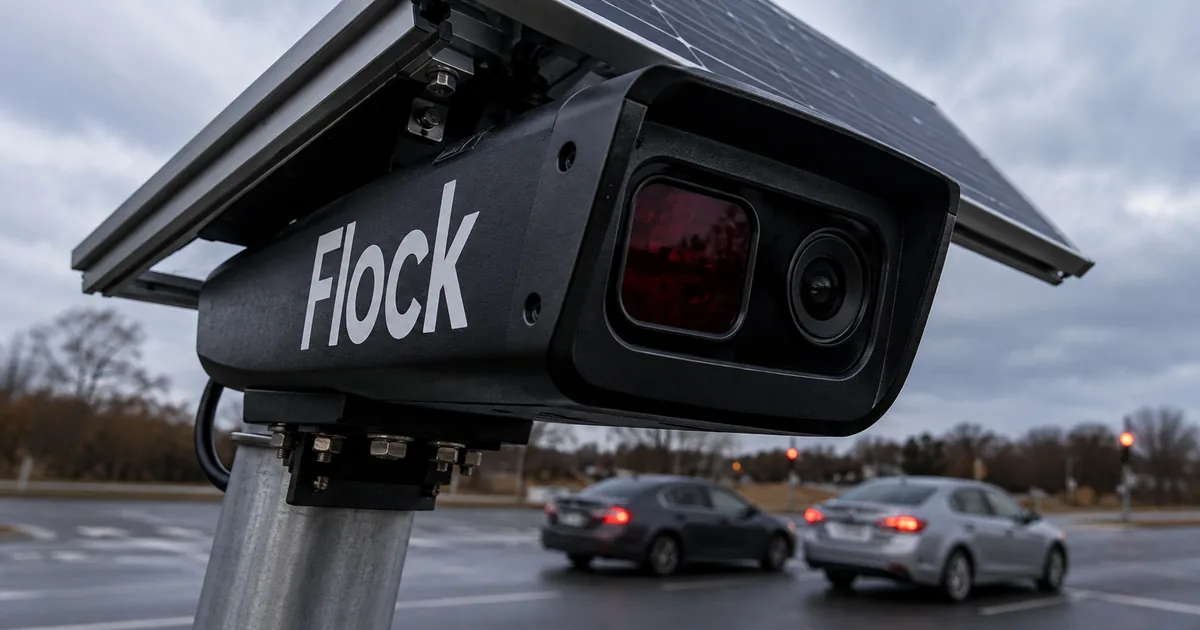
License plate reader warrant: what EFF is asking for
EFF, the Electronic Frontier Foundation, wrote about Flock Safety in August 2026. EFF's stated target is the search of stored license plate reader data for a specific vehicle. The table sets out the ask and the one related claim EFF reports about Flock's CEO.
EFF's ask and Flock's CEO position
A judge-signed warrant for historic ALPR data
ALPR is short for automated license plate reader. The data in question is the record of plates those cameras have already read.
EFF says police, at a minimum, need a warrant signed by a judge to search that historic data about specific vehicles. EFF calls this common sense. It likens such a search to police going back in time to retroactively follow someone's comings and goings.
"To be clear, our position has long been that police, at a minimum, need to get a warrant, signed by a judge, in order to search for historic ALPR data regarding specific vehicles. For us, it's common sense: if police want to dip into historic ALPR data like they were going back in time to retroactively follow your comings and goings, they need a warrant."(EFF Deeplinks)View official source →
Flock's CEO and the active case number
EFF reports that Flock's CEO has come to agree with groups such as the American Civil Liberties Union and EFF that police should need an active case number to search Flock's data. A case number is not a warrant. EFF's account of the CEO's position does not mention a judge.
"He added that he has come to agree with groups like the American Civil Liberties Union and the Electronic Frontier Foundation that police should need an active case number to search Flock's data."(EFF Deeplinks・on Flock's CEO)View official source →
What Flock changed: retention, filtering and audits
EFF describes Flock Safety as the embattled vendor of mass surveillance technology. It says Flock rolled out a handful of reforms after nationwide anger that has seen scores of towns cancel or suspend their ALPR contracts with the company.
EFF names three of the reforms: retention, offense filtering and audit lockouts. None of the three is a warrant requirement.
The three reforms EFF names
Flock data retention drops from 30 days to 7
Retention is the period for which Flock's system keeps plate reads. EFF calls the change to retention the most consequential of the reforms.
Flock's default setting is an optional 7-day retention period for ALPR data, down from an original default of an optional 30-day period. To keep data past the retention setting, police must use Evidence Mode. In EFF's description, that means the data is tied to an active investigation rather than a fishing expedition.
"The most consequential is Flock's default setting of an optional 7-day retention period for ALPR data, down from its original default optional 30-day retention period. This means if police want to retain data beyond the duration of their retention setting, they need to access "Evidence Mode," i.e., when the desired data is associated with an active investigation and not just a fishing expedition."(EFF Deeplinks)View official source →
Offense filtering and audit lockouts for officers
Offense filtering lets a city give other departments access to its ALPR data only when they are investigating certain crimes. EFF's example is murder or robbery, but not immigration-related investigations.
The other reform, EFF says, is supposedly a stronger audit feature that proactively locks out officers who file suspicious requests for data. EFF's objection is that these audit and transparency tools address a problem Flock created: an abusable mass surveillance system that tracks all cars all the time.
"Flock Safety, the embattled vendor of mass surveillance technology, has rolled out a handful of new reforms intended to appease the justified nationwide anger that has seen scores of towns cancel or suspend their contracts with the company for automated license plate readers (ALPRs)."/"The first is offense filtering so that cities can enable other departments to access their ALPR data only if they are investigating certain crimes, e.g., murder or robbery but not immigration-related investigations."/"The second is supposedly beefing up their audit feature and proactively locking out officers who file suspicious requests for data."/"The major problem here is the fact that Flock's enhanced audit and transparency tools help to address a problem that Flock itself has created—an abusable mass surveillance system that tracks all cars all the time."(EFF Deeplinks)View official source →
Why EFF says a vendor cannot settle the question
EFF's fundamental objection is about who sets the rules, not about any one setting. EFF's post is titled "Too Little, Too Late: Flock Admits Their Technology Needs Reforms." The two points that follow are EFF's reasoning.
EFF asks what stops Flock from reversing course
EFF poses the question directly: what stops Flock from reversing these reforms if its law enforcement customers defect to another ALPR vendor? Its answer is one word: nothing.
EFF adds a principle. In its view, the decision on how long police can collect and retain data on millions, if not hundreds of millions, of innocent people should not rest with Flock or any other ALPR vendor.
"Fundamentally, these reforms leave us wondering: what is stopping Flock from reversing course on them if their law enforcement customers respond by defecting to another ALPR vendor? Nothing."/"It shouldn't be up to Flock or any other ALPR vendor to decide how long police can collect and retain data on millions, if not hundreds of millions, of innocent people."(EFF Deeplinks)View official source →
EFF's call for laws that restrict police use
EFF's remedy is legislative: lawmakers need to pass laws that restrict police use of surveillance technology. In EFF's words, the surveillance business model is the problem, and the company-imposed reforms are slapdash.
Two other laws have their own write-ups: Colorado AI Act: Repealed Before It Took Effect and EU AI Act 2026: What Applies in August, What Waits. The quotes above come from EFF's post.
"We need lawmakers to step up and pass laws that restrict police's use of surveillance technology. After all, the surveillance business model is the problem, and a few company-imposed slapdash reforms aren't going to change that."(EFF Deeplinks)View official source →
FAQ
- Does EFF say police need a warrant to search license plate reader data?
- Yes. EFF's position is that police, at a minimum, need a warrant signed by a judge to search historic license plate reader (ALPR) data about specific vehicles. EFF calls this common sense. None of the three Flock reforms EFF names is a warrant requirement.
- What did Flock change?
- EFF calls the retention change the most consequential. The optional default dropped from 30 days to 7, and keeping data longer requires Evidence Mode, which ties the data to an active investigation. EFF also names offense filtering, which lets a city limit other departments' access to certain crimes, and a supposedly stronger audit feature that locks out officers who file suspicious requests.
- Is an active case number the same as a warrant?
- No. A case number is not a warrant. EFF reports that Flock's CEO has come to agree that police should need an active case number to search Flock's data. EFF's account of the CEO's position does not mention a judge.
- Why does EFF say a vendor policy is not enough?
- EFF asks what stops Flock from reversing the reforms if police departments move to another ALPR vendor, and answers that nothing does. It says lawmakers need to pass laws that restrict police use of surveillance technology.
Related articles
 Gmail, Photos linked to AI Mode can now shape adsGoogle's October 16 privacy policy lets Gmail and Photos data shape ads for people who connect them to AI Mode. Google says inboxes won't drive ads directly.
 Meta Muse Keeps Hourly Profiles of People You KnowExtracted system prompts show Meta Muse keeps an hourly page on your family, friends and coworkers. What the pages hold, Meta's reply, and how to delete them.
 Google Spirit Airlines Data: A $10M Auction WinGoogle bid $10 million for Spirit Airlines’ emails and chats at a bankruptcy auction. See what the data includes, how identities are handled and who objected.
 Google HEIR: A Homomorphic Encryption CompilerGoogle HEIR is an open-source compiler that turns annotated Python and pre-trained AI models into encrypted programs. See its targets, demos and cost.