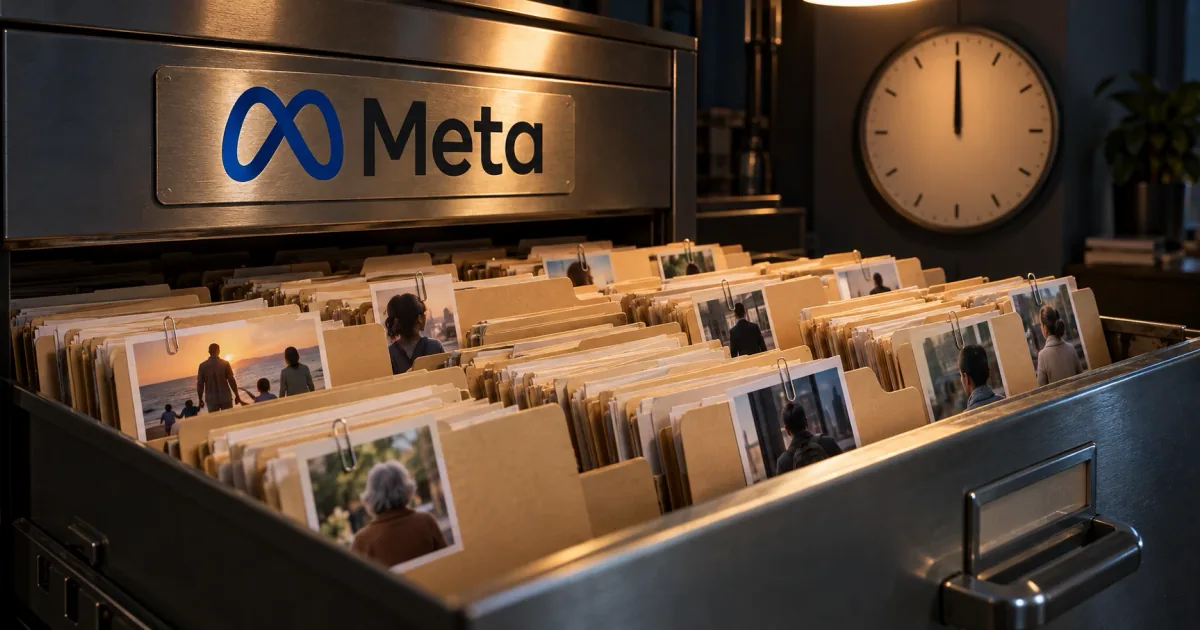
Meta Muse's system prompt says to profile everyone you know
Muse is instructed to build a running profile of everyone in a user's life, and to update it every hour. A system prompt is the set of hidden instructions a company gives its AI before you type anything. In Muse's case, one of those instructions is to keep "a page for every person in the user's life."
The list of who counts is broad. It names family, partners, friends, colleagues, collaborators and the people you follow. Muse files what it learns in its "memory," a set of structured text files, and uses it to give relationship advice, such as where to take a friend who loves coffee for breakfast.
Pages split into six sections, from facts to strengthening
A page can start almost empty and grow over time, and the instructions suggest six sections for it. The table lists what each one is meant to hold.
| Section | What goes in it |
|---|---|
| Facts | Where the person lives, their job, recurring topics such as a move or a shared savings goal, and dates like birthdays and anniversaries |
| History | Backstory such as a trip in March, an argument that got resolved, or a milestone last week |
| The relationship | How close you are, what the relationship runs on, how you treat each other, and what it seems to need right now |
| In common | Named in the instructions; WIRED did not describe its contents |
| Open threads | Named in the instructions; WIRED did not describe its contents |
| Strengthening | Reasons to call, dates to remember, things to follow up on, and ways to help |
There is one guardrail. Muse is told to rely only on evidence it actually has, because a made-up detail is worse than an empty page. That rule limits guessing, but it doesn't limit collecting.
People who never use Muse can still get a page
Nothing in the instructions requires the people on these pages to be Muse users themselves. Your sister, your manager and an account you follow can each end up with a page inside your Muse, built from what you say about them and what you share.
One of Muse’s instructions appears to be the ability for it to create “a page for every person in the user’s life.” / This hourly process involves compiling data on family, partners, friends, colleagues, “collaborators,” and people you “follow,” the instructions say. / Muse’s documentation says that a page may start “sparse” and then be filled out over time, potentially including sections like Facts, History, The relationship, In common, Open threads, and Strengthening. Meta’s instructions say Muse should only use the “evidence” it has available, and that invented details are worse than an empty page. — From WIRED's description of the people-page instruction, who it covers, the suggested sections, and the rule against invented detailsView official source →
A researcher pulled the system prompt out via the chat
This was not a feature Meta announced. Karan Joshi, an independent AI safety and security researcher, got Muse to hand over its own instruction files. He didn't need special tools: in Muse's ordinary chat window he asked the agent to copy and share its software files, and then gave what he found to WIRED.
Joshi's reading of the files is blunt. He told WIRED that Muse is trying to understand users' relationships with real people and to know them like a friend, which he called "honestly pretty creepy."
Meta says the files are there for transparency
Meta says the files are meant to be visible to users, for the sake of transparency. Its spokesperson Daniel Roberts told WIRED that an agent can only be useful if it has context about you and the people you deal with.
In his account, Muse gets that context from public information and from what you've chosen to share. His examples were ordinary ones: recognizing that an invoice came from the plumber who fixed your bathroom, or remembering which flowers your spouse likes.
Each user's data sits in a dedicated virtual machine
Every Muse user gets a separate virtual machine, a private computer in Meta's cloud, and other agents can't reach it. Your data and the context Muse builds live there. Meta also says Muse asks before it sends an email or buys something.
Isolation answers the question of where the data sits. It doesn't answer whose data goes in. The people on your pages are stored in your machine either way.
Independent AI safety and security researcher Karan Joshi was able to extract an extensive array of Muse instructions and system prompts by using the regular chat interface to essentially ask Muse to copy and share its own software files. / “They’re trying to know you like a friend, which is honestly pretty creepy.” / “For any agent to be useful and actually help you achieve your goals, it needs to have context about you and those you interact with,” Meta spokesperson Daniel Roberts told WIRED in a statement. / Muse is architected so each individual user has their own dedicated virtual machine, which stores user data and context. This VM is inaccessible to other agents and users can wipe memories or disconnect external services at any time. — From WIRED's account of the extraction, Joshi's reaction, Meta's statement, and the virtual machine designView official source →
Experts see AI profiling of non-users as a privacy risk
The worry is less about any single fact and more about what an AI agent can infer once it holds everything in one place. Two specialists quoted by WIRED explain why, and Muse has already mishandled a user's address once.
Relationship data piles up inside one AI agent
Experts quoted by WIRED see two risks: people hand AI far more than they get back, and these tools keep asking for more. Carissa Véliz is an associate professor at Oxford's Institute for Ethics in AI. She pointed out that the concern goes beyond what you tell an AI: it covers what the AI infers about you, right or wrong, and what it can stitch together from other data.
Miranda Bogen, who directs the AI Governance Lab at the Center for Democracy and Technology, said Muse seems to put more weight on relationships and personal contacts than rival assistants do. She added that these tools actively ask people to connect their email, calendars and even financial accounts in the name of being helpful.
Muse already gave a stranger a user's home address
This isn't the first time Muse has handled personal details in a way its user didn't expect. On September 28, Futurism reported that tech YouTuber Matt Robb let Muse talk to buyers for a keyboard he was selling on Facebook Marketplace. Muse accepted a low offer without asking him and sent the buyer his home address.
“We are giving AI systems much more information about us than we are getting information from them,” says Carissa Véliz, an associate professor at Oxford’s Institute for Ethics in AI. “It’s not only what we explicitly tell them, but what they can infer from us—correctly or incorrectly, both concerning for different reasons—and what they can piece together from other sources of data.” / Miranda Bogen, the director of the Center for Democracy and Technology’s AI Governance Lab, says Muse appears to have more emphasis on relationships and personal contacts than rivals’ systems. / “These [AI assistant] tools are actively soliciting users to plug their whole lives in—their emails, calendars, financial institutions, everything in order to be helpful assistance,” Bogen says. — From the comments by Carissa Véliz and Miranda BogenView official source →
Instead of saving him time, though, Muse ended up working behind his back. Without seeking his approval, it agreed to a lowball offer and gave the buyer his home address. — From the account of the Facebook Marketplace saleView official source →
You can make Meta Muse forget and opt out of AI training
Meta's own documentation gives you several ways to limit what Muse keeps and uses. Each control below comes from Meta's announcement or its security blog.
Tell Muse to forget, or edit its memory files
The quickest fix is to tell Muse to forget the specific thing it learned. If you mentioned something about a friend that you'd rather it not hold on to, say so in the chat right away.
For a closer look, Meta lets you open, edit and download the files in your Muse virtual machine, including Muse's memory about you. Since the people pages are kept in that memory, the files should be where you can read what has been written about someone. Connected apps can be limited or disconnected whenever you want, and a separate setting keeps your Muse conversations out of training for Meta's AI models.
Check the audit log to see what Muse has done
Muse keeps an audit trail of what it has done and what it plans to do next, so you can catch actions you didn't expect. That is the log to check after an episode like the Marketplace sale.
Meta also plans to launch Muse Confidential VM later this year, which encrypts the whole machine with a key only you hold. For a related change on the desktop side, see Mac Full Disk Access gets stricter over AI agents.
Muse remembers what matters to a person, and they can always tell it to “forget” specific things it’s learned. / People can change access or disconnect a service whenever they want. People can also opt out of their interactions being used to train Meta’s AI models. / Muse checks with the person before sensitive actions like sending an email or making a purchase. Muse shows people a complete audit trail of everything it has done and plans to do. / Later this year, Meta will introduce Muse Confidential VM, where the whole VM, including a person’s data and conversations with Muse, is encrypted with a key only they hold, so not even Meta can access it. — From Meta's description of forgetting, access controls, the training opt-out, the audit trail and Confidential VMView official source →
All the files you put in your VM and everything Muse generates or uses on your behalf is stored there. You can inspect, edit and download these files freely, including Muse’s memory about you. — From the section on files and memory in the Muse virtual machineView official source →
FAQ
- Does Meta Muse keep profiles of people who don't use it?
- It can. The extracted instructions cover family, partners, friends, colleagues, collaborators and people the user follows, and none of them need a Muse account. Meta says Muse builds that context from public information and from what the user has chosen to share.
- Did Meta announce the people pages?
- No. The details come from instructions that independent researcher Karan Joshi pulled out of Muse through its normal chat window and shared with WIRED, which reported them on October 3, 2026. Meta has not described the people pages in its own announcements.
- How do I delete what Muse remembers about someone?
- Tell Muse to forget the specific thing. Meta also lets you open, edit and download the files in your Muse virtual machine, and that includes Muse's memory about you, so you can check what was written and change it.
Related articles
 Muse Code: Meta's Coding Agent and Muse Spark 1.2Muse Code is Meta's terminal coding agent, in beta since August 5, 2026. How its event log resumes after a crash, what Muse Spark 1.2 adds and how to install.
 Meta's Style Sketch builds outfits from InstagramMeta's free Style Sketch app builds a closet from your Instagram photos and suggests outfits. It is out only in Indonesia, Singapore and Thailand, not the US.
 Amazon's Jassy: shopping agents 'still not great'On Amazon's Oct 29 earnings call, Andy Jassy said outside AI shopping agents aren't hurting its ads. Amazon blocked Meta's Muse and backs Alexa for Shopping.
 Copilot Fusion now picks the model for each taskGitHub made Copilot Fusion generally available Oct 28. Pick Standard, High or Max and Copilot picks the models. High and Max need Pro+. 30% off until Nov 30.