What is Google Deep Review?
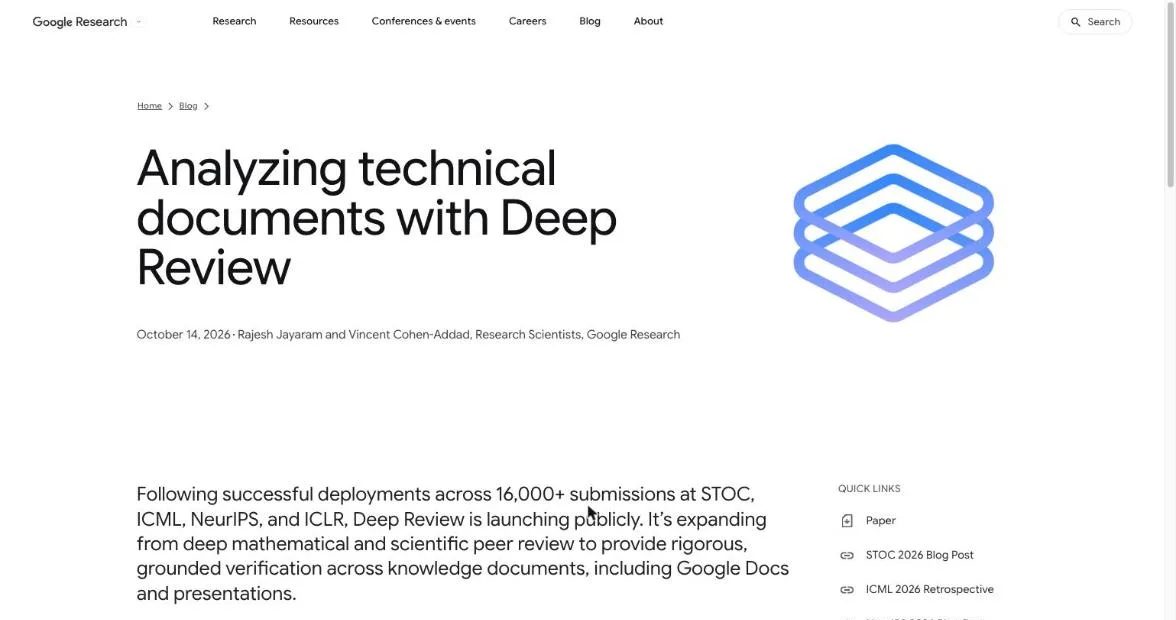
Google Deep Review is a free AI tool from Google Research that reads a paper or technical document and points out logic gaps, math errors and claims without evidence. It opened to the public on October 14, 2026, and anyone with a Google account can use it. Behind it are several AI agents (AI systems that plan steps and work toward a goal on their own), each taking one part of the document.
Google Research built it with Google DeepMind and Google Cloud. It started as a tool for computer science papers and now also handles legal and financial documents. Google pitches it both for drafting, where you revise and run it again, and for review, where you need to test someone else's claims.
It is not a grammar checker or a plagiarism detector. Deep Review looks at whether the argument and the math hold up, not at spelling or originality.
It grew out of the Paper Assistant Tool
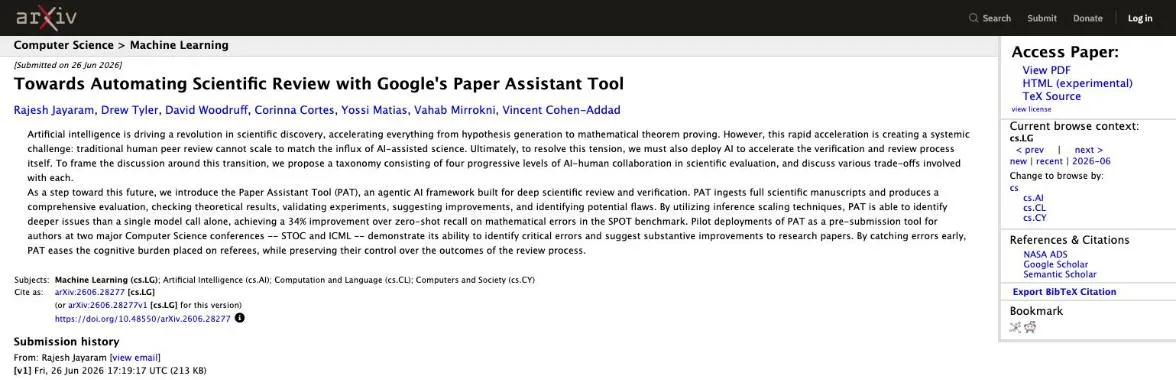
Deep Review is the public version of the Paper Assistant Tool (PAT), an experiment to stress-test manuscripts before they reach a conference. The pilots ran during the last year at STOC 2026, ICML 2026, NeurIPS 2026 and ICLR 2027, four flagship venues in the field.
Authors who opted in got private feedback before the submission deadline, and more than 16,000 manuscripts went through it. The feedback had no link to the official review process. Google says PAT kept no data for training and deleted each paper once its program ended.
"Over the past year, we partnered with four flagship computer science conferences (STOC 2026, ICML 2026, NeurIPS 2026, and ICLR 2027) to provide private, pre-submission feedback to authors of more than 16,000 manuscripts who opted in."/"PAT did not collect any of the data for training, and papers were deleted from Google systems promptly after each program concluded."— Google Research blogView official source →
AI conference submissions roughly tripled in three years
Submissions to ICLR, NeurIPS and ICML combined
2026 is more than 74,000. Source: Google Research blog.
ICLR, NeurIPS and ICML together received about 23,000 submissions in 2023 and more than 74,000 in 2026, roughly three times as many in three years. Google gives this growth as the reason it built Deep Review.
The pool of qualified reviewers has not grown at that pace. The PAT paper notes that checking dense proofs line by line can take a human reviewer days. arXiv has already started limiting how many new computer science papers one person can post (see arXiv caps new paper submissions at two per month), which shows how hard the volume has become to manage.
"74,000 submissions to three major AI conferences ( ICLR , NeurIPS , and ICML ) up from approximately 45,000 in 2025, 32,000 in 2024, and 23,000 in 2023."— Google Research blogView official source →
"In technical fields such as mathematics and theoretical computer science (TCS), comprehensive review requires line-by-line verification of dense proofs, which can take a human reviewer days to accomplish."(1 Introduction)— PAT paperView official source →
What Deep Review checks in a paper
Deep Review checks four things: whether the logic holds together, whether the math is correct, whether facts have support, and how the work compares with earlier research. For each problem it finds, it also suggests a fix.
Google frames it as taking on the most tiring parts of review while leaving the big calls to people. Whether a paper is novel or worth accepting is still a human decision.
Logic, math, evidence and prior work
The output goes beyond a list of mistakes and includes suggested rewrites and a comparison with related work. To find that related work, Deep Review may search the web. Google says the document itself stays private while it does so.
For a theory paper, that means flagging a step in a proof that does not follow, or a lemma that quietly depends on an assumption stated nowhere. For an empirical paper, it means asking whether the results actually back the claim in the abstract.
"By providing detailed, objective evaluations of documents, Deep Review checks logical consistency and mathematical statements, suggests improvements, grounds facts, and compares with existing work. It addresses some of the most cognitively burdensome facets of review, while leaving higher-level judgements to humans."— Google Research blogView official source →
"Deep Review reads your document to produce its review and may perform web searches to find related work, but your document remains private."(What happens to my document when I upload it to Deep Review?)— Deep Review pageView official source →
Design docs, slides, and legal or financial documents
Google says the same checks work on any document where claims need evidence, and names three other kinds. "What Deep Review looks for in each document type" lists them.
What Deep Review looks for in each document type
| Document | What Deep Review looks for |
|---|---|
| Design docs | Architecture assumptions nobody wrote down, edge cases, concrete fixes |
| Slides | Whether one slide leads to the next, whether bullet points match the charts |
| Legal and financial documents | Clauses and tables that contradict each other, vague terms, claims without backing |
So the audience is wider than academics. An engineer writing a design doc or a lawyer reviewing a contract can run the same check.
"Design documents: Catch unstated architectural assumptions, spot edge cases, and suggest concrete improvements. Presentations: Ensure slide transitions flow logically and bulleted takeaways match visual charts. Legal and financial documents: Check internal consistency across clauses and data tables, flag ambiguous terms or downstream consequences, and ground claims against supporting evidence."— Google Research blogView official source →
Deep Review pricing and free reviews
Deep Review access at a glance
Every user gets two free Deep Reviews a week, and anything beyond that is billed to your own Gemini API key. Google adds no separate fee for Deep Review.
Two free reviews a week on Gemini 4 Argon
The free reviews run on Gemini 4 Argon at the Medium setting. Gemini 4 Argon is the model Google made generally available on October 13 (see Gemini 4 Carbon vs Argon: price and availability). Two reviews cover a typical cycle for one paper: one before you submit and one after you revise.
Paying for more reviews with a Gemini API key
To go past two reviews a week, you save a Gemini API key on the Deep Review page. An API key is a credential that lets your own code call Google's models and bills that usage to you. You use the same key to call the Deep Review API.
You pay only for the Gemini API calls the review makes, at standard rates. The Deep Review page puts a 40-page document at about $3 with Gemini 3.8 Flash on Low and $20 with Gemini 4 Argon on Extra High. Google calls those numbers a guide, since the real cost depends on the document.
"Every user receives two complimentary document reviews per week. Users with high-volume workflows can connect their Gemini API key for higher usage limits and programmatic integration via the Deep Review API."— Google Research blogView official source →
"Enjoy 2 free reviews per week on us with 4 Argon on Medium."(Gemini API key)/"There is no additional charge for using Deep Review. You are only billed by Google for the underlying Gemini API model calls. Expected costs for a 40 page document range from ~$3.00 for Low with 3.8 Flash to $20 with 4 Argon on Extra High. Actual API usage charges will vary depending on the document and this estimate is provided only as a guide."(How is Deep Review priced?)— Deep Review pageView official source →
How to use Google Deep Review
Three ways to run Deep Review
You can run Google Deep Review from the web page, through its API, or inside Antigravity. The web page suits a single paper. The API suits teams that want every draft checked automatically.
Upload a PDF or paste text on the web
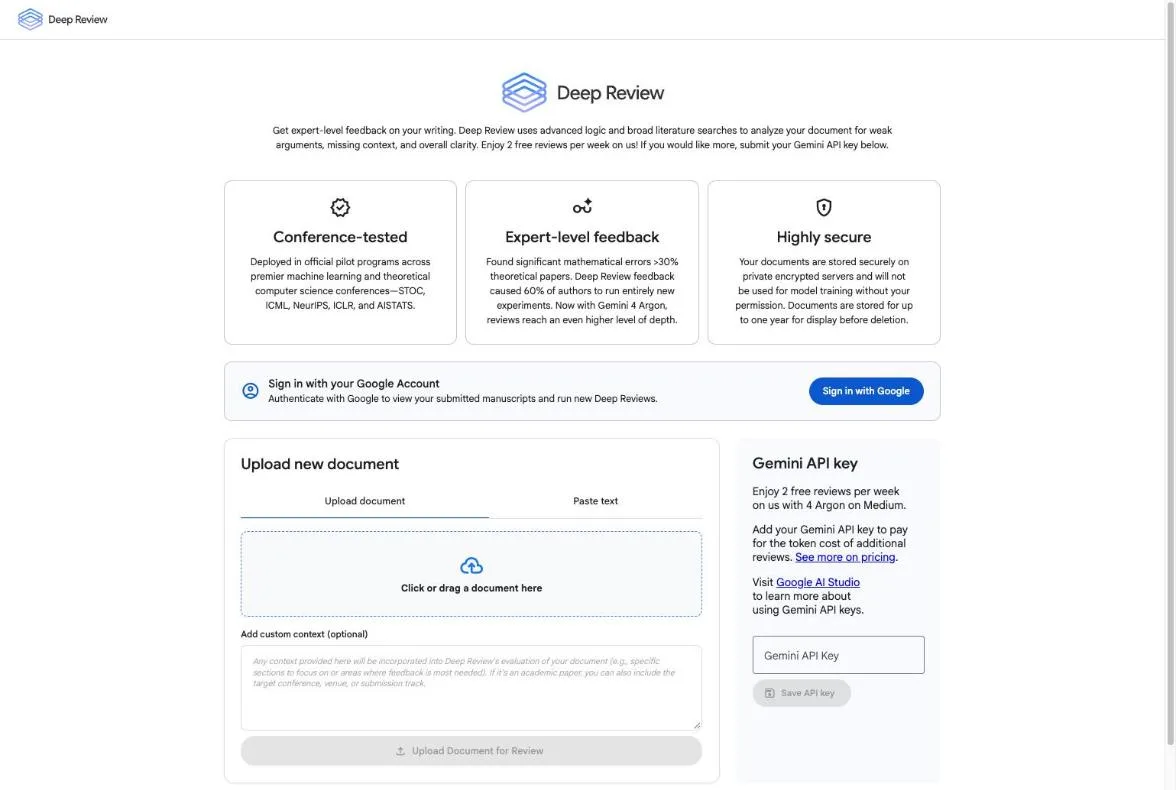
The quickest route is the Deep Review page on the Google Research Portal. All you need is a Google account and the file you want checked.
- Sign in with your Google account.
- Upload a document, or switch to the text tab and paste it in.
- Optionally add context, such as the sections you care about or the venue you are submitting to.
- Submit, then open the result from the "Your documents" table once it is ready.
"Authenticate with Google to view your submitted manuscripts and run new Deep Reviews."/"Add custom context (optional)"/"After submission, the results of the review will be ready in the "Your documents" table."(How do I use it?)— Deep Review pageView official source →
Call the Deep Review API
With a Gemini API key, you can call the same review from code. Google suggests wiring it into continuous integration (the automated checks that run each time a file changes) and drafting workflows. That way, a review can run whenever a document changes.
A team that keeps design docs in a repository could, for example, review every pull request that touches a spec. The API reference is listed in Google APIs Explorer, according to the Deep Review FAQ.
"Integrate with the API: Access programmatic verification in your continuous integration and drafting workflows using your Gemini API key ."— Google Research blogView official source →
Run the Teamwork pattern in Antigravity
Google also added a review pattern inspired by Deep Review to Antigravity, its agentic development tool. It is called the Teamwork Deep Document Review Pattern, and it runs on Teamwork, Antigravity's framework for coordinating several agents.
The pattern is meant for research papers, manuscript drafts and technical proposals. In Antigravity you start it with the /teamwork-preview command, without leaving your editor.
"We’re also introducing the Teamwork Deep Document Review Pattern , a document review implementation pattern inspired by Deep Review built into Antigravity using the Teamwork multi-agent orchestration framework . This pattern is designed systematically to evaluate research papers, manuscript drafts, and technical proposals using a multi-agent hierarchy with self-correction and segment-based rubrics. Antigravity users can invoke this pattern using the /teamwork-preview command."— Google Research blogView official source →
Inside the four-stage review pipeline
The four stages of a Deep Review
- SplitAn agent breaks the document into overlapping sections
- BudgetDense sections get more compute than light ones
- CheckSpecialist agents review the sections in parallel, each with the full document
- CombineOne agent merges the reports and checks them against outside sources
Deep Review does not hand the whole paper to one model in one prompt; it splits the work across four stages. Google says the move to Gemini 4 Argon makes these reviews deeper than the ones PAT produced.
Why a single prompt misses errors in long documents
Google gives three reasons a single prompt falls short on a long, technical document. Each one explains part of why Deep Review splits the job up.
- The model runs out of reasoning budget before it reaches the hard parts.
- It loses track of how a definition on page 3 connects to a proof on page 20.
- It accepts subtle claims without really testing them.
So the first stage is a segmenter agent that cuts the document into logical sections, such as the introduction, methods and experiments. The sections may overlap, and together they must cover every page.
"Single-prompt LLM calls often fail when evaluating long, complex documents due to exhausting their token reasoning budget, overlooking long-context cross-section dependencies, or accepting nuanced claims without fully scrutinizing them."/"These segments can be overlapping, and must cover all the content of the input document."— Google Research blogView official source →
Proofs get more compute, then agents check sections in parallel
Each section gets a compute budget that matches how dense it is, so a block of proofs receives more than an introduction or a related work section. Specialist agents then review their sections at the same time. Each one can see the full document, so it can notice when a symbol defined early is used differently later.
A final synthesis agent merges the section reports, checks them against each other and runs outside checks. In the PAT version, that agent used Google Search to catch citations to papers or theorems that do not exist.
"For instance, sections with dense mathematical proofs may receive more compute than an introduction or a related work section in an academic paper."/"Each agent has access to the full document context to track cross-references, but focuses its reasoning power specifically on the task of reviewing its specific target section."/"A dedicated synthesis agent consolidates the segment-level reports, and does final consistency checks between sections, rerunning logical checks if required."— Google Research blogView official source →
"The synthesis agent utilizes Google search as an extra check for hallucinations (e.g. non-existent papers or theorems), before assembling the final review."— PAT paperView official source →
How accurate is Deep Review?
Share of known math and proof errors detected
26 math and computer science papers containing 29 known errors, taken from the SPOT benchmark. Higher is better. The original SPOT figure was graded differently, so it is not a direct comparison. Source: PAT paper.
 Gemini 3.1 Pro, one call
In Google's test, Deep Review's predecessor found 89.7% of 29 known errors in 26 math and computer science papers, but authors who used it in real pilots rated its feedback as mostly grounded only 56% to 65% of the time. It catches a lot, and it also raises points that turn out to be wrong. Plan to verify each flag yourself.
89.7% of known errors, versus 55.2% for one Gemini 3.1 Pro call
The same Gemini 3.1 Pro model, given each paper in a single call, found 55.2% of the errors. PAT ran on that same model and reached 89.7% by splitting the work, so the gain comes from the pipeline, not a bigger model.
The papers come from SPOT, a benchmark of published papers with confirmed mistakes, filtered to equation and proof errors. The best result reported with SPOT itself was 21.1%, but it was graded another way. According to the PAT paper, single-call models tend to accept complex math claims without really checking them.
"This yields an evaluation subset of 26 papers with 29 errors."/"PAT, on the other hand, significantly outperforms single model generation, achieves a 34% gain improvement and increasing recall to 89.7%."/"In particular, zero-shot models are more likely to accept complex mathematical claims without critically scrutinizing them."(around Table 2)— PAT paperView official source →
What authors said in the STOC and ICML pilots
More than nine in ten authors in both pilots called the feedback very or mostly helpful. PAT ran with STOC in November 2025 and with ICML in January 2026, and reviewed over 4,700 submissions across the two.
| Survey result | STOC (124 authors) | ICML (733 authors) |
|---|---|---|
| Very or mostly helpful | 92.7% | 90.7% |
| Would use it again | 97% | 92.1% |
| Flagged a substantive theory gap | 11.6% | 35.4% |
| Ran new experiments after the review | — | 31% |
The ICML numbers stand out. In that pilot, 35.4% of authors were told about a substantive gap in their theory, and 31% ran new experiments after reading the review.
"Between the two conferences, over 4,700 submissions were reviewed by the PAT system."/"Similarly, over 90% said that the feedback was either Very or Mostly helpful."(3.1 Quantitative Author Feedback for PAT Experimental Programs)— PAT paperView official source →
Only 56% to 65% found the feedback mostly grounded
When asked whether most or all of the feedback was factually grounded, 55.8% of STOC authors and 64.8% of ICML authors said yes. The rest did not say so, which means a real share of flags may rest on a misreading.
The researchers name hallucination, where an AI states something false as if it were fact, as a key weak point of AI reviewing. Their advice is plain: whoever uses a review agent has to check what it says. Treat each Deep Review flag as a lead to confirm against your own text, not a correction to accept.
"Importantly, given that hallucinations and misunderstandings are key failure points of AI-assisted reviewing, we view the fact that over half found the feedback mostly or all grounded (factual) to be a strong positive result."(3.1 Quantitative Author Feedback for PAT Experimental Programs)/"Models are prone to hallucination; an actor using a review agent must check statements made to ensure their validity."— PAT paperView official source →
What happens to the documents you upload
Data and file formats
Google keeps uploaded files for one year and says it does not train its models on them. That matters if you plan to upload an unpublished paper or an internal document.
Not used for training and kept for one year
The announcement says uploads are never used to train, fine-tune or improve Google models, and are stored only so you can see them in the Deep Review interface. The Deep Review page words it a little differently: documents are not used for training without your permission, and you can opt in to let the research team use your data to improve the tool. If your lab or company has rules about sending manuscripts to outside services, check them before you upload.
"Documents uploaded to Deep Review are never used to train, fine-tune, or improve Google models. Uploaded documents are stored for one year for the sole purpose of display to the user in the Deep Review UI."— Google Research blogView official source →
"Your documents are stored securely on private encrypted servers and will not be used for model training without your permission. Documents are stored for up to one year for display before deletion."/"You can opt in to give the research team permission to use your data to improve Deep Review."(What happens to my document when I upload it to Deep Review?)— Deep Review pageView official source →
File formats: PDF and plain text, plus Docs and Slides
At launch, the announcement lists PDF and plain text as the input formats, with multi-file input coming soon. The FAQ on the Deep Review page goes further and lists Google Docs and Google Slides as well.
Until multi-file input arrives, a paper with a separate appendix has to go in as one file. If the main text and the appendix are separate PDFs, combine them into one PDF before you upload.
If you need to combine the main paper and its appendix, try our tool that merges several PDFs into one and lets you drag them into order first. It runs in your browser, so you can prepare the file before you upload it to Deep Review.
"Deep Review will initially support PDFs and plain text as input formats, with support for multi-file inputs coming soon."— Google Research blogView official source →
"Deep Review supports PDFs, text, Google Docs, and Google Slides across many domains including research, legal, and finance."(What kind of documents can Deep Review review?)— Deep Review pageView official source →
Use the free reviews for one paper and the API for a team
Google Deep Review gives you two free reviews a week, which is enough to check a paper before you submit it and again after you revise. If you need more, the API route costs roughly $3 to $20 for a 40-page paper.
Put the two headline numbers side by side and the right way to use it becomes clear. Its predecessor caught 89.7% of known errors, yet only 56% to 65% of authors found the feedback mostly grounded. Deep Review is good at surfacing problems you might have missed, so read each flag against your own text before you change anything.
FAQ
- Is Google Deep Review free?
- Yes, up to two reviews a week for every user. Beyond that, you add your own Gemini API key and pay only for the Gemini API calls the review makes. Google does not charge anything extra for Deep Review itself.
- How much does a Deep Review cost with a Gemini API key?
- Google's own estimate for a 40-page document runs from about $3 with Gemini 3.8 Flash on the Low setting to $20 with Gemini 4 Argon on Extra High. The actual charge depends on the document.
- Does Google train its AI on papers uploaded to Deep Review?
- No. Google's announcement says uploaded documents are never used to train, fine-tune or improve its models. They are kept for one year so you can see your results in the Deep Review interface.
- Can I trust everything Deep Review flags?
- No. Its predecessor found 89.7% of known errors in a test set, but only 55.8% of STOC authors and 64.8% of ICML authors said the feedback was mostly or all grounded. Google's researchers say anyone using a review agent has to check what it reports.
Related articles
 Gemini create files: edit PDFs and docs in chatGemini create files: docs, PDFs, slides and sheets now open in the chat as previews you can edit. Phones edit only PDFs; the web handles the rest.
 Gemini 4 Carbon vs Argon: Pricing and AccessGemini 4 Carbon vs Argon: Carbon opened to paid API developers, businesses and Google AI Ultra on Nov 10, at the same $2/$10 per 1M token price as Argon.
 What is the Gemini agent? Features and pricingThe Gemini agent is Google Cloud's AI agent for work. It runs inside Gmail, Docs and Slack, builds coworker agents and picks Gemini or Claude models per task.
 Gemini free tier goes Flash-Lite only on October 9The Gemini free tier is Flash-Lite only from October 9, 2026. Flash needs AI Plus ($4.99/month), Pro needs AI Pro ($19.99), and Deep Think stays Ultra-only.