Operation Blue Skies: Google AI contrail avoidance
Operation Blue Skies is a trial, announced on August 18, 2026, in which a consortium using Google AI will move a small share of flights over Shanwick airspace to another altitude so that they avoid contrails. Google calls it a world first, with government backing and a scope of one entire oceanic airspace.
It is the first airspace-wide step after trials with single airlines. Google has worked with airlines such as American Airlines, with air navigation service providers such as EUROCONTROL's MUAC and with flight-planning software providers including FlightKeys. Operation Blue Skies applies the idea across one stretch of ocean instead of airline by airline.
Shanwick airspace, 10,000 flights and persistent contrails
Shanwick airspace is the eastern half of the North Atlantic corridor. Around 10,000 flights from hundreds of cities pass through it during trial hours each year, and only a small percentage are deviated: those that would otherwise cross air where persistent contrails form strongly. The program lasts 30 months, in two operational trials of about four months each.
"Since publishing our initial research on ways AI can help mitigate contrail warming, we've partnered across the aviation industry, working alongside airlines such as American Airlines, air navigation service providers like EUROCONTROL's MUAC, and Flight Planning Software providers including FlightKeys, to demonstrate that avoiding warming contrails is both scientifically validated and operationally practical."/"Now, we’re taking the next major step: expanding beyond individual airline trials to coordinated contrail mitigation across an entire flight corridor. We’re launching Operation Blue Skies — the world’s first state-backed trial to avoid contrails at the scale of an entire oceanic airspace."/"The 30 month program consists of two operational trials, each lasting approximately four months. Around 10,000 flights, originating from hundreds of cities, will pass through Shanwick airspace during trial hours each year and a small percentage of these flights that would otherwise pass through contrail-sensitive airspace will be slightly deviated, preventing them from forming strongly warming contrails." (body) — from Google's official blogView official source →
Minor altitude changes against aircraft contrail warming
A deviated flight gets a minor altitude adjustment within standard flight operations. The change is coordinated through the established, standard channels of air traffic control.
The maneuvers take place mainly in the winters of 2026-2027 and 2027-2028, on roughly 20 to 40 test days each winter, timed for quieter traffic. Neither announcement says how large the change is in feet or meters.
"The trials will focus on minor altitude adjustments within standard flight operations, coordinated through established and standard Air Traffic Control (ATC) communication channels. Trial manoeuvres will take place primarily during winter testing windows in 2026-2027 and 2027-2028, with approximately 20 to 40 test days per winter. Testing will be conducted during periods of lower air traffic." (body) — from the University of CambridgeView official source →
What are contrails and why does contrail warming matter?
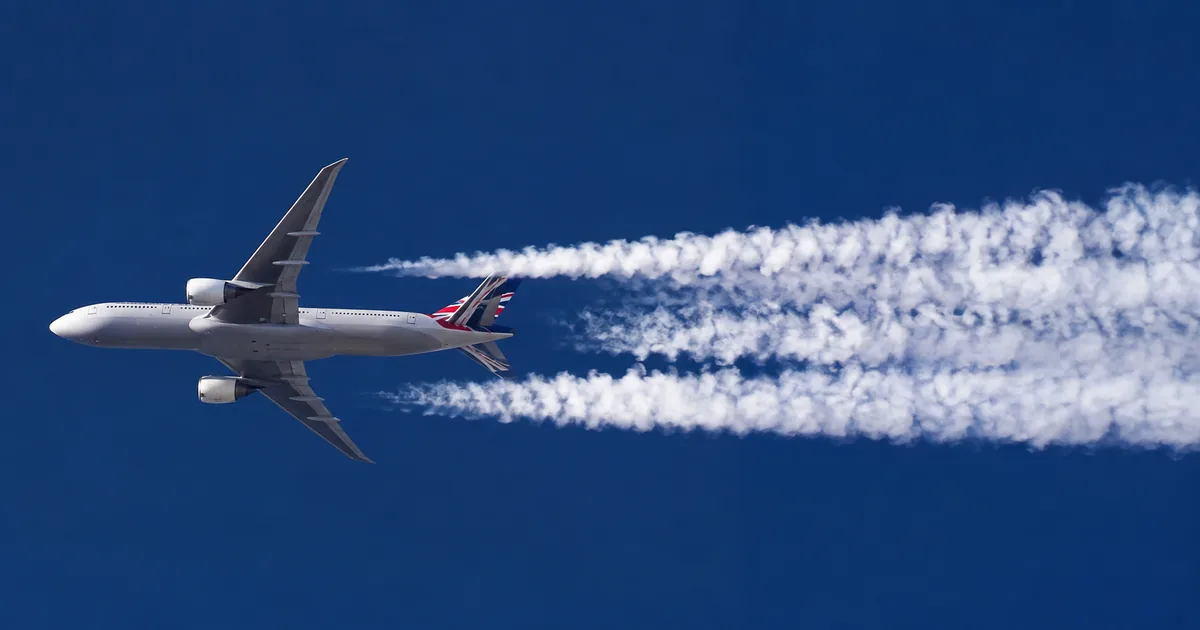
A contrail is a line of cloud that forms behind an aircraft when water vapour in the jet exhaust condenses and freezes in cold, humid air high up. On a clear day they show up as thin white lines trailing behind aircraft. The persistent kind is the target of this trial, because persistent warming contrails trap outgoing heat and account for roughly one third of aviation's total climate impact.
How do contrails form and become persistent contrails?
A contrail forms when water vapour in the exhaust freezes around soot and other aerosols in cold, humid air high above the ground. Jet engines release both the vapour and the particles. Persistent contrails are the ones that warm the climate, so they are what Operation Blue Skies tries to avoid.
"Contrails form when water vapour in jet-engine exhaust condenses and freezes around soot particles and other aerosols in the cold, humid air of the upper atmosphere." (body) — from the University of CambridgeView official source →
Contrails and climate change: a third of aviation impact
Cambridge and Google both put the share of persistent warming contrails at roughly one third of aviation's total climate impact. These contrails trap outgoing heat, and the trial tries to keep flights out of the air that makes them.
According to both releases, avoiding contrails could rank among the most cost-effective ways of reducing aviation's climate impact, and it could sharply cut that impact while costing passengers and companies very little. Neither release explains why the cost would be low.
"When you look up at a clear sky and see thin white lines trailing behind airplanes, you’re looking at condensation trails, or "contrails." These are clouds created when water vapor condenses around soot particles in jet exhaust. While they may seem harmless, these warming contrails account for roughly one third of aviation’s total climate impact."/"Contrails are one of the most urgent yet solvable climate challenges facing aviation today. Research suggests that avoiding contrails could be one of the most cost-effective ways to reduce aviation’s climate impact." (body) — from Google's official blogView official source →
"Persistent warming contrails trap outgoing heat, accounting for roughly one-third of aviation's total climate impact."/"Contrail avoidance could drastically reduce the global climate impact of aviation, at minimal cost to passengers and companies,” said Professor Steven Barrett, Regius Professor of Engineering at the University of Cambridge." (body) — from the University of CambridgeView official source →
Winter contrail warming over Shanwick airspace
Cambridge's release cites atmospheric modelling that puts Shanwick airspace at about 5% of global contrail warming. A significant part of that warming falls between November and February. The trial is therefore limited by place and by season, and AI models pick the times and places where a deviation could cut the most warming.
"Atmospheric modelling shows that the Shanwick airspace accounts for approximately 5% of global contrail warming. A significant part of this warming is concentrated in the winter season between November and February. Operation Blue Skies will target this specific high-impact window by using AI models to identify where and when interventions have the greatest potential to reduce contrail-related climate impact." (body) — from the University of CambridgeView official source →
Google AI contrails forecast and the consortium behind it
Google UK predicts the contrails, and Imperial College London and the University of Cambridge check the result independently. The UK arm builds the AI models and tracks the impact with machine learning and satellite imaging. The Met Office develops a new UK contrail forecast capability, and NATS runs the trial airspace operations and air traffic control coordination.
Operation Blue Skies partners and roles
"Google UK: Developing AI models to predict and avoid warming contrails, while using machine learning and satellite imaging to track and verify our impact."/"NATS (the UK's leading air navigation service provider): Trial airspace operations, air traffic control coordination, safety assessment and air traffic controller training."/"Imperial College London & University of Cambridge: Evaluating trial outcomes and providing independent verification of climate impact."/"Contrails.org: Leading forecast assessments, designing trial parameters, and supporting data analysis."/"Met Office: Developing a new UK contrail forecast capability and ensuring meteorological accuracy throughout the trial."/"Operation Blue Skies programme is co-funded by its industry partners and the Department for Transport (DfT) through the ATI Programme, a partnership between the Aerospace Technology Institute (ATI), the Department for Business, Innovation, Science and Trade (BIST) and Innovate UK." (A landmark consortium for global impact) — from Google's official blogView official source →
Funding for contrail avoidance and aviation climate impact
The Department for Transport pays £2.65 million of the £5 million, 30-month program, according to Cambridge's release. All of the government grant goes directly to academic, non-profit and aviation partners, so that public money builds domestic scientific capability. Google says industry partners and the Department for Transport share the funding through the ATI Programme.
Google UK takes part pro bono. It contributes £1.4 million in kind, as AI research expertise, engineering time and high-performance computing, to advance open climate science. Both announcements state this figure.
Some figures sit in one document only. Flight counts are in Google's announcement alone; the £5 million total, the £2.65 million government share and the winter windows are in Cambridge's alone. The £1.4 million in-kind figure, the 30-month length, the 5% share of global contrail warming and the one-third share of aviation's climate impact appear in both.
"Operation Blue Skies is a £5 million, 30-month programme, partly funded by £2.65 million from the Department for Transport."/"To ensure public funding directly advances sovereign scientific capabilities, 100% of the government grant funding is allocated directly to academic, non-profit, and aviation partners."/"Google UK is contributing £1.4 million in-kind through AI research expertise, engineering time, and high-performance computing infrastructure to advance open climate science." (body) — from the University of CambridgeView official source →
"Google UK is participating on a pro-bono basis, contributing £1.4 million in-kind through AI research expertise, engineering time, and high-performance computing infrastructure to advance open climate science." (body) — from Google's official blogView official source →
What contrail avoidance must prove for persistent contrails
No result from Operation Blue Skies exists yet. The first of the two operational trials, each of about four months, falls in the winter of 2026-2027.
Success would mean showing that avoiding persistent contrails works in practice across a whole airspace. Shanwick holds about 5% of global contrail warming, and contrails make up roughly a third of aviation's climate impact. Imperial College London and Cambridge evaluate the outcomes independently, and until they report, Operation Blue Skies has a plan and no findings.
FAQ
- Where does Operation Blue Skies run, and what is being tested?
- In Shanwick airspace, the eastern half of the North Atlantic corridor, which accounts for about 5% of global contrail warming. Flights that would otherwise cross contrail-forming air are nudged to a slightly different altitude on the strength of an AI forecast. Google calls it the world's first state-backed trial at the scale of an entire oceanic airspace.
- How much of aviation's warming comes from contrails?
- Roughly a third, according to both Cambridge and Google. Persistent warming contrails trap outgoing heat.
- When do the flights actually change course?
- The program runs 30 months, but the maneuvers are concentrated in two winter windows, 2026-2027 and 2027-2028, at roughly 20 to 40 test days per winter. Testing is scheduled for periods of lower air traffic.
Related articles
 Reddit to require logins as search referrals fallReddit will test a logged-in-only site outside the US in Q4. Search referrals fell over 1M a week in October; its CEO says Google's AI Mode drives no traffic.
 Gemini create files: edit PDFs and docs in chatGemini create files: docs, PDFs, slides and sheets now open in the chat as previews you can edit. Phones edit only PDFs; the web handles the rest.
 What is Genie 4? Google's world model with audioGenie 4 is Google DeepMind's world model that adds ambient sound and live dialogue to explorable worlds. Only testers have it; Ultra subscribers are next.
 Google Deep Review: what the AI paper checker doesGoogle Deep Review checks papers for logic gaps, math errors and weak evidence. Two reviews a week are free, and its predecessor caught 89.7% of known errors.