What Nozzle found in 17.8 million judged SERPs
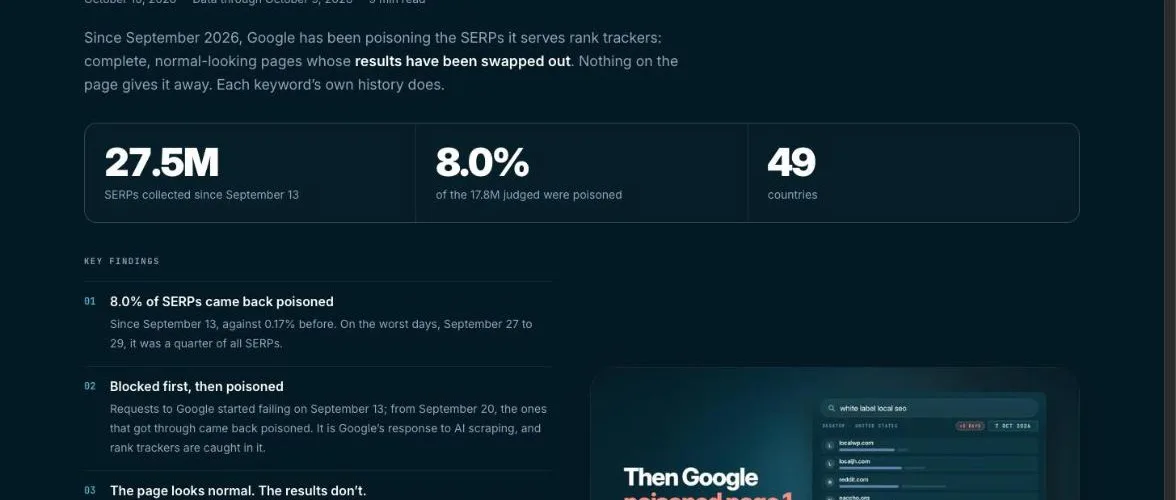
Nozzle measured poisoned results on 8.0% of the SERPs it could judge after September 13, 2026, against 0.17% before. A rank tracker is a tool that loads Google results automatically and records where each site sits, so a wrong page turns straight into a wrong ranking.
The poisoned pages carry no error and no captcha. The layout is the usual one; only the sites listed on it have changed.
Requests failed first, then the results came back wrong
The trouble started on September 13, when requests to Google began failing in large numbers. For about two weeks, trackers got far fewer pages back than usual.
From September 20, some of the requests that did go through returned poisoned pages. Nozzle collected 27.5 million SERPs from September 13 to October 9 and could judge 17.8 million of them. The share peaked at about a quarter from September 27 to 29 and has run at roughly 5 to 11% a day since October 1.
Share of judged SERPs that came back poisoned, by day (Nozzle)
| Day | Poisoned |
|---|---|
| September 13 | 0.17% |
| September 20 | 1.9% |
| September 27 | 24.9% |
| September 28 | 26.7% |
| September 29 | 27.0% |
| October 1 | 8.0% |
| October 9 | 4.2% |
Australia, India and Canada saw the highest rates
Among the markets in Nozzle's chart, Australia was highest at 11.5%, ahead of India at 10.9% and Canada at 10.5%. The United States came in at 8.5%. The United Kingdom was lowest at 3.0%.
Device made little difference: 7.7% on desktop, 8.3% on iPhone and 7.1% on Android. Query type mattered more.
"Near me" searches were poisoned 11.4% of the time, against 7.8% for everything else, and phrases searched fewer than 100 times a month hit 9.4%. Legal SERPs in the U.S. were the worst industry, at 15.9% since September 13 and 51.3% on September 27.
Requests to Google started failing on September 13; from September 20, the ones that got through came back poisoned. / Since September 13, 8.0% of SERPs were poisoned, against 0.17% in the baseline. — from the key findings and the country sectionView official source →
What a poisoned SERP looks like
Nozzle calls a SERP poisoned when fewer than half of a keyword's usual sites show up on any page, and those sites return on a later check. Usual sites are the ones that sat in the keyword's top 10 on at least 60% of its SERPs from August 20 to September 9.
On a poisoned page, the organic results keep only 20.7% of the sites from the previous SERP. In the August-to-September baseline, that figure was 88.5%. The AI Overview shows up less, on 34.9% of poisoned pages against 54.2%, while ads hold on to more of their previous entries than usual.
How often a site appears in the top 10 (Nozzle)
| Site | Same keywords, other SERPs | Poisoned SERPs |
|---|---|---|
| 20.8% | 28.8% | |
| 28.3% | 33.8% | |
| YouTube | 16.3% | 13.9% |
Reddit and Facebook take the empty spots
The sites that move in are mostly social platforms and forums. Reddit, Facebook, LinkedIn, Instagram and Quora appear in the top 10 more often on poisoned pages. YouTube, Yelp and MapQuest appear less.
Nozzle's example is the query "white label local seo." Between October 4 and October 7, all 9 page-1 sites were replaced.
Tracked sites drop out of the top 10, then come back
For keywords where a project's own site is one of the usual sites, that site was missing from the top 10 on 58.6% of poisoned SERPs. In the baseline the rate was 2.7%.
The drops do not stick. In Nozzle's data, 80% of poisoning spells lasted a single SERP, and 77.9% of poisoned SERPs had the usual sites back within three days, two days at the median.
the organic results keep 20.7% of the previous SERP’s sites, against 88.5% before. / A project’s own site misses the top 10 on 58.6% of poisoned SERPs, against 2.7% before. — from the key findingsView official source →
Why Nozzle ties it to Google's fight against AI scraping
Nozzle's concern is that Google answers these requests with wrong pages instead of refusing them. A failed request can be retried. A wrong page looks normal, so a tracker saves it as real data.
Nozzle reads the pattern as Google pushing back on AI scraping and grounding, meaning the bulk collection of search results to use as the basis for AI answers. Rank trackers pull SERPs the same way, so in Nozzle's view they got caught in it.
Google has not commented on the findings
The cause is Nozzle's interpretation, not something Google has said. Google has not confirmed Nozzle's figures or DemandSphere's, and it has not commented publicly on either.
Nozzle also found that the route a request takes matters. One of its collection routes returned 1 to 7% poisoned SERPs from September 30 to October 9, on the same days that another returned 9 to 30%.
DemandSphere and Morningscore saw the same pattern
Two other vendors report the same problem with their own data. DemandSphere says the heaviest blocking it has seen began around September 11. In an October 7 post, it put spurious results at about 11% of its daily SERPs, without describing how it measured them.
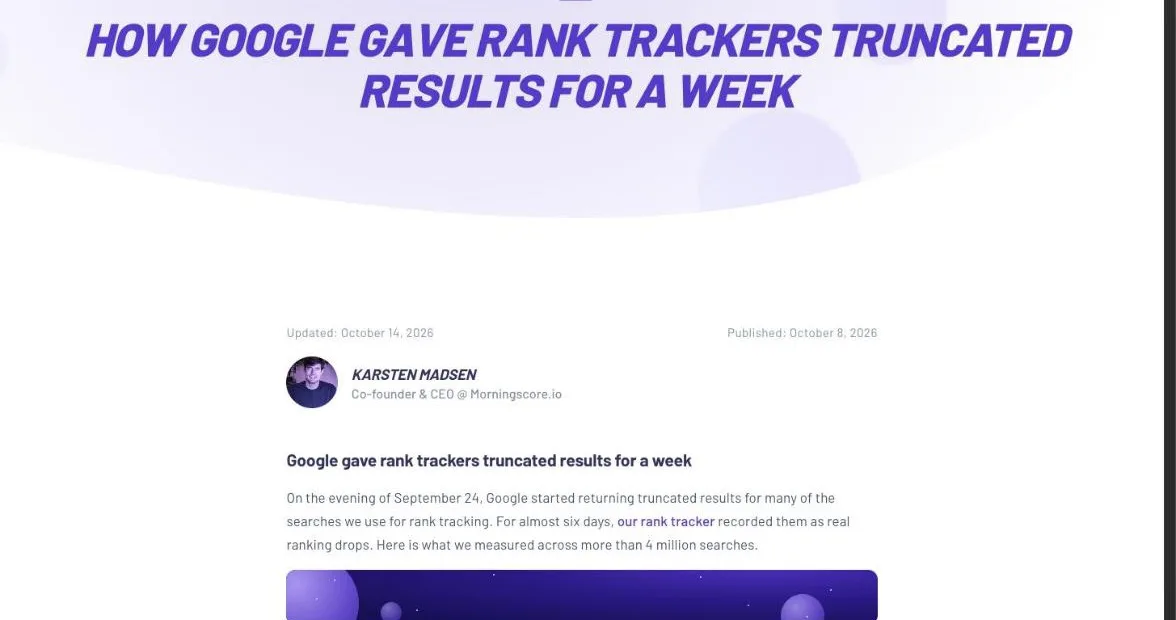
Morningscore saw cut-short result sets from 22:10 UTC on September 24. At the peak, on September 30 and October 1, about 60% of its searches returned fewer than 40 results instead of about 50.
When Morningscore ran the same searches in a normal Chrome browser at the same time, it got the full results. The company concludes that real searchers most likely never saw the broken pages.
It is Google’s response to AI scraping and grounding, the bulk collection of its results to feed AI answers, and rank trackers, which collect SERPs the same way, are caught in it. — from the section explaining why Nozzle calls it poisoningView official source →
Neither figure has been confirmed by Google, which has not commented publicly on either. — from the section headed October: spurious resultsView official source →
How do you tell a poisoned SERP from a real ranking drop?
Check three things: how long the drop lasted, whether the keyword's usual sites vanished too, and what Search Console shows for impressions and clicks that day. A poisoned SERP usually reverses within three days and wipes out most of the usual sites at once. If Search Console looks normal, the site did not lose anything.
Signs of a poisoned SERP (Nozzle)
| What to check | What a poisoned SERP shows |
|---|---|
| How long it lasts | 80% of spells last one SERP; most are back within three days |
| The keyword's usual sites over past weeks | Fewer than half of them appear |
| Search Console impressions and clicks | Still there |
| The page itself | Fewer AI Overviews and "People also search for" boxes, shallower pagination; not reliable alone |
Compare with past weeks, not just yesterday
Yesterday's SERP may have been poisoned too, so a one-day comparison can mislead. Nozzle suggests checking the keyword against its usual page-1 sites over the previous weeks. That separates a data problem from a ranking loss.
A drop that stays may be the spam update
If a drop has not reversed after three days, look for another cause. Google's September 2026 spam update started on September 24 and finished on October 8, the same stretch when poisoned SERPs were most common. PPC Land notes that real volatility and collection noise would look much the same on a dashboard over those two weeks.
Comparing against the keyword’s usual page-1 sites over the previous weeks separates a data problem from a ranking drop. / It does not last. Four in five spells of poisoning are a single SERP, and most are back within three days. A real ranking change stays. / If a site “disappears” and Search Console still shows impressions and clicks, nothing happened to the site. — from the section on telling it apart from a real ranking changeView official source →
Google's September 2026 spam update began on September 24 and was completed on October 8, after 13 days and 16 hours. — from the section headed September: the "ban hammer"View official source →
Summary: 8% of SERPs were poisoned, and most drops recovered
Nozzle found that 8.0% of the SERPs it could judge since September 13 were poisoned, with the wrong sites on an otherwise normal page. Tracked sites often fell out of the top 10 on those pages, but 77.9% were back within three days.
If a keyword dropped for a day in late September or early October, open Search Console before you report it. The link to Google's anti-scraping work is Nozzle's reading, and Google has not confirmed it.
FAQ
- Do regular searchers see the poisoned results?
- Probably not. Morningscore ran the same searches in a normal Chrome browser while its tracker was getting cut-short pages, and the browser showed the full results.
- How long does a poisoned SERP last?
- Usually one check. In Nozzle's data, 80% of poisoning spells lasted a single SERP and 77.9% of poisoned SERPs had the keyword's usual sites back within three days, two days at the median.
- Has Google confirmed it is doing this?
- No. Neither Nozzle's 8.0% nor DemandSphere's figure of about 11% has been confirmed by Google, and Google has not commented publicly on either.
Related articles
 Reddit to require logins as search referrals fallReddit will test a logged-in-only site outside the US in Q4. Search referrals fell over 1M a week in October; its CEO says Google's AI Mode drives no traffic.
 Gemini create files: edit PDFs and docs in chatGemini create files: docs, PDFs, slides and sheets now open in the chat as previews you can edit. Phones edit only PDFs; the web handles the rest.
 What is Genie 4? Google's world model with audioGenie 4 is Google DeepMind's world model that adds ambient sound and live dialogue to explorable worlds. Only testers have it; Ultra subscribers are next.
 Google Deep Review: what the AI paper checker doesGoogle Deep Review checks papers for logic gaps, math errors and weak evidence. Two reviews a week are free, and its predecessor caught 89.7% of known errors.