Where GPT-5.6 is available today across ChatGPT, Work, Codex and API
OpenAI switched on all three GPT-5.6 models for general use on July 9, 2026, in ChatGPT, Codex and the OpenAI API on the same day. The rollout started worldwide at once, and OpenAI expected it to reach full availability within 24 hours.
The family has three tiers. Sol is the flagship, Terra costs less and is described by OpenAI as competitive with GPT-5.5 on performance, and Luna is the fastest and cheapest. The 5.6 names the generation, and OpenAI says each tier name can move to a newer model on its own schedule.
What you can reach depends on where you use it. The table maps each product to the three tiers, based on the OpenAI Help Center page as saved on September 1, 2026.
Which GPT-5.6 tiers each product offers (OpenAI Help Center, September 1, 2026)
| Product | Sol | Terra | Luna |
|---|---|---|---|
| ChatGPT chat | Plus, Pro, Business, Enterprise | Not selectable | Default model on Free and Go, not selectable |
| Work in ChatGPT | Plus, Pro, Business, Enterprise | Plus, Pro, Business, Enterprise | Plus, Pro, Business, Enterprise |
| Codex | Plus, Pro, Business, Enterprise | Free, Go, Plus, Pro, Business, Enterprise | Plus, Pro, Business, Enterprise |
| OpenAI API | Available | Available | Available |
Free and Go users therefore meet a different GPT-5.6 model in each product: Luna in chat and Terra in Codex. Sol requires Plus or a higher plan everywhere except the API, where it is billed per token.
"GPT‑5.6 spans three model tiers: Sol, our flagship; Terra, a lower-cost model with performance competitive with GPT‑5.5; and Luna, our fastest and most affordable model." / "GPT‑5.6 is available starting today across ChatGPT, Codex, and the OpenAI API. The rollout is starting globally now and will continue gradually toward full availability over the next 24 hours." — from the Availability and pricing section of OpenAI's July 9, 2026 announcementView official source →
Which ChatGPT plan gets which reasoning level
Standard ChatGPT chat is where most confusion starts, because you choose a reasoning level there rather than picking Sol, Terra or Luna by name. Your plan decides which levels appear.
Standard chat: Sol only, chosen by reasoning effort
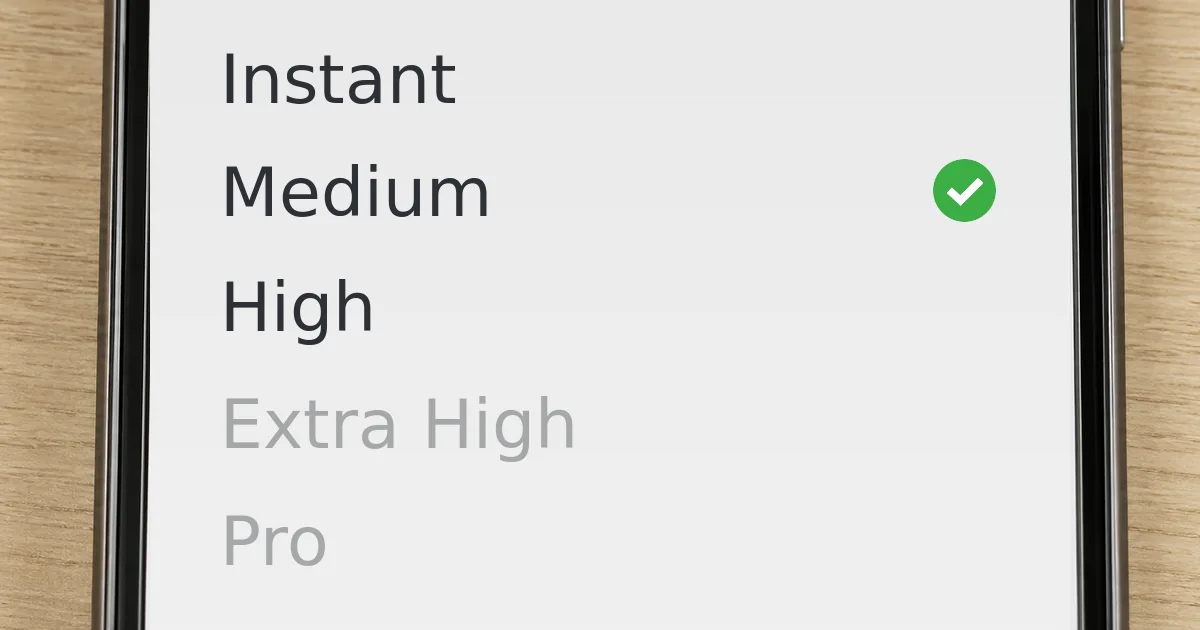
Reasoning effort is how much work the model does on a request before it replies, and ChatGPT offers five levels of it. Instant gives quick everyday answers, while Medium and High add standard and extended reasoning. Extra High is the highest effort ChatGPT offers with Sol, and Pro is for difficult, longer-running tasks.
On eligible paid plans, Instant through Extra High all run on GPT-5.6 Sol, and Pro runs on GPT-5.6 Sol Pro. Plus adds Medium and High to Instant, while Pro, Business and Enterprise get every level.
GPT-5.6 Sol reasoning levels by ChatGPT plan (OpenAI Help Center, September 1, 2026)
| Plan | Medium and High | Extra High | Pro (Sol Pro) |
|---|---|---|---|
| Plus | Included | Not included | Not included |
| Pro | Included | Included | Included |
| Business | Included | Included | Included |
| Enterprise | Included | Included | Included |
| Free and Go | Not included | Not included | Not included |
Free and Go have no Sol at any level. Their default model is GPT-5.6 Luna, and the Think button they get for harder questions also runs on Luna. Logged-out visitors cannot use Sol at all.
On eligible paid plans, ChatGPT can raise the reasoning level on its own for a complex request while Instant stays selected. You turn that off or on under Settings > General > Higher intelligence. In Business and Enterprise workspaces, admins can limit which models members can use, and Enterprise workspaces may keep the old model picker until the new controls reach them.
At launch, GPT-5.5 Instant was still the default in chat. That changed on August 6, 2026, when OpenAI moved Plus and Pro to a chat-tuned Sol for both Instant and deeper reasoning, and said Luna would become the Free and Go default that week. The Sol in Work and Codex was left unchanged, so the same name now covers two versions.
Two OpenAI pages also disagree on Sol Pro. The July 9 announcement lists it for Pro and Enterprise only, while the Help Center table saved on September 1 includes Business as well, and this article follows the Help Center. If a level you expect is missing, the rollout may not have reached your account yet.
The Help Center page has changed since launch, and the change was easy to miss. Keeping a Markdown copy of it lets you compare the next version line by line.
"GPT-5.6 Sol powers Instant, Medium, High, and Extra High on eligible paid plans, while GPT-5.6 Sol Pro powers Pro." / "The table below shows which GPT-5.6 Sol reasoning options are available by plan. Free and Go users receive GPT-5.6 Luna and do not have access to GPT-5.6 Sol." / "Logged-out users do not have access to GPT-5.6 Sol." / "On eligible paid plans, ChatGPT can automatically use more reasoning for complex requests while Instant remains selected. To turn automatic reasoning on or off, go to Settings > General and adjust Higher intelligence." / "In Business and Enterprise workspaces, admins may control which models workspace members can use." / "Enterprise customers may continue to see the existing model picker until the new controls reach their workspace." / "GPT‑5.6 is gradually rolling out to eligible ChatGPT plans. If you do not see GPT‑5.6 Sol in the ChatGPT model picker, it may not be available for your account yet." — from the Overview, How GPT-5.6 works in ChatGPT and Availability sectionsView official source →
"Because this version of GPT‑5.6 Sol is optimized for everyday chats, it will only be available in the Chat experience in ChatGPT. The version of GPT‑5.6 Sol that powers Work and Codex is not changing as part of this release." / "GPT‑5.6 Luna will become the default model for Free and Go users this week." / "For Plus and Pro users, the same model now powers both Instant responses and deeper reasoning, creating one consistent experience." — from the Safety and availability section and the GPT‑5.6 Sol section of OpenAI's August 6, 2026 postView official source →
"Pro and Enterprise users can also select GPT‑5.6 Sol Pro for the highest-quality results on complex tasks." — from the Chat line of the Availability and pricing sectionView official source →
Terra and Luna live in Work, Codex and the API
Terra and Luna cannot be picked in a standard ChatGPT conversation. You reach them in three other places: Work in ChatGPT, Codex and the OpenAI API.
Work in ChatGPT offers all three tiers to Plus, Pro, Business and Enterprise. Codex gives Free and Go users Terra and gives paid plans all three, but it needs version 26.707.30751 or later of the ChatGPT desktop app (Codex mode), or version 0.144.0 or later of the Codex CLI. In both products you set an effort level per model, and the max effort level is open to anyone with GPT-5.6 access once it is switched on in settings.
Ultra is a separate mode that splits a large job across subagents. OpenAI limits it to Pro and Enterprise in Work, and to Plus and higher plans in Codex.
In the API each tier has its own model ID, for example gpt-5.6-terra, and reasoning effort can be set anywhere from none to max. The shorter gpt-5.6 alias points to Sol, so a request that names only the generation is billed at Sol's rate.
GPT-5.6 has no country list of its own. ChatGPT access follows ChatGPT's supported countries, and API access follows the API's. The Help Center names the EEA, Switzerland, the United Kingdom and the UAE as covered, but workloads set to UAE inference residency cannot currently use GPT-5.6.
"Terra and Luna are not selectable in standard ChatGPT conversations. Depending on your plan, they are available in Work and Codex. Developers can also use them through the OpenAI API." / "Sol, Terra, and Luna for Plus, Pro, Business, and Enterprise" / "Terra for Free and Go; Sol, Terra, and Luna for Plus, Pro, Business, and Enterprise" / "ChatGPT desktop app (Codex mode): 26.707.30751" / "Codex CLI: 0.144.0" / "GPT-5.6 does not have a separate country list. ChatGPT access follows the ChatGPT supported countries and territories, and OpenAI API access follows the OpenAI API supported countries and territories." / "Eligible users in supported European locations, including the EEA, Switzerland, and the United Kingdom, and in the UAE can use GPT-5.6 when it is available for their plan and product." / "GPT-5.6 is not currently supported for workloads configured to use UAE inference residency." — from the Work in ChatGPT and Codex rows of the product table, the Codex minimum versions, the FAQ and the Regional availability sectionView official source →
"ChatGPT Work and Codex: Free and Go users access GPT‑5.6 Terra. Plus, Pro, Business, and Enterprise users can choose among GPT‑5.6 Sol, Terra, and Luna and set an effort level for each. max is available to all users with access to GPT‑5.6 in ChatGPT Work and Codex and can be toggled on in settings. In ChatGPT Work, ultra is available to Pro and Enterprise users. In Codex, it is available to Plus and higher plans." — from the ChatGPT Work and Codex line of the Availability and pricing sectionView official source →
"alias routes requests to GPT-5.6 Sol." / "Reasoning.effort supports: none, low, medium (default), high, xhigh, and max." — from the model overviewView official source →
"Additionally, we’re introducing a new ultra mode that goes beyond the capabilities of a single agent by leveraging subagents to accelerate complex work." — from the Capabilities section of OpenAI's June 26, 2026 postView official source →
What GPT-5.6 costs, tier by tier
In ChatGPT, GPT-5.6 comes with your plan. In the API you pay per million tokens, the units the API uses to count text, with separate rates for the input you send and the output you get back.
All three tiers are cheaper than at launch. On July 30, 2026, OpenAI cut Luna by 80% and Terra by 20%. On August 21, it cut Sol's API and credit pricing by over 20% for three months, and the API docs say that promotional rate lasts at least through November 21, 2026.
GPT-5.6 API price per 1M tokens, input / output: at the July 9 launch and now
| Tier | July 9, 2026 launch | Now (pricing page, September 25, 2026) |
|---|---|---|
| Sol | $5 / $30 | $4 / $20 (promotional) |
| Terra | $2.50 / $15 | $2 / $12 |
| Luna | $1 / $6 | $0.20 / $1.20 |
For scale, GPT-5.5 costs $5 input and $30 output, and GPT-5.4 costs $2.50 and $15. Terra now charges less than GPT-5.4 on both, even though OpenAI compares it with GPT-5.5, the pricier model. For choosing a tier by workload, see GPT-5.6 Sol, Terra and Luna: Specs and Pricing.
"GPT‑5.6 is priced per 1M tokens across three model sizes: Sol is $5 input / $30 output; Terra is $2.50 input / $15 output; and Luna is $1 input / $6 output." — from the Availability and pricing section of OpenAI's June 26, 2026 post (the same launch prices carried into general availability)View official source →
"Update on July 30, 2026: OpenAI reduced the price of GPT‑5.6 Luna by 80% and GPT‑5.6 Terra by 20%." / "Update on August 21, 2026: OpenAI dropped the API and credit pricing of GPT‑5.6 Sol by over 20% for the next 3 months." — from the two update notes at the top of the July 9, 2026 announcementView official source →
"GPT-5.6 Sol costs $4 per million input tokens and $20 per million output tokens, a 20% reduction in input pricing and a 33% reduction in output pricing. GPT-5.6 Sol’s promotional pricing is available at least through November 21, 2026." — from the Pricing sectionView official source →
Standard and batch pricing across Sol, Terra and Luna
The pricing page lists two rates that matter for most API users. Standard is the regular rate, and Batch is the rate for requests sent through the Batch API endpoint. Cached input is the cheaper rate for the part of a prompt the API has already stored from an earlier request.
GPT-5.6 API pricing per 1M tokens, under 272K input tokens (OpenAI pricing page, September 25, 2026)
| Tier | Standard: input / cached / output | Batch: input / cached / output |
|---|---|---|
| Sol (promotional) | $4 / $0.40 / $20 | $2 / $0.20 / $10 |
| Terra | $2 / $0.20 / $12 | $1 / $0.10 / $6 |
| Luna | $0.20 / $0.02 / $1.20 | $0.10 / $0.01 / $0.60 |
Every Batch figure is half the Standard figure beside it, a ratio we worked out from the table rather than one OpenAI states. Writing a prompt into the cache costs 1.25x the uncached input rate, and reading it back keeps the 90% cached-input discount.
"gpt-5.6-terra" / "$2.00" / "$0.20" / "$12.00" / "$1.00" / "$0.10" / "$6.00" / "GPT-5.6 Sol’s promotional pricing is available at least through November 21, 2026." — from the gpt-5.6-terra rows of the Standard and Batch tables (short context) and the note under the Standard tableView official source →
"cache writes are billed at 1.25x the model’s uncached input rate, while cache reads continue to receive the 90% cached-input discount." — from the prompt caching note in the Availability and pricing sectionView official source →
The 272K-token pricing cliff
All three tiers accept up to 922,000 input tokens inside a 1,050,000-token context window. Past 272K input tokens in a single request, though, the price changes for the whole request, not only for the tokens over the threshold.
That is why it works like a cliff. Cross 272K by a single token and every input token in the request costs 2x, while every output token costs 1.5x. Trimming a prompt back under the threshold, or splitting it into smaller requests, keeps it on the standard rate.
GPT-5.6 API pricing per 1M tokens above 272K input tokens (OpenAI pricing page, September 25, 2026)
| Tier | Input | Cached input | Output |
|---|---|---|---|
| Sol (promotional) | $8 | $0.80 | $30 |
| Terra | $4 | $0.40 | $18 |
| Luna | $0.40 | $0.04 | $1.80 |
"1,050,000 context window" / "Maximum input tokens: 922,000" / "Prompts with >272K input tokens are priced at 2x input and 1.5x output for the full request." — from the Model details and Pricing sectionsView official source →
"gpt-5.6-luna" / "$0.40" / "$0.04" / "$1.80" — from the long-context columns of the gpt-5.6-luna row in the Standard tableView official source →
Why it wasn't available to everyone at launch
Everything above describes GPT-5.6 since July 9, 2026. From the June 26 announcement until general availability, only a small group of partners could use it.
A government-requested limited preview
On June 26, 2026, OpenAI opened GPT-5.6 only to a select group of trusted partners and organizations, through the API and Codex. ChatGPT users had no way in.
OpenAI said the US government asked for this. It had shown the government its plans and the models' capabilities before launch, and the government requested a preview limited to partners whose participation had been shared with it. OpenAI also said it did not want this kind of government access process to become the long-term default, and it moved to general availability on July 9.
"During the preview, GPT‑5.6 models will initially be available through the API and Codex to a select group of trusted partners and organizations." / "As part of our ongoing engagement with the U.S. government, we previewed our plans and the models’ capabilities ahead of today’s launch." / "At their request, we are starting with a limited preview for a small group of trusted partners whose participation has been shared with the government, before releasing more broadly." / "We don’t believe this kind of government access process should become the long-term default." — from the introduction and the Availability and pricing section of OpenAI's June 26, 2026 postView official source →
Executive Order 14409, in plain terms
OpenAI's preview post names no order number. It says only that OpenAI was helping the Administration build what it calls "the cyber Executive Order framework", along with a process it can reuse for later launches.
At the time, the order in force that described this kind of arrangement was Executive Order 14409, signed on June 2, 2026. Section 3 tells agencies to design a voluntary framework in which AI developers could give the federal government access to a covered frontier model for up to 30 days before releasing it to other trusted partners. The same section says nothing in it authorizes a mandatory licensing, preclearance or permitting requirement for developing or releasing AI models.
OpenAI does not say whether its preview ran under this framework. Either way, the preview ended on July 9, 2026, so if GPT-5.6 is still missing for you today, look at your plan, your account or workspace settings, and the product you are using. For how ChatGPT's plans and model picker work in general, see GPT-5 in ChatGPT: Free Tier, Pricing, Model Picks.
"we work with the Administration to develop the cyber Executive Order framework and a repeatable process for future model releases." — from the introduction of OpenAI's June 26, 2026 postView official source →
"(b) design a voluntary framework with AI developers through which developers would be able to:" / "(ii) provide the Federal Government with access to covered frontier models, subject to appropriate confidentiality, cybersecurity, insider-risk, and intellectual-property protection, use, and nondisclosure requirements, for a period of up to 30 days before they plan to release such models to other trusted partners; and" / "(c) Nothing in this section shall be construed to authorize the creation of a mandatory governmental licensing, preclearance, or permitting requirement for the development, publication, release, or distribution of new AI models, including frontier models." — from Section 3 of the orderView official source →
FAQ
- Is GPT-5.6 available yet?
- Yes. OpenAI made GPT-5.6 generally available on July 9, 2026, in ChatGPT, Codex and the OpenAI API at the same time. The limited preview that ran from June 26 has ended, so what you get now depends on your plan and the product you use.
- Can I use GPT-5.6 on the free plan?
- Yes, but not Sol. On ChatGPT Free and Go, GPT-5.6 Luna is the default model and also runs the Think button. In Codex, Free and Go users get GPT-5.6 Terra.
- Why can't I see GPT-5.6 Sol in ChatGPT?
- Check three things. Sol needs Plus or a higher plan, you have to be signed in to the account that holds that plan, and in a Business or Enterprise workspace an admin may have limited which models members can use.
- Can I pick GPT-5.6 Terra or Luna in ChatGPT?
- Not in a standard ChatGPT conversation. You can choose Terra and Luna in Work in ChatGPT and in Codex if your plan allows it, and developers can call both through the OpenAI API.
- Why wasn't GPT-5.6 available to everyone at launch?
- OpenAI says the US government asked for it. OpenAI opened GPT-5.6 on June 26, 2026, only to a small group of partners whose participation had been shared with the government, through the API and Codex. OpenAI said it did not want this kind of process to become the long-term default.
Related articles
 ChatGPT for Academic Researchers: Free for 100,000ChatGPT for Academic Researchers will bring free GPT-5.6, deep research and Codex to 100,000 researchers. Who qualifies, what's included and how to apply.
 GPT-5.6 Sol Ultrafast: Up to 14x Faster OutputGPT-5.6 Sol Ultrafast outputs up to 750 tokens per second on Cerebras, up to 14x faster than Standard. A limited OpenAI API preview since August 13, 2026.
 ARC AGI 3: Two Settings Tripled OpenAI's ScoreARC AGI 3 scores for GPT-5.6 Sol rose from 13.3% to 38.3% when OpenAI kept the model's reasoning and enabled compaction instead of rolling truncation.
 OpenAI investigation: what state AGs subpoenaedOpenAI investigation: a coalition of state attorneys general subpoenaed records on ads, consumer and health data and minors, reports said on June 12, 2026.