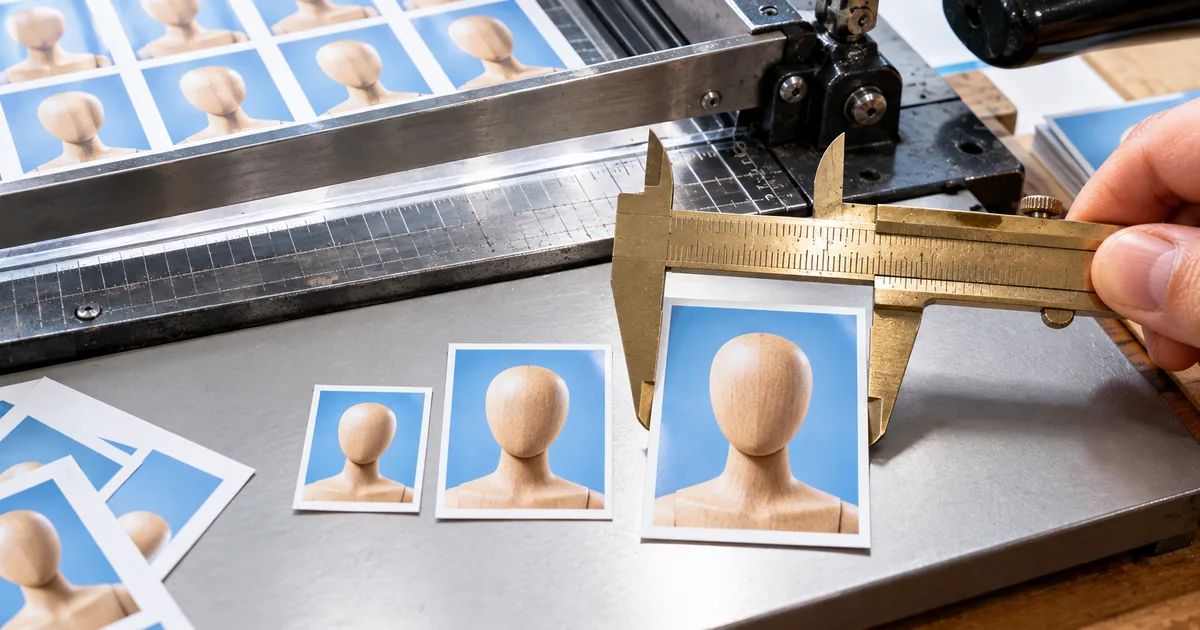
A Japan visa photo is 45 mm tall and 35 mm wide on the application form the Ministry of Foreign Affairs distributes. The Embassy of Japan in India asks for 45 mm by 45 mm instead, and the Consulate-General in Denver also accepts a US passport photo of 2 by 2 inches. All three numbers come from Japanese government pages, and the office that receives the form decides which one applies.
Japan visa photo size is 45×35 mm, or 45×45 mm in India
The form, the Embassy in India and the Denver consulate each print a different number, so the office that receives the application sets the measurement. The ministry form has 45 mm by 35 mm printed inside the box where the photo goes, with an inch figure beside it. The India page headed "PHOTOGRAPH - Standards" asks for a square of 45 millimeters by 45 millimeters with no edges, and Denver's tourism visa checklist takes 35 mm by 45 mm, width by height, or a US passport photo.
A reader in India and a reader in Colorado who both follow "the official Japan visa photo size" will hand in different photographs, and both are right. Checking the receiving office's page first costs a few minutes, while a wrong crop means taking, printing and filing the photo again.
The inch figures are not exact conversions of the millimeter figures. Two inches is 50.8 mm, not 45 mm, and 1.4 inches is about 35.6 mm, not 35 mm.
A print made to 2 inches instead of 45 mm comes out almost 6 mm too tall, so work in millimeters and print at actual size. The "Photo size as each page states it" table lists what each page says.
Photo size as each page states it
| Where the application is filed | What the page says | In millimeters |
|---|---|---|
| Ministry application form | 45mm ×35mm or 2in x 1.4in | 45 × 35 |
| Embassy of Japan in India | 45 millimeters × 45 millimeters | 45 × 45 |
| Consulate-General in Denver | 35mm x 45mm or 2in x 2in | 35 × 45, or 50.8 × 50.8 |
"(Paste photo here) 45mm ×35mm or 2in x 1.4in"View official source →
"45 millimeters × 45 millimeters size (no edges)"View official source →
"Size: 35mm x 45mm (width x height) OR U.S. passport photo size (2in x 2in)."View official source →
Japan visa photo requirements inside the frame
Denver sets the head-to-chin band at 32 to 36 mm, and recent means within six months at the Immigration Services Agency. The Denver checklist says the area from the top of the head to the chin must be no less than 32 mm and no more than 36 mm high. In a 45 mm frame, that leaves a face that fills most of the height, which is why a loosely cropped snapshot is usually too small rather than too large.
The India page asks for a white background and no border around the picture. A photo with a wall, a curtain or a door behind the head should be retaken against a plain white surface.
The Immigration Services Agency asks for a photo taken within six months before the submission date, and the Hokkaido police page uses the same six months for a driver's license photo. The six months count from the day the photo was taken, not the day it was printed, so a fresh print of an old file can still fail on date alone.
"The area from the top of the head to the chin must be no less than 32 mm, and no more than 36 mm high."View official source →
"Photos taken within six months prior to the submission date. / If you cover your face with cloth or other material for religious or medical reasons, please submit a statement (any format is acceptable)."View official source →
Why Japan visa photos get sent back: usually the glasses
Three of the 11 rejected examples the Immigration Services Agency publishes show frames or reflections, so taking the lenses off removes the biggest known risk. The agency posts a gallery of 11 photographs it will not accept, each with a caption naming the fault. Three of those captions are about glasses: frames that cover the eyes, frames that are very thick, and light reflecting off the lenses.
The captions read "The eyeglass frames are very thick." and "The light is reflecting off the glasses." A phone camera flash or a window in front of the face produces that reflection without anyone noticing. Anyone with heavy frames, or who cannot remove the glare at home, can take the glasses off for the shot at no cost.
The same guide covers a face that is covered for religious or medical reasons. That photo is acceptable with a statement in any format, as long as the face is clearly visible. The statement goes in with the application and does not need a special form.
"The eyeglass frames are very thick. / The light is reflecting off the glasses."View official source →
Do other Japanese documents use the same photo size?
No: a residence card application asks for 40 × 30 mm and a driver's license for 30 × 24 mm, both smaller than the visa form frame. The Immigration Services Agency guide for extension of stay, change of status and residence card reissue asks for 4 cm high and 3 cm wide. That is 5 mm shorter and 5 mm narrower than the 45 × 35 mm frame on the visa form.
The Hokkaido Prefectural Police English page for foreign residents lists the photograph for an application form as 3.0 cm long and 2.4 cm wide, taken within six months. A visa photo trimmed down to either size puts the face in the wrong place, because the proportions differ as well as the edges.
A fresh crop from the original file is the way to get each size. The "Photo ratios by document" table shows the ratios.
Photo ratios by document
| Document | Size | Ratio |
|---|---|---|
| Japan visa, ministry form | 45 × 35 mm | 9:7 |
| Japan visa, Embassy in India | 45 × 45 mm | 1:1 |
| Residence card and immigration applications | 40 × 30 mm | 4:3 |
| Driver's license | 30 × 24 mm | 5:4 |
"4 cm high, 3 cm wide"View official source →
"A photograph for an application form (3.0cm length x 2.4cm width, taken within six months)"View official source →
Japan visa photo size in pixels, from millimeters
Divide each side by 25.4 and multiply by 300: a 45 mm edge becomes 531 px at 300 dpi. The "Photo sizes in pixels at 300 dpi" table puts each print size in pixel terms for a file that will be printed, with width first and height second.
Photo sizes in pixels at 300 dpi
| Document | Size | Pixels at 300 dpi (width × height) |
|---|---|---|
| Japan visa, ministry form | 35 × 45 mm | 413 × 531 |
| Japan visa, Embassy in India | 45 × 45 mm | 531 × 531 |
| Residence card and immigration applications | 30 × 40 mm | 354 × 472 |
| Driver's license | 24 × 30 mm | 283 × 354 |
The same conversion works for every print size, and A4 size in pixels: 2480 × 3508 at 300 DPI walks through it with paper formats. A phone photo is far larger than these numbers, so crop the image to the ratio of the frame first and keep the face in place. Then resize the cropped image to the pixel count in the "Photo sizes in pixels at 300 dpi" table, so the printer or upload form gets the file it expects.
Denver's checklist also names the paper: glossy or matte photo paper, with regular thin copy paper not accepted. A photo that is cut to the right size can still be refused when it is printed on office paper.
"Photo paper (glossy or matte). Regular thin copy paper is not accepted."View official source →
Summary: the receiving office sets the photo size
Check the page of the embassy or consulate that gets the form, crop to that frame, and take the glasses off. The ministry form prints 45 × 35 mm, the Embassy in India asks for 45 × 45 mm, and Denver also accepts a US 2 by 2 inch photo, so no single number covers every applicant.
Inside the frame, Denver's head-to-chin band is 32 to 36 mm and the Immigration Services Agency counts a photo as recent within six months. Glasses account for three of the 11 rejected examples the agency publishes, and a thin copy paper print fails at Denver even when the crop is correct. Residence cards and driver's licenses use their own smaller sizes, so each document gets its own crop.
FAQ
- What size is a Japan visa photo?
- The form the Ministry of Foreign Affairs distributes prints 45 mm by 35 mm inside the photo box. The Embassy of Japan in India asks for 45 mm by 45 mm instead, so the page of the embassy or consulate that receives the application is the one to follow before cutting anything.
- Can I use a US 2 by 2 inch passport photo for a Japan visa?
- In Denver, yes, because the consulate names the US passport photo as an accepted alternative. The India page asks for a square of 45 mm, and 2 inches is 50.8 mm, so the answer depends on where the application is filed rather than on the photo itself.
- How recent does the photo have to be?
- The Immigration Services Agency of Japan asks for photos taken within six months before the submission date, and the Hokkaido Prefectural Police use the same six months for a driver's license photo. The date counts from the day the photo was taken, not the day it was printed.
- Can I wear glasses in the photo?
- Three of the eleven rejected examples the Immigration Services Agency publishes are about glasses: frames covering the eyes, very thick frames, and light reflecting off the lenses. If any of those is a risk, taking the glasses off avoids it.
- Is the residence card photo the same size as the visa photo?
- No. Immigration applications ask for 4 cm high by 3 cm wide, which is 5 mm shorter and 5 mm narrower than the 45 × 35 mm frame on the visa form. A visa photo trimmed down will not have the face in the right place.
Related articles
 A4 size in pixels: 2480 × 3508 at 300 DPIA4 size in pixels is 2480 × 3508 at 300 DPI and Letter is exactly 2550 × 3300. Get A0–A7 at 72–600 DPI, plus the DPI formula and why A4 is rounded.
 Profile picture size by platform: official specsProfile picture size for Facebook, LinkedIn and YouTube from each help center, plus cover and banner sizes and what to upload for Instagram and TikTok.
 Claude Fable 5.2: 20% price cut, up to 30% fasterAnthropic released Claude Fable 5.2 on November 9, 2026. API prices fall 20% to $8/$40 per million tokens, and output is up to 30% faster than Fable 5.1.
 PayPay security and passkeys in 10 Japan pay appsPayPay security compared with 9 other Japanese payment apps: passkeys, extra checks to send or pay, and fraud compensation deadlines.