
Kimi K3.1 Pro is Kimi K3 with more post-training
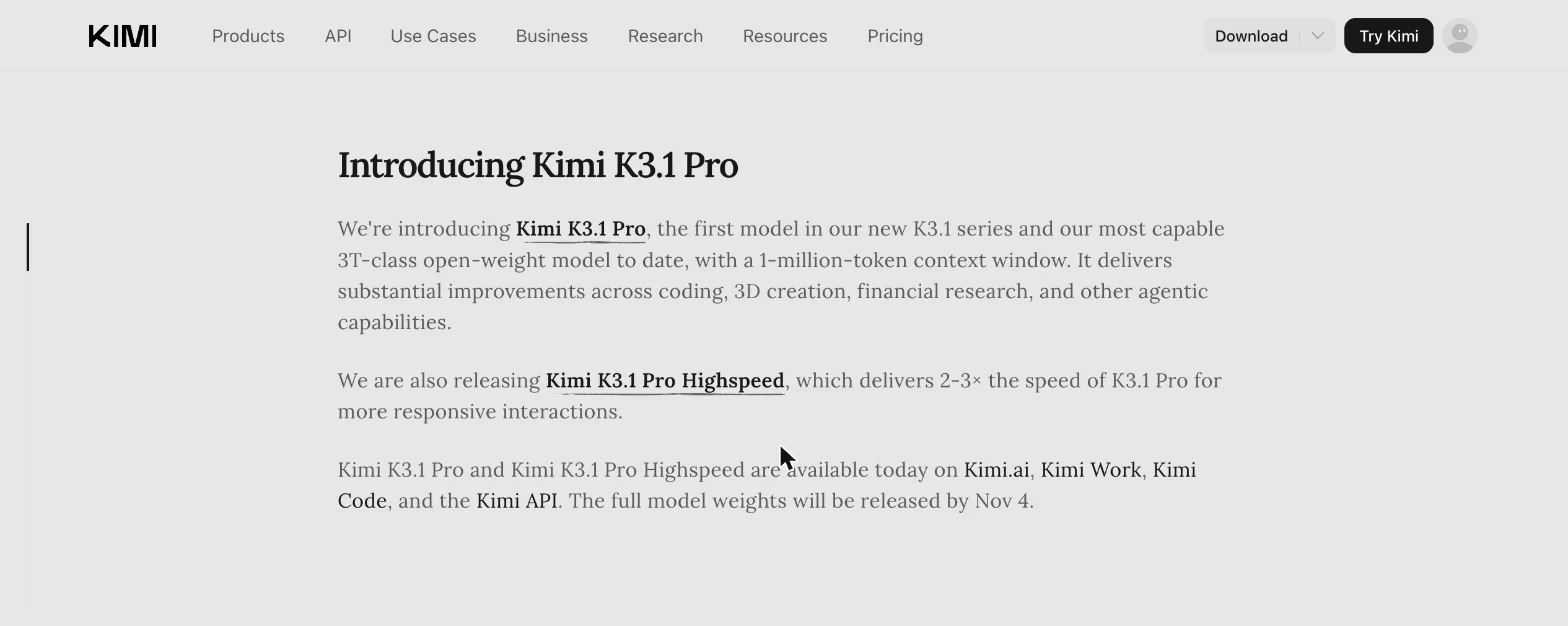
Kimi K3.1 Pro is a large language model that the Chinese AI company Moonshot AI announced on October 24, 2026, as the first model in its new K3.1 series. It went live the same day in four places:
- Kimi.ai, the chat service
- Kimi Work, the desktop app
- Kimi Code, the coding tool
- the Kimi API for developers
It is not a new architecture: Kimi K3.1 Pro is the July release of Kimi K3, post-trained with much more compute. Post-training is the stage after pretraining that turns a model into one people can actually use, and it is where skills such as coding or financial analysis get sharpened. Moonshot says it rebuilt its reinforcement learning (RL) setup, including the RL framework, long-context inference and training efficiency, so that it could train across hundreds of domains at once.
Moonshot calls K3.1 Pro its most capable "3T-class" open-weight model. An open-weight model is one whose trained weights are published, so anyone can download it and run it on their own servers. The K3 architecture and license are covered in Kimi K3 benchmarks, pricing and open weights.
the first model in our new K3.1 series and our most capable 3T-class open-weight model to date, with a 1-million-token context window. / Kimi K3.1 Pro is a post-trained version of Kimi K3, with substantially larger post-training compute. — From the opening paragraph and "Advancing the Frontier of Open Intelligence"View official source →
The base Kimi K3 has 2.8T parameters, 104B active per token
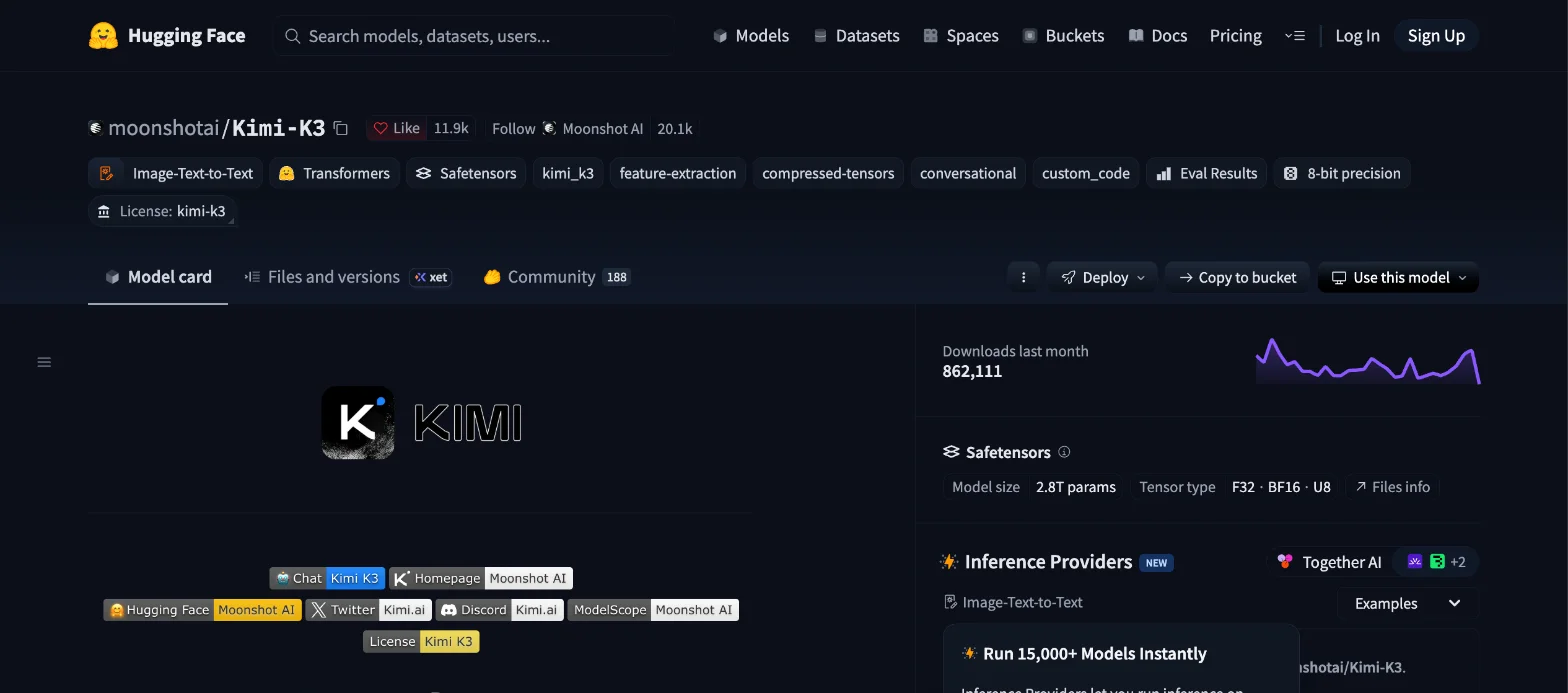
Kimi K3 is a mixture-of-experts (MoE) model, which means it holds many specialized sub-networks and switches on only a few of them for each input. So although the base K3 has 2.8 trillion parameters in total, only 104 billion of them work on any single token. A token is the smallest unit of text a model processes, roughly a short word or part of one.
Its context window, the amount of text the model can take in at once, is 1,048,576 tokens, or about one million. Because K3.1 Pro is a post-trained K3, it keeps the same one-million-token window.
Total Parameters / 2.8T / Activated Parameters / 104B — From the specification table (total and activated parameters)View official source →
A Highspeed version runs at 2-3× the speed
On the same day Moonshot also released Kimi K3.1 Pro Highspeed, which answers two to three times faster than K3.1 Pro. On the API the two models are called kimi-k3.1-pro and kimi-k3.1-pro-highspeed, and API customers can turn on Zero Data Retention so that their data is not stored.
In Kimi Enterprise, K3.1 Pro starts switched off, and an administrator has to enable it for the organization. Kimi Work needs desktop app version 3.1.0 or later, and in Kimi Code you pick the model with the /model command.
which delivers 2-3× the speed of K3.1 Pro for more responsive interactions. / can enable K3.1 Pro for their organization; access is off by default at launch. / version 3.1.0 or later, available for Windows and Apple silicon Macs. / select kimi-k3.1-pro / kimi-k3.1-pro-highspeed. Zero Data Retention is available for API customers. — From the Highspeed paragraph and each channel under "Availability"View official source →
Benchmarks put it just behind Claude Opus 5.5 on coding
A benchmark is a shared set of test problems used to score and compare AI models. On those tests, Kimi K3.1 Pro lands just behind Claude Opus 5.5 on coding and ahead of GPT-6 Astra. Every number below comes from Moonshot's own blog, and unless noted, K3.1 Pro was run with reasoning effort set to max.
Kimi K3.1 Pro against other vendors' models
Bars show the score in percent (higher is better), scaled to the highest bar in each chart. Source: Moonshot AI blog.
 Kimi K3.1 Pro
 Claude Opus 5.5
 GPT-6 AstraKimi K3.1 ProClaude Opus 5.5GPT-6 Astra
It beats GPT-6 Astra with 65.7% on Terminal-Bench 4.0
Terminal-Bench 4.0 tests how well an AI agent handles real coding tasks in a terminal, the text window where you type commands. K3.1 Pro scored 65.7%, ahead of GPT-6 Astra at 58.2% and just short of Claude Opus 5.5 at 66.4%.
Moonshot ran K3.1 Pro through Claude Code as the harness, the program that runs the model through each test. On Kimi Code Bench 3.0, its internal test of long, multi-step coding work, K3.1 Pro rose from K3's 55.95% to 61.2%.
It does not lead everywhere, though. On BenchCAD, which asks a model to rebuild 3D objects from several rendered views by writing CAD code, K3.1 Pro scored 92.7% with tools, behind Claude Opus 5.5 at 96.2% and GPT-6 Astra at 95.9%. Moonshot also says the model builds games in Unity, Unreal Engine and Godot, and writes scripts that drive Blender and CAD software.
K3.1 Pro scores 65.7%, ahead of GPT-6 Astra (58.2%) and narrowly behind Claude Opus 5.5 (66.4%) / Kimi K3.1 Pro is evaluated with the Claude-Code harness. / K3.1 Pro scores 92.7% with tools / Claude Opus 5.5 (96.2%) / GPT-6 Astra (95.9%) / Unity, Unreal Engine, and Godot — From the Terminal-Bench 4.0 and BenchCAD results, the test notes and the game-engine paragraphView official source →
Claim-level hallucinations drop from 23.4% to 8.3%
A hallucination is when an AI states something false as if it were true. On Kimi Hallu Bench Hard, Moonshot's internal test of factual accuracy, the share of individual claims that were hallucinated fell from 23.4% for K3 to 8.3%. The share of answers with at least one factual error fell to 42.4% of K3's rate.
The test is built from questions chosen because models tend to get them wrong. Moonshot notes that the rates are not the error rates you would see in everyday use.
Finance work improved as well. On OfficeQA Pro v2, which asks questions about real financial documents, K3.1 Pro scored 64.4, a result Moonshot calls state of the art. On its internal finance tests, financial modeling rose 7.2 points over K3 and financial research 11.6 points, and in a simulated business it scored about 4.2 times what K3 did.
its claim-level hallucination rate fell from 23.4% for K3 to 8.3%, while the share of responses containing at least one factual error was just 42.4% of its predecessor's rate. / The reported rates do not represent overall error rates in daily use. / K3.1 Pro achieves state-of-the-art results on OfficeQA Pro v2 (64.4), / K3.1 Pro improves on K3 by 7.2 points. / K3.1 Pro achieves about 4.2× K3's performance. — From the Kimi Hallu Bench Hard result and note, and the finance resultsView official source →
API prices are a third below K3's, and the weights are out
An API is the interface that lets software call another service's functions and data. On the Kimi API, Kimi K3.1 Pro costs a third less than K3 for both input and output. The weights are also out on Hugging Face, so you can run the model on your own servers instead of going through Kimi's apps or the API.
Kimi API price per million tokens (US dollars)
Bars are scaled to the highest price in each chart. Prices from the Kimi API pricing page on October 29, 2026.
K3.1 ProK3.1 Pro HighspeedK3K3.1 ProK3.1 Pro HighspeedK3Input costs $2 and output $10 per million tokens
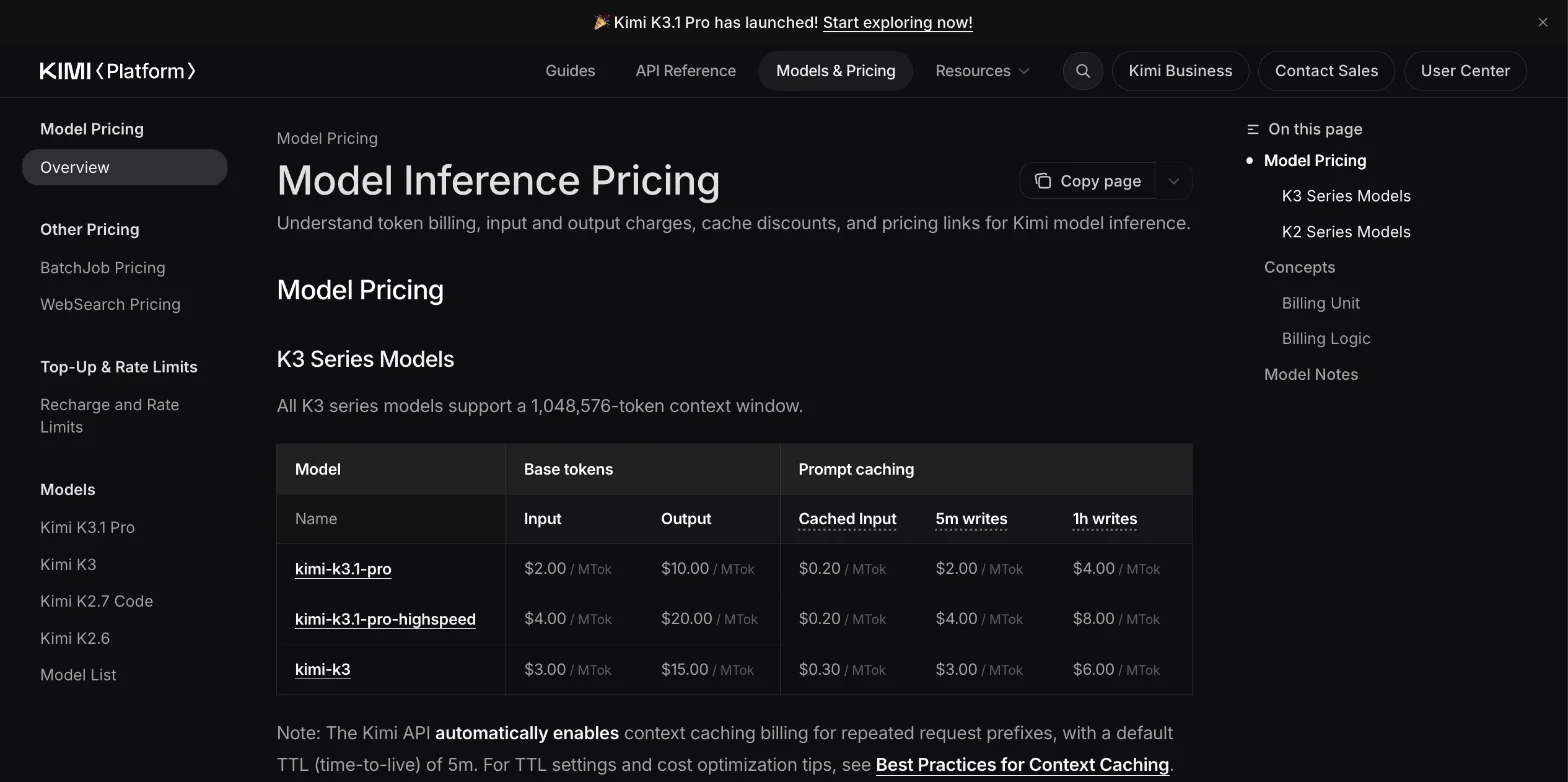
Kimi K3.1 Pro costs $2 per million input tokens and $10 per million output tokens. K3 costs $3 and $15, so the same workload on K3.1 Pro comes to two thirds of the K3 bill. Cached input, the part of a prompt that repeats an earlier request, drops to $0.20, against $0.30 on K3.
Highspeed costs $4 for input and $20 for output, exactly twice the K3.1 Pro rate. API use is pay-as-you-go and is billed separately from a Kimi membership or Kimi Code.
Model inference on the Kimi API platform is billed on a pay-as-you-go basis, with no subscription plan. It differs from products such as the Kimi membership and Kimi Code. — From the billing descriptionView official source →
The released weights were trained without cyber-related data
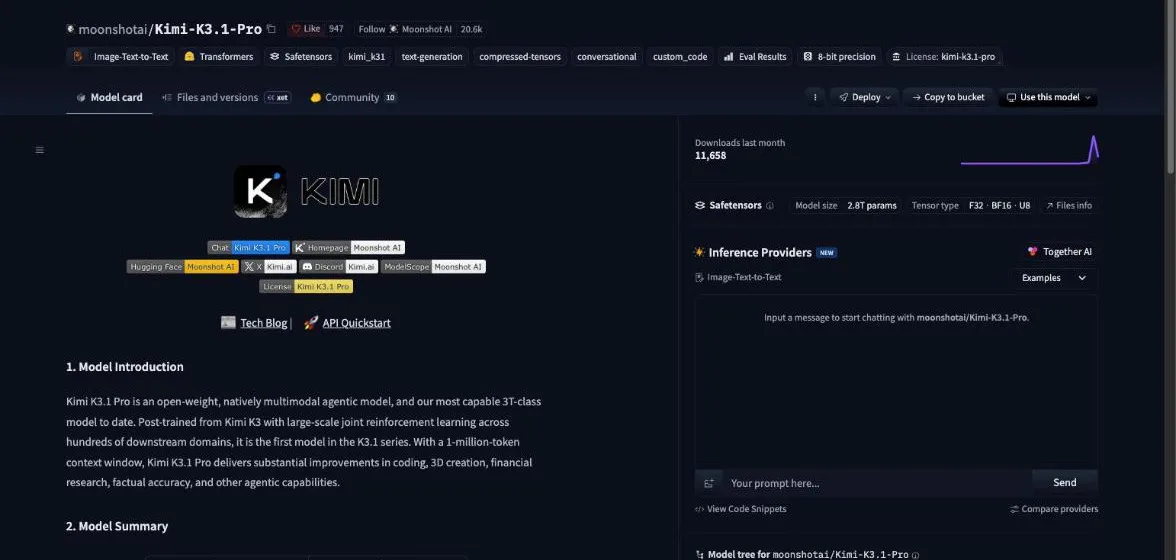
Moonshot had promised to release the full K3.1 Pro weights by November 4, 2026. The Hugging Face repository was created on November 2, and as of November 6 anyone can download the weights.
Moonshot removed cyber-related data from both mid-training and reinforcement learning before releasing them. It says these targeted controls lower the risk of misuse while keeping the model useful for general work.
A vulnerability is a security weakness in software or a system. On xdev-bench-hard, Moonshot's internal test of writing exploits for known vulnerabilities, a version trained without the data removal solved 90.5% of tasks, while the released open-weight K3.1 Pro solved 81.0%.
Moonshot says this cyber capability still trails frontier proprietary models that have been public for three months or more. It also says it will not release open weights that push the frontier of cyber capability forward.
Full model weights will be released by Nov 4, 2026. / solves 90.5% of problems at pass@3; the final K3.1 Pro reaches 81.0%. / First, we aim not to release open weights that would extend the absolute frontier of cyber capability. — From the weight release date, the xdev-bench-hard result and the open-weight principlesView official source →
Kimi K3.1 Pro is released under the Kimi K3.1 Pro License. — From the license sectionView official source →
Switch the API to K3.1 Pro now, read the license to self-host
If you already use Kimi K3 through the API, setting the model name to kimi-k3.1-pro is enough to try a cheaper K3.1 Pro. K3.1 Pro is built on K3 and keeps the same one-million-token context window. On top of that, its price is a third lower and its scores on coding and factual accuracy are higher.
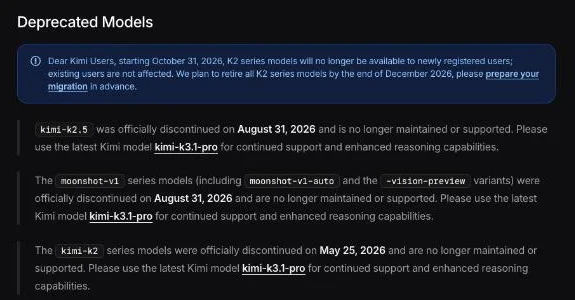
Teams still on the older Kimi K2 models have until the end of 2026, at the latest, to move. Kimi's API model list says the K2 series stopped accepting new accounts on October 31, 2026, while accounts that already use it can carry on for now.
That grace period is short. Moonshot plans to switch off every K2 model by the end of December, and one of them, kimi-k2.5, was already shut down on August 31. The list names kimi-k3.1-pro as the model to move to.
If you want to download the weights and run them on your own servers, read the Kimi K3.1 Pro License on Hugging Face first. Only the main K3.1 Pro weights were released; the Highspeed version has none.
The released weights were trained without cyber-related data, and they score lower on the exploit-writing test than a version trained with that data. For work that needs exploit knowledge, such as security testing, factor that gap into the choice of model.
starting October 31, 2026, K2 series models will no longer be available to newly registered users; existing users are not affected. / We plan to retire all K2 series models by the end of December 2026, please prepare your migration in advance. / kimi-k2.5 was officially discontinued on August 31, 2026 and is no longer maintained or supported. / Please use the latest Kimi model kimi-k3.1-pro for continued support — From the Deprecated Models noticeView official source →
FAQ
- How much does Kimi K3.1 Pro cost?
- On the Kimi API it costs $2 per million input tokens and $10 per million output tokens, a third less than Kimi K3 at $3 and $15. The faster Highspeed version costs $4 and $20. API use is pay-as-you-go and separate from a Kimi membership. These are the prices on the Kimi API pricing page on October 29, 2026.
- Where can I download the Kimi K3.1 Pro weights?
- The weights are on Hugging Face at moonshotai/Kimi-K3.1-Pro, and you can download them without requesting access. They are released under the Kimi K3.1 Pro License. Only the main K3.1 Pro weights are there; the Highspeed version has none. This is based on the Hugging Face page as of November 6, 2026.
- What is the difference between Kimi K3.1 Pro and Kimi K3?
- Kimi K3.1 Pro is Kimi K3 post-trained with much more compute, not a new architecture. It scores higher on coding, finance and factual-accuracy tests, and its API price is a third lower than K3's.
Related articles
 Kimi K3 Distillation: What the White House ClaimsThe Kimi K3 distillation claim: the White House says Moonshot AI distilled Anthropic's Fable. What Kratsios posted, what Moonshot denies, what is unproven.
 Kimi K3 benchmarks, pricing and open weightsKimi K3 is Moonshot AI's 2.8T-parameter open-weight model. Here is what its benchmark scores mean, what the API costs, the license terms and hardware needs.
 Reflection Beam is a 501B open-weight MoE modelReflection Beam has 501B total and 23B active parameters. See its scores against Kimi K3, GLM 5.2 and DeepSeek V4 and when the Apache 2.0 weights ship.
 Chinese Open Source AI Faces Possible US CurbsChinese open source AI models may face new US restrictions. The trigger, Kimi K3, the measures under discussion, and the split inside the administration.