Over a million people have used the LinkedIn AI slop button
LinkedIn announced a button labeled "Seems like AI slop" on 30 July 2026, and chief product officer Hari Srinivasan wrote in a Thursday post that "over a million people" had clicked it. The Verge reported that post on 21 August 2026.
"AI slop" is a common name for low-quality filler written by AI, and it is the label on LinkedIn's button. LinkedIn says a lot of people have already used the button, and Srinivasan's figure counts people, not clicks. The report gives no total for clicks.
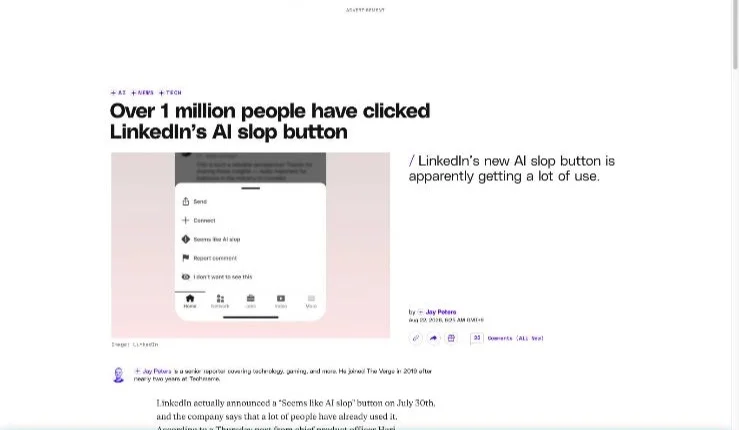
"LinkedIn actually announced a “Seems like AI slop” button on July 30th, and the company says that a lot of people have already used it. According to a Thursday post from chief product officer Hari Srinivasan , “over a million people” have clicked on the button, which is accessible from the three dots menu on a post."(article body)— The VergeView official source →
Where to find "Seems like AI slop" on a LinkedIn post
The option is in the three dots menu on a LinkedIn post, under the label "Seems like AI slop". LinkedIn announced it on 30 July 2026. It came with classifiers, the programs that judge whether a post was written by AI, and with the removal of a feature that offered to "enhance your post" with AI.
LinkedIn calls the classifiers "new and improved". The Verge's report does not say what the button does to a post once someone selects it.
"“over a million people” have clicked on the button, which is accessible from the three dots menu on a post."/"Alongside the AI slop button, LinkedIn introduced “new and improved” classifiers to identify posts as AI and removed a feature that would “enhance your post” with AI."(article body)— The VergeView official source →
Pangram rated 41% of LinkedIn longform posts AI-made
A few weeks before LinkedIn announced the button, the AI detector Pangram flagged 41% of LinkedIn's longform posts as fully AI-generated. A detector is a tool that scores whether a text was written by AI. 404 Media reported the result.
The 41% is Pangram's finding, not a number LinkedIn produced. Srinivasan said at the time that AI slop is "a top priority for all of us." Earlier in 2026, LinkedIn had also said it would crack down on comments that users create at scale with little or no human involvement.
"LinkedIn announced the button a few weeks after AI detector Pangram determined that 41 percent of LinkedIn’s longform posts were flagged as fully AI generated, which 404 Media reported on ."/"“AI slop is a top priority for all of us,” Srinivasan said at the time"/"Earlier this year, LinkedIn also said it would be cracking down on comments users create at scale “with little or no human involvement.”"(article body)— The VergeView official source →
LinkedIn says AI slop posts now get 40% fewer views
In his Thursday post, Srinivasan said users are now seeing 40% fewer views on what LinkedIn classifies as AI slop than a few weeks earlier. The figure is the company's own, and it rests on its own classification of which posts count as AI slop.
The number describes views of posts LinkedIn has already classified. It does not say how many such posts there are. The Verge says it sounds as if the platform's changes may be making a difference.
"In Thursday’s post, Srinivasan said that users are overall “now experiencing 40% less views on what we classify as AI slop from just a few weeks ago.”"/"it sounds as if the platform’s changes may be making a difference"(article body)— The VergeView official source →
What Hari Srinivasan says LinkedIn will tell authors
LinkedIn is adding a message for people who make a post, telling them when some members said the post seems like AI. The wording is "Some members told us this post seems like AI." The Verge says LinkedIn is adding it, and does not say it is live yet.
Srinivasan described the thinking behind it this way: LinkedIn approached the change assuming good intent. He added that he is increasingly conscious of how not to sound like AI himself, and that the goal is to provide helpful feedback.
"LinkedIn is also adding a new message that will tell users who make a post if “Some members told us this post seems like AI.”"/"“We approached this assuming good intent; I know I’m increasingly conscious on how to not sound like AI & the goal is to provide helpful feedback,” Srinivasan said."(article body)— The VergeView official source →
Points the report leaves open
The Verge's report of 21 August 2026 leaves six things open. It does not say:
- how LinkedIn decides that a post is AI slop
- how many posts were classified
- how the 40% was measured
- when the message to authors goes live
- what an author can do after seeing the message
- how many times the button was clicked in total
Each number here comes from one party. The million people and the 40% fewer views come from LinkedIn, through Srinivasan's post, and the 41% comes from Pangram. Everything above is as of 21 August 2026.
FAQ
- Where is the LinkedIn AI slop button?
- It sits in the three dots menu on a post, where it reads 'Seems like AI slop'. LinkedIn announced it on 30 July 2026, and its chief product officer says over a million people have clicked it since.
- Does the poster find out they were reported?
- LinkedIn says it is adding a message that tells the author when some members said the post seems like AI. The Verge's report does not say when the message goes live. Srinivasan said LinkedIn approached it assuming good intent.
- Where did the 41% figure come from?
- It came from Pangram, an AI detector, which found 41% of LinkedIn's longform posts flagged as fully AI generated. 404 Media reported the finding, and LinkedIn announced the button a few weeks later. The figure is Pangram's, not LinkedIn's.
Related articles
 Claude Fable 5.2: 20% price cut, up to 30% fasterAnthropic released Claude Fable 5.2 on November 9, 2026. API prices fall 20% to $8/$40 per million tokens, and output is up to 30% faster than Fable 5.1.
 PayPay security and passkeys in 10 Japan pay appsPayPay security compared with 9 other Japanese payment apps: passkeys, extra checks to send or pay, and fraud compensation deadlines.
 AI fact check: only 40% of cited stats hold upAI fact check: Trakkr traced 1,285 stats cited by ChatGPT, Perplexity, Gemini, Claude and AI Overviews. Only 40% led to a matching study. How to check one.
 Akamai: online scams double and overtake phishingAkamai's fraud report says online scams doubled to about 6.4 million and passed phishing in Q1 2026, while phishing sites now last 22 days instead of 48.