What Microsoft announced on October 12
Microsoft announced Maia 300, the third generation of its Azure Maia AI accelerators, in a blog post by Scott Guthrie, executive vice president of Cloud + AI. The post sets 2027 as the start of production deployments.
Maia to become Microsoft's main inference system
Microsoft plans to make Maia the primary inference system for its products and services, scaling the chip family to multi-gigawatt deployments starting in 2027. Inference is the work an AI model does after training, when it reads a prompt and writes a response.
Multi-gigawatt refers to the electricity the deployment draws. The post does not give a total gigawatt figure or name the datacenter regions.
Built for long context, chat and agents
Microsoft designed Maia 300 for three newer kinds of AI work. The post lists three:
- Reasoning over long context, where a model reads a large amount of text at once
- Conversations where response time matters
- Agents that carry out many steps in a row
According to Microsoft, moving data efficiently, more than raw compute, is becoming the bottleneck in large inference systems. Maia 300 roughly doubles HBM bandwidth per watt over Maia 200 to address that.
We will scale our Azure Maia family to multi-gigawatt deployments starting in 2027, making Maia the primary inference system for Microsoft products and services. / Maia 300 is a complete intelligent system designed for the new types of AI workloads emerging today: Long-context reasoning, latency-sensitive conversational experiences and sustained, multi-step agentic tasks. — from the opening of the post and the Maia 300 overviewView official source →
What the 40% and 7x figures are measured against
The two headline numbers use different baselines, so they cannot be read as one claim. A token is the unit of text an AI model processes; tokens per megawatt measures how much work a system gets out of its power budget.
Maia 300 performance claims and their baselines (Microsoft and Azure blogs)
| Figure | Compared with | Metric |
|---|---|---|
| 40% more | Leading GPU-based systems | Tokens per megawatt |
| Up to 7x | Maia 200 | Token throughput of a 96-chip rack |
| More than 2.5x | Maia 200 | Rack performance per watt |
Expected 40% more tokens per megawatt than leading GPUs
Microsoft expects Maia 300 to produce 40% more tokens per megawatt than leading GPU-based systems. The post presents this as an expectation tied to efficiency gains across the whole system. Microsoft has not published a measured result behind it.
Up to 7x Maia 200's rack throughput at 96 chips
A full rack of 96 Maia 300 chips delivers up to seven times the token throughput of a Maia 200 rack. That figure compares whole racks, and since a Maia 300 rack holds twice as many chips, it is not a per-chip comparison. The Azure engineering post adds a per-watt figure: the Maia 300 rack does more than 2.5 times the work of Maia 200 for the same power.
Microsoft has not named the GPU baseline
Neither Microsoft post identifies the GPU system behind the 40% figure or the conditions of the comparison. Nobody outside Microsoft can check the number yet.
OpenAI, by contrast, reported 1.5–1.9x the work per watt of Nvidia GB200 and GB300 for its own inference chip. Those results and their test conditions are covered in OpenAI Jalapeno Chip: Inference Benchmarks 2026.
By improving efficiency across the system, we expect Maia 300 to deliver 40% more tokens per megawatt compared to leading GPU-based systems. / And in a full 96-accelerator configuration, it delivers up to 7x the rack-scale token throughput of Maia 200. — from the Maia 300 overviewView official source →
Maia 300 chip and rack specifications
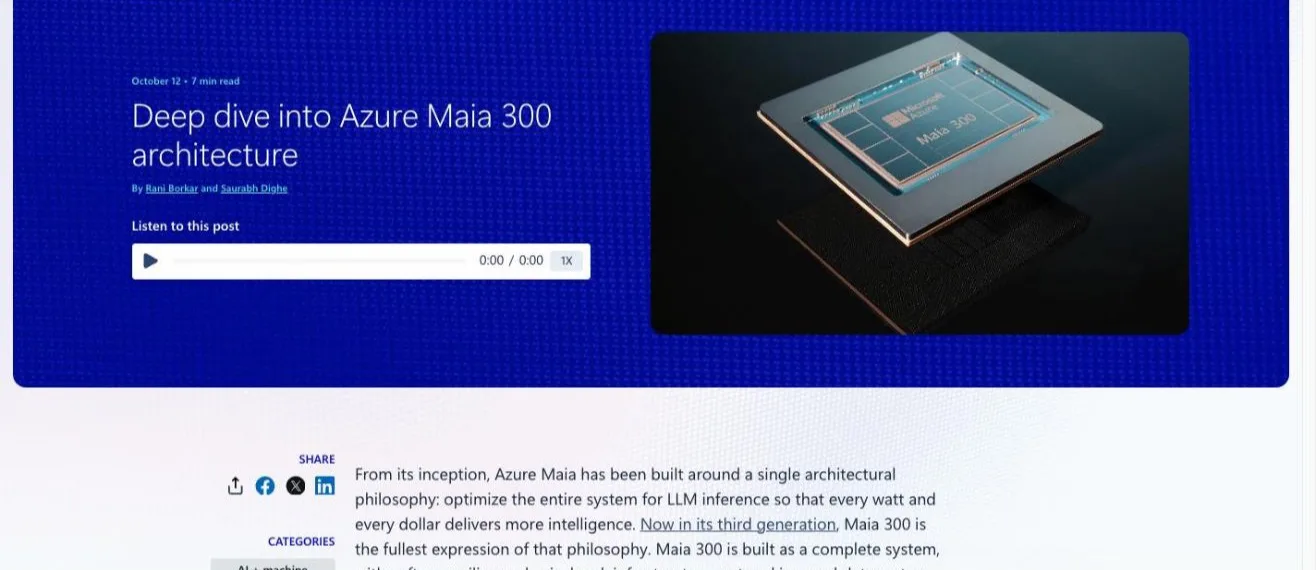
Microsoft describes Maia 300 as a full system, with the chip, rack, cooling and network designed together. Rani Borkar, president of Azure Hardware Systems and Infrastructure, and Saurabh Dighe, who leads Azure hardware planning and architecture, published an architecture write-up the same day.
Maia 300 key specifications (Microsoft and Azure blogs)
| Item | Maia 300 |
|---|---|
| Memory | 8 HBM4 stacks, 288 GB |
| Memory bandwidth | 18.0 TB/s |
| Power (TDP) | 950 W |
| Compute chiplet process | TSMC N2P |
| Rack | 96 chips, 167 kW |
| Rack HBM | 27.6 TB, 1.7 PB/s |
288 GB of HBM4 at 18 TB/s in a 950 W chip
Each Maia 300 carries eight stacks of HBM4, for 288 GB of capacity and 18.0 TB/s of peak bandwidth. HBM is stacked memory placed right beside the processor, so it can move data quickly. Compared with Maia 200, bandwidth is 2.5 times higher and capacity is up 33%.
The chip splits compute, memory control and input/output into separate chiplets, smaller dies packaged together as one chip. The compute chiplets are built on TSMC's N2P process, and the whole chip is rated at a 950 W TDP, the maximum power it is designed to draw.
96 chips in a 167 kW liquid-cooled rack
A Maia 300 rack fits 96 chips on 24 trays of four, inside a 167 kW power budget. That is double the chip density of a Maia 200 rack.
Liquid cooling takes away more than 80% of the rack's heat, while air handles memory, storage and other parts. Microsoft says the rack can connect to facility water or, in air-cooled buildings, use a heat-exchanger unit.
Up to 12,288 chips in one superpod
A two-tier, Ethernet-based network links up to 128 racks, or 12,288 chips, into what Microsoft calls a superpod. Links inside a rack are electrical, and links between racks are optical. Any chip can reach any other chip in the superpod directly.
Eight HBM4 stacks provide 18.0 TB/s of peak memory bandwidth within a 950-watt TDP, enabling efficient execution of large models and long-context workloads. / Maia 300 rack systems bring together 96 accelerators within a 167-kilowatt power envelope, delivering 27.6 TB of HBM capacity and 1.7 PB/s of aggregate HBM bandwidth across a high-speed scale-up domain. — from the Maia 300 capability listView official source →
eight HBM4 stacks providing 288 GB of capacity and 18 TB/s of bandwidth per accelerator. / Maia 300 brings 2.5 times the memory bandwidth, 33% more capacity, and approximately 2 times the HBM bandwidth per watt compared with Maia 200 / A two-tier network builds a high-performance superpod with up to 12,288 accelerators. / Liquid cooling removes more than 80% of the rack’s thermal load from accelerators, voltage regulators, and switch ASICs, while air cooling supports memory, storage, and other ancillary components. / Relative to Maia 200, Maia 300 delivers up to 7 times greater rack-scale token throughput in its full 96-accelerator configuration and more than 2.5 times the performance per watt. — from the memory, network, cooling and summary sectionsView official source →
Where Maia 200 already runs
Maia 200 is already handling production work inside Microsoft, and the company says what it learned there shaped Maia 300. Microsoft runs Maia as a multigenerational program, and Maia 200 is the generation in service now.
Where Maia 200 runs today (Microsoft blog)
| Item | Detail |
|---|---|
| In production | Microsoft Copilot and other services |
| Due by year-end | GitHub Copilot, Microsoft Foundry |
| Models | OpenAI, Microsoft MAI, leading open-source families |
| Regions | United States, Europe, Australia |
Copilot now, GitHub Copilot and Foundry by year-end
Maia 200 serves Microsoft Copilot and supports the MAI team, Microsoft's in-house model group, as it builds new models. GitHub Copilot and Microsoft Foundry, the company's platform for building AI apps, are set to move onto it by the end of 2026.
The chip is not tied to a single model vendor. It runs OpenAI models, Microsoft's own MAI models and leading open-source model families. Maia 200 is rolling out across the United States, Europe and Australia.
Up to 1.7x more tokens per watt than leading GPUs
For the AI features built into Teams, Copilot and Cowork, Microsoft says Maia 200 produces up to 1.7 times more tokens per watt than leading GPU infrastructure. As with the Maia 300 claim, the GPU is not named.
Maia 200 is now serving Microsoft production workloads, including Microsoft Copilot, and supporting the MAI team as they develop next-generation models, with GitHub Copilot and Microsoft Foundry to follow by end of year. / Maia 200 is deploying across the United States, Europe and Australia and delivering up to 1.7x more tokens per watt for built-in AI capabilities in Microsoft Teams, Copilot and Cowork experiences compared with leading GPU infrastructure. — from the Maia 200 sectionView official source →
What to watch at Ignite in November
Microsoft has committed to a 2027 start, but several details are still open. The company says it will share more about its AI strategy at Microsoft Ignite 2026, held November 17–20 in San Francisco and online.
- Which GPU system the 40% figure is measured against, and under what conditions
- How many gigawatts the Maia rollout will reach, and in which regions
- Whether Azure customers will be able to rent Maia capacity, which the announcement does not address
Until Microsoft fills those gaps, read the 40% figure as a projection against an unnamed GPU, and the 7x figure as a rack-to-rack comparison with Maia 200 rather than a per-chip gain. The 1.7x figure for Maia 200 rests on the same unnamed GPU baseline.
FAQ
- When will Microsoft start using Maia 300?
- Microsoft says Maia 300 production deployments begin in 2027. From that year it plans to grow the Maia family to multi-gigawatt scale and make it the primary system for inference in its own products.
- Which GPU is the 40% figure measured against?
- Microsoft does not say. Its post compares Maia 300 with leading GPU-based systems without naming a product or describing the test setup, and the 40% figure is a projection rather than a measurement.
- Can Azure customers rent Maia 300?
- The announcement does not say. Every workload Microsoft lists runs inside its own services. Copilot uses Maia 200 today, and GitHub Copilot and Microsoft Foundry move onto it by the end of 2026.
Related articles
 North Korean hackers embed AI in their operationsMicrosoft rated eight North Korean hacking groups on AI use on October 29, 2026. Three run AI across entire operations, from fake recruiters to malware.
 Microsoft offers buyouts to about 60,000 employeesMicrosoft offers voluntary buyouts to staff at level 70 and below in four countries. CNBC says about 60,000 are eligible; those who accept leave Dec. 31.
 Microsoft-Decision-1: Jev-priced decision modelMicrosoft-Decision-1 scores fixed options instead of writing text, at Jev's price of $0.042 per million input tokens. JevBench measured 459 ms, not 85 ms.
 Nadella says to treat AI models as insider risksMicrosoft CEO Satya Nadella says companies should assume AI models are compromised, keep controls outside them and let a person stop them mid-task.