What OpenAI's Jalapeño Chip Actually Is
Jalapeño at a glance
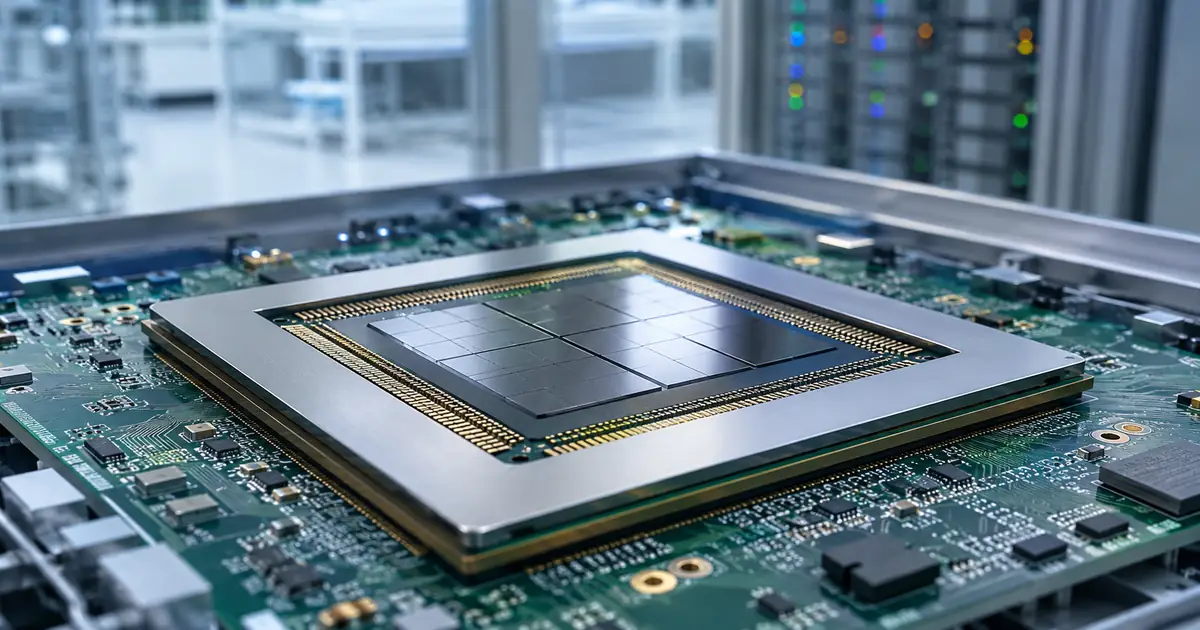
Jalapeño is a chip OpenAI designed from scratch to run its language models and built with Broadcom. At the June 24, 2026, unveiling, Broadcom President and CEO Hock Tan and Broadcom President Charlie Kawwas delivered the chip to OpenAI CEO Sam Altman and President Greg Brockman. OpenAI called the moment an important step in its strategy to build the full stack behind its models and products.
An "Intelligence Processor," Not a GPU
"Intelligence Processor" is OpenAI's own name for Jalapeño, and OpenAI architected it around its view of where LLM inference is heading. OpenAI says Jalapeño is a blank-slate design, not a general-purpose accelerator adapted from earlier AI workloads. That is the real difference from a GPU, which has to serve many buyers and many kinds of work.
OpenAI did not build it alone. Broadcom and Celestica help industrialize the platform through chip implementation, board and rack system integration, high-performance networking, and scalable production, with Broadcom's Tomahawk networking silicon in the mix. Jalapeño is also the first AI accelerator in a multi-generation compute platform the two companies are building together.
"OpenAI and Broadcom (NASDAQ: AVGO) today unveiled Jalapeño, OpenAI's first Intelligence Processor: an accelerator architected around OpenAI's vision for the future of LLM inference" / "Jalapeño is a blank-slate design for modern LLM inference, not a general-purpose accelerator adapted from earlier AI workloads." — from OpenAI's June 24, 2026 announcementView official source →
Inference-Only, by Design
AI work comes in two stages. Training builds a model from large amounts of data, while inference runs the finished model to answer a request, which is what happens every time ChatGPT replies. Jalapeño is built only for inference, the stage that runs each time someone actually uses a model.
Richard Ho, OpenAI's hardware lead, says the team tuned the design to what counts most when serving frontier models: kernels, how memory moves, networking, and serving patterns. Engineering samples already run ML workloads in OpenAI's lab at their target production frequency and power, and GPT‑5.3‑Codex‑Spark is one of them.
"Jalapeño was designed from the ground up for LLM inference using detailed insights from our close collaboration with OpenAI researchers" / "We optimized the architecture around the kernels, memory movement, networking, and serving patterns that matter most for frontier AI models." / "Engineering samples of the Jalapeño chip are running ML workloads in the lab at production target frequency and power, including GPT‑5.3‑Codex‑Spark." — Richard Ho's statement and the lab status, from OpenAI's announcementView official source →
The August 25 Benchmark Results, Explained
Jalapeño's first benchmark results (shared by OpenAI on August 25, 2026)
| Measure | Result |
|---|---|
| AI work per watt at peak throughput | 1.5 to 1.9x more than the comparison Nvidia systems |
| End-to-end latency | 1.7 to 3.6x lower than the comparison Nvidia systems |
| Benchmark | SemiAnalysis InferenceX |
| Models tested | GPT-OSS 120B, DeepSeek R1 670B, Kimi K2.5 1T |
| Comparison systems | GB200 (GPT-OSS 120B), GB300 (DeepSeek R1, Kimi K2.5) |
| Power rating in OpenAI's charts | Jalapeño 700 watts, GB200 1,200 watts, GB300 1,400 watts |
Two months after the June unveiling, OpenAI took Jalapeño's first measured results to Hot Chips on Tuesday, August 25, 2026. The test bench was SemiAnalysis's open InferenceX suite. Three open-weight models went through it, from the smallest to the largest: the 120B GPT-OSS, the 670B DeepSeek R1, and the 1T-parameter Kimi K2.5.
1.5 to 1.9x More Work per Watt
Across those three models, Jalapeño delivered 1.5 to 1.9x more AI work per watt at peak throughput and 1.7 to 3.6x lower end-to-end latency than the comparison Nvidia systems, a GB200 for GPT-OSS 120B and a GB300 for DeepSeek R1 and Kimi K2.5. The chip did more inference on the same power while also answering faster, and OpenAI presents that combination as the point of the design. Richard Ho called the results a "very, very significant performance advance over state of the art."
OpenAI ties the gains to cutting data movement. Model state, including the KV cache used while a response is being generated, can be placed and kept local while the system activates the right mix of compute, memory, and networking for each phase of inference.
"At the Hot Chips conference on Tuesday, OpenAI shared a more detailed look at Jalapeño, including the first batch of benchmark results for the new system." / "The bottom line is that the results show a very, very significant performance advance over state of the art" / "Jalapeño can serve more AI work per unit of power, while also returning responses more quickly." — TechCrunch's report on the Hot Chips talk, including Richard Ho's press callView official source →
"Across all three, Jalapeño delivered 1.5 to 1.9 times more AI work per watt at peak throughput and 1.7 to 3.6 times lower end-to-end latency than the comparison systems." / "We designed Jalapeño to minimize data movement and communication delays." — from OpenAI's August 25, 2026 results postView official source →
Why the Comparison Chip Matters
Both headline multipliers are measured against specific Nvidia systems: a GB200 for GPT-OSS 120B and a GB300 for DeepSeek R1 and Kimi K2.5. Change the baseline and the multipliers change with it, so the figures describe Jalapeño against those two systems, not against every chip on the market.
Power ratings are part of the picture too. In OpenAI's own charts, the GB200 is rated at 1,200 watts, the GB300 at 1,400 watts, and Jalapeño at 700 watts, so the per-watt figures say more about efficiency than about how much work a single chip does.
The numbers are also OpenAI's measurements of its own hardware, so the original posts are worth reading in full. If you plan to hand them to an AI summarizer, converting the page to Markdown first keeps the headings and lists intact.
"To compare the systems consistently, we normalized the results using each accelerator’s published chip power rating." / "InferenceX · GPT‑OSS‑120B · nominal 8k/1k · STP · package TDP: Jalapeño 700 W; GB200 1,200 W" / "InferenceX · DeepSeek R1 MXFP4 · nominal 8k/1k · STP · package TDP: Jalapeño 700 W; GB300 1,400 W" / "InferenceX · Kimi K2.5 MXFP4 · nominal 8k/1k · STP · package TDP: Jalapeño 700 W; GB300 1,400 W" — from the results post and its appendix chartsView official source →
How Jalapeño Compares to Nvidia's GB200 and GB300
On the GB200 and GB300 comparisons OpenAI chose, Jalapeño comes out ahead on both efficiency and latency across all three models. TechCrunch summed up the results as more tokens per user and more throughput per kilowatt than the most advanced inference processors currently available. What the results do not show is a blanket win over Nvidia, because they cover two baseline systems and three public models, and OpenAI ran the tests itself.
"Tested on SemiAnalysis' InferenceX benchmark, Jalapeño registered both more tokens per user and more throughput per kilowatt than the currently available state-of-the-art inference processors." — TechCrunch's summary of the benchmark resultsView official source →
The 104.3x Number Comes From One Operating Point
The largest multiplier in OpenAI's charts is 104.3x. It comes from the DeepSeek R1 chart in the appendix of OpenAI's results post, which compares Jalapeño with a GB300 system at the GB300's own best time between output tokens; at that setting, Jalapeño's throughput per kilowatt is 104.3x higher. OpenAI's own label ties the figure to one setting, 169.41 tokens per second per user, so it is not evidence that Jalapeño runs 104 times faster.
The catch is how low the GB300 sits at that point. According to OpenAI's appendix, the GB300 delivered 118 mixed tokens per second per kilowatt there against Jalapeño's 12,258, while the peak-throughput gap on the same DeepSeek R1 chart is about 1.7x. For Jalapeño's efficiency at peak throughput, the 1.5 to 1.9x per-watt figure is the one to quote. TechCrunch adds a broader caveat: the comparison is against an Nvidia Blackwell system, and the competition may have advanced by the time Jalapeño reaches full deployment.
"InferenceX · DeepSeek R1 MXFP4 · nominal 8k/1k · STP · package TDP: Jalapeño 700 W; GB300 1,400 W" / "Higher peak mixed TPS / kW ≈1.7× 19,641 vs. 11,781 mixed / kW" / "More throughput at previous TBT ≈104.3× 12,258 vs. 118 mixed / kW (at 169.41 tok/s/user)" — the DeepSeek R1 chart in the appendix of OpenAI's August 25, 2026 results postView official source →
"Notably, that comparison is against an Nvidia Blackwell system — but by the time Jalapeño reaches full deployment, the competition may have advanced significantly." — TechCrunch's report on the Hot Chips talkView official source →
The Nine-Month Design Behind Jalapeño
How Jalapeño reached tape-out so quickly
Jalapeño went from its first design to tape-out, the point where a finished chip design is sent off for manufacturing, in nine months. OpenAI believes no high-performance advanced chip has had a faster ASIC development cycle. That is OpenAI's own view in the announcement, not a record anyone else has verified.
"Jalapeño was co-developed from initial design to manufacturing tape-out in just nine months, and the custom AI accelerator program represents what we believe to be the fastest ASIC development cycle ever achieved in high-performance advanced semiconductors." — from OpenAI's announcementView official source →
OpenAI's Own Models Sped Up the Chip Design
OpenAI gives three reasons for the pace. Its engineering teams developed the software and hardware side by side, Broadcom brought its know-how in turning designs into silicon, and OpenAI's models sped up some steps of designing and optimizing the chip. So OpenAI's own AI models were among the tools used to make its inference chip.
The wording is careful, though. The models accelerated parts of the design and optimization process, and the announcement does not say which parts, so read it as a speedup to specific steps rather than a chip designed by AI.
"That speed reflects deep software-hardware co-development with OpenAI's engineering teams, Broadcom's silicon implementation expertise, and the use of OpenAI models to accelerate parts of the design and optimization process." — from OpenAI's announcementView official source →
When Jalapeño Deploys and What Changes
Jalapeño's public milestones
- October 2025First announced, according to TechCrunch
- June 24, 2026OpenAI and Broadcom unveil Jalapeño by name
- August 25, 2026First benchmark results at Hot Chips
- End of 2026Deployment begins in very small volumes
- 2027More significant deployment
Jalapeño has passed three public milestones so far. TechCrunch says the chip was first announced in October 2025, OpenAI unveiled it by name on June 24, 2026, and the first benchmark results came at Hot Chips on August 25, 2026. Deployment is the next milestone, and it starts small.
End of 2026 in Small Volumes, Wider Rollout in 2027
In TechCrunch's August 25 report, Richard Ho estimated that Jalapeño would deploy at the end of 2026 "in very small volumes," with more significant deployment coming in 2027. By OpenAI's own estimate, Jalapeño's footprint in 2026 will be small, and 2027 is the year to watch.
The longer-term plan is much bigger. According to OpenAI's announcement, the platform will roll out over several generations and reach gigawatt scale through data center partners. Broadcom CEO Hock Tan adds that the partnership makes gigawatt-scale data centers possible with Microsoft and other partners, starting in 2026.
"Ho estimated that Jalapeño would deploy at the end of 2026 “in very small volumes,” with more significant deployment coming in 2027." — TechCrunch's report on the deployment timelineView official source →
"To be deployed at gigawatt scale with data center partners, over multiple generations" / "By co-developing our industry-leading silicon directly with OpenAI, we are enabling the deployment of gigawatt scale data centers with Microsoft and other partners beginning in 2026." — the announcement's summary and Hock Tan's statementView official source →
OpenAI Still Buys Nvidia
In its August 25 results post, OpenAI says meeting growing demand for AI will take compute from every available source, and that it will continue to widely deploy accelerators from Nvidia and other partners for both training and inference. OpenAI has not claimed that Jalapeño replaces Nvidia. OpenAI frames Jalapeño as part of a long-term full-stack strategy to make compute more abundant, not as a swap of one supplier for another.
The timeline points the same way. With only very small volumes expected at the end of 2026, most of OpenAI's inference will keep running on other hardware for now.
Jalapeño is OpenAI's first Intelligence Processor, built from scratch for LLM inference with Broadcom and taken from initial design to tape-out in nine months. Its first benchmarks show 1.5 to 1.9x more work per watt at peak throughput and 1.7 to 3.6x lower end-to-end latency than Nvidia's GB200 and GB300 systems, while the 104.3x figure holds only at one narrow operating point against GB300. The number to watch next is how much of OpenAI's inference Jalapeño carries in 2027.
"Jalapeño is part of our long-term full-stack infrastructure strategy to make compute more abundant, resulting in AI which is faster, more reliable, more affordable for people and businesses, and can be used to solve more important problems." — Greg Brockman, President and Co-Founder of OpenAIView official source →
"Meeting growing demand for AI will require more compute from every available source. We will continue to widely deploy accelerators from NVIDIA and other partners for both training and inference workloads." — from OpenAI's August 25, 2026 results postView official source →
FAQ
- What is the OpenAI Jalapeño chip?
- Jalapeño is OpenAI's first Intelligence Processor, an AI accelerator OpenAI designed from scratch for LLM inference and built with Broadcom. It was unveiled on June 24, 2026, and it is a blank-slate design rather than a general-purpose accelerator adapted from earlier AI workloads.
- When will Jalapeño be used?
- OpenAI hardware lead Richard Ho expects Jalapeño to deploy at the end of 2026 in very small volumes, with more significant deployment in 2027. Over the longer term, OpenAI plans to deploy the platform at gigawatt scale with data center partners, over multiple generations.
- Does Jalapeño replace Nvidia?
- OpenAI has not said so. It describes Jalapeño as part of a long-term full-stack infrastructure strategy to make compute more abundant, and its first benchmarks measure the chip against Nvidia's GB200 and GB300 systems rather than presenting it as a substitute. With only very small volumes expected at the end of 2026, Jalapeño will be one part of OpenAI's compute, not all of it.
Related articles
 OpenAI, ServiceNow expand deal with ChatGPT pluginOpenAI and ServiceNow expanded their deal on Oct 28, 2026. A ServiceNow MCP plugin for ChatGPT is live now; Codex, security and voice tools follow in 2027.
 AI crawler training opt-out in one robots.txt ruleAI crawler training opt-out now takes one robots.txt rule. OpenAI, Google and Microsoft will honor it, Microsoft from Feb. 1, 2027. Until then, name each bot.
 ChatGPT and Codex usage limits merge in DecemberFrom December, Plus, Pro and Business plans will share one token-based allowance across ChatGPT and Codex. Instant chat won't count, and no start date is set.
 ChatGPT now works with iCloud Mail and CalendarOpenAI added iCloud Mail and Calendar plugins to ChatGPT on Oct 27 for all plans. You connect with an Apple app-specific password that outlives a disconnect.